2475N5-V 5hp gal Two-Stage Compressor overview
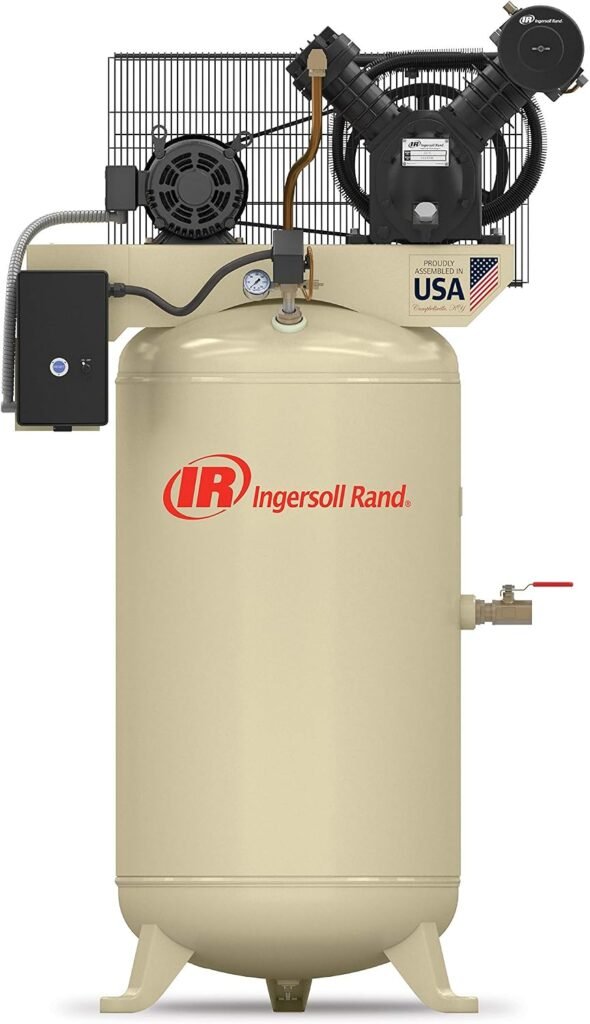
A stationary 80-gallon machine isn’t a casual household purchase, so the real question is whether this 80 gal compressor suits the workload, electrical supply, and installation space in your workshop. The 2475N5-V 5hp gal Two-Stage Compressor (230/3) is built for fixed commercial, service, fabrication, and production settings rather than occasional nail-gun use. Its 230-volt, three-phase configuration immediately narrows the audience.
The core package combines a hp motor, an 80-gallon ASME receiver tank, a two-stage pump, a maximum operating pressure of psig, and a 100% continuous-duty design. Those figures suggest a serious workshop air source, but they don’t tell us the delivered airflow available to a particular tool. Without a published CFM figure at PSI, we can’t give a definitive tool-compatibility verdict.
The supplied listing shows the price as unavailable rather than presenting a credible free-purchase offer. We should verify the live selling price and freight charges before making any value comparison. For this review, our early assessment is straightforward: the machine appears promising for a facility with compatible three-phase power, but important buying data remains unconfirmed.

Key specifications and what they mean in daily use for an gal compressor
The 80-gallon receiver is the most practical feature for intermittent bursts of demanding air use. It stores a substantial reserve, allowing a spray gun, impact tool, or other pneumatic equipment to draw air briefly without forcing the pump to restart immediately. That reserve can smooth short-duration demand, although it cannot compensate indefinitely for a pump whose delivered airflow is below the tool’s requirement.
A psig maximum operating pressure indicates the upper pressure limit of the system, not the airflow that reaches an attached tool. Regulators, hoses, filters, fittings, and the tool itself affect usable pressure. We should therefore compare the compressor’s verified CFM at the same operating pressure specified by each tool, rather than treating the maximum tank pressure as a performance score.
The hp rating and 100% continuous-duty claim point toward extended operation, but horsepower alone doesn’t establish output. The missing CFM-at-90-PSI specification is a significant limitation in the supplied data. Before ordering, we should obtain that number, then add together the requirements of tools that may run simultaneously.
Two-stage compression is generally suited to higher-pressure stationary applications because air is compressed in successive stages rather than in one step. The/3 designation means 230-volt, three-phase power; it is not interchangeable with a standard domestic outlet or a similarly named single-phase model. A qualified electrician should confirm service capacity, motor protection, overload settings, grounding, and local requirements.
The ASME receiver designation identifies a pressure-vessel standard for the tank, but it doesn’t make the whole installation automatically safe. Correct relief-valve operation, ventilation, condensate drainage, anchoring, clearances, and compliance with local codes still belong in the installation plan.
Construction and long-term durability of the gal compressor
The product description specifies durable cast-iron construction and states that the pump is designed for more than 15,000 hours of trouble-free use. We should treat that figure as a manufacturer claim, not as an independently verified endurance test. Even so, cast iron is a conventional choice for a fixed workshop compressor because it can tolerate repeated thermal cycling and is usually serviceable over a long ownership period.
The trade-off is physical permanence. Cast iron contributes to a substantial, non-portable installation, so this isn’t equipment we would expect to move around a jobsite. The description also identifies individually cast cylinders, an overhung crankshaft, and a one-piece connecting rod. These design choices are intended to simplify access and reduce mechanical complexity during service.
In practical ownership, that means inspecting belts and guards, checking fasteners, monitoring oil level, and arranging replacement parts before a failure stops production. We would ask the seller for the installation weight, overall dimensions, required clearances, noise rating, and airflow figures because those details are absent from the supplied product data. Those facts affect lifting, placement, operator comfort, and whether the compressor can support the planned tools.
Durability and warranty are separate considerations. The advertised extended pump warranty is conditional on purchasing an All-Season Select lubricant start-up kit, so a long-life pump claim should not be confused with automatic warranty protection. We would want the written warranty terms before assigning a monetary value to that promise.
All-Season Select lubricant and maintenance requirements
The supplied description says All-Season Select synthetic lubricant allows 2,000 hours between changes and performs four times longer than petroleum-based lubricant. That can reduce planned oil-change frequency in a busy workshop, but it isn’t permission to ignore routine checks. The actual interval depends on operating conditions, oil level, ambient temperature, duty cycle, contamination, and the manufacturer’s maintenance schedule.
Our practical routine would begin with checking the oil before operation and recording running hours. We would drain condensate from the receiver regularly, inspect for air leaks, examine belts and guards, and look for unusual vibration or oil seepage. A simple service log helps establish whether the stated interval is realistic for the facility instead of relying on a generic number.
- Check the oil level and visible condition before starting the pump.
- Drain receiver moisture on the schedule specified by the manual and local operating conditions.
- Inspect belts, guards, fittings, and air lines for wear or leakage.
- Record running hours, service work, lubricant changes, and any pressure-recovery issue.
The start-up kit is described as supplying parts for commissioning and the first year of maintenance, alongside access to a possible two-year extended pump warranty. We should confirm exactly which parts, labour, exclusions, registration steps, and maintenance records apply; the supplied description doesn’t provide the complete terms.
Because this is an oil-lubricated compressor, the installation area needs ventilation and sensible spill management. A professional workshop should provide a clean service zone, safe access around the pump, and a way to handle condensate and lubricant without creating a slip or disposal problem.

How the 2475N5-V compares with competing gal compressors
The closest named alternative is the Ingersoll Rand 2475N7.5 7.5 HP Two-Stage Air Compressor. Its 7.5 hp motor is materially larger than the reviewed model’s hp configuration, and the competitor is listed with output of up to 24.3 CFM at PSI. We must not assume that the 2475N5-V delivers the same airflow because its CFM-at-90-PSI figure isn’t supplied.
The Quincy QT-7.5 80-gallon vertical compressor is another relevant comparison, but electrical setup matters more than the badge on the motor. A facility with three-phase service may find the/3 arrangement appropriate, while a single-phase installation may need a different model or costly electrical work. The NorthStar 7.5 HP, CFM, 80-gallon compressor is worth considering for shoppers who prioritise published airflow, though noise, warranty support, service access, footprint, and installation demands still need checking.
We would compare candidates in this order:
- Match voltage and phase to the building’s available service.
- Compare CFM at the same PSI, including simultaneous tool demand.
- Check receiver size, duty cycle, pump material, and maintenance intervals.
- Review warranty terms, local service support, footprint, and installation requirements.
- Calculate delivered price in SEK rather than comparing catalogue prices alone.
There is no responsible winner declaration here. The reviewed machine has a potentially useful industrial specification, but without verified airflow and a live price, the choice depends on electrical compatibility, tool requirements, and local parts and service access.
What Customers Are Saying
The supplied product data contains no verified star rating, review count, or individual customer comments for this exact configuration. We therefore won’t invent buyer sentiment or describe unverified patterns as established facts. That absence is itself a reason to inspect the live listing carefully before treating the product as proven by customer experience.
When current reviews are available, we would separate them into practical themes: freight delivery and tank condition, motor start-up, pump noise, pressure recovery, installation difficulty, oil leaks, and access to service parts. A review that praises durability may still sit alongside a useful warning about freight handling or electrical installation.
Our review-reading process would be:
- Sort comments by newest first and note the date checked, since ratings and prices change.
- Read one-star and three-star comments for recurring mechanical or delivery problems.
- Confirm that the reviewer bought the hp, 230-volt, three-phase version.
- Look for repeated issues across several comments rather than relying on one isolated complaint.
- Compare positive claims about servicing or durability with reports about noise, freight, and commissioning.
Variant confusion is a real risk with the family. Feedback for a 7.5 hp or/1 model may not apply to this hp/3 version. If the live listing eventually shows ratings or verified buyer comments, we should identify the exact variant and publication date before using them in a buying decision.
Who should buy the 2475N5-V 5hp gal Two-Stage Compressor?
The best fit is a fixed workshop, fabrication area, repair facility, commercial garage, or production environment that already has compatible 230-volt three-phase power. The large receiver and continuous-duty design are sensible for extended pneumatic work, provided the compressor’s actual delivered CFM matches the tools being used.
It is a poor fit for homes without three-phase service, mobile contractors, buyers seeking a compact plug-in unit, and people who only use nailers or small air tools occasionally. Those users would be paying for installation scale and stored capacity that they may rarely exploit.
Before choosing this 80 gal compressor, we would make a tool schedule. List every air tool, record its CFM requirement at its operating PSI, identify which tools can run together, and add a sensible reserve. Then compare the total with the verified compressor output rather than with the hp label.
Commercial buyers should also plan for delivery equipment, floor space, vibration control, condensate drainage, electrical installation, and regular oil maintenance before placing an order. These are not optional extras for a stationary system; they determine whether the compressor can be commissioned safely and kept productive.
The hp configuration may be preferable to a 7.5 hp alternative when the facility’s power capacity and airflow needs are moderate. That conclusion depends on verified performance data, though. If the tools require the output published for larger competitors, moving up in motor size may be more practical than accepting an under-specified machine.
Installation and buying checks before ordering
We would complete the following checks in sequence before committing to this 80 gal compressor:
- Confirm that the building has suitable 230-volt three-phase service and enough capacity for the motor.
- Obtain verified airflow data, especially CFM at PSI and any other pressure points relevant to the tools.
- Measure the proposed installation area and confirm access for delivery and lifting.
- Review the written warranty and start-up-kit conditions.
- Calculate the complete installed cost in SEK, including freight, electrical work, air lines, controls, and service supplies.
We should also ask whether the compressor is supplied with the required starter, pressure switch, safety valve, drain arrangement, and documentation. The product description does not list every included component, so assuming that all controls and commissioning hardware are present could create an expensive delay.
Professional electrical installation is the sensible route. The installer should follow the manual for grounding, overload protection, motor rotation checks, pressure settings, and commissioning. On first use, we would check oil level, belt alignment, leaks, abnormal vibration, pressure cut-in and cut-out operation, and correct condensate drainage.
Finally, compare the exact/3 configuration rather than relying on similarly named 2475N7.5 or/1 listings. The family resemblance is not enough: motor size, phase, voltage, airflow, controls, and warranty conditions can change the ownership experience.
Pros and Cons
Pros
- 80-gallon ASME receiver provides useful stored-air capacity for intermittent heavy tool demand.
- Two-stage pump and psig maximum operating pressure suit higher-pressure stationary workshop applications.
- 100% continuous-duty design is intended for extended operation.
- Cast-iron construction and a stated pump-life target exceeding 15,000 hours suggest a service-oriented design.
- Individually cast cylinders, an overhung crankshaft, and one-piece connecting rod are intended to simplify maintenance.
Cons
- The 230-volt, three-phase configuration excludes facilities without compatible electrical service.
- CFM at PSI is not provided, making precise pneumatic-tool compatibility impossible to confirm.
- Weight, dimensions, clearance needs, noise rating, and several installation details are absent from the supplied product data.
- The extended pump warranty requires an All-Season Select lubricant start-up kit and has unprovided conditions.
- SEK0.00 appears to be placeholder or unavailable pricing, so value cannot currently be judged.
Final Verdict
Key Takeaways
- The 2475N5-V combines a hp motor, 80-gallon ASME receiver, two-stage pump, psig maximum pressure, and 100% continuous-duty design.
- Its 230-volt, three-phase electrical requirement makes it a workshop or commercial installation rather than a typical household compressor.
- The missing CFM-at-90-PSI figure prevents a confident tool-compatibility or performance comparison.
- SEK0.00 is not a reliable value signal; buyers need confirmed pricing, freight, installation, warranty, and parts costs.
- The strongest candidates are fixed facilities with compatible power, sustained pneumatic demand, and the ability to support professional installation and oil maintenance.
Frequently Asked Questions
Who makes the best gallon air compressor?
There is no universal best manufacturer because the right choice depends on airflow, voltage, phase, service support, warranty, and price. Ingersoll Rand, Quincy, and NorthStar are relevant alternatives here, but we should compare their published CFM at the required PSI and electrical configuration before choosing.
What is the best stationary air compressor?
The best stationary compressor is one that safely meets the combined CFM demand of the intended tools and matches the facility’s electrical supply. For a demanding workshop, we would prioritise verified airflow, receiver capacity, duty cycle, serviceability, warranty terms, and local parts support over horsepower alone.
Is there an gallon air compressor available for sale?
Yes, 80-gallon stationary compressors are sold in several motor sizes, voltages, and phase configurations. Availability and pricing change, and the supplied 2475N5-V listing shows SEK0.00, so buyers should confirm live stock, delivered pricing, and the exact/3 specification with the seller.
Are Ingersoll Rand air compressors any good?
Ingersoll Rand has a strong presence in stationary workshop compressors, and the series is commonly considered for cast-iron, two-stage applications. The 2475N7.5 comparison model is listed with up to 24.3 CFM at PSI, but buyers should still verify warranty coverage, installation requirements, service access, and the exact model configuration.
Disclosure: As an Amazon Associate, I earn from qualifying purchases.