EMAX Gal Electric Air Compressor overview
Can a large stationary 80 gallon air compressor provide enough sustained airflow for demanding shop tools without making ownership unnecessarily complicated? The EMAX Gal Electric Air Compressor makes a strong case on paper, pairing a 7.5 HP motor with CFM at PSI, a two-stage pump, and a PSI maximum rating. Those figures suggest serious workshop capability rather than occasional tire inflation, but this is not a plug-and-play appliance.
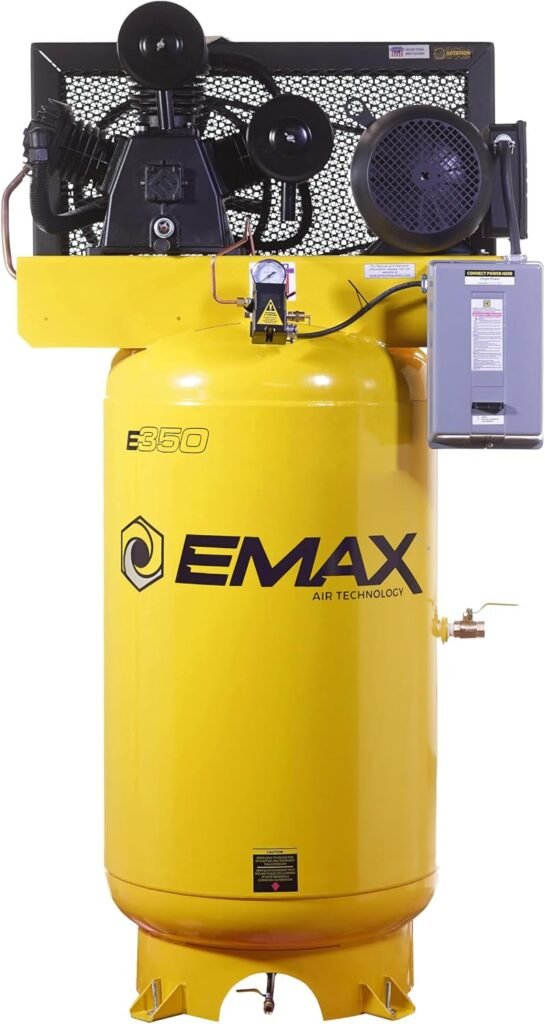
We’re reviewing the EMAX Gal Electric Air Compressor for buyers who need a permanent compressed-air supply in a workshop, automotive bay, fabrication area, maintenance department, or small industrial setting. Its 80-gallon tank and single-phase operation suit a fixed installation, while the steel tank and cast-iron pump point toward repeated use. The preliminary assessment is positive for capacity, but installation planning, manual draining, unavailable electrical details, and warranty verification are essential before committing.

What the gallon air compressor specifications mean in practice
The most useful airflow figure supplied here is 26 CFM at PSI. CFM, or cubic feet per minute, indicates how much air the compressor can deliver at a stated pressure. That makes it more helpful for judging grinders, sanders, spray equipment, and other air-hungry tools than tank size alone. A compressor may inflate a tire or run a brad nailer easily while still struggling with continuous-duty equipment.
The 80-gallon tank stores a substantial reserve, and the stated PSI maximum describes the highest listed storage pressure. Neither number proves that every tool will receive CFM continuously. A tank helps cover short bursts, such as several impact-wrench operations, but sustained blasting, sanding, grinding, or painting depends primarily on pump output, duty cycle, cooling, and appropriate air treatment.
To size the system, we would first record each tool’s CFM requirement at the same PSI used for this compressor’s rating. We would then leave a practical reserve rather than matching the figures exactly; simultaneous tools require adding their demands together. For example, a tool listed at nearly the compressor’s full output leaves little allowance for pressure loss, hose restrictions, or recovery.
| Specification | Supplied detail |
|---|---|
| Tank capacity | 80 gallons |
| Motor | 7.5 HP, industrial-grade |
| Airflow rating | 26 CFM at PSI |
| Maximum pressure | 200 PSI |
| Pump | Two-stage, all-cast-iron, splash-lubricated |
| Drain | Manual tank drain |
| Tank construction | Steel |
| Electrical format | Single-phase electric |
| Stated service-life target | Up to 50,000 hours |
Key features of this gallon air compressor
The 7.5 HP industrial-grade motor is the foundation of this model’s capacity. Motor power affects how effectively the pump compresses air and recovers tank pressure, but it also affects installation. Because the listing does not provide voltage, amperage, or a wiring diagram, we cannot responsibly describe this unit as suitable for a particular circuit. Buyers need the full manual or manufacturer confirmation before arranging electrical work.
The two-stage system compresses air through successive stages instead of attempting to reach high pressure in one step. In practical terms, that design is commonly used in demanding stationary compressors because it supports higher-pressure operation and can provide a better fit for repeated shop work. The PSI maximum is a storage rating, not a recommendation to run every pneumatic tool at that pressure. The regulator and the tool’s specified working pressure should determine actual use.
EMAX describes the pump as a steel, splash-lubricated design intended for up to 50,000 hours of use. We regard that as a design-life claim, not a promise that every pump will reach the figure. Correct oil, cooling, drainage, belt and guard inspection, and timely servicing all influence longevity. The all-cast-iron pump and steel tank are sensible durability-focused choices for repeated shop use, although they add weight and reinforce the need for a permanent location.
The product is also positioned as Ohio-built and rigorously tested in Ohio. That may appeal to buyers who value domestic manufacturing, but it should be considered separately from ownership factors we can verify only at purchase: warranty length, covered parts, replacement-parts availability, and service response. A manufacturing claim does not by itself guarantee convenient support.
Installation, electrical needs, and day-to-day maintenance
This is a stationary, single-phase electric compressor, not a portable workshop appliance. The supplied information does not state the exact voltage, amperage, breaker size, disconnect specification, or conductor requirements. We would ask for those details before purchase and have a qualified electrician or compressor installer handle the connection in accordance with local code.
Our recommended setup sequence is straightforward:
- Choose a level, ventilated location with clear access around the pump and controls.
- Confirm floor strength, anchoring requirements, delivery access, and service clearance from the current manual.
- Install correctly sized air piping, isolation points, filtration, and regulation for the intended tools.
- Check the pressure switch, pressure gauge, safety relief equipment, guards, and belt alignment.
- Run the first cycle under supervision, watching for abnormal vibration, overheating, leaks, or unusual sounds.
The manual tank drain is a genuine ownership responsibility. Moisture collects as compressed air cools, particularly in humid environments or during heavy use. We would establish a regular depressurizing and draining routine based on climate and workload rather than assuming the tank manages condensation automatically.
The splash-lubricated pump also needs routine attention. Check oil before operation, use only the specified oil, follow the stated change interval, keep cooling surfaces clean, and inspect belts and guards. Stop the compressor immediately if oil loss, overheating, abnormal vibration, or a sudden change in operating noise appears. For painting, blasting, or sensitive pneumatic equipment, add an appropriate separator, filter, dryer, and regulator; moisture control protects both the tank and downstream tools.

What customers are saying about the EMAX Gal Electric Air Compressor
The supplied product record does not display a current star rating, review count, review dates, or verified-purchase breakdown. We therefore cannot honestly claim that buyers praise its recovery, quietness, packaging, setup, or Ohio-built construction, and we will not invent a customer consensus. That absence is itself a reason to inspect the live listing carefully before purchase, especially for a large, expensive-to-ship machine.
When reviews are available, we would look for detailed ownership evidence rather than short comments saying only that the compressor is good or bad. The most useful reviews identify the pneumatic tool being used, operating pressure, electrical setup, installation conditions, and length of ownership. Repeated reports of sufficient airflow for a named grinder or sander carry more weight than a general statement about power.
We would separate recurring issues from isolated incidents. Search specifically for shipping damage, missing components, motor or pressure-switch faults, oil leaks, excessive vibration or noise, unclear instructions, and warranty-support experiences. A freight complaint may concern packaging or delivery handling rather than the pump itself, but it still matters because replacement logistics for a stationary compressor can be difficult.
Ownership experiences may also vary with undersized wiring, voltage drop, poor ventilation, incorrect oil, inadequate drainage, or restrictive air piping. Our buyer action plan is simple: read the newest reviews, search for installation and warranty terms, distinguish freight complaints from operating faults, and retain the invoice, photographs, setup notes, and service correspondence in case a claim becomes necessary.
Who should buy this gallon air compressor?
We would primarily recommend this format to owners of permanent workshops, automotive repair spaces, fabrication shops, maintenance departments, and serious home garages that need sustained compressed-air availability. The combination of a large tank, 7.5 HP motor, and two-stage pump is aimed at repeated pneumatic work rather than occasional household use.
Potentially suitable applications include impact wrenches, air ratchets, grinders, sanders, blow-off work, and certain spray-painting setups. Compatibility still depends on each tool’s CFM demand, recommended operating pressure, duty cycle, and manufacturer guidance. A large tank does not automatically make every tool suitable, particularly when a tool runs continuously.
Poor matches include apartment users, light-duty garage owners, buyers who need jobsite portability, facilities without the correct single-phase supply, and anyone unwilling to check oil or drain condensate manually. The machine’s stationary design also means the physical plan matters. Before delivery, confirm the current specification sheet for footprint and height, then check the route, floor strength, service clearance, and local installation rules.
For sizing, we would list the highest-demand tool first, find its CFM at the intended PSI, add a sensible reserve, account for simultaneous tools, and confirm the electrical supply. We would then budget separately for piping, filtration, regulation, installation, and maintenance. This approach prevents a common mistake: choosing an air compressor by tank size or horsepower without checking whether the complete facility can support it.
EMAX Gal Electric Air Compressor buying checklist
Before placing an order, we would work through the following sequence rather than relying on the product title alone:
- Identify the highest-demand application and list every tool that may run at the same time.
- Record each tool’s required CFM and working pressure from its own manual.
- Allow operating reserve instead of matching the compressor output exactly.
- Verify that the facility can provide the required single-phase electrical supply.
- Confirm delivery access, floor conditions, service space, and installation rules from the current specification sheet.
- Plan condensate management, including the manual drain and any separator, filter, regulator, or dryer required.
We would also confirm that the seller’s listing matches the advertised 7.5 HP motor, CFM at PSI, 80-gallon tank, two-stage pump, PSI maximum, single-phase configuration, and manual-drain design. If any of those details differ between the listing, manual, and specification sheet, we would pause until the discrepancy is resolved.
At delivery, photograph the packaging and tank before unpacking where possible. Inspect for freight damage before signing, report missing or damaged components promptly, and retain the invoice, serial information, setup records, oil receipts, and warranty-registration details. We would not discard packaging until the compressor has been inspected and successfully completed its first controlled run.
Our buying position is balanced: this EMAX deserves consideration when we need industrial-scale stationary airflow and have the installation capacity to support it. Its value depends on verified pricing, electrical compatibility, maintenance discipline, and responsive after-sales support—not on the impressive headline specifications alone.
Pros and Cons
Pros
- Stated CFM at PSI is strong for a stationary workshop compressor.
- 7.5 HP motor and two-stage pump are suited to demanding repeated-use applications.
- All-cast-iron pump and steel tank emphasize durability.
- 200 PSI maximum rating provides substantial pressure-storage capability.
- Ohio-built and rigorously tested positioning may appeal to buyers seeking domestic manufacturing.
Cons
- Exact voltage, amperage, breaker, and wiring requirements are not supplied.
- Manual tank draining and splash-lubrication maintenance require regular owner attention.
- The large stationary design is unsuitable for portable or space-constrained users.
- The supplied price has no currency symbol and cannot support a reliable value judgment.
- Current star rating, review count, verified-purchase patterns, and detailed warranty terms are unavailable.
Final Verdict
Key Takeaways
- The EMAX combines a 7.5 HP motor, CFM at PSI, two-stage compression, and an 80-gallon tank for demanding stationary workshop use.
- Its manual drain, oil-lubricated pump, and permanent-installation requirements mean ownership involves regular maintenance and professional setup planning.
- The PSI maximum and tank size do not guarantee continuous performance for every air tool; compare each tool’s CFM at the same working pressure and leave reserve.
- It is a promising option for permanent workshops, but buyers should compare delivered installation cost and support with Ingersoll Rand and Quincy alternatives.
Frequently Asked Questions
Who makes the best gallon air compressor?
There is no universally best manufacturer because the right choice depends on airflow, electrical supply, warranty, service access, and total installation cost. EMAX, Ingersoll Rand, and Quincy all offer models in this industrial category, so we would compare equivalent CFM ratings at the same pressure and verify current support terms.
What is the best stationary air compressor?
The best stationary compressor is the one that exceeds your tools’ combined CFM demand, matches the available electrical service, and has suitable warranty and parts support. The EMAX model is worth considering for its stated capacity, but its exact electrical details, live price, and warranty terms should be confirmed before purchase.
Is there an gallon air compressor available for sale?
Yes, 80-gallon stationary compressors are sold for workshops, automotive facilities, fabrication spaces, and industrial applications. Availability, delivery charges, and pricing vary, so buyers should check the current listing and confirm freight access before ordering.
Are Ingersoll Rand air compressors any good?
Ingersoll Rand has established stationary models such as the 2475N7.5, which is listed with an 80-gallon tank, 7.5 HP motor, and up to 24.3 CFM at PSI. We would still compare the exact warranty, electrical requirements, service network, and airflow reference pressure with competing EMAX and Quincy models.
Disclosure: As an Amazon Associate, I earn from qualifying purchases.