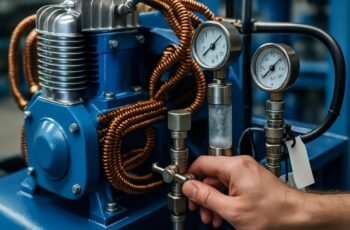
While it’s easy to overlook, small inefficiencies in air compressor systems can accumulate into significant energy costs over time. By examining key factors such as system design, maintenance practices, and operational controls, we can identify practical strategies to reduce waste. Understanding these underlying elements is essential for improving overall efficiency and cost-effectiveness. Exploring these aspects in detail reveals the potential for meaningful savings—if we’re willing to scrutinize our current approaches.
Key Takeaways
- Regularly inspect and repair leaks, pipe insulation, and system components to prevent energy loss.
- Use variable speed drives to match compressor output with demand, reducing unnecessary energy consumption.
- Maintain optimal air pressure settings to avoid over-pressurization and reduce power usage.
- Schedule routine maintenance for lubrication, cleaning, and component checks to ensure efficient compressor operation.
- Upgrade to energy-efficient models and implement smart monitoring systems for real-time performance optimization.
How Do Air Compressors Consume Energy?
Air compressors consume energy primarily through the process of compressing air, which requires converting electrical or fuel energy into kinetic energy. The efficiency of this process, known as air compressor efficiency, heavily influences overall energy consumption. Several energy consumption factors come into play, including compressor load, operating pressure, and volumetric flow rate. Higher pressures demand more energy, and inefficient compression leads to increased power use. Additionally, the design and condition of the compressor impact how effectively it converts input energy into compressed air. Compressors operating under partial load tend to waste energy, while those running continuously at steady loads are typically more efficient. Understanding these factors allows us to identify opportunities to optimize operation and reduce unnecessary energy expenditure.
Conduct Regular Maintenance to Improve Efficiency
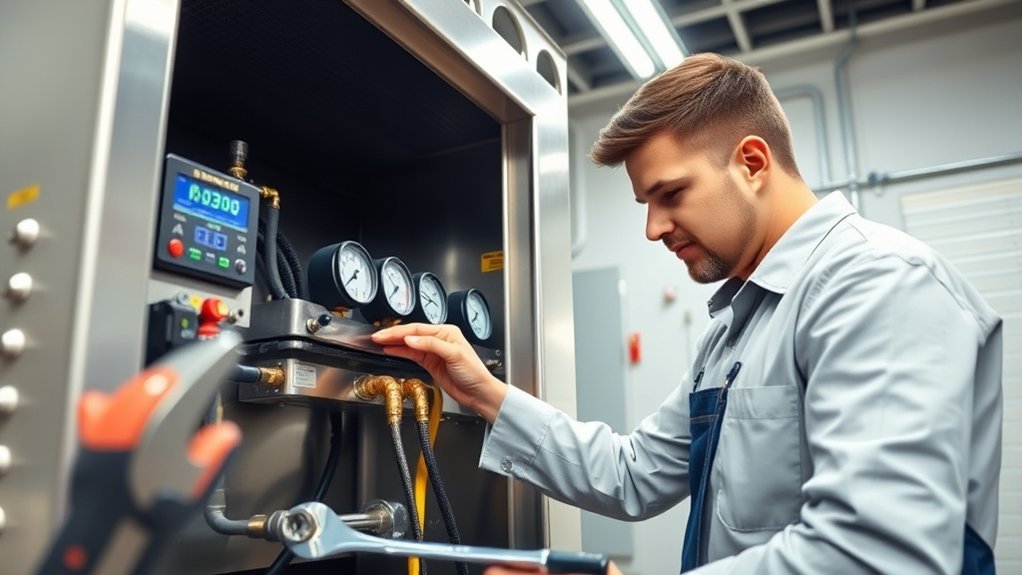
Regular maintenance is essential for guaranteeing compressors operate at peak efficiency and minimizing energy waste. Proper air compressor lubrication reduces friction and prevents component wear, directly impacting energy consumption. Regularly checking and replenishing lubricant levels ensures ideal performance and prevents overheating. Additionally, maintenance routines that address compressor noise reduction often involve inspecting and tightening loose components, which can also improve overall efficiency. By systematically monitoring and maintaining critical parts, we can avoid unnecessary energy expenditures caused by increased friction or mechanical inefficiencies. Consistent maintenance not only prolongs equipment lifespan but also ensures the compressor runs smoothly, reducing power draw. Ultimately, diligent upkeep of lubrication systems and noise control measures leads to significant energy savings while maintaining reliable compressor operation.
Optimize Air Pressure Settings for Savings
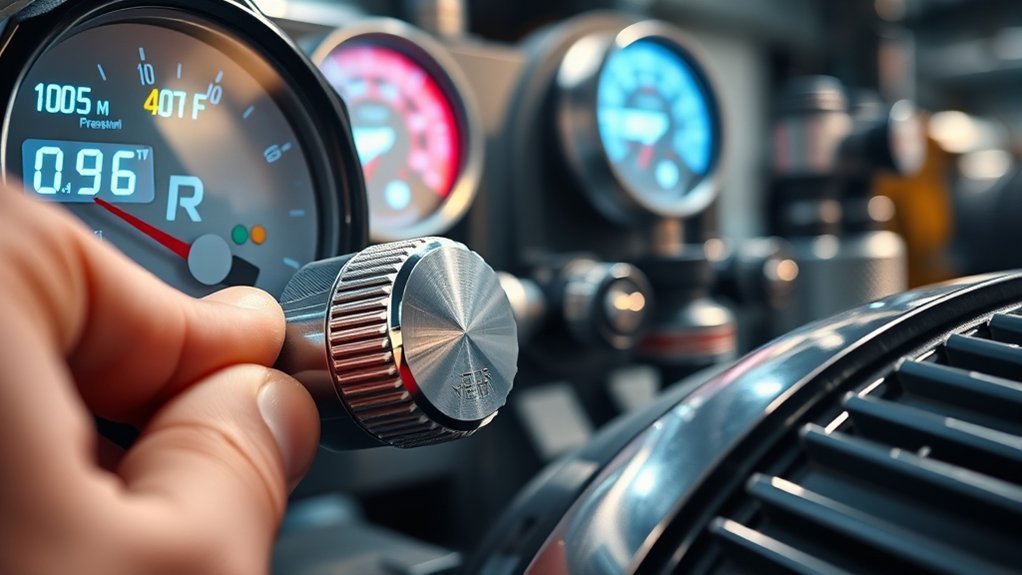
Optimizing air pressure settings involves maintaining the manufacturer-recommended pressure to prevent energy waste. Regularly checking gauges guarantees accurate readings, and adjusting pressure during operation can further reduce unnecessary energy consumption. Implementing these practices can lead to significant efficiency gains and cost savings.
Maintain Recommended Pressure
Maintaining the recommended pressure levels is essential for achieving energy efficiency in compressed air systems. Proper air pressure ensures the compressor operates within ideal parameters, reducing unnecessary energy consumption. Incorrect compressor settings, whether too high or too low, lead to increased power usage and system inefficiencies. We advise setting the air pressure to match the actual requirements of your tools and processes, avoiding excess pressure that results in wasted energy. Consistent adjustment of compressor settings to maintain these recommended levels minimizes energy loss and prolongs equipment lifespan. Regularly evaluating and fine-tuning air pressure based on system demands helps maximize performance. Ultimately, precise control over air pressure not only enhances efficiency but also reduces operational costs, making maintenance of recommended compressor settings a critical component of energy-saving strategies.
Regularly Check Gauges
To guarantee air pressure remains within ideal ranges, it’s essential to routinely check the gauges on your compressor system. Accurate gauge readings ensure best air quality and prevent over-pressurization, which can compromise equipment safety protocols. Consistent monitoring allows us to identify pressure fluctuations that may indicate leaks or malfunctions, enabling timely adjustments. Maintaining proper pressure levels minimizes energy consumption by avoiding unnecessary compressor cycling or excessive load demands. Additionally, precise gauge checks support safety compliance, reducing risks associated with high-pressure scenarios. Regular assessments help us maximize system performance, extend equipment lifespan, and ensure that air quality standards are maintained for downstream tools and processes. Ultimately, diligent gauge monitoring is a critical step toward energy-efficient operation and adherence to safety protocols.
Adjust Pressure During Use
Adjusting air pressure during operation is essential for achieving energy savings, as maintaining the correct pressure levels directly impacts compressor efficiency. Proper pressure calibration ensures the system isn’t over-pressurized, reducing energy waste. Regular nozzle adjustment optimizes airflow, preventing unnecessary compressor cycling. Monitoring gauges actively allows us to identify deviations from ideal pressure, enabling timely corrections.
| Situation | Action |
|---|---|
| Excessive energy use | Lower pressure to ideal level |
| Insufficient airflow | Increase pressure slightly |
| Fluctuating readings | Recalibrate pressure settings |
| Nozzle misalignment | Adjust nozzle for precise airflow |
| Consistent overpressure | Perform pressure calibration |
Implementing these practices ensures energy-efficient operation and prolongs equipment lifespan.
Use Proper Piping and Ducting to Minimize Losses
Using proper piping and ducting is vital to minimizing pressure drops and energy losses in compressed air systems. Selecting suitable pipe materials, designing an optimized layout, and conducting regular maintenance guarantee efficient airflow and reduce unnecessary energy consumption. Implementing these practices can greatly enhance overall system performance and energy efficiency.
Select Suitable Pipe Materials
Have you considered how the choice of pipe materials directly impacts the efficiency of your compressed air system? Selecting materials with high durability and corrosion resistance minimizes leaks and reduces pressure drops. For example, steel offers excellent material durability but may require coating for corrosion resistance, while aluminum is lightweight and resilient. Copper provides superior corrosion resistance but is more costly. The table below compares common piping options:
| Material | Material Durability | Corrosion Resistance |
|---|---|---|
| Steel | High | Moderate |
| Aluminum | Moderate | Good |
| Copper | Good | Excellent |
Choosing the right pipe material guarantees long-term integrity, lower maintenance costs, and energy savings through minimized system losses.
Optimize Pipe Layout Design
Optimizing pipe layout design involves strategic placement and configuration of piping and ducting to reduce pressure losses and improve system efficiency. Properly designed layouts minimize unnecessary bends, long runs, and areas where turbulence can occur, which helps maintain ideal ventilation airflow. Incorporating pipe insulation reduces heat loss and prevents condensation, enhancing overall system performance. Additionally, aligning pipe diameters with flow requirements prevents pressure drops that increase compressor workload. Careful routing ensures minimal elevation changes and shortens pipe runs, further reducing energy consumption. Effective pipe insulation not only conserves energy but also stabilizes airflow, preventing fluctuations that can cause inefficiencies. By focusing on these design principles, we can substantially decrease energy losses and enhance overall compressor operation.
Regular Maintenance Checks
Regular maintenance checks are essential for ensuring piping and ducting systems remain efficient and minimize energy losses. Properly maintained systems reduce pressure drops, conserving energy and improving air quality. Regular inspections help identify leaks, corrosion, or blockages that increase energy consumption and negatively impact environmental impact. To optimize performance, focus on verifying correct pipe sizing, sealing joints, and ensuring insulation integrity.
| Issue | Impact |
|---|---|
| Leaks | Increased energy costs, reduced air quality |
| Corrosion | System inefficiency, environmental contamination |
| Blockages | Elevated pressure loss, higher power consumption |
Implement Variable Speed Drives to Match Demand
Implementing variable speed drives (VSDs) allows air compressors to dynamically adjust motor speed in response to fluctuating demand, thereby maximizing energy consumption. VSDs enable demand matching by modulating compressor output precisely to current air flow requirements, eliminating unnecessary energy use during low-demand periods. This technology improves system efficiency by reducing the on/off cycling typical of fixed-speed units, which often lead to energy wastage. By continuously monitoring demand signals, VSDs adjust motor speed in real-time, maintaining ideal pressure levels without excessive power draw. The integration of VSDs requires careful control system calibration but offers significant energy savings and reduced operational costs. Overall, demand matching with variable speed drives enhances compressor performance while providing a sustainable approach to energy management.
Monitor and Control Your Compressor’s Energy Use
Monitoring and controlling your compressor’s energy use is essential for identifying inefficiencies and ensuring peak performance. Implementing smart monitoring systems allows us to track real-time data on pressure, flow rates, and power consumption, providing insights into operational anomalies. Automated controls enable precise adjustments, reducing energy waste during low-demand periods by modulating compressor activity accordingly. By integrating these technologies, we maximize energy efficiency without sacrificing system reliability. Continuous analysis of energy consumption patterns helps pinpoint areas where adjustments can yield significant savings. This proactive approach minimizes unnecessary energy expenditure, prolongs equipment lifespan, and enhances overall system management. Fundamentally, leveraging smart monitoring and automated controls creates a dynamic, responsive environment that promotes optimal compressor performance and energy conservation.
Upgrade to Energy-Efficient Compressor Models
Upgrading to energy-efficient compressor models can substantially reduce operational costs and improve overall system performance. Modern compressors incorporate innovative technologies, such as variable frequency drives and advanced control algorithms, which optimize energy consumption based on real-time demand. Market trends indicate a shift toward these high-efficiency models, driven by regulatory pressures and rising energy costs. By adopting these technologies, we can minimize power waste and enhance reliability, ensuring smoother operation and lower maintenance expenses. Evaluating compressor specifications against current market standards allows us to identify units that deliver significant energy savings without sacrificing capacity. Ultimately, investing in energy-efficient models aligns operational efficiency with environmental responsibility, providing a strategic advantage in today’s competitive landscape.
Reduce Air Leaks to Save Power
Reducing air leaks is a practical step to enhance overall energy efficiency in compressed air systems. Effective air leak detection allows us to identify sources of pressure loss, which can account for significant energy waste. Once leaks are identified, implementing proper sealing techniques becomes essential. Consider these strategies:
- Conduct regular leak detection using ultrasonic or soap solution methods.
- Prioritize repairs on high-volume leaks to maximize savings.
- Use high-quality, airtight sealing materials for joints and fittings.
- Reassess connections periodically to guarantee continual integrity.
Train Staff on Best Practices for Energy Conservation
Training staff on best practices for energy conservation is essential to guarantee that operational procedures align with efficiency goals. Effective training techniques focus on technical knowledge transfer, emphasizing equipment operation, maintenance schedules, and leak detection. By standardizing procedures, we minimize energy waste and optimize compressor performance. Incorporating employee incentives fosters motivation and accountability, encouraging staff to adhere to conservation protocols. Regular workshops and simulations reinforce learning and highlight the financial and environmental benefits of energy-efficient practices. Empowering employees with the skills and motivation to identify inefficiencies ensures proactive engagement and continuous improvement. Ultimately, a well-trained team, supported by targeted incentives, creates a culture of energy consciousness that sustains long-term compressor efficiency and reduces operational costs.
Frequently Asked Questions
How Can I Determine the Ideal Air Pressure for My System?
We determine the ideal air pressure through optimal pressure assessment, ensuring proper system calibration. By analyzing operational requirements and monitoring pressure gauges, we fine-tune settings to maximize efficiency while preventing energy waste or equipment damage.
What Are the Signs of an Inefficient Air Compressor?
We notice that increased compressor noise and air leakage often signal inefficiency; studies show up to 30% of compressed air is lost this way. These signs indicate a need for maintenance to optimize performance and energy use.
How Often Should Compressor Maintenance Be Performed?
We recommend adhering to a strict maintenance schedule, typically every 3 to 6 months, depending on usage, and following proper lubrication practices to guarantee peak efficiency, reduce wear, and prevent costly breakdowns.
Can Energy-Saving Measures Impact Compressor Performance?
Energy-saving measures can impact compressor performance by optimizing startup procedures, reducing noise, and enhancing efficiency, but they must be carefully implemented to prevent issues like reduced airflow or increased wear, ensuring reliable, sustained operation.
What Are the Costs Associated With Upgrading to Energy-Efficient Models?
We’ve found that upgrading to energy-efficient models involves initial costs that vary, but a thorough cost analysis and ROI estimation show significant long-term savings, making these investments technically justified despite higher upfront expenses.
Conclusion
By implementing these energy-saving strategies, we can greatly reduce our compressor’s power consumption—potentially saving enough energy to light up a small city! Regular maintenance, optimized pressure settings, and advanced controls ensure peak efficiency and reliability. Embracing these practices isn’t just about saving money; it’s about transforming our operations into models of energy stewardship and operational excellence. Together, we’re not just conserving energy—we’re revolutionizing how we power our industries.