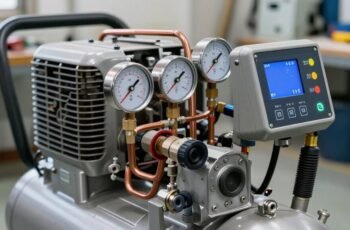
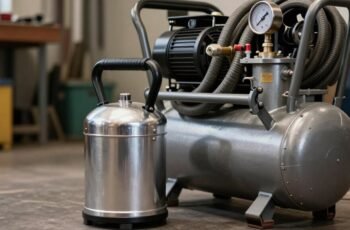
Choosing the right air compressor tank requires a careful analysis of your operational needs and technical specifications. We need to take into account factors like capacity, material properties, pressure ratings, and mobility options to guarantee ideal performance and safety. Each decision impacts efficiency and durability, but understanding these nuances can be complex. To make an informed choice, we must examine these elements systematically, as the right tank setup can greatly influence your overall system reliability.
Key Takeaways
- Determine airflow needs and operation cycle to select an appropriately sized tank for pressure stability.
- Choose tank material based on environment, weight, durability, and budget considerations.
- Match tank pressure rating to tools’ PSI requirements with a safety margin for reliable performance.
- Decide between portable or stationary tanks based on mobility, capacity, and usage environment.
- Inspect safety features, compliance standards, and structural integrity for durability and safe operation.
How to Determine the Right Size for Your Air Compressor Tank
To accurately determine the right size for your air compressor tank, we must first analyze your specific airflow requirements and the intended applications. This involves calculating the average and peak CFM (cubic feet per minute) demands based on your tools or processes. We evaluate whether continuous operation or intermittent use dominates, as this influences tank size—larger tanks buffer pressure fluctuations and reduce cycling. Additionally, understanding the duty cycle and pressure settings helps optimize capacity. Precise sizing minimizes energy consumption and wear on the compressor, ensuring system efficiency. By analyzing these parameters, we establish a target tank volume that maintains consistent pressure, prevents short cycling, and supports your operational needs effectively. This technical assessment forms the foundation for selecting an appropriately sized tank.
What Materials Are Best for Air Compressor Tanks and Why
Selecting the appropriate material for an air compressor tank is crucial because it directly impacts the tank’s durability, safety, and performance. Steel remains the most common choice due to its high strength-to-weight ratio, excellent corrosion resistance, and proven reliability under high pressure. Aluminum tanks are lighter and resist corrosion better but tend to be more expensive and less durable under extreme conditions. Composites, such as fiberglass-reinforced plastics, offer corrosion resistance and reduced weight but may lack the same long-term durability and pressure capacity of metals. Material selection depends on application demands, environmental exposure, and budget constraints. Ultimately, steel’s robustness makes it ideal for industrial use, while aluminum and composites suit portable or specialized applications where weight and corrosion are critical factors.
How to Choose the Appropriate Pressure Rating for Your Needs
Choosing the correct pressure rating for your air compressor tank requires careful consideration of your specific operational needs. It’s essential to match the tank’s maximum pressure with the requirements of your tools and applications, guaranteeing safe and efficient operation. Over-pressurizing a tank can pose safety risks, while under-pressurizing may compromise performance. Analyze the pressure ratings of your tools—most pneumatic tools specify their required operating pressure, typically in PSI. Select a tank with a pressure rating that exceeds your maximum tool pressure by a safe margin to allow for system fluctuations. Additionally, consider future expansion needs; a slightly higher pressure rating provides flexibility for evolving demands. Precise alignment of your tank’s pressure capacity with your operational parameters ensures effective performance and safety.
Factors to Consider When Selecting a Portable vs. Stationary Tank
When deciding between a portable and a stationary air compressor tank, several operational factors must be considered to guarantee ideal performance and safety. Portability demands lightweight construction, compact dimensions, and ease of movement, making it suitable for job sites with variable locations. Stationary tanks prioritize capacity and stability, often supporting continuous operation in fixed environments. The intended application influences choice: portable tanks excel for intermittent, mobile tasks, while stationary tanks support high-volume, long-duration use. Power source compatibility, space constraints, and setup time further differentiate options. Additionally, operational airflow requirements and maintenance accessibility impact selection. Evaluating these factors ensures the tank aligns with operational demands, minimizing downtime and optimizing efficiency. This analytical approach promotes a strategic, safety-conscious decision tailored to specific work conditions.
Tips for Evaluating the Safety and Durability of Air Compressor Tanks
Evaluating the safety and durability of air compressor tanks requires a systematic approach rooted in technical assessment. First, inspect for corrosion, cracks, or dents that compromise structural integrity. Next, verify compliance with relevant standards, such as ASME or ISO, to ensure manufacturing quality. Additionally, assess the tank’s pressure rating and safety valves to confirm they match operational requirements.
| Criterion | Inspection Focus | Critical Indicator |
|---|---|---|
| Material Integrity | Rust, cracks, deformation | Signs of fatigue or corrosion |
| Certification | Standards compliance | Valid certification labels |
| Pressure Rating | Max operating pressure | Adequate for intended use |
| Safety Valve Function | Proper release mechanism | Prevents over-pressurization |
| Structural Design | Welds, seams, mounting points | Uniform, defect-free construction |
Frequently Asked Questions
Can I Upgrade My Air Compressor Tank Later?
Yes, you can upgrade your air compressor tank later, but it requires evaluating compatibility with your existing system, ensuring proper safety standards, and possibly modifying connections for ideal performance, making professional consultation advisable for a safe, effective upgrade.
How Do I Prevent Rust Inside the Tank?
We prevent rust by draining moisture regularly, applying rust-inhibitor coatings, and using desiccant filters to keep internal humidity low; these measures safeguard the tank’s integrity, ensuring peak performance and longevity over time.
What Are the Maintenance Requirements for Different Tank Types?
We regularly inspect and drain moisture from all tank types, check for corrosion, and adhere to manufacturer guidelines to guarantee ideal performance and longevity. Maintenance varies slightly between tank materials, but consistent care is crucial across all types.
How Does Altitude Affect Tank Performance?
Altitude impacts tank performance by decreasing air density, which reduces pressure efficiency. We analyze altitude effects to optimize tank size and pressure settings, ensuring reliable operation and safety at various elevations, especially in high-altitude environments.
Are There Specific Certifications to Look for in Tanks?
Absolutely, look for tanks with ASME certification, ensuring they meet safety standards. These certifications act as a seal of approval, giving us confidence that the tank’s design, materials, and construction adhere to industry safety and quality benchmarks.
Conclusion
Ultimately, selecting the perfect air compressor tank isn’t just about size or material — it’s about mastering the fine art of balancing safety, efficiency, and portability. Ignore these considerations, and you might find yourself trapped in a cycle of costly repairs or, worse, safety hazards. So, approach this decision with the precision of a scientist, because in the world of compressed air, a misstep can turn a simple tool into a ticking time bomb.