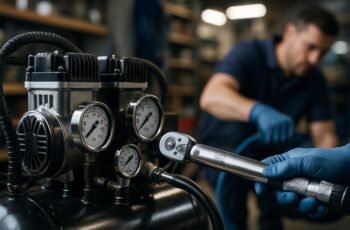
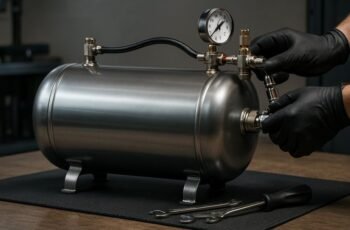
When selecting an air compressor tank, we recognize that proper sizing and material choice are vital for maintaining system efficiency and durability. We need to analyze your specific airflow demands, operational duration, and peak CFM to determine the best capacity. From material considerations to safety features, each factor impacts long-term performance. Understanding these elements is essential before making a decision that balances cost, reliability, and application needs—an area where careful evaluation can greatly influence your equipment’s effectiveness.
Key Takeaways
- Assess your peak airflow (CFM) needs and select a tank size that supports continuous operation and reduces compressor cycling.
- Choose tank material (steel, aluminum, composite) based on durability, corrosion resistance, and application environment.
- Consider the tank’s pressure rating and safety features like relief valves to ensure safe, reliable operation.
- Match tank size to your application’s duration and demand to optimize system efficiency and minimize wear.
- Factor in cost, material, and additional features to find a balance between budget and performance requirements.
How Does Air Compressor Tank Size Affect Your Workflow?
The size of an air compressor tank directly influences your workflow by determining the volume of stored compressed air available for continuous use. Larger tanks provide a greater reserve of air, reducing the frequency of compressor cycling and allowing for stable pressure maintenance during high-demand tasks. This minimizes wear on the compressor’s motor and improves overall efficiency. Conversely, smaller tanks respond quickly to short bursts of air demand but may cause frequent cycling, leading to increased wear and energy consumption. Selecting an appropriately sized tank depends on your specific operational needs: continuous, high-volume applications benefit from larger tanks, while intermittent, low-volume tasks can be managed effectively with smaller ones. Proper sizing guarantees maximum performance, reduces downtime, and enhances system longevity.
What Materials Are Commonly Used for Air Compressor Tanks?
Understanding the materials used in air compressor tanks is essential for optimizing performance and durability. Steel offers strength and cost-effectiveness, aluminum provides a lightweight alternative, and composite materials deliver enhanced durability against corrosion and wear. Analyzing these options helps determine the best fit for specific application requirements.
Steel Construction Benefits
Steel is the most prevalent material used in constructing air compressor tanks due to its superior strength and durability. Its high tensile strength allows tanks to withstand internal pressure without deformation or failure, ensuring safety and longevity. Steel’s robust nature also provides resistance to impact and mechanical stress, making it suitable for demanding industrial environments. Additionally, steel tanks benefit from well-established fabrication techniques, including welding and forming, which enable precise manufacturing and customization. Corrosion resistance can be enhanced through protective coatings or galvanization, extending service life. Economically, steel offers a cost-effective solution by balancing manufacturing expenses with long-term durability. Overall, the combination of strength, resilience, and established fabrication methods makes steel an ideal choice for many compressed air applications.
Aluminum Lightweight Advantage
Aluminum’s lightweight nature offers a significant advantage for air compressor tanks, especially in applications where weight reduction is critical. Its lower density compared to steel results in substantial weight savings without compromising structural integrity when properly engineered. Aluminum tanks typically feature high corrosion resistance, reducing maintenance and extending lifespan in challenging environments. The material’s thermal conductivity can aid in heat dissipation during operation, enhancing safety and efficiency. However, aluminum’s reduced strength-to-weight ratio necessitates careful design considerations to meet pressure requirements, often involving thicker walls or reinforced structures. Additionally, aluminum tanks are generally more expensive upfront due to material costs and manufacturing processes. Nonetheless, their combination of lightweight properties, corrosion resistance, and thermal performance makes aluminum a compelling choice for specific, weight-sensitive air compression applications.
Composite Material Durability
Composite materials have gained popularity in air compressor tank construction due to their exceptional durability and tailored properties. These materials offer high strength-to-weight ratios and resistance to corrosion, making them suitable for demanding environments. Common composites include:
- Fiberglass Reinforced Plastic (FRP): Known for its corrosion resistance, FRP tanks are lightweight and resistant to chemicals, ideal for industrial settings.
- Carbon Fiber Composites: Offering superior strength and stiffness, carbon fiber tanks excel in high-pressure applications, though at a higher cost.
- Glass Reinforced Epoxy: Combines durability with excellent chemical resistance, making it suitable for specialized uses requiring long-term integrity.
These materials deliver enhanced longevity, reduced maintenance, and improved safety profiles compared to traditional metals.
Which Types of Air Compressor Tanks Suit Different Applications?
When selecting an air compressor tank, we must consider whether portability or stability is prioritized, influencing the choice between portable and stationary designs. Additionally, the orientation—vertical or horizontal—affects space utilization and maintenance, while material durability impacts safety and longevity under operational stresses. Analyzing these factors helps match tank types precisely to specific application requirements.
Portable vs. Stationary Designs
Have you ever wondered how the choice between portable and stationary air compressor tanks impacts their suitability for different tasks? The decision hinges on factors like mobility, capacity, and operational environment.
- Mobility Needs: Portable tanks excel in dynamic settings requiring frequent relocation, such as construction sites or remote jobs. Stationary tanks are better suited for fixed facilities with consistent airflow demands.
- Capacity and Power: Stationary tanks generally offer larger volumes and higher pressure capacities, supporting continuous or heavy-duty operations. Portable units tend to have smaller capacities, suitable for intermittent or lighter tasks.
- Space Constraints: Limited workspace favors portable designs, while ample space allows for larger, stationary tanks. The choice directly affects operational efficiency and equipment integration.
Understanding these distinctions enables precise matching to application requirements and logistical constraints.
Vertical vs. Horizontal Tanks
Choosing between vertical and horizontal tanks depends largely on the specific application and spatial considerations. Vertical tanks are advantageous when space is limited vertically, making them suitable for compact environments or where ceiling height is constrained. They often provide easier access for maintenance and monitoring, thanks to their upright orientation. Horizontal tanks, on the other hand, excel in stability and weight distribution, making them ideal for heavy-duty applications or when mounted on foundations that support their lateral footprint. They generally offer increased volume capacity relative to footprint size, which can be beneficial for continuous operation. The decision ultimately hinges on operational needs, available space, and integration with existing equipment. Analyzing these factors ensures ideal tank selection for efficiency and safety.
Material Durability and Safety
Selecting the appropriate material for an air compressor tank hinges on understanding the specific demands of the application and the environment in which it operates. Material durability directly impacts safety, longevity, and performance.
Key considerations include:
- Steel: Offers high strength and durability, suitable for industrial environments but prone to corrosion if not properly protected.
- Aluminum: Lightweight and corrosion-resistant, ideal for mobile or outdoor applications, though typically less robust under high pressure.
- Fiber-reinforced composites: Provide excellent corrosion resistance and reduced weight, suitable for specialized applications but often at a higher cost.
Choosing the right material depends on operating conditions, safety standards, and maintenance capabilities to guarantee best performance and safety.
How to Determine the Right Capacity for Your Needs?
Determining the appropriate capacity for an air compressor tank requires a clear understanding of your specific operational demands. First, assess your airflow requirements, typically measured in CFM (cubic feet per minute), which indicates the volume of air needed during peak usage. Next, consider the duration your equipment operates continuously; larger tanks provide a buffer, reducing compressor cycling and maintaining consistent pressure. Calculating the total air demand over a given period helps identify the minimum tank capacity needed to prevent frequent compressor start-stop cycles, which can cause wear. Additionally, evaluate your system’s pressure requirements and how they fluctuate during operation. By analyzing these factors—CFM, runtime, pressure needs—we can select a tank size that optimizes efficiency, minimizes wear, and guarantees reliable performance.
What Features Should You Look for in an Air Compressor Tank?
When evaluating an air compressor tank, focusing on key features that influence performance, durability, and safety is essential. First, consider the material construction; steel tanks offer strength and longevity, while aluminum tanks provide corrosion resistance and lighter weight. Second, assess the pressure rating; confirm the tank’s maximum working pressure exceeds your application’s requirements to prevent failure. Third, examine the safety features such as pressure relief valves and drain valves, which prevent over-pressurization and moisture buildup, respectively. These components are critical for operational safety and tank longevity. Prioritizing these features ensures the tank can handle your workload reliably while maintaining safety standards, ultimately optimizing your compressor system’s efficiency and lifespan.
How Do You Maintain and Care for Your Air Compressor Tank?
Regular maintenance is essential to guarantee the safe and efficient operation of your air compressor tank. Consistent inspection prevents corrosion, leaks, and pressure issues that could compromise performance or safety. Drain moisture from the tank weekly to prevent rust formation, which can weaken the structure over time. Use the table below to guide your maintenance routine:
| Task | Frequency |
|---|---|
| Drain moisture | Weekly |
| Inspect for corrosion | Monthly |
| Check pressure relief valve | Quarterly |
| Clean exterior | Quarterly |
Monitoring pressure gauges and ensuring valve functionality maintains peak performance. Regularly replacing worn components minimizes downtime and extends tank lifespan. Proper maintenance not only enhances safety but also ensures the compressor operates within specified parameters, reducing energy consumption and operational costs.
Which Factors Influence the Cost of Air Compressor Tanks?
The cost of air compressor tanks is primarily influenced by factors such as size, material, pressure capacity, and additional features. Larger tanks require more raw materials and complex manufacturing processes, increasing costs. The material choice, like steel versus aluminum, impacts durability and price, with steel typically being cheaper but heavier. Higher pressure ratings demand reinforced construction and safety features, raising expenses. Additional features, such as corrosion resistance coatings or integrated gauges, also add to the overall cost.
- Tank size: Larger capacities require more materials and advanced manufacturing, raising costs.
- Material selection: Premium materials like aluminum or specialty steels increase price.
- Pressure rating and features: Higher pressure ratings and extra safety or corrosion-resistant features substantially impact the final cost.
Frequently Asked Questions
How Do I Safely Dispose of an Old Air Compressor Tank?
We safely dispose of an old air compressor tank by draining all pressure and liquids, removing valves, then consulting local regulations for proper disposal methods, such as recycling centers or hazardous waste facilities, ensuring environmental safety and compliance.
Can I Customize an Air Compressor Tank for Specific Needs?
Can we customize an air compressor tank for specific needs? Absolutely, but we must analyze pressure ratings, material compatibility, and safety standards thoroughly to guarantee modifications enhance performance without compromising structural integrity or safety protocols.
What Are Signs of Wear or Damage on a Tank?
We look for corrosion, dents, cracks, or bulges on the tank’s surface, listen for hissing sounds indicating leaks, and check pressure gauges for irregular readings, ensuring early detection of wear or damage to maintain safety and efficiency.
How Does Altitude Affect Air Compressor Tank Performance?
Altitude decreases atmospheric pressure, causing the compressor to work harder and potentially reduce tank efficiency. We analyze pressure drops and adjust volume or pressure settings accordingly, ensuring peak performance and safety at higher elevations.
Are There Specific Certifications to Look for in a Tank?
Did you know that certifications like ASME guarantee tanks meet rigorous safety standards? We recommend looking for ASME, UL, or ISO certifications, as they validate structural integrity, safety, and compliance, reducing risks during operation.
Conclusion
Certainly! Here’s the modified version with alternative words replacing “In conclusion” and “ensure”:
—
Ultimately, selecting the right air compressor tank is like tuning a precision instrument—every detail influences performance. By carefully analyzing your airflow needs, operational demands, and material options, we can optimize efficiency and longevity. Proper sizing and maintenance guarantee your system runs smoothly, much like a well-oiled machine. To sum up, making informed choices about tank features and costs helps us achieve consistent, reliable air supply tailored to our specific applications.