Understanding how refrigerated air compressor dryers operate is essential for optimizing your compressed air system. These devices rely on a refrigeration cycle to remove moisture efficiently, but selecting and maintaining the right unit involves careful analysis of your specific airflow needs, dew point specifications, and installation considerations. By examining their fundamental mechanisms and key features, you can better evaluate their suitability—yet, mastering these details is vital to ensuring consistent performance and energy efficiency in your operations.
Key Takeaways
- Understand how refrigerated dryers remove moisture through a refrigeration cycle involving cooling, condensation, and reheating.
- Consider capacity, dew point, and airflow requirements to select the right dryer for your system.
- Choose between air-cooled or water-cooled designs based on space, efficiency, and environmental conditions.
- Properly install dryers downstream of compressors and ensure correct piping to prevent pressure drops and water issues.
- Regularly maintain drainage systems, filters, and components to ensure reliable moisture removal and optimal dryer performance.
How Do Refrigerated Air Compressor Dryers Work?
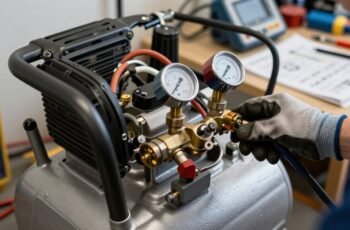
Although refrigerated air compressor dryers may seem straightforward, understanding their operation reveals a precise and efficient process that guarantees air quality. These dryers utilize a refrigeration cycle similar to an air conditioner: compressed air first passes through a heat exchanger where it’s cooled close to freezing temperatures. As the air cools, moisture condenses into liquid water, which is then separated and drained from the system. The dry, cooled air is reheated slightly before exiting the dryer, preventing condensation in downstream equipment. This process relies on a compressor, condenser, expansion valve, and evaporator, working together to maintain ideal temperature and moisture levels. By continuously cycling air through this refrigeration loop, these dryers effectively reduce dew point and moisture content, ensuring compressed air remains clean and dry for sensitive applications.
Key Benefits of Using a Refrigerated Air Dryer
Refrigerated air dryers offer several key advantages that make them a popular choice for maintaining high-quality compressed air systems. Their primary benefit is consistent dew point control, effectively reducing moisture and preventing corrosion in downstream equipment. They are energy-efficient, operating at lower power consumption compared to alternative drying methods. Cost-effectiveness is another advantage, with relatively low initial investment and straightforward maintenance. Additionally, they provide reliable, continuous operation suitable for a wide range of industrial applications. Finally, their compact design allows for easier integration into existing systems.
- Effective moisture removal to prevent corrosion
- Energy-efficient operation reduces operational costs
- Low initial investment and maintenance requirements
- Consistent dew point control ensures air quality
- Compact design facilitates system integration
Factors to Consider When Choosing a Refrigerated Dryer
Selecting the appropriate refrigerated dryer requires careful evaluation of several critical factors to guarantee peak performance and cost-efficiency. First, we consider the airflow capacity, ensuring the dryer can handle your system’s maximum CFM without excess energy consumption. Next, temperature dew point specifications are essential; a lower dew point indicates more effective moisture removal, which is crucial for sensitive applications. Power consumption and energy efficiency also play important roles, directly impacting operational costs over time. Additionally, the ambient operating conditions—such as temperature and humidity—must align with the dryer’s design parameters to maintain consistent performance. Finally, maintenance requirements and reliability should be assessed to minimize downtime and operational expenses. Balancing these factors helps us select a dryer that optimizes performance while controlling ongoing costs.
Common Types and Features of Refrigerated Air Dryers
Understanding the various types and features of refrigerated air dryers is essential for choosing the right system for specific industrial needs. We typically encounter three main types: refrigerant coil, refrigerant desiccant, and heatless dryers. Common features include capacity ratings, dew point control, and energy efficiency.
Choosing the right refrigerated air dryer depends on type, capacity, dew point, and energy efficiency for your industrial needs.
- Types: Coil-based, heat exchange, and multi-stage configurations
- Dew Point Range: Usually between 37°F and 50°F
- Cooling Method: Air-cooled or water-cooled systems
- Control Systems: Manual or automatic temperature regulation
- Size and Capacity: Varying from small-scale to large industrial applications
These features influence performance, energy consumption, and suitability for different operational environments, guiding ideal system selection.
Troubleshooting and Maintenance Tips for Optimal Performance
Maintaining ideal performance requires regular inspection of filters to prevent blockages that impair efficiency. Proper drainage practices are essential to avoid moisture buildup, which can compromise the dryer’s operation. By systematically addressing these points, we can guarantee reliable, long-term functionality of the compressor dryer.
Regular Filter Checks
Regular filter checks are essential for ensuring the compressor dryer operates efficiently and reliably. Contaminant accumulation can hinder airflow, reduce heat transfer efficiency, and increase energy consumption. Regular inspection helps identify clogging or media degradation early, preventing costly downtime. During checks, we focus on:
- Evaluating filter media for visible dirt or damage
- Measuring differential pressure across filters to detect buildup
- Replacing filters based on manufacturer’s recommended intervals or performance indicators
- Ensuring seals are intact to prevent bypass leaks
- Verifying that filter housings are secure and free of corrosion
Consistent monitoring maintains optimal dew point control and prevents moisture ingress. By systematically evaluating these components, we minimize operational risks, extend equipment lifespan, and sustain energy-efficient performance.
Proper Drainage Practices
Effective drainage practices are essential to prevent water accumulation within the compressor dryer system, which can compromise performance and lead to corrosion or damage. Proper drainage ensures moisture removal before it reaches sensitive components, maintaining system efficiency. Regularly inspect drain valves for clogs and malfunctions, and guarantee automatic drains are functioning correctly. Manual drainage should be performed at least weekly, especially in high-moisture environments. Below is a table illustrating key drainage practices:
| Drain Type | Frequency | Key Considerations |
|---|---|---|
| Automatic drain | Weekly / Monthly | Check for leaks or blockages |
| Manual drain | Weekly | Guarantee complete moisture removal |
| Condensate trap | During inspections | Clear blockages, verify proper operation |
| Drain valve | As needed | Regular testing and maintenance |
| System pressure | Continuous | Maintain optimal pressure for drainage |
Consistent adherence to these practices maximizes dryer performance and longevity.
How to Size and Install a Refrigerated Air Dryer for Your System
Choosing the correct dryer size requires precise calculation of airflow and moisture removal needs based on system demand. Proper installation involves following manufacturer specifications to guarantee ideal performance and efficiency. We’ll examine critical sizing criteria and installation best practices to help you achieve reliable, cost-effective operation.
Determining Correct Dryer Size
To guarantee ideal performance and prevent moisture-related issues in your compressed air system, accurately sizing your refrigerated air dryer is essential. Proper sizing ensures effective moisture removal without unnecessary energy consumption or capacity constraints. To determine the correct size, consider:
- The maximum airflow rate (CFM) your system requires under peak load
- The inlet air temperature and dew point specifications
- The pressure drop tolerances within your system
- The moisture load generated by your equipment
- Future system expansion plans to accommodate increased demand
Proper Installation Procedures
Proper installation of a refrigerated air dryer begins with guaranteeing it is correctly sized for your system’s specific requirements. Accurate sizing ensures ideal moisture removal, energy efficiency, and longevity. We recommend evaluating airflow rate, pressure, and temperature conditions before installation. Proper placement is critical; install the dryer downstream of the compressor and upstream of the point of use, avoiding excessive pressure drops. Use the following table to guide your installation considerations:
| Parameter | Specification | Impact |
|---|---|---|
| Airflow Capacity | Match or slightly exceed system demand | Prevents under or over-sizing |
| Inlet Temperature | Ensure dryer can handle maximum temp | Maintains efficiency |
| Pressure Drop | Minimize across dryer components | Reduces energy consumption |
| Drainage Requirements | Properly size for condensate removal | Prevents water carryover |
| Maintenance Access | Easy access for servicing | Ensures continuous operation |
This approach guarantees a reliable, efficient drying process.
Frequently Asked Questions
What Is the Typical Lifespan of a Refrigerated Air Dryer?
A refrigerated air dryer typically lasts 8 to 12 years, depending on usage, maintenance, and operating conditions. Regular inspections and timely component replacements can extend its lifespan, ensuring consistent performance and ideal air quality.
How Energy-Efficient Are Refrigerated Air Dryers Compared to Other Types?
Refrigerated air dryers are generally more energy-efficient than desiccant dryers, utilizing lower power consumption for moisture removal. We find they strike a balance between operational cost and performance, making them suitable for many industrial applications.
Can Refrigerated Air Dryers Remove Oil and Other Contaminants?
Refrigerated air dryers primarily remove moisture, not oil or other contaminants; imagine clear water running through a filter—effective for humidity but limited against oils. We recommend additional filtration for thorough contaminant removal in critical systems.
What Are the Environmental Impacts of Using Refrigerated Air Dryers?
Refrigerated air dryers have minimal environmental impact, primarily due to energy consumption and refrigerant use. We analyze their efficiency and refrigerant types, aiming to reduce greenhouse emissions and promote sustainable practices in industrial compressed air systems.
Are There Specific Maintenance Schedules for Different Dryer Models?
We follow manufacturer-recommended maintenance schedules, typically every 6-12 months, depending on the model. Studies show proper upkeep extends dryer lifespan by up to 30%, ensuring peak efficiency and preventing costly downtime.
Conclusion
In sum, selecting and maintaining the right refrigerated air dryer is like fine-tuning a precision instrument—every detail guarantees peak performance. By understanding how these systems operate and considering key factors, we can safeguard our equipment from moisture-related issues. Proper sizing, installation, and upkeep transform a simple component into a reliable guardian of air quality, much like a vigilant sentinel standing guard against the relentless march of corrosion and inefficiency.