Imagine trying to paint a car with a garden hose—disorganized, uneven, and frustrating. That’s why choosing the right air compressor makes all the difference. Car enthusiasts swear by specific models that deliver smooth, professional finishes without excess noise or hassle. With so many options on the market, knowing which ones truly stand out can be overwhelming. Keep going to discover the top compressors that turn a tricky task into a seamless process.
Key Takeaways
- Choose compressors with sufficient CFM (around 6+ at 90 PSI) for smooth, even spray painting on cars.
- Opt for ultra-quiet models (60-65 dBA) like California Air Tools for a comfortable, noise-sensitive workspace.
- Prioritize portable units with wheels and lightweight design for easy mobility around the garage or workspace.
- Select compressors with large tanks (15 gallons) for continuous airflow and longer spray sessions without interruptions.
- Ensure compatibility of compressor PSI and power supply with your spray gun, like the AEROPRO LVLP for optimal paint efficiency.
California Air Tools 8010 PK Air Compressor & Spray Kit
Product offers are temporarily unavailable.
The California Air Tools 8010 PK Air Compressor & Spray Kit stands out for car enthusiasts who need a quiet, reliable, and portable solution for spray painting. Its ultra-quiet 60 dBA noise level makes it ideal for use in residential areas. The lightweight design, weighing around 48-58 pounds with wheels, ensures easy transport. The 8-gallon alloy steel tank provides steady airflow, while the oil-free dual piston pump guarantees durability. With 3.10 CFM at 40 PSI, it handles larger surfaces efficiently. The included LVLP spray gun, with adjustable controls, offers precision for automotive, marine, or woodworking projects. This kit combines power, portability, and quiet operation seamlessly.
Best For: DIY enthusiasts, automotive painters, and woodworking hobbyists seeking a quiet, portable, and durable air compressor with a spray kit for detailed projects.
Pros:
- Ultra-quiet operation at 60 dBA, ideal for residential use
- Lightweight and portable with included wheels for easy transport
- Durable alloy steel tank with a long lifespan of over 3000 hours
Cons:
- Conflicting weight specifications (48 lbs vs. 58 lbs) may cause confusion
- Limited maximum pressure of 90 PSI, which might not suit all heavy-duty applications
- The kit’s size and weight may still be cumbersome for some users despite the portability features
AEROPRO R500 LVLP Air Spray Gun with Nozzles
Product offers are temporarily unavailable.
Designed for precision and versatility, the AEROPRO R500 LVLP Air Spray Gun is ideal for both professionals and DIY enthusiasts. Its upgraded Teflon-coated body resists wear and dirt, ensuring durability. The stainless steel nozzle and needle handle various coatings, while replaceable nozzles (1.3mm, 1.5mm, 1.7mm) suit different finishes like varnish and topcoat. With a lightweight design and adjustable spray pattern from 180mm to 280mm, it offers smooth, efficient atomization with up to 65% paint utilization. Perfect for automotive, furniture, or home projects, it combines ease of use with high performance for achieving a flawless finish.
Best For: DIY enthusiasts and professionals seeking a durable, versatile air spray gun for automotive, furniture, or home improvement projects with efficient paint usage and smooth finishes.
Pros:
- Upgraded Teflon-coated body enhances durability and resistance to wear and dirt.
- Adjustable spray pattern from 180mm to 280mm allows for versatile coverage.
- High paint utilization of up to 65% reduces waste and increases efficiency.
Cons:
- Slightly heavier at 1.39 kg, which may cause fatigue during extended use.
- Requires an air compressor capable of supplying 3.0-3.9 cfm at 2.0-3.5 bar, which could be additional cost.
- Limited to specific nozzle sizes (1.3mm, 1.5mm, 1.7mm), potentially requiring additional nozzles for specialized coatings.
15-Gallon Quiet Oil-Free Air Compressor with Wheels
Product offers are temporarily unavailable.
A 15-gallon quiet oil-free air compressor with wheels is perfect for car enthusiasts who need reliable, low-noise power for spray painting. It features a 3.74 HP industrial-grade motor that delivers 6 CFM at 90 PSI, with a max of 115 PSI, supporting various pneumatic tools. Operating at just 70dB, it’s designed for quiet performance, thanks to a high-quality muffler and noise-reducing components. Its oil-free, rust-proof construction guarantees easy maintenance and durability. Weighing only 70 pounds, it’s portable with wheels and a handle, ready for demanding auto projects with quick recovery times and built-in safety features.
Best For: auto enthusiasts, DIYers, and professionals seeking a quiet, portable, and reliable air compressor for spray painting, tire inflation, and pneumatic tools.
Pros:
- Operates at a low noise level of just 70dB, ideal for residential and workshop environments
- Oil-free, rust-proof design ensures low maintenance and long-lasting durability
- Lightweight and portable with wheels and handle for easy transportation
Cons:
- Limited to 15 gallons, which may not be sufficient for very high-demand industrial tasks
- Maximum pressure of 115 PSI might be inadequate for certain heavy-duty applications
- Recovery time of 95 seconds could be slower compared to larger or more powerful units
MZB 2.4 Gallon 1.0HP Oil-Free Air Compressor
Product offers are temporarily unavailable.
Ideal for small workshops and hobbyists, the MZB 2.4-gallon, 1.0 HP oil-free compressor offers quiet operation and reliable performance, making it perfect for spray painting projects. It operates at 110V/60Hz, reaching up to 115 PSI with an airflow of 5.65 CFM, ensuring efficient, continuous use. Its compact, lightweight design makes it highly portable, suitable for auto shops, woodworking, or home projects. With a noise level of just 65 decibels, thanks to dual silencers, it creates a quieter workspace. The oil-free motor and durable steel tank promote safety, ease of maintenance, and long-lasting performance.
Best For: hobbyists, small workshops, and DIY enthusiasts seeking a portable, quiet, and reliable air compressor for spray painting, nailing, and light-duty tasks.
Pros:
- Ultra-quiet operation at just 65 decibels, ideal for noise-sensitive environments
- Compact, lightweight design enhances portability and ease of use
- Oil-free motor promotes low maintenance, safety, and environmental friendliness
Cons:
- 2.4-gallon tank may require frequent refilling during continuous heavy-duty tasks
- Limited airflow capacity (5.65 CFM) might not support high-demand industrial tools
- Not suitable for large-scale or demanding industrial applications
HVLP Air Spray Gun with Nozzles & Regulator
Product offers are temporarily unavailable.
This HVLP air spray gun stands out for its adjustable nozzles and regulator, making it perfect for precise spray painting. It comes with 1.4, 1.7, and 2mm nozzles, allowing customization for different coatings. The included 2-in-1 regulator with a reusable filter guarantees accurate pressure control, optimizing paint flow. Its lightweight aluminum body and adjustable air valve make handling comfortable and efficient. Suitable for car, house, and furniture projects, it reduces overspray and paint waste with up to 65% utilization. The kit also includes disposable cups, brushes, and wrenches, providing everything needed for detailed, professional results.
Best For: DIY enthusiasts and professionals seeking precise, efficient spray painting for automotive, household, and furniture projects with adjustable nozzles and minimal waste.
Pros:
- Adjustable nozzles (1.4, 1.7, 2mm) for versatile coatings and detailed finishes
- High paint utilization up to 65%, reducing waste and saving costs
- Lightweight aluminum body with adjustable air valve for comfortable handling
Cons:
- Requires replacing the needle when switching nozzle sizes, which may be inconvenient
- Compatibility limited to specific air compressors with regulated pressure
- Disposable cups, while reducing cleanup, may increase long-term waste if not reused
Factors to Consider When Choosing Air Compressors for Spray Painting Cars
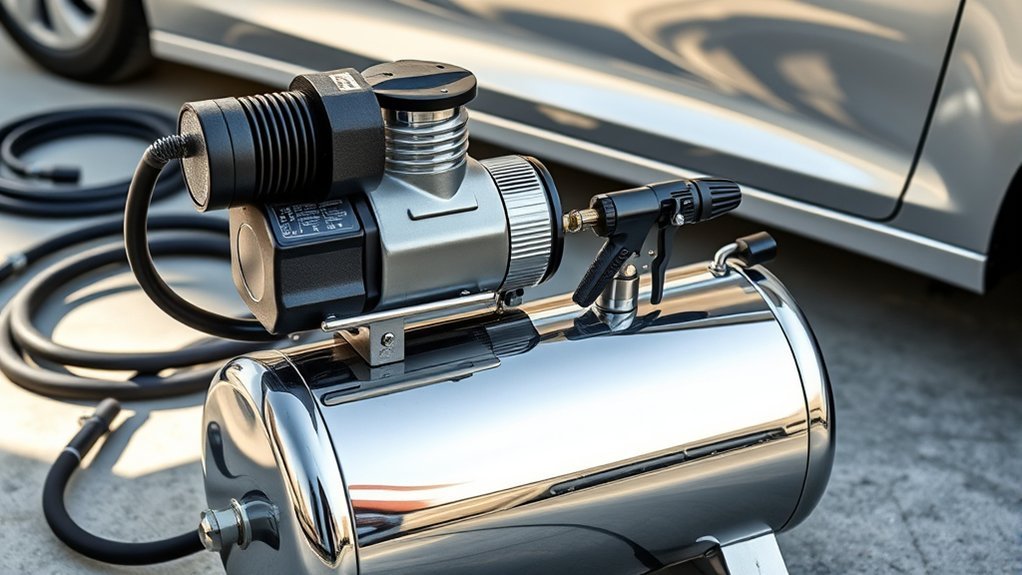
When selecting an air compressor for spray painting, we need to take into account several key factors to guarantee ideal performance. Things like airflow requirements, noise levels, portability, tank capacity, and power supply all play a role in making the right choice. Let’s explore these points to help you find the best compressor for your car painting projects.
Airflow Requirements
Choosing the right air compressor for spray painting cars hinges heavily on airflow capacity, measured in CFM. Adequate airflow guarantees a smooth, even spray finish, which is critical for professional results. Most spray painting jobs require at least 6 CFM at 90 PSI to maintain consistent paint flow and proper atomization. If the compressor doesn’t meet this requirement, you risk uneven spray patterns, dry spots, and a subpar finish. Higher airflow capacity allows for better handling of larger spray guns and thicker coatings, reducing clogs and uneven coverage. It’s crucial to match your compressor’s CFM rating to your spray gun’s specifications to assure ideal performance and efficient paint application. Proper airflow is key to achieving a flawless, professional-looking paint job.
Noise Level Considerations
Noise levels are a critical factor in selecting an air compressor for spray painting cars, especially in residential or noise-sensitive environments. Lower noise levels, around 60 dBA, are ideal because they help minimize disturbance and create a more comfortable workspace. Quiet compressors also reduce fatigue and make communication easier during long sessions. Excessive noise above 70 dBA can cause discomfort and might even breach local noise regulations, which is a concern in shared or enclosed spaces. Many ultra-quiet compressors include mufflers or soundproofing features to considerably cut down operational sound. Considering noise level alongside safety and comfort ensures a more pleasant working environment and helps avoid potential legal issues related to noise pollution.
Portability Features
Portability is a key factor in selecting an air compressor for spray painting cars, especially if you need to move it around your workspace frequently. A lightweight design with wheels and handles makes transportation effortless, allowing you to switch locations without hassle. Compact compressors with smaller tanks are highly portable, but keep in mind they may need more frequent restarts during long sessions. Built-in handles or shoulder straps add convenience for carrying across different work areas. For larger or heavier units, a wheel kit can markedly improve mobility, reducing strain. Ideally, aim for a compressor weighing under 60 pounds to balance portability and performance. Considering these features ensures you have a portable, efficient tool that adapts to your spray painting needs without sacrificing convenience.
Tank Capacity Needs
When selecting an air compressor for spray painting your car, tank capacity plays a crucial role in ensuring smooth, uninterrupted work sessions. Larger tanks, like 15 gallons, store more air, allowing longer painting sessions without needing to pause for refilling. This is ideal for extensive projects. Smaller tanks, such as 2.4 gallons, are more portable and suited for quick, small-scale jobs. An 8-gallon tank offers a middle ground, providing enough air for moderate tasks while remaining manageable to move around. Adequate tank capacity helps maintain consistent air pressure, reducing frequent compressor cycling and improving the quality of your finish. Ultimately, choosing the right size depends on your project’s scope and how long you’ll need continuous airflow, ensuring peak performance and efficiency.
Power and Voltage
Choosing the right power and voltage for your air compressor is essential to guarantee it can handle the demands of spray painting your car effectively. The compressor’s horsepower (HP) indicates its power, with 1.0 HP suitable for hobbyists and higher HP models needed for professional use. Voltage requirements typically range from 110V for smaller units to 220V or more for industrial-grade machines, influencing compatibility with your power supply. Higher horsepower and wattage units deliver increased airflow (CFM), which assures smooth, even paint application on larger surfaces. A properly matched power and voltage capacity allows continuous operation without overheating or pressure drops, leading to a consistent finish. Always check that your compressor’s specs align with your spray gun’s requirements for ideal performance and equipment safety.
Equipment Compatibility
Selecting an air compressor that matches your spray painting setup involves more than just power and voltage; it’s about guaranteeing compatibility with your equipment. First, check that the compressor’s CFM (cubic feet per minute) output meets your spray gun’s requirements for continuous operation, preventing interruptions. Match the maximum PSI of the compressor with your spray gun’s recommended operating pressure to achieve the best spray pattern. Also, verify that the nozzle sizes and pressure capabilities align with your specific spray gun model. The compressor’s design should support the type of spray gun you use, whether LVLP or HVLP, to ensure proper airflow and efficient paint transfer. Finally, confirm that fittings and hoses are compatible with your equipment’s inlet and outlet specifications for a seamless, trouble-free painting experience.
Durability and Build
Durability and build quality are essential factors that determine how well an air compressor will perform over time, especially for spray painting cars frequently. A sturdy construction using high-quality materials like alloy steel or rust-proof components guarantees the compressor can withstand daily use. Reinforced tanks and sealed parts help prevent leaks, corrosion, and environmental damage, extending the unit’s lifespan. Long-lasting compressors often boast a high cycle life, exceeding 3,000 hours, which means reliable performance over years. Oil-free models with sealed piston systems require less maintenance and are less prone to wear, making them ideal for consistent use. Additionally, safety features like automatic shutoff, overpressure relief, and corrosion-resistant casings contribute to both safety and longevity.
Budget Constraints
Budget constraints considerably influence the type of air compressor that car enthusiasts can afford for spray painting. Often, this means choosing smaller, less powerful models with lower CFM ratings, which can impact spray efficiency and finish quality. Cheaper compressors tend to have shorter lifespans and lower durability, leading to higher replacement costs over time. Higher-priced units typically offer better noise control, energy efficiency, and longer warranties, saving money in the long run. However, budget-friendly options might lack advanced features like oil-free operation or quick recovery times, which can affect productivity and increase maintenance needs. Striking a balance between initial cost and performance is vital to guarantee the compressor meets spray painting requirements without overspending, making it a critical factor in selecting the right equipment.
Frequently Asked Questions
How Long Can I Run a Compressor Continuously During Spray Painting?
We typically run our compressors continuously for about 20 to 30 minutes during spray painting, then give them a break to cool down. It’s essential to monitor temperature and pressure to prevent overheating and guarantee peak performance.
Which Compressor Is Best for Detailed or Small-Area Spray Jobs?
Like a trusty steed, a small, high-pressure compressor is best for detailed or small-area spray jobs. We recommend a compact, oil-free model with precise control, ensuring smooth, detailed finishes without overwhelming the workspace or causing fatigue.
Do Oil-Free Compressors Require More Maintenance Than Oil-Lubricated Ones?
Oil-free compressors generally require less maintenance since they lack oil changes, but they might need more frequent part replacements due to higher wear. Oil-lubricated models need regular oil changes but tend to last longer overall.
How Do Noise Levels Impact Using Compressors in Residential Areas?
Did you know noise levels above 85 decibels can cause hearing damage? We find that quieter compressors, under 75 decibels, let us work comfortably in residential areas without disturbing neighbors or risking health.
What Safety Precautions Are Essential When Operating Air Compressors for Painting?
We always wear hearing protection and eye goggles, guarantee proper ventilation, check for leaks before use, and keep the compressor on a stable surface. These precautions keep us safe and ensure quality spray painting results.
Conclusion
We understand choosing the right air compressor can feel overwhelming, but don’t worry—our top picks balance power, quiet operation, and portability. Many think you need a huge, loud unit for perfect spray painting, but these models prove otherwise. With the right compressor, you can achieve professional-quality finishes without sacrificing comfort or convenience. So, go ahead, pick one that fits your needs, and enjoy a smoother, more enjoyable spray painting experience.