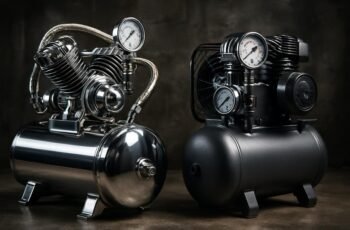
When evaluating air compressor options, understanding the fundamental differences between rotary screw and piston models is essential. Their operational efficiencies, maintenance needs, and suitability for specific tasks vary considerably, influencing long-term costs and performance. To make an informed choice, it’s important to analyze these factors in detail, considering your operational demands and budget constraints. Exploring these distinctions can clarify which compressor aligns best with your application, but the decision isn’t always straightforward.
Key Takeaways
- Rotary screw compressors offer higher energy efficiency and lower operational costs for continuous, high-volume use.
- Piston compressors are more affordable upfront but have higher maintenance and energy expenses over time.
- Rotary screw units are quieter, more compact, and suitable for space-constrained, noise-sensitive environments.
- Piston compressors are better for short-term, low-to-moderate demand applications with intermittent operation.
- Long-term cost savings and operational efficiency favor rotary screw compressors over piston types.
What Are Rotary Screw and Piston Compressors and How Do They Work?
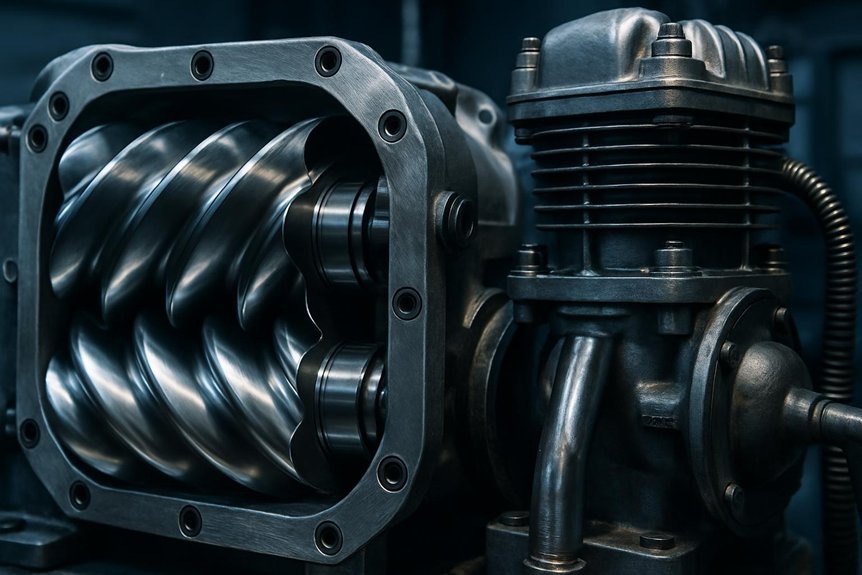
Although both rotary screw and piston compressors serve the purpose of compressing air, they operate through fundamentally different mechanisms. Rotary screw compressors utilize a continuous rotary motion, employing interlocking helical rotors that trap and compress air within a sealed chamber. They typically use splash or pressure-lubrication methods to reduce friction and wear, ensuring smooth operation. Their cooling systems often involve intercoolers and aftercoolers to efficiently dissipate heat generated during compression. In contrast, piston compressors employ reciprocating pistons within cylinders, compressing air in discrete strokes. They rely on splash or forced lubrication for piston and cylinder lubrication, while cooling is achieved through air or water-cooled jackets surrounding the cylinders. These differences in lubrication methods and cooling systems notably influence performance and application suitability.
Comparing Efficiency: Rotary Screw vs Piston Compressors
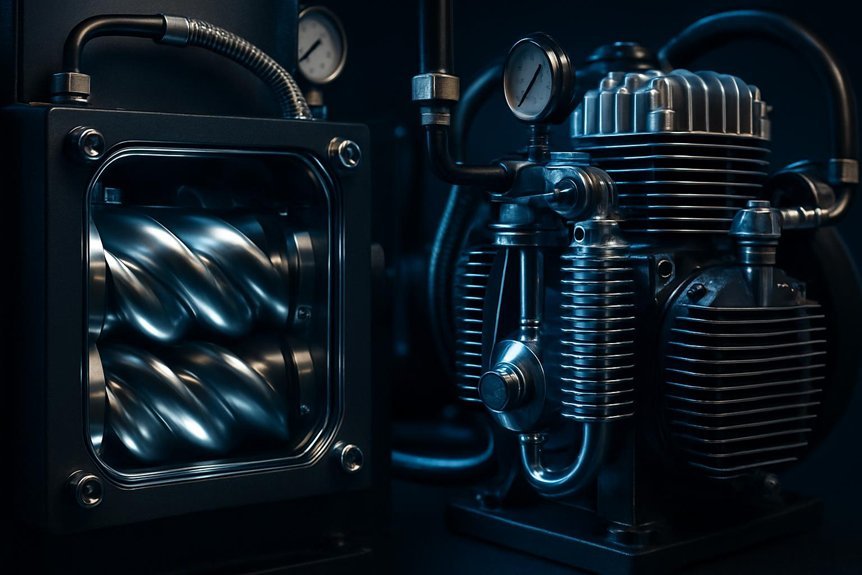
We evaluate the efficiency of rotary screw and piston compressors by examining their energy consumption patterns and operational costs. While rotary screw units typically offer lower energy use at steady operation, piston compressors often incur higher maintenance expenses over time. Analyzing these differences helps determine which technology provides better cost efficiency for specific applications.
Energy Consumption Differences
When comparing energy consumption, rotary screw compressors generally demonstrate higher efficiency than piston compressors, especially during continuous operation. Their design guarantees more consistent power efficiency, reducing energy waste over time. Piston compressors experience higher fluctuations in power draw due to their cyclic nature, leading to increased energy consumption during start-up and shut-down. To illustrate this, consider the following:
| Compressor Type | Average Power Efficiency | Energy Savings Potential | Suitability for Continuous Use | Maintenance Impact |
|---|---|---|---|---|
| Rotary Screw | 85-90% | High | Excellent | Low |
| Piston | 70-75% | Moderate | Limited | Moderate to High |
This comparison highlights the significant energy savings rotary screw models provide, emphasizing their superior power efficiency for sustained operations.
Operational Cost Efficiency
Operational cost efficiency is a key factor when evaluating compressor options, as it directly impacts long-term expenses beyond initial investment. Rotary screw compressors generally offer lower lubrication requirements, which reduces ongoing maintenance and lubricant costs, contributing to improved operational efficiency. Their continuous operation further enhances fuel efficiency, especially in applications requiring high volume, steady airflow. Conversely, piston compressors typically have higher lubrication needs and intermittent operation, leading to increased wear and maintenance costs. Piston models also tend to consume more fuel under similar loads due to less efficient combustion or compression processes. Overall, rotary screw compressors deliver superior operational cost efficiency through consistent performance, reduced lubrication expenses, and better fuel efficiency, making them a more cost-effective choice for long-term operations.
Cost Considerations: Which Compressor Fits Your Budget?
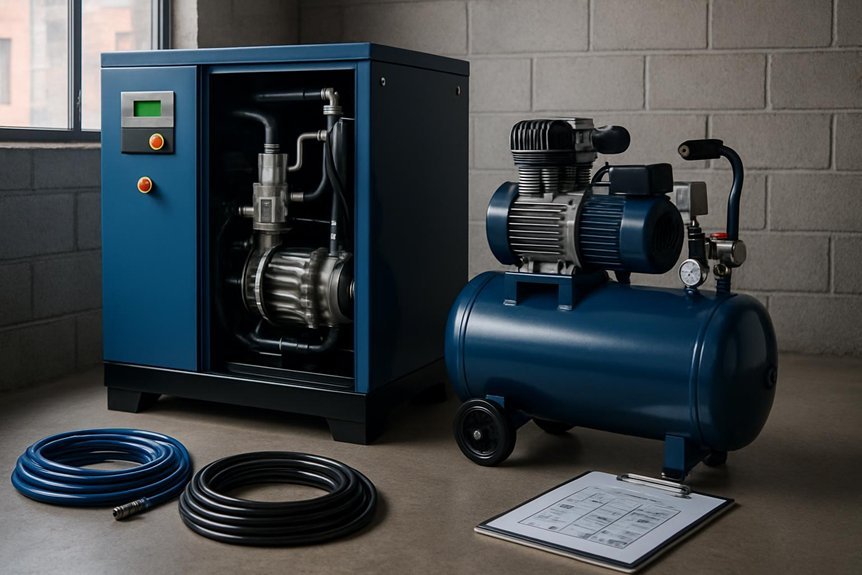
Choosing the right compressor requires careful consideration of initial investment and ongoing costs, as these factors substantially impact budget planning. A thorough cost analysis helps determine which model aligns with financial constraints. Rotary screw compressors typically entail higher upfront costs but offer lower energy consumption, reducing operational expenses over time. Conversely, piston compressors have lower initial prices but may incur higher maintenance costs and energy usage.
| Aspect | Rotary Screw | Piston Compressor |
|---|---|---|
| Initial Investment | Higher | Lower |
| Operating Costs | Lower (energy-efficient) | Higher (less efficient) |
| Maintenance Expenses | Moderate | Potentially higher |
| Budget Suitability | Long-term cost savings | Short-term affordability |
This analysis guides efficient budget planning based on total cost of ownership.
Maintenance and Durability: Which Compressor Requires Less Downtime?
Maintenance requirements and durability considerably influence the downtime associated with each compressor type. Rotary screw compressors generally require less frequent maintenance due to their continuous lubrication techniques, which promote consistent operation and reduce wear on internal components. Their advanced lubrication systems also facilitate better heat dissipation, extending lifespan and minimizing repair intervals. Piston compressors, in contrast, often demand more frequent oil changes and component checks, increasing downtime. Noise control plays a role here; rotary screws operate more quietly with fewer vibrations, reducing the need for extensive soundproofing and maintenance adjustments. Overall, rotary screw compressors demonstrate higher durability and lower maintenance demands, translating to less operational downtime. This makes them more reliable for continuous industrial use, whereas piston compressors may incur more frequent interruptions due to their maintenance-intensive design.
Ideal Applications for Rotary Screw and Piston Compressors
Rotary screw and piston compressors each excel in specific application environments based on their design characteristics and operational efficiencies. Market trends and technological advancements influence where each type thrives. Rotary screw compressors are ideal for continuous, high-volume operations like manufacturing plants and HVAC systems, benefiting from their reliability and energy efficiency. Piston compressors suit intermittent, low-to-moderate demand settings such as small workshops or dental offices, where simplicity and cost-effectiveness are priorities.
| Application Type | Suitable Compressor |
|---|---|
| Continuous, high-volume use | Rotary screw compressors |
| Intermittent, low demand | Piston compressors |
| Rapid, short-term needs | Piston compressors |
Noise Levels and Space Requirements for Each Type
We need to compare the noise emission levels and spatial footprints of rotary screw and piston compressors to understand their operational impacts. Rotary screw units generally produce lower noise levels and have a more efficient space footprint, making them suitable for compact environments. In contrast, piston compressors tend to generate higher noise and require more installation space, which influences site planning and sound attenuation measures.
Noise Emission Levels
When evaluating compressor options, understanding their noise emission levels is vital for proper installation and operation. Rotary screw compressors generally produce lower noise levels due to their enclosed design and smoother operation, making noise mitigation easier with effective soundproofing strategies. Conversely, piston compressors tend to generate higher noise emissions because of their reciprocating motion and open configurations, often requiring specialized soundproofing to minimize disturbance. Accurate assessment of noise levels helps determine suitable placement, especially in noise-sensitive environments. Implementing soundproofing strategies such as acoustic enclosures or vibration dampers can considerably reduce operational noise, enhancing workplace safety and comfort. Recognizing these differences ensures informed decisions when selecting a compressor, aligning noise management with overall operational requirements.
Space Efficiency Comparison
Although both rotary screw and piston compressors have distinct space requirements, their differences considerably influence facility layout and operational efficiency. Rotary screw compressors are generally more compact, thanks to design innovations that optimize internal components. They tend to operate with integrated cooling and noise reduction features, reducing their overall footprint. Conversely, piston compressors often necessitate larger, separate enclosures due to their design complexity and cooling needs. Market trends favor rotary screw models for their space efficiency and continuous operation capabilities, enabling tighter facility arrangements. Key considerations include:
- Rotary screw units’ streamlined design minimizes floor space
- Piston compressors require additional space for cooling and maintenance
- Noise insulation features in modern rotary screw models save room for soundproofing
- Design innovation drives trend toward smaller, more efficient units
- Space savings support increased operational flexibility and plant layout optimization
Installation Footprint Differences
The installation footprint of rotary screw and piston compressors varies considerably in terms of noise levels and spatial requirements, directly affecting facility design and operational planning. Rotary screw compressors typically operate more quietly, reducing noise pollution and easing installation logistics in noise-sensitive environments. Their larger physical size demands more space, influencing spatial planning and potentially increasing construction costs. Piston compressors, on the other hand, are generally more compact and produce higher noise levels, which may necessitate additional soundproofing measures. These differences impact how facilities allocate space and manage installation logistics, with rotary screws requiring dedicated, larger areas and piston units fitting into tighter spaces. Understanding these footprint distinctions is essential for optimizing layout efficiency and ensuring compliance with noise regulations.
How to Choose the Right Compressor for Your Business Needs
Selecting the appropriate compressor hinges on a clear understanding of your business’s specific operational demands and workload requirements. Critical factors include air quality standards, power consumption, maintenance complexity, and operational environment. To determine the best fit, consider:
Choosing the right compressor depends on your business’s unique operational demands and workload needs.
- The required airflow and pressure levels for consistent performance
- The importance of compressor lubrication and its impact on air purity
- The compressor’s ability to maintain air quality standards and minimize contaminants
- Energy efficiency and long-term operational costs
- Space constraints and installation footprint
Both rotary screw and piston compressors offer distinct advantages depending on these factors. A thorough assessment ensures you choose a compressor that provides reliable performance, ideal air quality, and manageable maintenance aligned with your operational needs.
Frequently Asked Questions
What Are the Environmental Impacts of Each Compressor Type?
Both compressor types emit environmental emissions, but rotary screw compressors are more energy-efficient, reducing overall environmental impact. Piston compressors consume more energy, leading to higher emissions, making rotary screws a greener choice for sustainable operations.
How Do Startup Times Compare Between Rotary Screw and Piston Compressors?
We find rotary screw compressors start faster, with lower noise levels and less maintenance, compared to piston compressors, which often have longer startup times and higher noise, making them less efficient initially—an intriguing contrast in performance.
Are There Any Safety Concerns Specific to Each Compressor?
We recognize safety concerns differ; rotary screw compressors require proper lubrication to prevent overheating, while piston compressors generate higher noise levels, necessitating soundproofing. Both demand careful maintenance to mitigate risks and guarantee safe operation.
Can Both Compressors Operate Effectively in Extreme Temperatures?
Both compressors can operate effectively in extreme temperatures, but rotary screw compressors generally offer better temperature resilience and efficiency in cold conditions due to their continuous operation design, whereas piston compressors may face challenges with cold start-up and thermal stability.
What Are the Typical Lifespan Differences Between the Two Compressors?
Think of lifespan as a marathon, not a sprint; rotary screw compressors generally last 10,000-20,000 hours, while piston compressors often reach 8,000-12,000 hours. Maintenance frequency impacts longevity, and noise levels tend to be lower in screw models.
Conclusion
Choosing between rotary screw and piston compressors is like selecting the right tool for a precise craft—each has its unique strengths. Rotary screws are the steady heartbeat of continuous industrial operations, offering efficiency and durability. Piston compressors, meanwhile, serve well for short bursts and budget constraints. Understanding your operational demands, budget, and space needs helps us make an informed decision, ensuring your compressed air system runs as smoothly and reliably as the gears of a well-oiled machine.