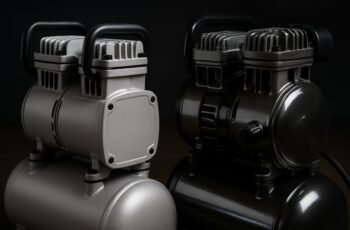
As the saying goes, “the devil is in the details,” and when it comes to choosing between reciprocating and rotary screw air compressors, understanding their fundamental differences is vital. Both serve specific industrial needs, yet their operational efficiencies, maintenance costs, and application scopes vary considerably. To determine which type best fits your requirements, it’s essential to analyze their mechanics, performance characteristics, and long-term value. This exploration reveals insights that could influence your equipment investment strategy.
Key Takeaways
- Reciprocating compressors are suitable for low-volume, intermittent tasks, while rotary screw units excel in continuous, high-volume applications.
- Reciprocating models typically have higher maintenance needs and noise levels compared to quieter, more efficient rotary screw compressors.
- Rotary screw compressors offer lower operational costs over time due to better energy efficiency and reduced maintenance requirements.
- Reciprocating compressors are more cost-effective upfront and ideal for smaller-scale, sporadic use.
- Rotary screw compressors are preferred in industrial settings needing reliable, high-capacity, and low-noise compressed air supply.
How Do Reciprocating and Rotary Screw Compressors Work Differently?
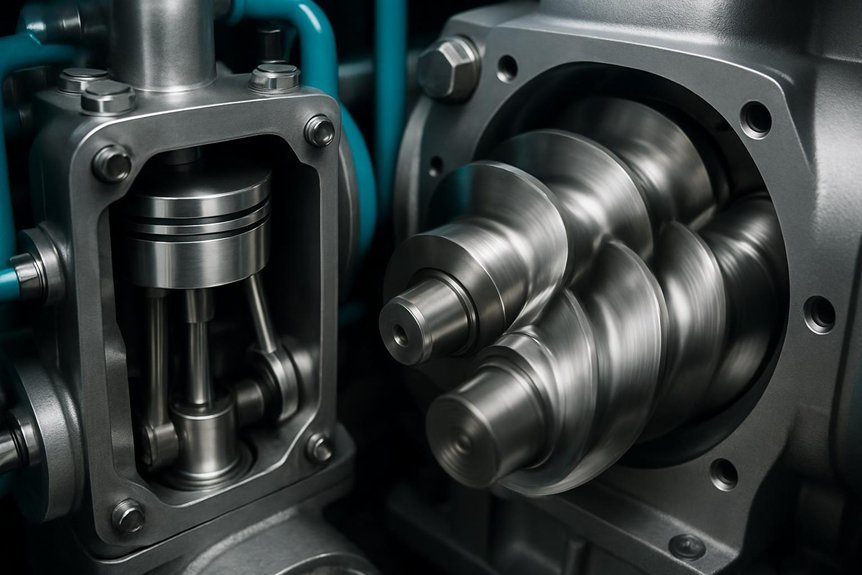
While both reciprocating and rotary screw compressors serve the purpose of compressing air, they operate through fundamentally different mechanisms. Reciprocating compressors utilize pistons driven by a crankshaft within cylinders, requiring complex lubrication systems to reduce friction and wear. These compressors often generate higher noise levels due to the reciprocating motion and valve operations. In contrast, rotary screw compressors employ two intermeshing rotors that continuously trap and compress air, resulting in smoother operation. Their lubrication systems are designed for continuous, efficient cooling and lubrication of the rotors, which helps minimize vibration and noise. Overall, the differing mechanisms considerably influence their operational characteristics, with reciprocating units tending to be noisier and more maintenance-intensive, while rotary screw systems offer quieter, more consistent performance.
Which Air Compressor Type Is Better for Small-Scale or Intermittent Use?
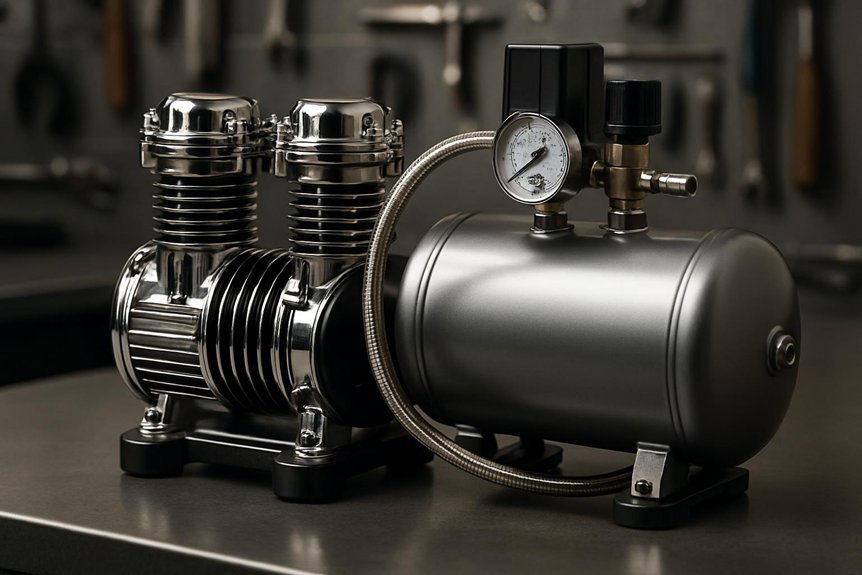
When determining the most appropriate air compressor for small-scale or intermittent applications, it’s important to consider operational demands and maintenance needs. Reciprocating compressors often excel here due to their high air compressor efficiency at lower volumes, making them ideal for sporadic use. Rotary screw compressors, while efficient continuously, may be excessive for intermittent tasks, and their noise levels can be disruptive.
Reciprocating compressors are ideal for small-scale, intermittent use due to their efficiency, affordability, and quieter operation.
Key considerations include:
- Lower initial costs for reciprocating units, suitable for occasional use
- Ease of maintenance due to simpler design
- Lower noise level considerations, important in quiet work environments
- Energy consumption patterns aligning with intermittent operation
- Size and portability, critical for small-scale tasks.
Choosing the right type hinges on balancing efficiency, noise, and operational frequency for suitable performance.
Why Are Rotary Screw Compressors More Suitable for Continuous, High-Volume Tasks?
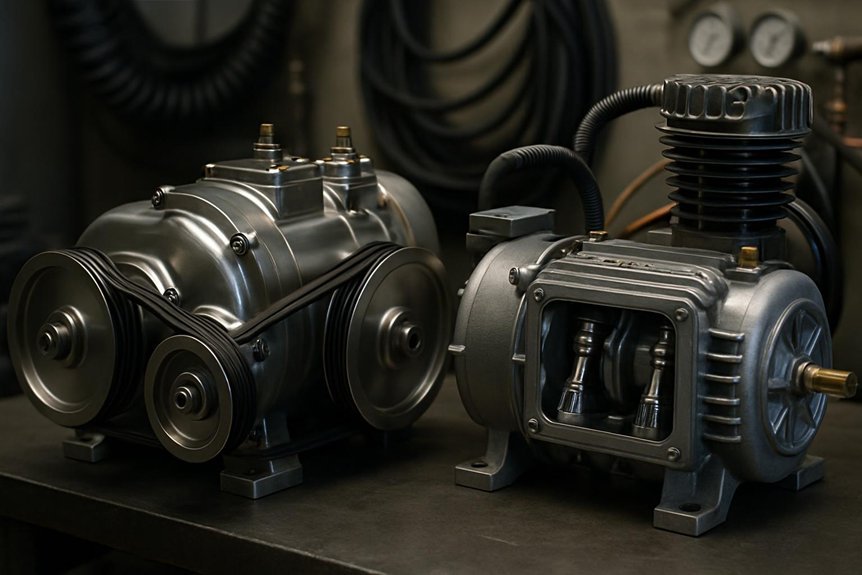
Rotary screw compressors are inherently well-suited for continuous, high-volume applications due to their design, which enables sustained, efficient operation with minimal fluctuations in output. Their positive displacement mechanism ensures a consistent flow of compressed air, supporting uninterrupted workflows. This stability enhances energy efficiency, as the compressor maintains ideal performance without frequent cycling, reducing energy waste. Additionally, rotary screw units generally operate at lower noise levels compared to reciprocating compressors, making them more suitable for continuous operation in noise-sensitive environments. Their ability to provide a steady air supply under high demand conditions, combined with improved energy efficiency and quieter operation, makes rotary screw compressors the preferred choice for industrial settings requiring reliable, high-volume air supply over extended periods.
What Are the Cost and Maintenance Considerations for Each Compressor Type?
Cost and maintenance considerations substantially influence the overall efficiency and operational expenses of both reciprocating and rotary screw compressors. Reciprocating models typically involve higher maintenance due to more moving parts, leading to increased downtime and costs. They often have lower energy efficiency, resulting in higher operational expenses over time. Rotary screw compressors, on the other hand, tend to have lower maintenance requirements and better energy efficiency, reducing long-term costs. However, initial investment can be higher, and noise levels may be more significant in certain models.
Key considerations include:
- Energy efficiency directly impacts ongoing operational costs
- Noise levels can affect workplace safety and comfort
- Maintenance frequency and complexity
- Upfront purchase price
- Long-term operational expenses
How Do You Choose the Right Air Compressor Based on Your Industry Needs?
Choosing the appropriate air compressor hinges on a thorough understanding of your industry’s specific operational demands and application requirements. We evaluate energy efficiency to minimize operational costs, especially in continuous-use environments. For industries prioritizing low noise levels, rotary screw compressors often outperform reciprocating models due to their quieter operation, making them suitable for enclosed or customer-facing spaces. Conversely, reciprocating compressors can be advantageous for intermittent, low-volume tasks, where initial investment and maintenance costs are critical considerations. We also assess load variability—industries with fluctuating demand benefit from compressors with adjustable output, often achieved by rotary screw units. Ultimately, selecting the right compressor involves balancing energy efficiency, noise levels, duty cycle, and application-specific performance to optimize operational efficiency and cost-effectiveness.
Frequently Asked Questions
What Are the Typical Applications for Reciprocating vs. Rotary Screw Compressors?
We find reciprocating compressors ideal for small-scale, high-pressure applications with lower maintenance costs, while rotary screw compressors suit continuous, large-volume operations with simpler installation requirements. Both serve distinct industrial needs efficiently.
How Does Energy Efficiency Differ Between the Two Compressor Types?
We find rotary screw compressors generally offer lower power consumption and higher energy savings over time compared to reciprocating models. Their continuous operation and efficient design reduce energy costs, making them more suitable for high-demand, long-term applications.
What Are the Noise Level Differences Between Reciprocating and Rotary Screw Compressors?
Like a symphony, rotary screw compressors produce steadier, quieter operation with lower noise levels, unlike reciprocating models that generate more vibration and noise. Their maintenance requirements are also less frequent and less disruptive.
How Long Is the Typical Lifespan of Each Compressor Type?
We find reciprocating compressors typically last 10-15 years with proper maintenance and careful startup procedures, while rotary screw compressors often endure 15-20 years, thanks to lower maintenance costs and smoother startup processes, enhancing longevity and reliability.
Are There Specific Industries That Favor One Compressor Type Over the Other?
We find specific industries favor one compressor type over another, considering maintenance costs and startup procedures; oil-free compressors suit healthcare, while industrial manufacturing often prefers rotary screws for reliability and efficiency, emphasizing tailored technical choices for ideal operation.
Conclusion
Ultimately, selecting the right compressor depends on your operational demands; a small workshop might favor a reciprocating model, whereas a manufacturing plant benefits from a rotary screw system. While initial costs matter, consider long-term efficiency and maintenance. Imagine a rotary screw compressor running seamlessly, like a well-oiled machine in a factory—durable and reliable. Investing wisely guarantees your equipment supports productivity without unexpected downtime, aligning with industry needs and future growth.