When selecting an air compressor, understanding the fundamental differences between stationary and portable units is essential for making an informed decision. Each type is designed to meet specific operational needs, with distinct advantages and limitations that can impact performance, cost, and convenience. Evaluating these factors requires a detailed analysis of application requirements, environment, and long-term goals—considerations that can considerably influence the most suitable choice for your projects.
Key Takeaways
- Stationary compressors are larger, fixed units suitable for continuous, high-demand industrial applications, while portable units are compact and mobile for versatile tasks.
- Stationary models typically operate quieter and are more energy-efficient; portable units prioritize mobility and quick setup despite higher noise levels.
- Fixed installation of stationary compressors requires stable infrastructure, whereas portable units are easy to transport and deploy in various environments.
- Stationary compressors offer greater durability and stability for long-term use; portable units are ideal for intermittent, light-duty tasks.
- The choice depends on workload demands, environment, need for mobility, noise restrictions, and budget considerations.
How Do Stationary and Portable Air Compressors Differ in Design and Functionality?
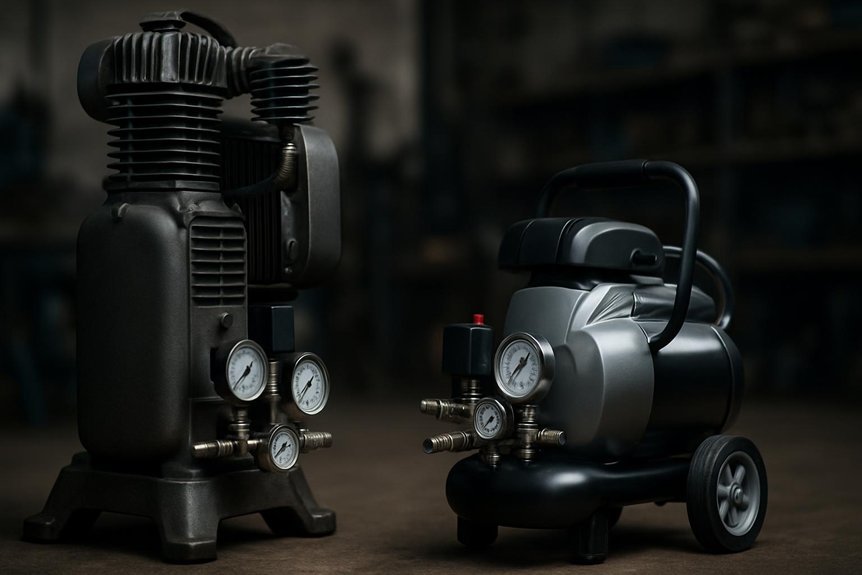
While both stationary and portable air compressors serve the fundamental purpose of generating compressed air, they differ considerably in their design and functionality to suit various applications. Stationary compressors are built with larger components, requiring more complex maintenance due to their extensive systems, but they typically offer lower noise levels during operation. Portable compressors, by contrast, feature compact, lightweight designs optimized for mobility, often with simplified maintenance routines. Their smaller size and enclosed housings tend to produce higher noise levels, which may necessitate additional soundproofing in noise-sensitive environments. The choice between the two hinges on balancing maintenance requirements and noise considerations: stationary units favor durability and quieter operation, while portable models prioritize ease of transport and quick serviceability for diverse, on-the-go tasks.
What Are the Main Advantages and Limitations of Stationary Air Compressors?
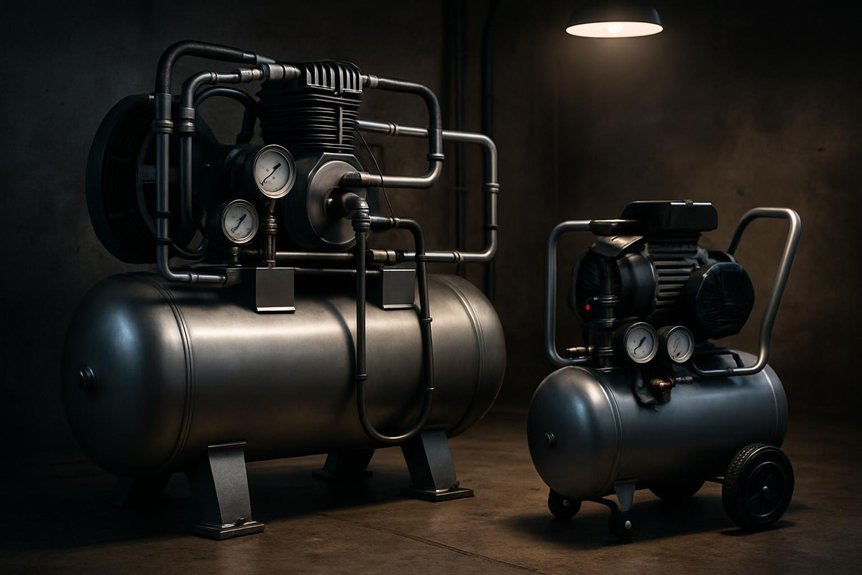
Stationary air compressors offer a reliable power supply essential for continuous industrial operations, but they are inherently limited in mobility due to their fixed installation. This stability guarantees consistent performance, yet it constrains their adaptability to different work environments. Understanding these trade-offs helps in evaluating their suitability for specific applications.
Reliable Power Supply
What makes stationary air compressors particularly reliable for continuous operation is their stable power supply, driven by dedicated electrical connections and robust components. This setup guarantees consistent air delivery without fluctuations, vital for demanding industrial applications. They typically feature optimized energy efficiency, reducing operational costs while maintaining high performance. Additionally, stationary units often operate at lower noise levels compared to portable counterparts, thanks to sound-dampening enclosures and strategic placement. These factors collectively contribute to their dependability, minimizing downtime and maintenance needs. However, their fixed installation requires a stable electrical infrastructure and adequate space. Despite these limitations, stationary compressors excel in delivering a reliable, steady power source essential for continuous operation, making them ideal for settings where uninterrupted airflow and energy efficiency are priorities.
Limited Mobility
Despite their reliability in continuous operation, stationary air compressors are inherently limited in mobility due to their fixed installation requirements. This restriction impacts flexibility in dynamic work environments, where portability becomes essential. However, stationary units excel in space efficiency, often occupying a designated, organized area that minimizes clutter. Their design enables better control of noise levels, typically resulting in quieter operation compared to portable alternatives, which often have less effective sound mitigation. While stationary compressors provide consistent performance and integrated system management, their limited mobility hampers deployment in remote or rapidly changing job sites. Consequently, industries requiring frequent relocation or on-the-go use might favor portable options, despite the trade-offs in space utilization and noise control.
Why Choose a Portable Air Compressor for Your Projects?
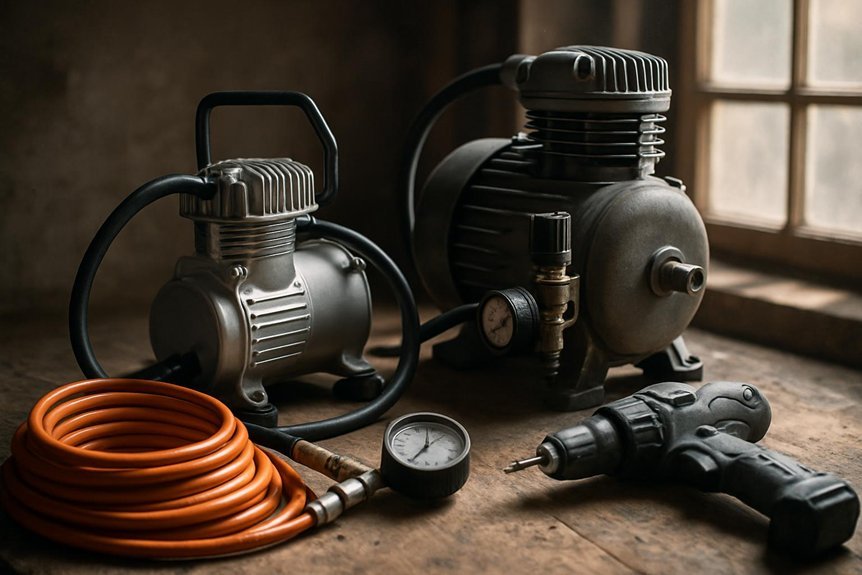
Because of their portability and ease of use, portable air compressors have become an essential tool for a wide range of projects. Their advantages extend beyond mobility, impacting maintenance requirements and noise levels considerably.
- Lower maintenance needs: Portable units generally feature simplified components, reducing routine upkeep and minimizing downtime.
- Flexible noise management: Many models are designed with noise reduction technology, making them suitable for environments with noise restrictions.
- Operational convenience: Their compact design allows quick setup, easy transport, and immediate deployment, saving time on job sites.
These factors make portable compressors more adaptable for varied tasks, especially when frequent movement or quiet operation is necessary, aligning with the demands of modern project workflows.
How to Determine Which Type of Air Compressor Fits Your Needs?
Choosing the right air compressor depends on evaluating your specific operational requirements, including workload, portability needs, and environment. To determine the best fit, consider energy efficiency—stationary models often provide better long-term efficiency due to optimized components, reducing operational costs. Noise levels are also vital; portable compressors tend to generate higher noise, which may impact work conditions, especially in enclosed or noise-sensitive settings. Analyzing your workload’s intensity and duration helps identify whether a stationary unit’s consistent power supply or a portable unit’s flexibility is more advantageous. Additionally, evaluating the environment—indoor versus outdoor, urban versus remote—guides the decision. Ultimately, balancing energy efficiency with noise considerations ensures an ideal match between compressor type and operational demands.
What Factors Should You Consider When Purchasing an Air Compressor?
When purchasing an air compressor, evaluating several key factors that directly impact performance, efficiency, and suitability for your specific applications is vital. First, consider energy efficiency, as it affects operating costs and environmental impact; higher efficiency models reduce power consumption. Second, assess noise levels, especially in enclosed or noise-sensitive environments, since quieter compressors improve safety and comfort. Third, examine performance specifications such as CFM (cubic feet per minute) and PSI (pounds per square inch), ensuring the compressor meets your workload demands. Additionally, evaluate durability and maintenance requirements to guarantee long-term reliability. Prioritizing these factors helps optimize your investment, balancing operational costs, convenience, and environmental considerations for your specific needs.
Which Air Compressor Type Offers Better Value for Different Usage Scenarios?
Determining which air compressor type offers better value depends heavily on the specific usage scenario, as each design excels under different operational conditions. Stationary compressors typically provide superior durability and lower noise levels, making them ideal for long-term, high-demand applications. They often require more extensive air compressor maintenance but benefit from stability and consistent performance. Portable units, by contrast, prioritize mobility and ease of use, suitable for intermittent tasks or job sites with limited space. Their noise level comparison generally favors stationary models, which operate more quietly due to larger enclosures. For infrequent or light-duty use, portable compressors offer better value; however, for continuous, high-volume tasks, stationary units justify their higher initial investment through long-term efficiency and reduced operational costs.
Frequently Asked Questions
How Long Do Stationary and Portable Air Compressors Typically Last?
Stationary air compressors typically last 10-15 years, while portable units last 5-10 years. Energy efficiency and cost comparison influence longevity, with stationary models often offering better durability and efficiency, extending their operational lifespan considerably.
What Maintenance Is Required for Each Type?
We perform regular oil checks and changes based on manufacturer specs, considering mobility needs—stationary units need stable setups, while portable compressors require lightweight maintenance. Both require filter cleaning and inspection to guarantee ideal performance.
Are There Noise Level Differences Between the Two?
We find that stationary air compressors generally produce higher sound levels due to larger motors and enclosed designs, resulting in a more significant noise comparison, whereas portable units tend to operate more quietly, making sound level differences notable in noise-sensitive environments.
Can Portable Compressors Handle Heavy-Duty Tasks?
Portable compressors can handle heavy-duty tasks when they possess sufficient power capacity, though their mobility advantages may limit maximum output. We analyze their specifications carefully, ensuring they meet the demands of rigorous applications without sacrificing portability benefits.
What Safety Precautions Are Necessary for Each?
We prioritize safety gear like goggles and gloves, and follow strict emergency procedures, ensuring secure setups and proper maintenance, whether stationary or portable, to prevent accidents and handle unexpected issues effectively during heavy-duty tasks.
Conclusion
In summary, selecting between stationary and portable air compressors depends on your specific operational needs. For instance, a manufacturing plant benefits from a stationary unit for continuous production, while a construction site might prioritize portability for quick, on-the-go tasks. By carefully analyzing workload demands, mobility requirements, and environment, you can optimize efficiency and cost-effectiveness. Ultimately, understanding these factors guarantees you choose the most suitable compressor, improving workflow and reducing downtime in your projects.