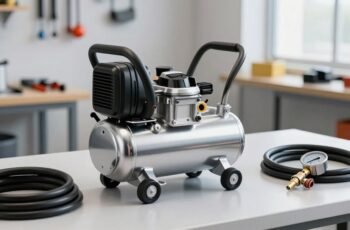
Understanding how tank sizes influence air compressor performance is essential for making an informed choice. The size affects not only the compressor’s capacity to deliver consistent airflow but also its efficiency and suitability for specific tasks. With numerous options available, selecting the right tank size involves analyzing operational demands, space constraints, and budget considerations. As we explore these factors, it becomes clear that a nuanced approach can optimize both performance and investment—something worth examining closely.
Key Takeaways
- Tank size influences airflow stability, pressure consistency, and compressor cycling frequency.
- Smaller tanks are portable, quick to pressurize, and suitable for light or transient tasks.
- Larger tanks provide more stored air, support continuous use, and reduce compressor cycling.
- Space constraints and operational needs should guide tank size selection for optimal performance.
- Matching tank size with airflow demands, power, and duty cycle ensures efficient and reliable operation.
What Does Tank Size Mean for Air Compressor Performance?
While tank size may seem like a straightforward measurement, it directly influences a compressor’s ability to deliver consistent airflow and maintain pressure stability. Larger tanks serve as reservoirs, smoothing out pressure fluctuations by providing stored compressed air during peak demands. This reduces the compressor’s cycling frequency, minimizing wear on motor components and enhancing overall efficiency. Conversely, smaller tanks respond more rapidly to pressure drops, but they can lead to frequent cycling, which may increase mechanical stress and reduce lifespan. The tank size also impacts recovery time; larger tanks can prolong the interval between compressor cycles, but they require more space and initial investment. Thus, understanding how tank capacity interacts with performance helps us optimize compressor selection for specific operational needs.
Common Air Compressor Tank Sizes and Their Typical Uses
Small tanks are ideal for portable applications where mobility is essential, while large tanks support continuous operation with stable air supply. Understanding these distinctions helps optimize system efficiency for specific tasks. Analyzing tank sizes against use cases guarantees the right match for performance and longevity.
Small Tanks for Portability
Have you ever wondered which air compressor tank sizes are best suited for portability without sacrificing performance? Small tanks, typically ranging from 1 to 6 gallons, are designed for lightweight, mobile applications. Their compact size allows for easy transportation and quick setup in tight spaces, making them ideal for tasks like tire inflation, small-scale spray painting, or on-the-go repairs. However, their limited volume means they can deliver shorter bursts of compressed air before needing to recharge. This trade-off favors portability over sustained airflow. These tanks are often paired with portable electric or gas-powered compressors, optimizing convenience without markedly compromising pressure stability for brief tasks. Ultimately, small tanks excel in scenarios demanding mobility with moderate air requirements, but they’re not suitable for continuous or high-demand operations.
Large Tanks for Continuous Use
Large air compressor tanks, typically ranging from 60 to several hundred gallons, are vital for continuous or high-demand operations. These tanks provide a steady supply of compressed air, minimizing compressor cycling and maintaining consistent pressure levels. They are ideal for industrial settings, manufacturing lines, and automotive shops where prolonged, uninterrupted air flow is necessary. The larger volume ensures that the compressor doesn’t need to run constantly, reducing wear and energy consumption. Such tanks often incorporate features like pressure relief valves and drain valves to guarantee safety and efficiency. When selecting a tank size for continuous use, it’s important to take into account the application’s air demand, cycle frequency, and system pressure requirements to optimize performance and minimize operational costs.
How to Determine the Right Tank Size for Your Job or Workshop
To select the appropriate tank size, we first need to accurately assess your air consumption rates during typical operations. Matching the tank capacity to these demands guarantees consistent pressure and minimizes compressor cycling, while space constraints can influence feasible options. By analyzing these factors systematically, we can determine the most effective tank size for your specific application.
Assess Your Air Usage
Understanding your air consumption patterns is essential for selecting the appropriate compressor tank size, as it directly influences system efficiency and performance. To accurately assess your usage, we analyze the flow rate requirements of each tool or application, typically expressed in CFM (cubic feet per minute). Monitoring peak demands during typical operation provides insight into the maximum air volume needed over short periods. Additionally, evaluating the duty cycle—how long tools are active versus idle—helps determine whether a larger tank can buffer fluctuations or if a smaller, more responsive tank suffices. Precise measurement of your actual air demands enables informed decisions about tank capacity, ensuring the compressor can sustain continuous operation without excessive cycling, which optimizes efficiency and reduces wear.
Match Tank Capacity
Selecting the appropriate tank size requires precise matching of the compressor’s capacity to your specific workload and operational demands. To determine the right size, analyze your peak air consumption and duty cycle. A larger tank acts as a reservoir, smoothing out pressure fluctuations and providing reserve capacity during high-demand intervals. Conversely, smaller tanks are suitable for intermittent tasks with lower continuous airflow, where rapid compressor cycling is manageable. It’s essential to evaluate your compressor’s CFM (cubic feet per minute) output relative to your peak usage; an undersized tank leads to frequent cycling, increasing wear, while an oversized tank can result in unnecessary cost and space consumption. Accurate matching guarantees consistent performance, minimizes compressor stress, and optimizes energy efficiency for your specific application.
Consider Space Constraints
Space constraints play a crucial role in determining the appropriate tank size for your workshop or job site, as physical limitations directly influence installation feasibility and operational efficiency. To optimize your setup, measure available space accurately, considering clearance for maintenance and airflow. Larger tanks require more floor space and may necessitate reinforced flooring or specific mounting options. We must evaluate ceiling height, proximity to walls, and potential obstructions that could hinder installation or access. Additionally, consider future expansion; selecting a tank size that fits current space but allows for growth can prevent costly modifications later. Precise spatial assessment ensures the selected tank size aligns with your operational needs while fitting within physical restrictions, ultimately balancing capacity requirements with practical installation considerations.
Benefits of Larger Tanks: When Bigger Is Better
Larger air compressor tanks offer significant operational advantages by providing a greater volume of stored compressed air, which reduces the frequency of compressor cycling. This stabilization minimizes wear on the motor and internal components, extending equipment lifespan and enhancing reliability. Additionally, bigger tanks deliver more consistent pressure output, supporting continuous or high-demand applications without frequent compressor activation. This results in improved energy efficiency, as the compressor runs less often and at a steadier load. In industrial settings, larger tanks accommodate sudden surges in demand, maintaining system stability and reducing pressure fluctuations. Overall, the increased storage capacity of larger tanks leads to smoother operation, lower maintenance costs, and greater system resilience, making them a strategic choice for demanding or long-duration tasks.
Why Smaller Tanks Can Be Ideal for Portable and Light-Duty Tasks
While larger tanks excel in high-demand or industrial applications, smaller tanks offer distinct advantages for portable and light-duty tasks. Their reduced volume results in faster compressor cycling, which minimizes energy consumption and wear on components. This efficiency is vital when portability is a priority, as smaller tanks are lighter and easier to transport. Additionally, they provide sufficient air volume for intermittent use, making them ideal for tasks like inflating tires, powering air tools, or small DIY projects. Smaller tanks also enable quicker startup times and easier storage, reducing setup complexity. Although they have less capacity, their design aligns with the demands of transient use cases, ensuring reliable performance without the bulk or weight associated with larger tanks. This balance of portability and functionality makes smaller tanks highly suitable for on-the-go applications.
Understanding Airflow, Run Time, and Tank Size Relationships
How do airflow, run time, and tank size interconnect to influence compressor performance? Airflow, measured in CFM, determines how quickly the compressor supplies compressed air to tools or equipment. Run time reflects how long the compressor can operate before needing to recharge the tank. Tank size directly affects this, as larger tanks store more air, extending run time under constant demand. When airflow exceeds the compressor’s delivery capacity, the tank’s pressure drops rapidly, reducing operational efficiency. Conversely, a well-matched tank size balances airflow and run time, ensuring continuous operation without excessive cycling. Understanding these relationships helps optimize performance: larger tanks provide longer run times but may slow pressure recovery, while smaller tanks require higher airflow to maintain consistent output, impacting overall system stability.
Factors to Consider Beyond Tank Size: Power, CFM, and Duty Cycle
Beyond tank size, other factors profoundly influence compressor performance and suitability for specific applications. Power, measured in horsepower, determines the motor’s ability to sustain airflow under load. Cubic feet per minute (CFM) indicates the volume of compressed air delivered; higher CFM supports continuous, demanding tasks. Duty cycle reflects the percentage of time a compressor can operate without overheating, affecting operational longevity. These elements collectively impact efficiency, maintenance needs, and overall capability.
- Adequate power ensures consistent performance under load
- Higher CFM supports continuous or high-demand tools
- A proper duty cycle prevents overheating and extends lifespan
- Mismatch between these factors and application demands leads to inefficiencies
- Balancing all three ensures suitable compressor selection and operation
Tips for Choosing the Optimal Tank Size on a Budget
Selecting the right tank size on a budget requires a strategic approach that balances initial cost with long-term efficiency. We recommend evaluating your specific airflow requirements and workload to avoid overspending on oversized tanks that won’t provide proportional benefits. Smaller tanks are more affordable upfront and can suffice for intermittent use or low CFM demands, but they may lead to more frequent compressor cycling, increasing energy consumption over time. Conversely, slightly larger tanks can smooth out airflow fluctuations and reduce cycling, improving efficiency without substantially inflating costs. Prioritize tanks that meet your minimum CFM needs while considering durability and build quality to prevent long-term replacement expenses. Careful analysis of your operational demands ensures ideal performance at a cost-effective level, maximizing value without compromising functionality.
Common Mistakes to Avoid When Selecting an Air Compressor Tank
Choosing the right tank size is only part of the equation; avoiding common mistakes during selection guarantees ideal performance and cost-efficiency. One key mistake is neglecting the system’s airflow demands, which can lead to under- or over-sized tanks that impair compressor efficiency. Additionally, ignoring the compressor’s working pressure range can cause pressure fluctuations and system failures. Failing to consider future expansion needs limits scalability, resulting in costly replacements later. Overlooking maintenance accessibility can lead to operational downtime. In the end, choosing tanks solely based on price without analyzing build quality and durability risks premature failure.
- Ignoring airflow requirements
- Overlooking pressure compatibility
- Not planning for future needs
- Neglecting maintenance access
- Prioritizing cost over quality
Frequently Asked Questions
How Does Tank Material Affect Compressor Longevity?
Tank material influences compressor longevity by affecting corrosion resistance, durability, and heat dissipation. We analyze these factors to guarantee ideal performance, selecting appropriate materials like cast iron or aluminum, which extend lifespan and reduce maintenance needs over time.
Can a Larger Tank Increase Compressor Noise Levels?
Like a steady heartbeat, a larger tank can amplify compressor noise, as the increased volume of compressed air and longer cycling may produce more sound. We analyze this effect, considering sound dampening and operational efficiency for ideal system design.
What Safety Considerations Are Linked to Different Tank Sizes?
Larger tanks require robust pressure relief devices, regular inspections, and secure mounting to prevent accidents, while smaller tanks demand careful pressure regulation. We emphasize safety protocols tailored to tank size to mitigate risks and guarantee operational integrity.
How Often Should I Drain Moisture From My Tank?
We recommend draining moisture daily for small tanks and weekly for larger ones, as studies show regular maintenance prevents corrosion and equipment failure, ensuring ideal compressor performance. Consistent drainage is essential for safety and efficiency.
Are There Regulations Governing Tank Size and Safety Standards?
Yes, regulations govern tank size and safety standards, requiring compliance with OSHA, ANSI, and ASME codes, ensuring structural integrity, pressure limits, and safety protocols to prevent accidents, and maintaining legal operation and workplace safety.
Conclusion
Choosing the right air compressor tank size balances performance and practicality. While larger tanks offer stability and efficiency for demanding tasks, smaller tanks excel in portability and quick readiness. It’s a matter of weighing operational needs against workspace constraints. Ultimately, understanding airflow requirements and usage patterns guides us to the ideal choice—ensuring we avoid costly overinvestment or insufficient capacity. In this technical balance, precision in selection maximizes both productivity and cost-effectiveness.