When we’re hauling gear or towing a camper, a reliable air source can save the day. The best towable air compressors of 2025 combine high PSI output, rugged builds, and smart extras like jump-start capability and long hoses. We’ve narrowed the field to five standout units that balance power, portability, and value. From RV tires to marine inflatables, they’re built for tough conditions. Here’s how they compare—and which one fits your setup best.
4-in-1 Dual Cylinder Tire Inflator with Jump Starter and 65W Power Bank


July 10, 2026 7:57 am
Need a towable-ready solution that jump-starts a dead truck, tops off trailer tires fast, and charges your laptop? We like MobiBot’s MB01, a 4-in-1 dual-cylinder inflator, 4000A jump starter, and 65W PD power bank. It restarts 12V vehicles up to 8.0L gas/6.0L diesel, works from -4 to 140°F, and its smart clamps prevent sparks, reverse polarity, and shorts. The compressor hits 160 PSI, inflates 0–36 PSI in about six minutes, and auto‑shuts off. With a 20,000 mAh battery, it powers up to six tire top-offs and fast-charges laptops. You get USB‑C, a DC cord, hoses, nozzles, LED light, case, and a 2‑year warranty.
Best For: Drivers, RVers, and tradespeople who need a towable-ready all-in-one that can jump-start large 12V engines, quickly inflate tires, and fast-charge laptops on the go.
Pros:
- Powerful 4000A jump starter handles up to 8.0L gas/6.0L diesel with spark-proof smart clamps and multiple protections
- Dual-cylinder compressor to 160 PSI with auto shut-off; inflates 0–36 PSI in ~6 minutes and includes multiple nozzles and hoses
- 20,000 mAh battery with 65W PD/QC 3.0 for laptop fast charging; includes USB-C and DC car cord, LED light, and carrying case
Cons:
- Heavier unit compared to basic inflators or standalone jump starters
- Compressor noise can be loud during operation
- Accessory quality can vary; some users may prefer higher-grade hoses/clamps
VIAIR 30034 Tire Inflator for Towables 300P-RVS
July 9, 2026 4:46 am
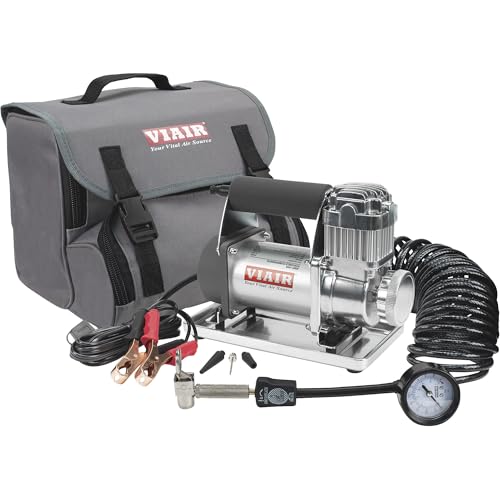
For smaller RVs and towables where space and speed matter, we like the VIAIR 30034 300P-RVS for its quick 80–90 PSI top-off in under 44 seconds and true 150 PSI capability. Running on 12V DC with a 0.5 hp motor, it clips to your battery, travels light, and stores cleanly in its case. The 30-foot hose and 5-in-1 braided coil hose reach dual axles easily, while the inline gauge reads accurately to 150 PSI. We’ve seen strong durability, tight valve seals, and easy portability praised by users. Minor gripe: the inflator piece on the hose can be fiddly. Overall, compact, fast, and road-ready.
Best For: Class B motorhome owners and towable/smaller RV users who need a fast, portable 12V compressor that can reliably top off high-pressure tires up to 150 PSI.
Pros:
- Quickly tops off from 80 to 90 PSI in under 44 seconds; true 150 PSI capability
- Long reach with 30 ft hose plus 5‑in‑1 braided coil hose; accurate inline gauge to 150 PSI
- Portable, battery-clamp powered 12V unit with carrying case; praised for durability and tight seals
Cons:
- Inflator piece on the hose can be fiddly during use
- AC power option not included (12V DC only)
- Heavier than tiny plug-in inflators at around 12 lbs and bulkier than glovebox units
Portable Tire Inflator Air Compressor (Cordless, 150 PSI)

July 12, 2026 7:48 am
Travelers who want a compact, cordless inflator with real speed will appreciate this 150 PSI unit that tops off small car tires from 27–36 PSI in about a minute. We like its 20 LPM airflow, auto shut-off within ±1 PSI, and quiet ~70 dB operation. The high-capacity lithium battery runs 1–2 hours, while the included 12V car cable keeps us going on the road. A dual LCD shows real-time and target pressures, with presets for car, bike, motorcycle, and balls, plus PSI/KPA/BAR/KG/CM² units. USB-C input and USB-A output add emergency power. At 590 g, it’s portable, cooled, and backed by a 1-year warranty.
Best For: Travelers, commuters, and cyclists who need a fast, cordless inflator with accurate auto shut-off and the option to run from a 12V car outlet.
Pros:
- Rapid inflation: tops off small car tires (27–36 PSI) in about 1 minute with 20 LPM airflow and ±1 PSI accuracy
- Versatile and portable: cordless design, dual LCD, 4 presets, multiple units, 4 adapters, LED light, and 1-year warranty
- Power flexibility: high-capacity lithium battery (1–2 hours) plus USB-C input/USB-A output and included 12V cigarette lighter cable
Cons:
- Battery performance can drop in cold temperatures; occasional reports of shorter runtime
- Max flow (20 LPM) and 0.2 HP are ideal for topping off, not for large truck tires or high-volume inflations
- Specs list both lithium battery and “3 AAA batteries,” which may cause confusion about power configuration
Airhead AHP-120 Kwik Tek Air Pump Canister (120-Volt), Yellow/Black

July 9, 2026 4:46 am
Looking for a compact inflator that swaps between home AC and on-the-go power without fuss? We like the Airhead AHP-120 Kwik Tek Air Pump Canister for its simple, fast airflow and grab-and-go design. It’s a 120-volt pump for in-home AC outlets, yet it also plugs into a car or boat’s 12-volt socket via the included cigarette lighter adapter. Expect high-volume output—listed at 290 liters per minute and 300 liters per minute—and quick inflation/deflation across pool floats, towables, boats, and air mattresses. The handheld body, 5-foot cord, and three universal nozzles make it travel-friendly for backyard fun, lake days, and road trips.
Best For: People who need a compact, fast air pump that can switch between home AC power (120-volt) and a car/boat 12-volt outlet for inflating and deflating a wide range of inflatables.
Pros:
- Dual power options: 120-volt AC for home use plus included 12-volt cigarette lighter adapter for vehicles
- High-volume airflow rated at both 290 L/min and 300 L/min for quick inflation/deflation
- Compact, lightweight design with 5-foot cord and three universal nozzles for broad valve compatibility
Cons:
- Cord length (5 feet) may be short for larger setups without an extension
- No battery option; requires access to an outlet or vehicle socket
- Conflicting airflow specs (290 vs. 300 L/min) may cause uncertainty about exact performance
AIRHEAD High Pressure Air Pump

July 9, 2026 4:46 am
Need rapid, firm inflation straight off a vehicle battery? We like the AIRHEAD 12 Volt High Pressure Pump (AHP-12HP) for towables, boats, and rafts. It pushes up to 410 L/min and includes a removable pressure release valve capped at 1.4 psi to prevent over-inflation. The 10-foot cord with alligator clips connects directly to your car, truck, or boat battery—don’t use a cigarette lighter, as it draws 28 amps.
It’s compact, durable, and ships with adapters for Stem, Boston, Leafield, Bravo, and Hulkey Roberts valves. It inflates fast but runs loud and can heat up; we allow cooling cycles. Warranty: 90 days.
Best For: Boaters and towable owners who need fast, firm inflation directly from a 12V vehicle or boat battery and use common valves like Boston, Leafield, Bravo, or Hulkey Roberts.
Pros:
- High output: up to 410 L/min for rapid inflation of boats, rafts, and towables
- Built-in 1.4 psi pressure release valve helps prevent over-inflation
- Includes multiple adapters; 10-foot cord with alligator clips for direct battery connection
Cons:
- Draws 28 amps—cannot use a cigarette lighter socket
- Loud operation and can get hot; may require cooling cycles during extended use
- Limited to 1.4 psi max, not suitable for gear requiring higher pressures
Factors to Consider When Choosing Towable Air Compressors
Before we pick a model, let’s match the power source to our tow vehicle and confirm the max PSI our tools demand. We’ll check airflow rate (CFM) and duty cycle to be sure the compressor can sustain the workload without overheating. Finally, we’ll consider hose length reach to cover our job site without constant repositioning.
Power Source Compatibility
How do we ensure a towable air compressor plays nicely with our power setup? We start by matching the compressor’s power options to where we’ll use it most. Many towable inflators run on 12V DC from a vehicle battery and, at around 0.5 HP, deliver fast inflation for big towables. If we split time between the truck and a garage, dual-power models (12V DC plus 110V AC) add flexibility—but we should confirm AC compatibility; not all units support both.
We also check usability features that support reliable connections: a long hose (around 30 ft) reaches awkward valves, and an inline gauge improves visibility. Integrated pressure gauges, automatic shut-off, and multi-valve adapters (Stem, Boston, Leafield, and more) help ensure safe, accurate, and compatible operation.
Max PSI Requirements
Power setup sorted, we should lock in the right max PSI for the loads we tow. Most towable compressors target 90–150 PSI; many cap at 150 PSI, while RV-focused units hit 90 PSI quickly. We should match the compressor’s max PSI to our highest-pressure tires or towable inflatables so we’re not flirting with under-inflation warnings under heavy load.
Beyond the headline number, we need precise control. A clear, accurate gauge and stable regulation let us set pressures right up to the limit without overshooting. Check the usable pressure range—what the unit can consistently deliver versus its stated maximum—to ensure it aligns with our tire specs. Speed matters too: quick top-offs (e.g., 80 to 90 PSI in under 44 seconds) help us balance readiness with accuracy.
Airflow Rate (CFM)
Why does airflow rate matter? CFM tells us how quickly a compressor moves air into our towables, tubes, or RV tires. Higher CFM means faster inflation, especially on larger or stiffer inflatables where volume, not just pressure, is the bottleneck. Many models flaunt high PSI (like 150 PSI), but their CFM can drop sharply as pressure rises, slowing the final push to target. That’s why we should compare compressors by their delivered CFM at the pressures we actually use.
We look for consistent airflow across the working range to keep fill times predictable under load. For towables and RV use, a robust CFM ensures we spend less time waiting and more time rolling. Match CFM to your biggest inflatable to avoid sluggish top-offs.
Duty Cycle Rating
Curious what keeps a compressor running without forced breaks? That’s the duty cycle. It’s the proportion of time a unit can operate before it must cool, often shown as a percentage within a set window. A 50% duty cycle means five minutes on, five minutes off in a 10‑minute cycle. Many towable models list it as continuous minutes followed by a required rest period.
We look for higher duty cycle ratings when we’ll inflate multiple or large tires back-to-back. Longer continuous run time reduces downtime and improves job pacing. Keep in mind, motor size, cooling design, ambient temperature, and each brand’s testing method affect results. Real-world performance also shifts with load, venting, and heat buildup. When comparing models, a higher duty cycle generally suits frequent or prolonged towing use.
Hose Length Reach
How far do we need to park the compressor from the tires we’re airing up? Hose length reach decides that. For towables and RVs, extended options—like 30 ft hoses or detachable 30 ft extensions—let us inflate from a safe, convenient spot without shuffling the unit around a large trailer.
Longer hoses cut repositioning and time. They also help us keep cables and heat away from tires, reducing strain that can trigger overheating. Flexibility matters too: a 5‑in‑1 braided coil hose and adapters improve maneuverability around fenders and let us connect to different valve types across the rig.
Before we buy, we should measure our typical distance from power source to the furthest tire. Match hose length to that span to ensure consistent, hassle‑free reach.
Portability and Weight
Hose reach keeps us from dragging gear across a campsite, but portability and weight decide whether we can actually move the compressor when it counts. We look first at packed size and weight because they drive transport and storage. Lighter models are simply easier to lift into a trunk, slide into a hitch basket, or carry down a trail. Units under 10 pounds shine for quick tire inflations away from power sources.
A compact form factor—around 12 x 11 x 9 inches—fits glove boxes, side bins, or under-seat compartments. Integrated cases or shoulder straps cut bulk and free a hand during hitching or roadside setups. Longer 30-foot hoses and power cords (12V or 110V) extend reach, so we reposition less and keep workflows efficient.
Noise and Heat
Why do the loudest, fastest towable compressors also run the hottest? It’s simple physics: pushing high airflow demands more power, which creates more noise and heat. Many high-output models draw serious current—some 12V designs pull up to 28 amps—so heat can spike during continuous use. That’s why consumer feedback often flags loud operation and why heat management is a must-have, not a nice-to-have.
We should look for clear cooling strategies. Side cooling designs and built-in cooling ports help sustain performance during long sessions. Overheating protection and thermal throttling are worth prioritizing; they cut output before damage occurs and keep components within safe limits. Expect some units to need cooling cycles between bursts. Plan for noise, too, if you’ll work near campsites or neighborhoods.
Accessories and Adapters
What makes a towable compressor truly useful on the road is the kit it comes with. We should look for a diverse set of adapters—ideally a 3- to 5‑in‑1 hose—so we can match common towable and inflation valves without hunting for extras. A long, reinforced air hose (around 30 ft) or a braided coil option helps us reach axles, trailers, and gear while resisting kinks and abrasion.
An inline gauge that reads clearly up to at least 150 PSI lets us dial in precise pressures for tires and airbags. Power flexibility matters, too: verify 12V DC or 110V AC compatibility for our vehicle or campsite. Lastly, a well-organized kit—5‑in‑1 valve adapter, tire chuck, deflation tools, and a carrying case—keeps setup fast and portable.
Conclusion
We’ve hauled these towable compressors across campgrounds and marina lots, and they’ve never blinked. Once, at dusk on a wind-blown pass, a single 90–150 PSI top-off turned a looming delay into a smooth, confident descent—like flipping on headlights in fog. With rugged builds, smart clamps, and jump-start backup, they’re more than inflators; they’re peace-of-mind kits on wheels. Choose the right PSI, hose reach, and power options, and we’ll spend more weekends moving, not mending.