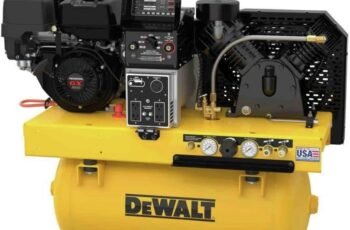
Like a steady workhorse from a well-built shop, the Makita MAC5200 pairs a 3.0 HP motor with a cast-iron Big Bore pump to deliver 6.5 CFM at 90 PSI. We’ll examine how that output matches common pneumatic tools, along with the compressor’s maintenance needs, portability, and noise. Its folding handle helps with storage, but its weight may complicate transport. Before deciding whether it fits your setup, consider the trade-offs behind its performance.
Key Takeaways
- The Makita MAC5200 delivers 6.5 CFM at 90 PSI, making its airflow rating useful for comparing compatible pneumatic tools.
- Check each tool’s pressure and air-consumption requirements; demanding tools or simultaneous use may exceed the compressor’s output.
- Its 3.0 HP motor, cast-iron Big Bore pump, and oil lubrication support durable operation and faster recovery.
- The removable cylinder simplifies pump access, but oil lubrication requires regular level checks and maintenance.
- A folding, low-profile handle helps with storage, though the compressor’s weight and noise may limit portability.
6.5 CFM at 90 PSI
At 90 PSI, the Makita MAC5200 delivers 6.5 CFM, giving us a clear measure of its airflow at a common working pressure. This airflow capacity helps us assess whether the compressor can supply a pneumatic tool at its specified pressure and consumption rate.
To judge tool compatibility, compare each tool’s required CFM at 90 PSI with the compressor’s 6.5 CFM rating. Tools that demand less airflow may run within that output; tools requiring more can lose performance or need pauses for pressure recovery.
We should also account for simultaneous tool use, since combined demand can exceed the available airflow and reduce consistent operation.
Detailed features
Beyond its 3.0 HP motor and 6.5 CFM output, the Makita MAC5200 uses a cast-iron Big Bore cylinder and piston designed for faster recovery. This Big Bore pump design supports efficient air delivery, while the cast-iron construction helps the pump withstand repeated operation.
Its oil lubricated cooling system reduces operating heat and wear, supporting longer pump life. We can access the removable cylinder for easier maintenance, which simplifies service when the pump needs attention.
For storage, the folding, low-profile handle collapses to reduce the compressor’s footprint. Together, these features provide practical serviceability, durable pump construction, and a more compact storage configuration for workshop use.
Pros and Cons
We’ll weigh the MAC5200’s 6.5 CFM output at 90 PSI, fast-recovery cast-iron pump, and serviceable design against its practical limitations.
We’ll consider how its oil-lubricated pump and folding handle affect maintenance and storage.
This comparison will help you assess its key pros and cons for your work.
Pros
The Makita MAC5200’s main advantages are its 3.0 HP motor and 6.5 CFM output at 90 PSI, which support strong air delivery and faster recovery. Its cast-iron Big Bore cylinder and piston help the pump replenish air efficiently, while oil lubrication promotes cooler operation and reduced wear.
We can also appreciate the durable cast-iron cylinder, which is designed to extend pump life during regular use. For upkeep, the removable cylinder allows easier maintenance by improving access to pump components.
The folding, low-profile handle adds practical storage flexibility: we can fold it down to reduce the compressor’s footprint between jobs or in a workshop.
Cons
Although the MAC5200 offers strong output, its oil-lubricated pump requires routine maintenance, including checking and replenishing oil. We’ll need to monitor oil levels and follow service intervals, which adds upkeep compared with oil-free compressors.
Its cast-iron construction supports durability but contributes to a Heavyweight design, making the unit less convenient to lift, carry, or reposition without assistance. The folding handle helps with compact storage, yet it doesn’t eliminate the burden of moving the compressor.
We should also expect loud operation: the 3.0 HP motor and pump can make it unsuitable for noise-sensitive indoor spaces or jobsites where sound needs to be limited.
Concluding thoughts
For demanding jobs that need steady air delivery, the Makita MAC5200 pairs a 3.0 HP motor with an output of 6.5 CFM at 90 PSI. Its cast-iron Big Bore pump supports faster recovery, while oil lubrication helps manage operating temperature and wear.
We’d consider these features relevant to Long Term Reliability, though routine maintenance remains essential. The removable cylinder can simplify service, and the folding, low-profile handle makes storage more practical.
For Ideal Workshop Use, this compressor suits tasks that benefit from consistent airflow and a durable pump. We’d match its capacity to your tools’ requirements before purchase, rather than assume compatibility.
Frequently Asked Questions
What Tools Can the Makita MAC5200 Power?
We can power air tools supported by the MAC5200, including nailers, staplers, and compatible impact wrenches or spray guns, by matching compressor capacity to tool requirements: it delivers 6.5 CFM at 90 PSI.
What Type of Oil Does the MAC5200 Require?
Use SAE 30 non-detergent compressor oil; we should verify the manual for exact oil viscosity recommendations. Its 3.0-horsepower motor delivers 6.5 CFM at 90 PSI. Don’t assume synthetic oil compatibility without Makita’s approval.
How Often Should You Change the Compressor Oil?
We should follow Makita’s manual for Oil Change Intervals: change the oil after the first 20 operating hours, then every 100 hours or six months, whichever comes first. Include these intervals in your Maintenance Schedule, checking oil regularly.
Is the Makita MAC5200 Suitable for Home Use?
Yes, we’d consider the Makita MAC5200 suitable for a home workshop if you need 6.5 CFM at 90 PSI. Home workshop suitability depends on your tools and space; check residential noise levels before placing it indoors.
How Much Does the MAC5200 Weigh?
We can’t confirm the MAC5200 weight from the available specifications. For MAC5200 weight and portability, check Makita’s current product documentation; consider compressor transport considerations, including its dimensions, handle, and whether you’ll need assistance moving it safely.
Conclusion
We’d choose the Makita MAC5200 when our tools need up to 6.5 CFM at 90 PSI, but we’d check each tool’s airflow requirements first. That output gives us a practical benchmark: a tool rated above 6.5 CFM may outpace the compressor during sustained use. Its 3.0 HP motor, cast-iron pump, and removable cylinder support performance and maintenance, while oil lubrication requires routine care. We should also account for its weight and noise. Overall, it’s a capable shop compressor, not a low-maintenance option.