We’ll assess the Makita MAC2400’s Big Bore pump, air delivery, and job-site features to see where its 4.2-gallon tank fits in a working setup. Its 2.5 HP motor supplies 4.2 CFM at 90 PSI, while the 1,730-RPM pump and cast-iron construction are designed for durability. We’ll also weigh its 77-pound build, oil maintenance, and limited support for high-demand tools—trade-offs that may determine whether this compressor suits your needs.
Key Takeaways
- The Makita MAC2400’s 2.5 HP Big Bore pump delivers 4.2 CFM at 90 PSI, with a maximum pressure of 130 PSI.
- Its 4.2-gallon twin-stack tank can support framing and repeated use of two nailers, but limits runtime for sanders and spray guns.
- A cast-iron, oil-lubricated pump running at 1,730 RPM is built for durability and serviceability, but requires regular oil maintenance.
- At 77 pounds and 79 dB, it offers job-site portability features and manageable noise, though it is heavy to carry and loud indoors.
- Overall, it suits demanding nailing and light industrial work; its durable construction and steady recovery come with limited tank capacity and a one-year warranty.
Big Bore Pump Performance
The MAC2400’s 2.5 HP Big Bore pump delivers 4.2 CFM at 90 PSI and reaches a maximum pressure of 130 PSI. Its cast iron cylinder and piston support steady airflow for demanding pneumatic tools.
When we compare output with operating pressure, we can assess whether the compressor suits your workload, including framing and simultaneous use of two nailers. The pump’s design promotes Compression efficiency, while its output supports recovery speed between tool cycles. This helps maintain usable pressure during repeated operation.
For consistent results, match each tool’s air requirements to the compressor’s rated delivery, since actual performance depends on pressure and demand.
Detailed features
Beyond its rated airflow, the MAC2400’s construction and controls shape its day-to-day performance. Its Cast Iron Construction includes a removable cylinder, which gives us direct access for servicing the pump.
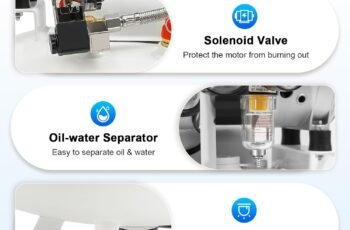
Oil lubrication helps control operating temperature and wear, while the large automotive-style air filter supports efficient intake. Finned discharge tubing moves heat away from the pump during operation.
We can check oil through the sight glass and use the convenient oil drain for changes. A tank drain valve releases accumulated moisture.
The roll-cage handle protects key components and gives us a secure grip for moving the 77-pound unit between work areas. These Maintenance Features simplify routine care.
Pros and Cons
We’ll weigh the MAC2400’s 4.2 CFM output, durable cast-iron pump, and 79 dB operating noise against its 77-pound weight and oil-maintenance requirements.
These trade-offs affect portability, upkeep, and suitability for different job-site tasks. Let’s examine the main pros and cons.
Pros
Although the MAC2400 weighs 77 pounds, its roll-cage handle makes it manageable to move around a job site, while the cast-iron pump and 2.5 HP motor deliver durable, high-output performance. Its Big Bore design supplies 4.2 CFM at 90 PSI, supporting framing and other demanding pneumatic tasks.
We can also run two nailers from the 4.2-gallon twin-stack tank. The oil-lubricated pump operates at 1,730 RPM, helping reduce wear and extend service life. At 79 dB, its low noise supports more comfortable operation. Low amp draw, effective heat dissipation, and accessible maintenance features further strengthen Jobsite reliability during sustained use.
Cons
Despite its strong output, the MAC2400 has trade-offs: at 77 pounds, it is heavy to lift or carry, and its 4.2-gallon tank limits runtime for air-hungry tools such as sanders or spray guns.
| Drawback | Practical impact |
|---|---|
| Heavy unit | Moving it between locations takes effort. |
| Limited capacity | Frequent recovery may interrupt sustained tool use. |
We’ll also need to account for Oil maintenance: the lubricated pump requires regular oil checks and changes, unlike an oil-free model. Its 79 dB operating noise may still bother users in enclosed spaces, despite being quieter than many compressors. The compact twin-stack design saves floor space, but doesn’t offset the weight when portability matters. For framing or two nailers, these limitations may be less significant.
Concluding thoughts
For demanding nailing, framing, and light industrial work, the Makita MAC2400 combines a durable cast-iron pump with useful output: 4.2 CFM at 90 PSI and a 130 PSI maximum. Its 4.2-gallon twin-stack tank can support two nailers, while the low-speed, oil-lubricated pump runs at 79 dB and is built for extended service.
We’d recommend it to ideal users who prioritize job-site durability, steady recovery, and manageable noise over minimal weight; at 77 pounds, it isn’t effortless to move. Regular oil and drain maintenance remains necessary.
For buyers needing reliable output and repairable construction, the MAC2400 offers credible long term value and a one-year warranty.
Frequently Asked Questions
What Tools Can the Makita MAC2400 Power?
We can power framing and finish nailers, plus other compatible pneumatic tools for light industrial tasks. Pneumatic nailer compatibility includes running two nailers simultaneously; air tool runtime depends on each tool’s airflow demand and duty cycle.
Does the MAC2400 Require a Dedicated Electrical Circuit?
The MAC2400 doesn’t necessarily need a dedicated circuit; check your outlet’s rating and other loads first. For Electrical circuit requirements, we should consider startup amperage considerations: its low-amp draw helps, but startup may trip shared circuits.
What Oil Should I Use in the MAC2400?
We recommend Makita air-compressor oil; check your manual for the specified Oil type and oil capacity, since requirements can vary by model or conditions. Like a knight’s trusty steed, proper lubrication protects the pump and supports reliable operation.
How Often Should I Drain the Compressor’s Tanks?
Drain both tanks after every use, and more often during humid conditions or extended operation. For Tank Drain Frequency, we recommend draining daily; this supports Moisture Prevention and helps limit internal corrosion. We can drain through the tank valve.
Is the MAC2400 Suitable for Outdoor Use?
Yes, we can use the MAC2400 outdoors for suitable job-site tasks, but it isn’t described as weatherproof. Provide a Weather resistant setup, keep it dry, and consider its 79 dB outdoor noise level before operating.
Conclusion
The Makita MAC2400 suits us when durability and steady airflow matter more than portability. Its cast-iron, oil-lubricated Big Bore pump delivers 4.2 CFM at 90 PSI, enough to run framing nailers or support two nailers on a small crew. For example, we could frame a shed without frequent pressure interruptions, but wouldn’t choose it for continuous sanding. We should also plan for oil maintenance and lifting its 77-pound frame. Overall, it’s a capable job-site compressor with clear limits.