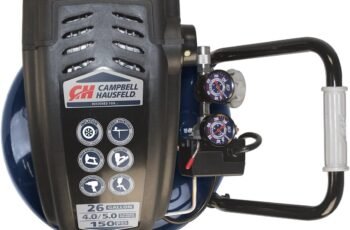
Introduction — who should read this and our quick take on the Pulsar Portable Air Compressor
Problem: you want a small, portable compressor for light garage tasks but don’t want to pay for a big pancake tank. The Pulsar Portable Air Compressor answers that need with a compact footprint and an easy-to-carry frame.
We examined this unit to give you a practical buy-or-skip judgment by the end of the review. We’ll focus strictly on home, hobby, and light shop uses — no exhaustive industrial comparisons here.
Who should read this: homeowners who inflate tires and sports gear, hobbyist woodworkers who use brad or finish nailers intermittently, and apartment dwellers who need a small but capable inflator.
Pulsar Portable Air Compressor — Product overview: what this unit is
Snapshot: this is a compact horizontal 2-gallon metal tank compressor in white, sold used and listed as-is. The package is minimalist but ready to use.
Key physical details: the unit’s dimensions are 18.00 x 9.00 x 16.00 inches and it weighs 19.00 pounds.
Package contents: the listing includes the compressor, a hose, and six accessories. The model number is PCE6021K.
Serviceability note: the manufacturer describes a fully sealed self-lubricating pump; we’ll explain the practical implications and maintenance expectations later in the review.
Pulsar Portable Air Compressor — Key features deep-dive (technical heart of the review)
Below we break the technical details into focused subsections so you can act on each feature: Tank & Pressure, Performance & Flow, Motor/Pump & Maintenance, Portability & Build, and Accessories. For every subsection we list measurable data and give practical takeaways.
We promise clear, actionable steps at the end of each subsection so you know what to test and what to expect when the unit arrives.
Pulsar Portable Air Compressor: Tank and pressure characteristics
Core numbers: the tank capacity is 2 gallons and the maximum rated pressure is 100 PSI. The seller-provided flow specs are 1.5 CFM at PSI and 0.70 CFM at PSI.
Those flow numbers tell you which jobs the unit can do without long waits. At PSI the unit delivers the kind of airflow suited to quick topping and many inflation tasks; at PSI the available flow drops significantly and the motor will run more frequently for higher-demand jobs.
Examples and expected performance:
- Inflating a car tire (30–35 PSI target): expect rapid pressure gain using short bursts; typical cycle pattern is a few minutes total with reachable pressure in under 3–5 minutes depending on starting pressure.
- Brad nailer for trim: usable for intermittent nailing — expect the motor to cycle between shots for small batches of nails rather than continuous firing.
- Quick topping of sports balls and rafts: straightforward and fast; the accessory nozzles included are designed for these jobs.
How to use the dual gauges (step-by-step):
- Power on the compressor and let it reach cut-out pressure near PSI.
- Read the tank gauge to confirm the maximum pressure and the regulated gauge for working pressure.
- Adjust the regulator knob to your target (e.g., PSI for car tires) while watching the regulated gauge.
- Connect the hose and perform a test inflate; if the regulator drifts, re-adjust before proceeding.
Motor, pump design and maintenance
Motor spec and design claim: the motor is rated at 1/3 HP, and the pump is described by the manufacturer as a fully sealed, self-lubricating system.
In practice that means you should not need daily oil checks or routine oil changes; the sealed design reduces maintenance but not zero inspections.
Five-step maintenance checklist for a used, sold-as-is unit:
- Drain the tank: attach a hose if needed and open the drain valve until clear. Do this after the first use to remove transit condensate.
- Inspect fittings and hoses: check threads and quick-connects for cracks or hardening; tighten or replace as needed.
- Check the motor mount and vibration: run the compressor briefly and watch for excessive movement.
- Look for oil or unusual deposits: even on sealed units check for residue at seals and fittings.
- Verify safety relief valve operation: pull the ring (with the compressor depressurized) to confirm it moves freely.
When to stop using a used compressor: visible tank rust, oil leaks (or residue at seals), or excessive vibration are red flags. On arrival perform a short inspection: visually scan the tank for corrosion, run the motor for a minute to listen for odd noises, and check the gauges for stable readings.

Portability, noise and build quality
Portability features: horizontal layout with a built-in carrying handle and a light metal construction make the unit genuinely portable. At 19.00 pounds two average adults can lift and position it easily; one reasonably fit adult can carry it for short distances.
Noise guidance: compact horizontal 2-gallon compressors typically produce higher perceived noise than small cordless inflators and lack the muffling of larger pancake tanks. Expect noticeable motor noise during run cycles; using the unit in a garage with the door open will reduce perceived loudness.
Three practical ways to reduce noise:
- Place the compressor on a rubber mat or anti-vibration pad to reduce transmitted noise.
- Run the unit on a firm, level surface and keep loose objects away from the motor area to avoid rattles.
- Work at times when household members are away if noise could be a problem; short, intermittent jobs reduce total noise exposure.
Packing and storage checklist:
- Secure fittings and coil the included hose neatly.
- Store the unit upright on a stable shelving surface or on the floor to avoid falls.
- Keep in a dry area; aim for moderate temperatures to extend seal and hose life.
Included hose, accessories, and real-world utility
What’s in the kit: the listing includes the compressor, an air hose, and six accessories. Typical accessories in similar kits are a tire chuck, a needle valve for sports balls, tapered nozzle for inflatables, and a handful of adaptors for different nozzles.
How each accessory maps to tasks:
- Tire chuck: car and bike tires.
- Needle valve: balls and small sports equipment.
- Tapered nozzle: pool floats and small inflatables.
Step-by-step setup and leak test:
- Attach the hose to the compressor’s outlet and hand-tighten the coupling.
- Select the accessory and thread or push it onto the hose end per the accessory type.
- Power the compressor and let it reach cut-out pressure, then attach the accessory to the target (tire valve, ball, etc.).
- Check for leaks by applying a soapy water solution to connections and watching for bubbles.
Low-cost accessories to expand functionality:
- Longer 25–50 ft hose: increases reach and reduces the need to move the compressor during jobs.
- Quick-connect coupler set: makes swapping tools and accessories faster and reduces wear on threaded fittings.
Both items are inexpensive and materially improve usability: the longer hose improves mobility and the quick-connect speeds tool changes and reduces the chance of cross-threading.
What Customers Are Saying — Pulsar Portable Air Compressor review patterns
We synthesized reviewer themes to give a realistic expectation of ownership. Below are recurring patterns we pulled from buyer feedback and what to do about them.
- Portability and usefulness: verified buyers report that the unit is genuinely portable and convenient for quick jobs; many praise the included hose and accessories for immediate use.
- Condition concerns with used listings: customer reviews indicate cosmetic wear and scuffs are common since this listing is sold used-as-is; buyers advise close inspection on arrival.
- Performance matches seller specs: some shoppers note that the compressor’s short-burst performance roughly tracks the stated flow numbers for light tasks, though heavy continuous use is limited.
- Motor start/stop complaints: a few reviewers mention frequent motor cycling during higher-pressure tasks; that behavior is consistent with a small tank and modest CFM.
What to test first on arrival (actionable):
- Visually inspect the tank for dents or corrosion.
- Run a 5-minute pump test to listen for odd noises and to observe cycling behavior.
- Perform a leak test with soapy water on all fittings and joints.
Six-step troubleshooting starter:
- Confirm power source and fuse/circuit integrity.
- Drain the tank to remove condensation and re-test pressure build time.
- Check quick-connects and threaded fittings for tightness.
- Inspect air filter areas for blockage (if accessible).
- Test the safety relief valve for movement.
- If motor stalls or hums, stop and document symptoms for seller or technician.
Comparisons: how the Pulsar Portable Air Compressor stacks up
We compared this compact Pulsar unit to two common alternatives: the CRAFTSMAN Gallon Portable Air Compressor and the Metabo HPT Portable Pancake Air Compressor. Below are the direct axes and a short decision checklist.
Comparison axes (three points each):
- Tank size & orientation: Pulsar = 2-gallon horizontal; CRAFTSMAN = 2-gallon (often vertical or small footprint); Metabo HPT = typically 6-gallon pancake (larger capacity).
- Max PSI & CFM: Pulsar max PSI with modest flows for short bursts; CRAFTSMAN 2-gallon variants often advertise up to PSI and similar CFM figures; Metabo HPT pancake models advertise higher sustained CFM suitable for multiple finish tools.
- Price/value: Pulsar here is sold used which makes it cheaper upfront but carries condition risk; the CRAFTSMAN and Metabo HPT new units cost more but typically include warranties and higher sustained performance.
Strengths and weaknesses:
- Pulsar strength: lighter and highly portable; weakness: lower sustained CFM and sold used.
- CRAFTSMAN strength: known brand, slightly higher max PSI; weakness: similar limited CFM on small tanks.
- Metabo HPT strength: larger tank and higher CFM for continuous tool use; weakness: heavier and pricier.
Actionable buying checklist — when to pick what:
- Choose the Pulsar if portability and a low upfront price for occasional tasks are top priorities.
- Choose the CRAFTSMAN Gallon if you want a small new unit from a widely known brand for similar light-duty jobs.
- Choose a Metabo HPT pancake if you need sustained CFM for repeated finish nailing or small spray work.
Who this is for — buyer profiles and use cases
We mapped three common buyer profiles and what to expect from the Pulsar Portable Air Compressor in each case.
- Casual car owner (tire inflation & emergency use):
Tasks: inflating car and bike tires, filling spare tire, topping off at-home inflations. Expect quick fills from low pressure and short wait times between motor cycles. Recommendation: good fit — one-line: buy if you want portability for occasional tire care.
- Hobbyist woodworker (brad/finish nailers):
Tasks: intermittent brad nailing and small trim work; expect motor cycles between short bursts of nailing and suitable performance for finishing runs under nails. Limitation: not ideal for long continuous nailing sessions. Recommendation: acceptable for small projects; get a larger compressor for heavy production work.
- Apartment dweller needing a compact inflator:
Tasks: sports gear, small inflatables, bike tires. Expect straightforward use but plan for noise management. Recommendation: buy if storage and portability are critical and occasional noise is tolerable.
Prerequisites before buying used:
- Have a dry storage spot and a safe outlet near where you’ll run the compressor.
- Plan to buy any additional hose length or quick-connects you may need.
- On first power-up, perform the quick inspection and leak test outlined earlier.
Practical buying and first-use checklist
Follow this 10-point checklist when the unit arrives to reduce surprises and preserve return options.
- Photograph the seller’s packaging and the unit from multiple angles before unboxing.
- Inspect the tank for dents, rust, or welding flaws.
- Check the power cord for frays and the plug for damage.
- Attach the hose and hand-tighten all fittings; confirm threads are intact.
- Drain the tank to clear shipping condensation.
- Run a five-minute motor test while watching for odd noises or smoke.
- Perform a leak test using a soapy water solution at all fittings.
- Verify both pressure gauges move and the regulator adjusts the working pressure.
- Record a short video of the motor running and the gauges showing cut-in/cut-out pressure.
- Keep all photos and videos for return or seller claim evidence.
Three quick tests to run in the first minutes:
- Pressure build time: time how long it takes to reach cut-out pressure; unusually slow fill indicates an issue.
- Motor duty cycle observation: note how long the motor runs vs. rests under a light load — frequent short cycles are normal for small tanks.
- Accessory fit test: attach each included nozzle and perform the leak test; a sloppy fit is grounds to request a return.
Return/refund considerations for used-as-is listings: document defects immediately with time-stamped photos and videos showing the issue, the unit’s condition, and serial/model labeling. Reach out to the seller with that evidence and reference the seller’s stated return policy.
How to get the most from a Pulsar Portable Air Compressor
We suggest practical tips to extend the unit’s usefulness and get consistent results.
- Match tasks to PSI/CFM: use the compressor for short bursts and intermittent tool use rather than sustained heavy-duty work.
- Conserve tank pressure: set the regulator only as high as needed for the task to reduce motor runtime.
- Use a pressure regulator and gauge for consistent results: fine-tune the regulated outlet for finish work.
- Proper hose routing: minimize kinks and avoid coiling the hose while in use to maximize flow and reduce wear.
- Recommended accessories: a longer hose and quick-connect couplers speed workflow and reduce connector wear.
- Storage advice: drain the tank before long-term storage and keep the unit in a dry, temperate spot.
Example — Inflating a car tire from to PSI:
- Set the regulator to PSI and attach the tire chuck.
- Run the pump until the regulated gauge reaches PSI, watching for the motor to cycle off at cut-out; expect short motor cycles as pressure builds.
- If the gauge overshoots, bleed pressure slightly and re-check; typical total time is a few minutes depending on starting pressure.
Example — Running a brad nailer for small trim work:
- Set the regulator to the nailer’s recommended working pressure and test-fire a couple of nails into scrap.
- Expect the motor to cycle between small bursts of nails; limit continuous runs and allow the tank to recover to minimize lag.
- To reduce lag, stagger firing and keep the nailer’s inlet plumbing short and straight.
Safety reminders:
- Avoid overpressurization; never bypass safety valves.
- Stop use and inspect immediately if you see tank discoloration or hear abnormal clanks.
- Use eye and hearing protection around pressurized fittings and during prolonged running.
How to decide: quick checklist for the final call
Here are five quick decision bullets to synthesize what we covered:
- Primary task: choose this Pulsar unit if tasks are short bursts (inflation, brief brad-nailer use).
- Mobility needs: choose Pulsar if portability is a top priority; it’s light and easy to stow.
- Tolerance for used-condition risk: buy only if you accept sold-as-is uncertainty and will run arrival checks.
- Budget limit: the unit is available at $114, attractive if that beats comparable new small units.
- Higher CFM needed?: if you require sustained CFM for long nailing or spraying, opt for a larger pancake tank instead.
Next step: buy this used unit if portability at $114 is your top priority; consider a new 6-gallon pancake compressor if sustained CFM and low-risk ownership are must-haves.
Pros and Cons
Pros
- Truly portable 2-gallon horizontal metal tank with carrying handle — easy to move and store
- Useful kit out of the box: compressor, hose and six accessories for inflation and basic workshop tasks
- Fully sealed, self-lubricating pump design reduces day-to-day maintenance
Cons
- Lower sustained CFM compared with 6-gallon pancake compressors — limits continuous tool use
- Sold used, listed as-is — cosmetic wear and unknown service history increase risk
- Motor duty cycle and noise level are typical of compact horizontal units and may bother apartment residents
Final Verdict
Key Takeaways
- The Pulsar Portable Air Compressor is a genuinely portable 2-gallon horizontal unit suited to light, intermittent tasks.
- Expect short bursts of useful airflow (1.5 CFM @ PSI; 0.70 CFM @ PSI) — not sustained heavy-duty use.
Frequently Asked Questions
What is the best-rated portable electric air compressor?
There isn’t a single universal “best” — top-rated models vary by task. For small shop and garage tasks a compact unit like the Pulsar Portable Air Compressor is popular for portability, while professionals often prefer 6–20 gallon pancake or tank compressors for sustained CFM.
What is the best air compressor on Amazon?
“Best” depends on the job. For everyday garage tasks look for reliable oil-free pumps and the CFM needed for your tools; name-brand options frequently recommended include Craftsman and Metabo HPT for higher CFM, while compact units such as the Pulsar Portable Air Compressor suit light-duty needs.
What’s the best air compressor for the money?
For most hobbyists and casual car owners, the best value balances price, portability, and the CFM required for your tools. If you only inflate tires and run brad nailers occasionally, a compact 2-gallon unit often offers the best bang for the buck.
Who has the best deal on air compressors?
Deals change frequently by seller, but shop comparison points are price versus CFM/PSI and warranty. Look for seasonal discounts and compare the total cost including any additional hoses or quick-connect couplers you’ll need.