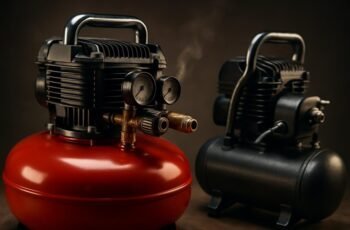
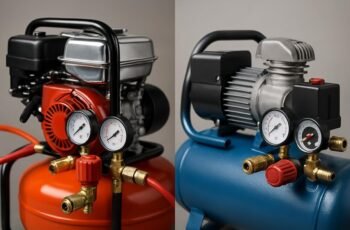
When evaluating high pressure air compressors against standard models, we recognize that each serves distinct operational needs based on design, pressure capacity, and application scope. Understanding these differences is essential for making an informed choice aligned with specific industrial or maintenance requirements. As we compare their functionalities, costs, and long-term performance, it becomes clear that selecting the right type can considerably impact efficiency and operational success—yet, the decision is more nuanced than it initially appears.
Key Takeaways
- High pressure compressors exceed 300 psi, suitable for specialized industrial and scientific applications; standard compressors operate at 100-150 psi for general use.
- High pressure units typically use multi-stage compression with intercooling, while standard compressors generally employ single-stage compression.
- High pressure compressors are more complex, noisy, and require rigorous maintenance; standard compressors are simpler, quieter, and easier to maintain.
- Initial costs for high pressure compressors are higher, but they can offer long-term energy savings; standard units are more affordable upfront.
- Choose based on application pressure needs, operational environment, noise considerations, and maintenance capacity.
What Are High Pressure and Standard Air Compressors?
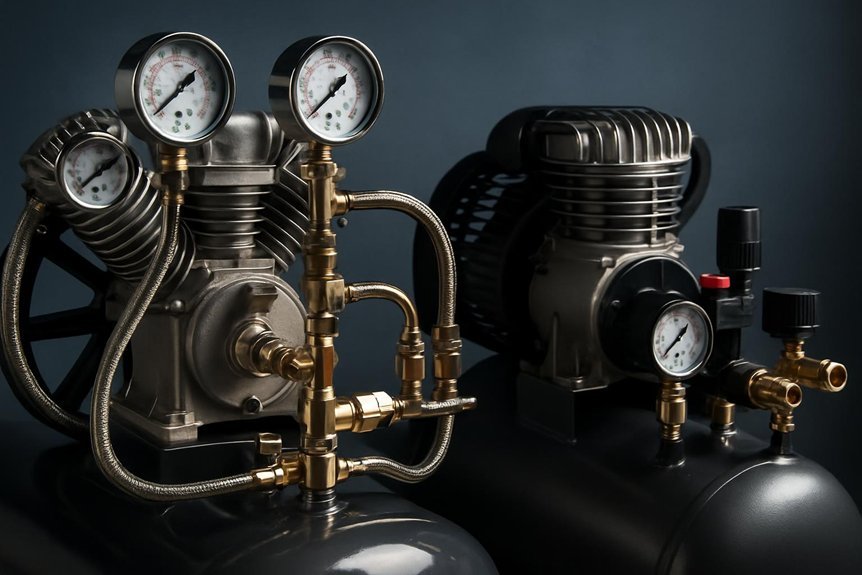
While both high pressure and standard air compressors serve the fundamental purpose of converting power into compressed air, they differ markedly in design, capacity, and application. High pressure compressors are engineered to generate greater pressure levels, often exceeding 300 psi, making them suitable for specialized industrial tasks. Standard compressors typically operate within 100-150 psi, catering to general manufacturing and maintenance needs. When evaluating these units, energy efficiency is critical; high pressure models often consume more power due to increased compression demands. Noise levels also vary considerably, with high pressure units tending to produce higher noise emissions because of their robust components and operating pressures. Understanding these distinctions helps determine the most appropriate compressor based on specific operational requirements and environmental considerations.
How Do High Pressure and Standard Compressors Differ in Design and Functionality?
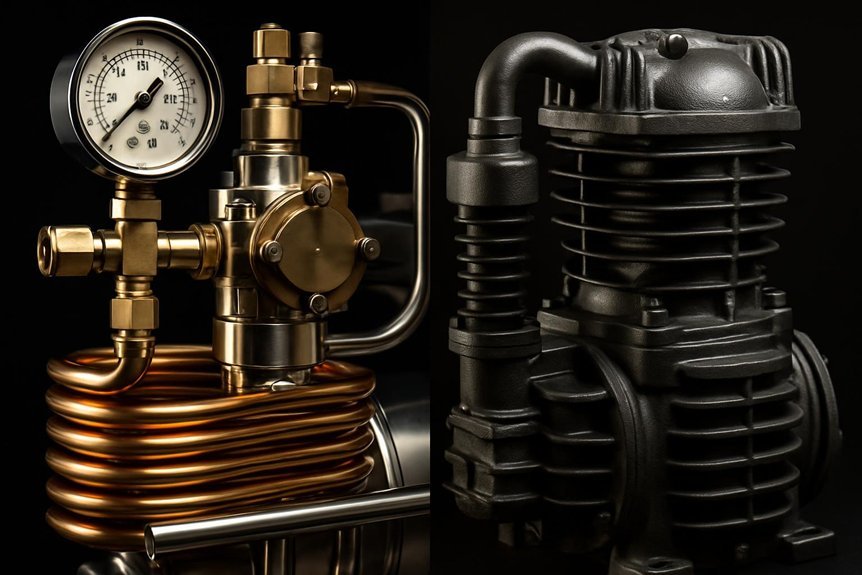
High pressure and standard compressors differ primarily in their compression mechanisms, with high-pressure units often utilizing multi-stage setups to achieve greater output. These design distinctions result in notable variations in pressure capabilities and flow rates, impacting their suitability for specific applications. Understanding these differences is essential for selecting the appropriate compressor for targeted performance requirements.
Compression Mechanism Differences
The core difference between high pressure and standard compressors lies in their compression mechanisms, which are optimized for distinct operational demands. High pressure models utilize multi-stage compression with intercooling to achieve higher pressure ratios efficiently, whereas standard compressors typically employ single-stage processes. This difference impacts compressor lubrication, as high-pressure units require advanced, high-temperature resistant lubricants to guarantee smooth operation under increased stress. Additionally, the compression mechanism influences noise levels; high pressure compressors often generate more noise due to their complex, multi-stage design and higher operating pressures. Key distinctions include:
- Multi-stage compression vs. single-stage
- Intercoolers for temperature control
- Enhanced lubrication requirements
- Increased mechanical complexity
- Variations in noise generation
These differences fundamentally shape performance, maintenance, and operational suitability.
Pressure and Flow Variations
How do pressure and flow characteristics fundamentally distinguish high pressure compressors from standard models? High pressure compressors are designed for elevated output pressures, which substantially impacts flow regulation and system stability. They typically operate at higher energy efficiency levels by optimizing compression cycles to reduce energy loss, despite increased mechanical stresses. Conversely, standard compressors deliver moderate airflow with lower pressure outputs, emphasizing consistent flow rather than maximum pressure. This often results in quieter operation due to lower mechanical strain, translating into reduced noise levels. The design variations directly influence the compressor’s ability to handle fluctuating demands; high pressure units maintain precise pressure and flow control under demanding conditions, while standard models prioritize steady, lower-pressure airflow. These differences are vital for selecting the appropriate compressor based on application-specific requirements for efficiency, noise, and performance.
Which Applications Are Best Suited for High Pressure Compressors?
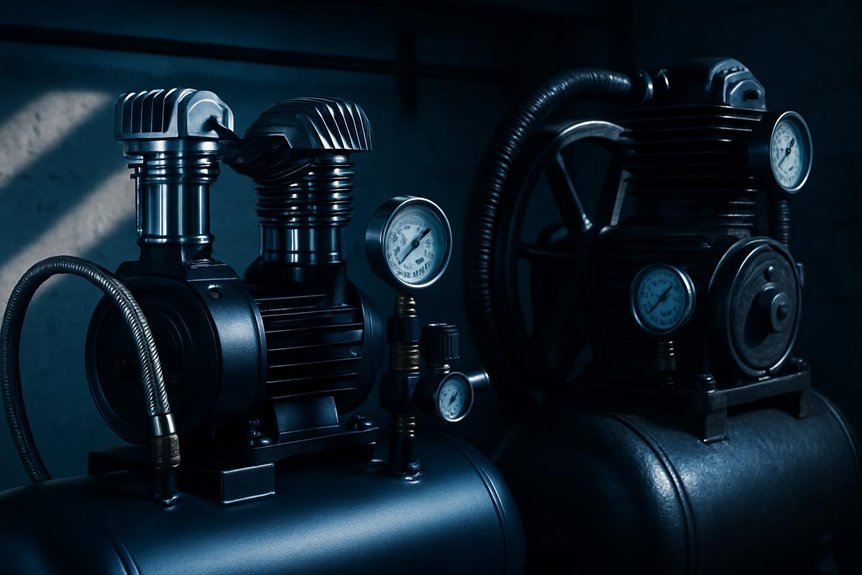
High pressure compressors are essential in applications requiring precise, high-intensity airflow. They excel in industrial manufacturing, high-pressure welding, and scientific research, where specific pressure thresholds are critical. Understanding these applications helps optimize equipment selection for efficiency and safety.
Industrial Manufacturing Processes
Which industrial manufacturing processes benefit most from high pressure compressors? These compressors excel in applications requiring precise, high-energy input, where energy efficiency directly impacts operational costs. They are ideal for processes such as:
- Petrochemical refining, where high-pressure air enhances reaction control
- Metal fabrication, for powering pneumatic tools with consistent force
- Glass manufacturing, aiding in forming and shaping processes
- Chemical processing, enabling efficient transfer of gases at elevated pressures
- Packaging industries, for high-pressure inflation and sealing tasks
High pressure compressors are preferred when managing noise levels is critical, as they often operate more quietly than standard models. Their ability to deliver consistent, high-energy output with optimized energy efficiency makes them indispensable in demanding industrial environments.
High-Pressure Welding Tasks
In welding applications demanding substantial pressure and consistent gas flow, high-pressure compressors prove to be particularly advantageous. They enable efficient compressed air storage, ensuring a steady supply critical for precision welding tasks. These compressors handle higher pressure levels, reducing the need for multiple units and minimizing system complexity. This not only streamlines operations but also improves energy efficiency. From an environmental perspective, high-pressure systems can lower overall energy consumption and reduce emissions, aligning with sustainable practices. Their ability to deliver reliable, high-pressure air makes them ideal for demanding welding environments, especially where continuous operation and minimal downtime are essential. Ultimately, high-pressure compressors optimize performance while mitigating environmental impact, making them a strategic choice for advanced welding applications.
Scientific and Laboratory Use
Scientific and laboratory applications often require precise control of gas pressures and flow rates, making high-pressure compressors essential for many experiments and testing procedures. They enable accurate calibration and delivery of gases, critical for sensitive measurements. When selecting equipment, considerations include maintaining ideal air quality and minimizing noise levels to guarantee experimental integrity. High-pressure compressors excel in applications such as spectrometry, gas chromatography, and material testing due to their ability to generate stable, high-pressure outputs. They also support laboratory processes that demand consistent gas flow at elevated pressures. Additionally, their design often incorporates features to reduce noise, preserving a controlled environment. Overall, high-pressure compressors are best suited for advanced scientific applications where precision, air quality, and noise control are paramount.
When Should You Choose a Standard Compressor for Your Needs?
Determining the appropriate compressor type depends heavily on your specific application requirements. A standard compressor is suitable when energy efficiency is a priority, especially in continuous or long-duration operations, since it generally consumes less power for moderate pressures. Additionally, if noise levels are a concern—such as in indoor environments or noise-sensitive settings—a standard compressor often produces lower sound emissions, making it preferable. These compressors excel in tasks that do not demand ultra-high pressures but require reliable, consistent airflow. They are also more straightforward to maintain and operate, reducing operational costs. To sum up, choose a standard compressor when your application involves moderate pressure needs, emphasizes energy efficiency, and demands quieter operation for ideal productivity.
Key Factors to Consider When Comparing Both Types of Compressors
When comparing high-pressure air compressors and standard compressors, it’s essential to evaluate several key factors to determine which best suits your specific needs. Critical considerations include energy efficiency, noise levels, maintenance demands, operational lifespan, and system footprint.
- Energy efficiency: Assess how each compressor converts electrical input into compressed air, impacting operational costs.
- Noise levels: Consider decibel ratings, especially in noise-sensitive environments.
- Maintenance requirements: Evaluate ease of servicing and component durability to minimize downtime.
- Operational lifespan: Determine longevity under continuous use for long-term investment decisions.
- System footprint: Analyze space requirements, especially where facility constraints exist.
Focusing on these factors ensures an informed choice that balances performance, operational costs, and environmental impact.
Cost Differences Between High Pressure and Standard Compressors
Cost considerations are a significant factor when choosing between high-pressure and standard compressors, as initial investment and ongoing expenses can vary markedly. High-pressure units typically entail higher upfront costs due to advanced materials and specialized components. Conversely, standard compressors usually have lower initial prices but may incur higher energy costs over time due to lower energy efficiency, especially under heavy usage. Noise levels also influence operational costs, as quieter models often require additional soundproofing or specialized enclosures, increasing expenses. The table below summarizes key cost factors:
| Aspect | High-Pressure Compressor | Standard Compressor |
|---|---|---|
| Initial Investment | Higher | Lower |
| Energy Efficiency | Generally higher | Typically lower |
| Noise Levels | Can be higher or lower | Usually standard |
| Operating Expenses | Potentially lower over time | Usually higher over time |
Maintenance and Operational Considerations for Each Compressor Type
Maintenance and operational considerations considerably impact the long-term performance and reliability of both high-pressure and standard compressors. For ideal energy efficiency, regular inspections of components like valves, seals, and cooling systems are essential. Addressing wear and tear promptly minimizes downtime and maintains efficiency. Noise levels require monitoring, especially in environments where noise pollution is a concern, with soundproofing or vibration dampers as potential solutions. High-pressure compressors often demand more rigorous maintenance due to their complex systems and higher operating stresses. Conversely, standard compressors typically have simpler maintenance routines. Key considerations include:
Regular maintenance and monitoring are essential for compressor efficiency and longevity.
- Routine lubrication and filter replacement
- Monitoring for pressure and temperature fluctuations
- Ensuring proper cooling to prevent overheating
- Managing noise levels through sound attenuation methods
- Regular calibration for energy efficiency
Pros and Cons of Using a High Pressure Air Compressor
High-pressure air compressors offer distinct advantages in applications requiring elevated airflow pressures, such as industrial manufacturing, gas transfer, and specialized instrumentation. They typically provide higher energy efficiency at their operational pressure range, reducing overall power consumption compared to standard compressors when handling specific tasks. However, their design often results in increased noise levels, which can pose challenges in noise-sensitive environments. The higher pressure output necessitates robust construction, contributing to more complex maintenance and potential operational costs. While they excel in delivering concentrated performance under demanding conditions, users must weigh the benefits of energy savings against the drawbacks of elevated noise and maintenance requirements. Ultimately, their suitability hinges on application-specific needs and environmental constraints.
Pros and Cons of Opting for a Standard Air Compressor
Standard air compressors are widely favored for their versatility and reliability across various applications. They typically offer balanced energy efficiency and manageable noise levels, making them suitable for many industrial and workshop settings. However, their performance may be limited in high-demand scenarios, and they often consume more energy compared to specialized high-pressure units. Additionally, noise levels, while moderate, can still be disruptive in noise-sensitive environments.
Key considerations include:
- Good overall energy efficiency for moderate use
- Lower initial cost compared to high-pressure models
- Moderate noise levels suitable for many workplaces
- Limited capacity for high-pressure applications
- Potentially higher operational costs over time due to energy consumption
Choosing a standard compressor depends on balancing these factors with your specific needs.
Frequently Asked Questions
What Safety Precautions Are Necessary When Operating High Pressure Compressors?
When operating high pressure compressors, we prioritize safety gear like protective eyewear and gloves to mitigate pressure hazards. We also guarantee proper training, regular inspections, and adherence to safety protocols to prevent accidents and equipment failures.
How Does Energy Efficiency Compare Between High Pressure and Standard Compressors?
We find that high-pressure compressors often utilize power more efficiently in specific applications, reducing overall energy consumption. While they may demand more initial energy, their tailored design enhances power efficiency, making them advantageous for targeted, high-demand tasks.
Are There Environmental Impacts Associated With Each Type of Compressor?
We find that high pressure compressors often produce higher environmental emissions due to increased energy use, whereas standard compressors tend to have fewer emissions; recycling considerations also vary, influencing overall environmental impact and sustainability strategies.
Can High Pressure Compressors Be Used for Continuous Operation?
We believe high pressure compressors can operate continuously if pressure regulation is properly maintained and maintenance requirements are diligently followed, ensuring system reliability, safety, and efficiency during extended operation without risking damage or performance decline.
What Are the Noise Level Differences Between High Pressure and Standard Compressors?
We find high pressure compressors typically generate more noise, requiring advanced sound insulation and noise reduction measures for operational safety and comfort, whereas standard compressors often operate quieter due to simpler designs and lower pressure outputs.
Conclusion
In evaluating high pressure versus standard compressors, it’s clear that the choice hinges on specific application requirements and operational constraints. While high pressure units excel in precision and demanding tasks, standard compressors offer versatility and cost-efficiency for everyday use. Our analysis suggests that understanding the technical distinctions and maintenance needs helps optimize performance and lifespan, ultimately supporting informed decision-making. By matching compressor capabilities with your operational demands, you can guarantee reliability and efficiency in your industrial processes.