Ingersoll Rand Rotary Screw Compressor: Quick Overview
This is an industrial-style stationary air compressor, not a portable garage compressor or a conventional piston unit. The Ingersoll Rand rotary screw compressor combines a 7.5 HP motor, 230-volt three-phase power, and stated CFM output, making it a serious candidate for sustained pneumatic work. It makes the most sense where compatible electrical service already exists and downtime from an undersized compressor is costly.
The product information says it usually ships within to days. Before ordering, we would confirm the current price, freight terms, installation requirements, and warranty coverage in writing. The Ingersoll Rand rotary screw compressor deserves consideration for professional workshops, tire facilities, service businesses, and small industrial operations, but its value depends heavily on the complete installed cost.
We examine the construction, controls, cooling, enclosure, installation demands, ownership feedback, competing models, and long-term economics below. The early takeaway is straightforward: this is potentially a strong production-air solution, but a poor choice for a hobbyist who lacks three-phase power or rarely uses air tools.
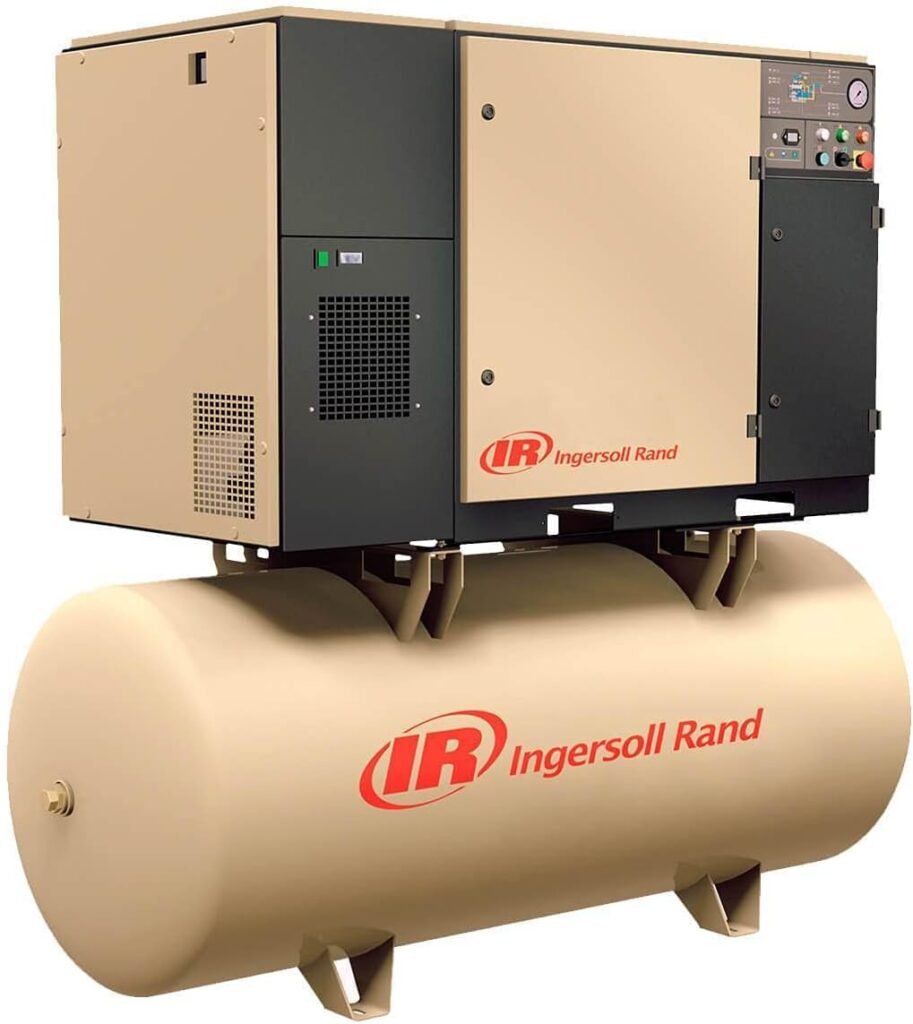

Product Specifications and What They Mean in Practice
The core specifications describe a stationary rotary screw air compressor intended for regular shop use. The Ingersoll Rand rotary screw compressor should be judged by its delivered performance at a stated pressure, not by horsepower alone.
| Specification | Listed detail |
|---|---|
| Motor | 7.5 HP ODP electric motor |
| Electrical supply | 230 volts, three-phase |
| Air delivery | 28 CFM |
| Compressor type | Rotary screw |
| Model | UP6-7.5-125 |
A stated CFM can be meaningful for several pneumatic tools, production equipment, tire service, spray work, and other applications with sustained demand. However, CFM figures are only useful when the pressure point is known. We would compare the published performance curve with the exact pressure required by each tool and with the amount of simultaneous use expected.
Three-phase power is a major practical distinction. The buyer needs an appropriate 230-volt, three-phase supply, a correctly sized circuit, suitable disconnect and protection, grounding, and installation by a qualified professional. A Ingersoll Rand rotary screw compressor cannot simply be connected to a typical household outlet, even if the nominal voltage appears familiar.
Compared with a reciprocating compressor, a rotary screw design is generally selected for smoother air delivery and frequent or continuous operation. It may offer a more controlled shop experience, while a piston compressor can cost less and may be easier to understand and service. The trade-offs include purchase price, installation planning, maintenance arrangements, and the need to verify the machine’s operating controls.
Output is not the same as receiver capacity. The supplied information does not state tank size, maximum working pressure, dimensions, weight, noise rating, or included accessories. Before purchase, we would request the complete manufacturer data sheet covering pressure-specific CFM, clearances, oil requirements, service intervals, amperage, and any receiver arrangement. Those details determine whether the Ingersoll Rand rotary screw compressor will fit the intended system.
Key Features of the Ingersoll Rand Rotary Screw Compressor
The listed equipment is more installation-ready than a bare compressor package, but it still requires technical verification. The Ingersoll Rand rotary screw compressor includes an ODP electric motor, an air-cooled aftercooler, a mounted and wired full-voltage motor starter, auto start/stop control, and a low-sound full-sheet-metal enclosure.
The 7.5 HP ODP motor provides the driving force for the screw element. We would still ask for the motor’s protection requirements, service factor, efficiency information, overload settings, and suitability for the planned operating schedule. ODP describes the motor enclosure style; it does not, by itself, prove that the motor is suitable for every dusty, damp, or hot environment.
The air-cooled aftercooler reduces discharge-air temperature. That helps moisture condense before air reaches downstream equipment, which can make filtration and drying more manageable. It does not replace a properly sized dryer, separator, drain, or filter when the application requires clean, dry air.
The full-voltage starter is listed as mounted and wired, potentially reducing the work of sourcing a separate starter enclosure and wiring its components. It does not remove the need for a qualified electrician to connect the supply, verify overload protection, check rotation, and commission the unit safely. Auto start/stop control can respond to demand within its pressure settings, reducing unnecessary manual operation, although excessive cycling would need investigation.
The low-sound, full-sheet-metal enclosure may be helpful in an indoor shop and can protect internal components from incidental contact. No decibel rating is provided, so we would not treat “low sound” as proof that the unit belongs in an office or occupied quiet room.
Before accepting delivery, we would verify pressure settings, ventilation, service access, condensate drains, oil specification, and whether the system needs a separate receiver, dryer, filter, regulator, or automatic drain. These checks will reveal whether the Ingersoll Rand rotary screw compressor is genuinely ready for the intended workflow or needs additional equipment.
Air Delivery, Cooling, and Controls for Daily Shop Use
The stated CFM output gives this machine more headroom for demanding air tools than smaller alternatives rated at 5.2 CFM or 11.8 CFM. That comparison is useful, but only if all figures are measured at comparable pressure. We would obtain the delivered-CFM figure at the pressure used by the spray gun, impact tools, grinders, or production equipment before sizing the system.
For paint spraying and machining, hot discharge air carrying condensed moisture can affect finish quality, contaminate lines, and shorten the life of downstream equipment. The aftercooler should help lower the air temperature, but the Ingersoll Rand rotary screw compressor still needs correctly sized separation and drying equipment when moisture control is critical.
Auto start/stop is convenient for variable demand because the compressor can respond to pressure changes without constant operator intervention. The trade-off is cycling: we would confirm the minimum run time, pressure range, restart requirements, and acceptable starts per hour. An application with a steady, heavy demand may need a different control strategy than one with short bursts of air use.
The enclosure may reduce perceived sound and shield the internal assembly, but ventilation openings must remain clear. A quieter cabinet still produces heat and needs service space, so it is not automatically suitable for every occupied area. In practice, the best setup combines the compressor with filtration and drying matched to the air-quality requirement rather than relying on the aftercooler alone.
For daily use, we would monitor pressure recovery, cycling frequency, discharge temperature, condensate, and air quality during the first week. That operating record will tell us more about the Ingersoll Rand rotary screw compressor than a headline CFM figure by itself.

Installation, Electrical Requirements, and Maintenance Planning
Electrical compatibility is the first checkpoint for the Ingersoll Rand rotary screw compressor. We would have an electrician confirm the available phase, 230-volt supply, circuit capacity, disconnect requirements, grounding, overload protection, and local code compliance before arranging delivery.
The mounted and wired full-voltage starter may reduce component-sourcing work, but it does not eliminate professional connection and commissioning. The installer should verify motor rotation, protection settings, startup behavior, pressure controls, and safe isolation procedures. These steps matter because an incorrect phase connection or poorly matched protection can damage equipment or create a serious hazard.
Placement also deserves planning. The unit needs level flooring, adequate airflow, clear access around the sheet-metal enclosure, and room to reach service points. A low-dust environment away from excessive heat and moisture should reduce stress on the cooling system and electrical components. We would follow the manufacturer’s clearance requirements rather than guessing from the cabinet size.
Routine maintenance will typically involve checking oil and filters, inspecting the air intake, cleaning the cooler, checking the drive system if applicable, managing condensate, looking for leaks, and confirming that controls operate correctly. We are not assigning service intervals because the listing does not provide them. The official installation and maintenance manual should specify oil type, filter requirements, inspection intervals, dimensions, weight, and clearances.
- Measure the proposed installation area and access route.
- Verify the three-phase electrical service with a qualified electrician.
- Estimate average and peak air demand, including simultaneous tools.
- Plan filtration, drying, piping, drains, and receiver capacity.
- Arrange suitable delivery and unloading equipment.
- Confirm who will commission and service the machine.
Following that sequence gives the Ingersoll Rand rotary screw compressor a better chance of performing reliably from its first operating day.
What Customers Are Saying About the UP6-7.5-125
The supplied product information does not include a star rating, review count, or quoted buyer comments. Consequently, we cannot honestly say that customers praise or criticize this particular model, and we will not present unverified ownership claims as established patterns.
When current customer reviews become available, we would record the exact rating and review count first. We would then separate repeated themes from isolated complaints, looking for useful details about delivery condition, packaging, installation, controls, sound, sustained output, cycling, reliability, service access, and replacement parts. A short comment saying “works great” provides less evidence than a detailed account describing hours of operation and pressure conditions.
Reviews discussing CFM should identify the operating pressure used. Without that context, buyers can easily compare a free-air or lower-pressure figure with a tool requirement stated at a different pressure. For this stationary machine, comments about three-phase wiring, starter setup, ventilation, oil leaks, condensate, and commissioning are more actionable than generic complaints about portability.
We would give greater weight to several independent reviews that describe the same issue under similar workloads. Mixed feedback should be interpreted cautiously: one damaged shipment may indicate a freight problem, while repeated reports of poor packaging could point to a broader concern. Unsupported claims about lifespan should not outweigh documented maintenance history.
Until a verified review record is available, the safest assessment of the Ingersoll Rand rotary screw compressor comes from its stated configuration and the buyer’s own installation plan, not invented sentiment. Before ordering, we would check the current listing for new reviews and note whether they describe the actual UP6-7.5-125 rather than a related compressor.
That approach keeps the Ingersoll Rand rotary screw compressor evaluation evidence-based while still giving future owners a clear way to judge real-world reports.
Who Should Buy This Compressor?
The best audience for the Ingersoll Rand rotary screw compressor is a professional workshop, automotive or tire facility, fabrication shop, manufacturing support area, service business, or similar operation with sustained compressed-air demand. These buyers may benefit from a stationary system designed around regular use rather than occasional bursts.
It makes less sense for a homeowner, hobbyist, mobile contractor, or small garage without 230-volt three-phase power. The purchase price and installation work can outweigh the benefit when air tools are used only briefly. A portable piston compressor may be more practical for jobsites or infrequent maintenance.
We would match the machine to the actual workload. Several air tools, frequent grinding, tire service, spray applications, or production equipment may justify investigating this capacity, but every tool should be checked for pressure and CFM requirements. Simultaneous use matters more than adding the individual maximums casually, so the final design should be reviewed by an installer.
This is a planned stationary installation. The enclosure, cooling system, electrical arrangement, and service access mean it should be integrated into the workflow rather than treated as equipment to move around a garage. Depending on the application, the project may also require a receiver tank, dryer, filters, drains, hoses, regulators, and properly sized piping.
- List every air-consuming tool and its required pressure.
- Record which tools operate at the same time.
- Add a sensible demand margin without inflating the estimate unnecessarily.
- Compare the result with the published performance curve.
- Ask an installer to validate the complete system design.
For the right professional operation, the Ingersoll Rand rotary screw compressor may provide a more suitable foundation than a small portable unit. For low-CFM hobby work, the extra complexity is difficult to justify.
How It Compares With Other Ingersoll Rand and Shop Compressors
The Ingersoll Rand rotary screw compressor competes with both piston machines and smaller portable products, so we would compare operating purpose before price. The closest Ingersoll Rand alternative in the supplied information is the 2475N7.5 two-stage compressor, listed at up to 24.3 CFM at PSI and equipped with an 80-gallon vertical tank.
The 2475N7.5 may suit a buyer who values stored air, a familiar cast-iron reciprocating design, and a conventional tank format. The rotary screw model may be more appropriate for frequent or continuous demand, but neither design is a universal winner. The relevant questions are duty cycle, pressure performance, noise, maintenance access, and the cost of keeping the operation running.
The Ingersoll Rand P1.5IU-A9-H is a smaller garage-oriented alternative with a 20-gallon horizontal tank and up to 5.2 CFM at PSI. Its lower output targets a different user. The SS3J5.5GH-WB is a mobile gas-powered option listed at 11.8 CFM at PSI, useful where electrical service is unavailable but less suitable for a permanently installed indoor shop.
Outside the brand, the NorthStar 7.5 HP compressor is listed at CFM with an 80-gallon capacity. That tank-based format may appeal to buyers who prioritize stored air, while the Ingersoll Rand rotary screw compressor calls for a more direct comparison of controls, electrical configuration, duty cycle, and service arrangements. We would not select solely on horsepower.
Before choosing, we would compare delivered CFM at the same pressure, warranty support, service network, noise information, included controls, receiver arrangement, and required accessories. Electrical configuration and total ownership cost can change the apparent bargain. A lower purchase price is not necessarily cheaper after wiring, dryers, filters, freight, and service are included.
The Ingersoll Rand rotary screw compressor is therefore best viewed as a continuous-air option, while the alternatives serve stored-air, portable, or lower-demand needs.
Before You Order: A Practical Buyer Checklist
We would use the following sequence before committing to the Ingersoll Rand rotary screw compressor. It turns an appealing headline specification into a more reliable purchase decision.
- Confirm the electrical supply. Verify the facility’s 230-volt three-phase service, circuit capacity, disconnect, grounding, and code requirements with a qualified electrician.
- Match real air demand. Compare simultaneous CFM needs and required operating pressure with the manufacturer’s performance curve, rather than relying only on the stated CFM headline.
- Request missing specifications. Ask for maximum pressure, exact dimensions, shipping weight, noise rating, receiver or tank arrangement, oil type, maintenance schedule, warranty coverage, and included accessories.
- Plan air quality equipment. Specify filters, a refrigerated or desiccant dryer, drains, regulators, and suitable piping if moisture or contamination could affect tools or finished work.
- Verify delivery and commissioning. Confirm floor loading, door access, unloading equipment, service clearance, freight appointment arrangements, and who is responsible for startup checks.
The final buying question is not simply whether CFM sounds impressive. This model deserves consideration when a professional operation needs that level of stationary rotary screw capacity and can support the electrical and installation demands. Our final choice would depend on verified pressure performance, available service support, and total installed cost.
Used carefully, the Ingersoll Rand rotary screw compressor can be a sensible long-term investment rather than an oversized purchase. If those checks reveal missing infrastructure or modest demand, a tank-based alternative may be the more responsible choice.
Pros and Cons
Pros
- Stated CFM output is suitable for investigating sustained shop-air applications.
- 7.5 HP rotary screw design is aimed at more regular operation than small portable piston compressors.
- Mounted and wired full-voltage motor starter may simplify component sourcing.
- Air-cooled aftercooler can help reduce discharge-air temperature and downstream moisture load.
- Auto start/stop control and a low-sound full-sheet-metal enclosure are useful listed features for shop installation.
Cons
- 230-volt three-phase power limits suitability for homes, garages, and facilities without compatible service.
- A separate dryer, filter, receiver, drain, regulator, or piping system may be required depending on the application.
Final Verdict
Key Takeaways
- The UP6-7.5-125 is a stationary 7.5 HP rotary screw compressor with stated CFM output and 230-volt three-phase power..
- The supplied listing omits pressure-specific CFM, maximum pressure, tank arrangement, dimensions, noise rating, service intervals, and other purchase-critical details.
- A qualified electrician and complete installation plan are essential because the mounted starter does not remove electrical commissioning requirements.
- Compare total installed cost and delivered CFM with alternatives such as the Ingersoll Rand 2475N7.5 or NorthStar 7.5 HP before ordering.
Frequently Asked Questions
Who makes the best gallon air compressors?
There is no single best manufacturer for every shop. Ingersoll Rand, NorthStar, and Quincy offer 7.5 HP, 80-gallon-class options, but buyers should compare delivered CFM at the same pressure, electrical configuration, duty cycle, warranty, service network, and total installed cost.
What is the best stationary air compressor?
The best stationary compressor depends on air demand, pressure, duty cycle, electrical service, and available space. The UP6-7.5-125 is worth considering for professional users who need sustained air and have compatible 230-volt three-phase power, while a two-stage piston model may suit buyers who prioritize a large receiver and lower initial complexity.
Is there an gallon air compressor available for sale?
Yes. The Ingersoll Rand 2475N7.5, NorthStar 7.5 HP, and other shop compressors are listed in 80-gallon configurations, while the UP6-7.5-125 product information supplied here does not state a receiver-tank capacity. Confirm current availability, freight terms, and tank details before ordering.
Are Ingersoll Rand air compressors any good?
Ingersoll Rand offers products ranging from portable piston compressors to stationary two-stage and rotary screw machines. The supplied information does not include a star rating, review count, or buyer comments for this specific model, so we would judge it by verified performance data, installation suitability, warranty support, and service availability.
Disclosure: As an Amazon Associate, I earn from qualifying purchases.