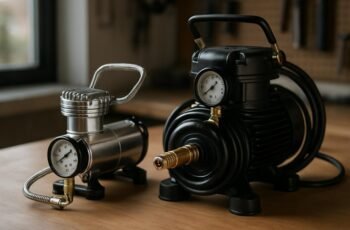
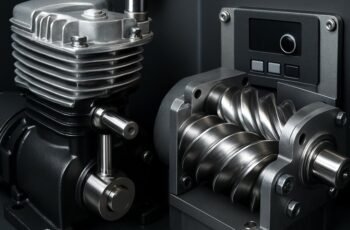
Choosing between desiccant and refrigerated dryers is like steering through a complex maze, where each path offers distinct advantages and limitations. Both systems serve vital roles in moisture control, but their suitability hinges on specific operational demands and cost considerations. As we analyze their working principles, efficiencies, and maintenance needs, you’ll find that understanding these nuances can greatly influence your decision. Let’s explore the technical intricacies that can help you determine the best fit for your application.
Key Takeaways
- Desiccant dryers provide lower dew points and are suitable for sensitive applications, while refrigerated dryers are more energy-efficient for less critical needs.
- Desiccant systems have higher initial costs and maintenance expenses but excel in environments requiring minimal residual moisture.
- Refrigerated dryers consume less energy and have simpler installation, making them cost-effective for general industrial use.
- Desiccant dryers are ideal for applications demanding dew points below -40°F, unlike refrigerated dryers which typically reach around 35-40°F.
- Environmental impacts vary: refrigerated dryers may use refrigerants, whereas desiccant dryers have higher power consumption.
How Do Desiccant and Refrigerated Dryers Work?
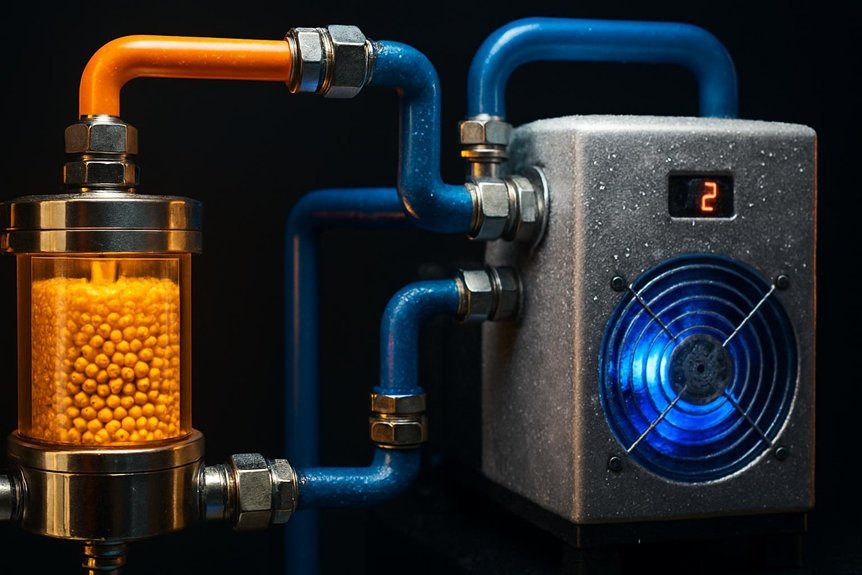
While both desiccant and refrigerated dryers are designed to remove moisture from compressed air, they do so through fundamentally different mechanisms. Desiccant dryers use a porous material that adsorbs moisture, providing extremely low dew points suitable for high-quality air applications. The process involves passing compressed air through a bed of desiccant, which captures water vapor, then periodically regenerating the desiccant with dry air or heated gas. Refrigerated dryers, on the other hand, cool the compressed air below its dew point using refrigeration cycles, condensing moisture into liquid that is then separated. Their operation emphasizes system integration, ensuring consistent air quality with minimal pressure drop. Both systems require precise control and monitoring to optimize performance, but they target different levels of moisture removal based on specific operational needs.
Comparing Cost and Energy Efficiency of Both Dryer Types
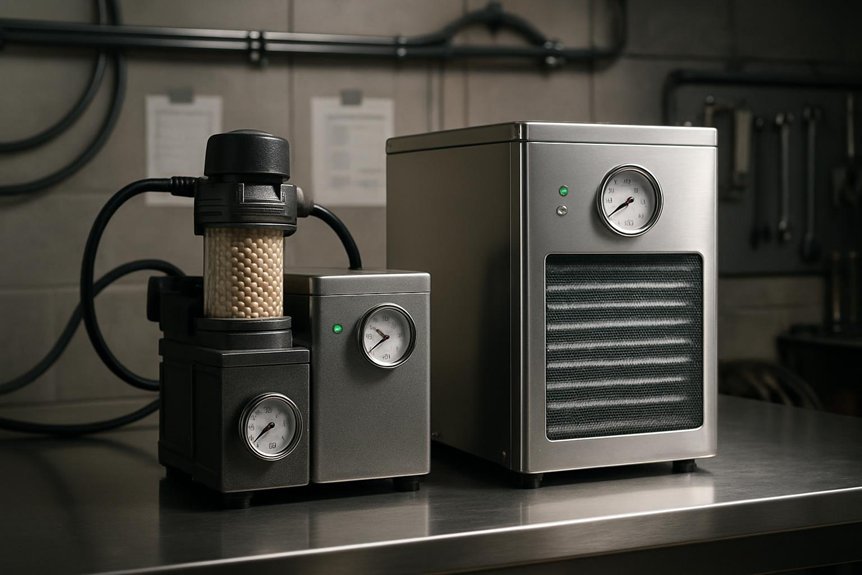
When evaluating the cost and energy efficiency of desiccant versus refrigerated dryers, it’s essential to take into account both capital investment and ongoing operational expenses. Desiccant dryers typically have higher initial costs but better energy consumption for maintaining low dew points, especially in continuous operation. Refrigerated dryers usually feature lower upfront costs and are more energy-efficient for general applications, but their efficiency drops at very low dew points. The table below summarizes key differences:
| Aspect | Desiccant Dryer | Refrigerated Dryer |
|---|---|---|
| Cost Comparison | Higher capital, maintenance | Lower upfront, lower operational |
| Energy Consumption | Higher at low dew points | More energy-efficient overall |
| Operational Expenses | Higher due to desiccant replacement | Lower, minimal replacement costs |
When Should You Choose a Desiccant Dryer Over a Refrigerated Dryer?
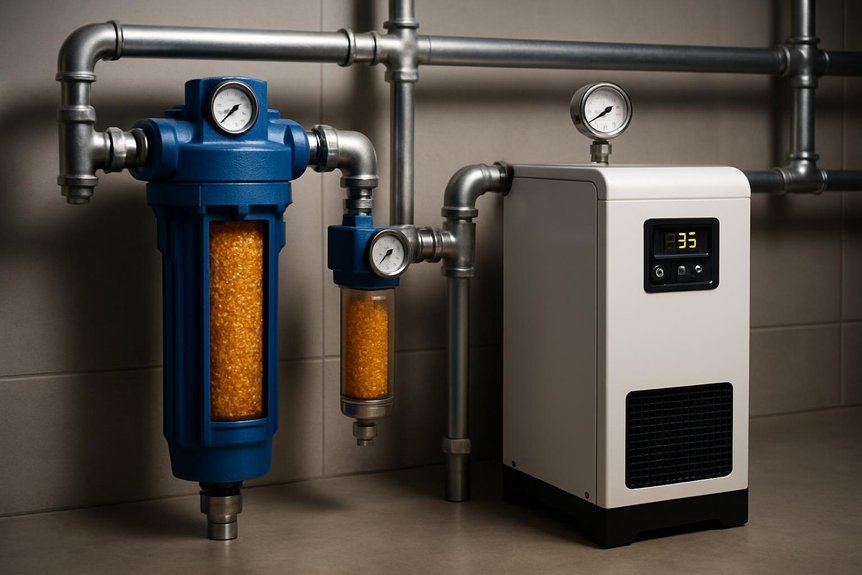
Choosing a desiccant dryer is ideal when strict dew point requirements demand removal of moisture below -40°F, especially in sensitive applications. Variability in ambient conditions can also favor desiccant systems, as they maintain consistent performance despite temperature fluctuations. Additionally, when high purity compressed air is essential, desiccant dryers ensure the necessary dryness and contaminant removal.
Dew Point Requirements
Determining whether to select a desiccant dryer over a refrigerated dryer hinges primarily on the specific dew point requirements of your application. For critical humidity control, where dew points below -40°F (-40°C) are necessary, desiccant dryers deliver superior performance through active moisture adsorption, ensuring system integrity and preventing corrosion or product spoilage. These dryers are ideal when tight dew point control is essential for system integration, especially in sensitive manufacturing processes or compressed air systems with stringent quality standards. Conversely, refrigerated dryers typically achieve dew points around 35-40°F (2-4°C), making them suitable for less demanding humidity control applications. Ultimately, choosing depends on balancing dew point specifications with operational costs and system reliability.
Ambient Conditions Variability
Variability in ambient conditions considerably influences the decision to select a desiccant dryer over a refrigerated dryer. When environmental humidity fluctuates or temperature stability is compromised, a desiccant dryer provides superior humidity control, maintaining consistent dew points regardless of external changes. Refrigerated dryers rely heavily on stable ambient temperatures to operate efficiently; fluctuations can cause condensate formation and reduce drying effectiveness. Conversely, desiccant dryers are unaffected by ambient temperature swings, ensuring reliable moisture removal even in unpredictable conditions. This makes them ideal for environments with high or variable humidity and temperature instability. Ultimately, when ambient conditions are unpredictable, choosing a desiccant dryer guarantees consistent air quality and prevents downstream issues caused by moisture variability.
Compressed Air Purity
When high levels of compressed air purity are essential for sensitive processes or quality control, a desiccant dryer often outperforms a refrigerated dryer. The key factor is its superior moisture management, guaranteeing minimal residual humidity that could compromise air quality. Desiccant dryers excel in applications requiring dew points below -40°F, preventing moisture-related issues like corrosion or microbial growth. They are ideal for industries such as pharmaceutical, food, or electronics manufacturing, where even trace moisture can impact product integrity. Consider choosing a desiccant dryer if:
- Extremely low dew points are necessary
- Air quality must be free of water vapor
- Moisture-sensitive equipment is used
- Continuous operation under variable ambient conditions is required
This guarantees optimized moisture control and consistent air purity.
Maintenance Requirements and Lifespan of Desiccant vs. Refrigerated Dryers
Maintenance requirements differ considerably between desiccant and refrigerated dryers, primarily in the frequency and complexity of tasks such as filter replacement and desiccant regeneration. The expected lifespan of these units also varies, with desiccant dryers typically lasting longer but incurring higher repair costs over time. Analyzing these factors helps inform cost-effective decisions aligned with operational demands.
Routine Maintenance Differences
Routine maintenance requirements and the expected lifespan of desiccant and refrigerated dryers differ considerably due to their operational principles and component designs. Desiccant dryers demand regular regeneration cycle management, including monitoring desiccant bed condition and replacing or reactivating desiccant material to maintain maximum energy savings. Refrigerated dryers primarily require routine filter changes and refrigerant checks to sustain efficiency.
Key maintenance considerations include:
- Desiccant dryers: Desiccant replacement, bed regeneration, and moisture indicator inspections.
- Refrigerated dryers: Refrigerant level assessments, condenser cleaning, and filter replacements.
- Energy savings: Proper maintenance ensures consistent performance, reducing energy consumption over time.
- Maintenance schedules: Desiccant dryers typically demand more frequent attention compared to refrigerated units, affecting operational planning and overall longevity.
Expected Equipment Lifespan
The expected lifespan of desiccant and refrigerated dryers varies considerably due to their distinct operational mechanisms and maintenance demands. Desiccant dryers typically last between 8 to 12 years, contingent on regeneration cycle efficiency and desiccant replacement frequency. Refrigerated dryers generally have a lifespan of 10 to 15 years, influenced by compressor wear and filter maintenance. Energy savings play a significant role in lifespan, as inefficient units escalate operational costs and stress components, reducing longevity. From an environmental impact perspective, longer-lasting equipment reduces waste and resource consumption, emphasizing the importance of proper maintenance. Overall, while refrigerated dryers often have a longer baseline lifespan, both systems require diligent upkeep to maximize lifespan, optimize energy savings, and minimize environmental footprint.
Cost of Repairs
Understanding the costs associated with repairs and ongoing maintenance reveals significant differences between desiccant and refrigerated dryers, impacting their overall operational expenses and lifespan. The cost comparison highlights that desiccant dryers typically incur higher repair expenses due to their complex components, such as towers and regenerators, which require regular replacement. Conversely, refrigerated dryers generally have lower maintenance requirements, primarily involving compressor and fan inspections. Key considerations include:
- Desiccant dryers demand frequent replacement of desiccant material, increasing repair costs.
- Refrigerated dryers’ simpler design reduces repair complexity and expenses.
- Both systems benefit from routine filter and component checks to prevent costly failures.
- Lifespan differences influence long-term maintenance budgets, with desiccant units often requiring more extensive repairs over time.
Key Factors to Consider When Selecting a Drying System for Your Application
Selecting the appropriate drying system for your application requires a careful assessment of several critical factors. Environmental impact is paramount; consider energy consumption and emissions, as these affect sustainability and operational costs. Refrigerated dryers typically have lower energy usage but may generate refrigerant-related environmental concerns, whereas desiccant systems often consume more power. Installation considerations include space constraints, system complexity, and integration with existing equipment. Proper ventilation and maintenance access influence long-term reliability. Additionally, evaluate how ambient conditions—temperature and humidity—impact performance and efficiency. A thorough analysis of these factors ensures the chosen system balances environmental responsibility with operational demands, ultimately optimizing your compressed air quality while minimizing costs and ecological footprint.
Which Dryer Is Right for Your Industry and Specific Needs?
Choosing the right drying system depends heavily on the specific industry requirements and operational conditions. For applications demanding minimal residual moisture and strict air quality, desiccant dryers are often preferred due to their superior dew point control. Conversely, refrigerated dryers suit industries prioritizing energy efficiency and lower initial costs. Considerations include environmental impact, as desiccant systems may require consumables, increasing waste, while refrigerated units tend to be more eco-friendly. Installation complexity also varies; desiccant dryers often involve more intricate setup and maintenance, impacting downtime.
- Industry-specific moisture requirements
- Environmental regulations and sustainability goals
- Infrastructure and space constraints
- Long-term operational costs and maintenance
Frequently Asked Questions
Can Desiccant and Refrigerated Dryers Be Used Together?
We can use hybrid systems combining desiccant and refrigerated dryers, but we must consider cost implications and system complexity. Such integration optimizes dew point control, yet demands careful planning to balance efficiency gains against increased initial investment and maintenance efforts.
How Do Environmental Conditions Affect Dryer Performance?
Environmental factors considerably impact dryer performance; studies show humidity increases energy consumption by up to 30%. Climate considerations like temperature and airborne contaminants influence efficiency, requiring tailored solutions to maintain ideal drying, especially in extreme or variable conditions.
Are There Portable Drying Options for Mobile Applications?
We find portable drying solutions ideal for mobile applications, offering flexibility and efficient moisture removal. These systems are designed with compact, robust components, ensuring consistent performance despite environmental variability, making them essential for on-the-go industrial and maintenance operations.
What Are Common Troubleshooting Issues for Each Dryer Type?
We often troubleshoot adsorption failure and moisture buildup, noticing that desiccant dryers may need resealing or regeneration, while refrigerated dryers sometimes face coil freezing or condenser issues—both require precise inspection and timely maintenance for ideal performance.
How Does Humidity Impact Dryer Selection and Efficiency?
Humidity levels considerably influence dryer selection and efficiency, as high humidity demands superior humidity control to prevent moisture carryover, ensuring ideal air quality. Properly matching dryer type to environmental conditions maximizes performance and reduces maintenance costs.
Conclusion
In the end, choosing between a desiccant and refrigerated dryer isn’t just a decision—it’s a strategic move that can make or break your entire operation. Think of it as selecting the air quality superhero for your industry’s needs; one offers near-absolute dryness, while the other’s energy efficiency saves you a fortune. Making the right choice guarantees your equipment runs flawlessly, your costs stay in check, and your production line remains unstoppable—because, honestly, no one wants moisture to sabotage their success.