When we need serious air delivery for nailers, sprayers, or impact tools, a large compressor makes the difference. This year’s standouts balance tank size, CFM at working PSI, recovery speed, and noise control—whether we’re in a garage or on a job site. We’ll compare electric and gas options, oil-free vs oil-lubed pumps, and portability features that actually matter. If you’ve been frustrated by short runtimes or lag, the right pick is closer than you think.
PORTER CABLE PXCMF220VW 20-Gallon Portable Air Compressor


July 11, 2026 5:08 pm
If you want a compact yet capable shop workhorse, Porter-Cable’s PXCMF220VW stands out with its 20-gallon steel tank, 150 psi max, and oil-free twin‑V pump that delivers 4 CFM at 90 psi. We get 5 CFM at 40 psi, a 1.5 HP, 120V motor, low‑voltage start, and included regulator, gauges, and quick connect. It’s portable at 97 lbs with semi‑pneumatic wheels and rubber feet, and the shroud protects components.
In use, it handles air brushing, nailing, drilling, and light spraying. Noise lands around 84 dB. Reviews note quick recovery and stability, but occasional leaks or missing parts. UL/CSA certifications and Amazon’s return window add confidence.
Best For: DIYers and home shops needing a compact, low‑maintenance 20-gallon compressor for general tasks like nailing, air brushing, light spraying, and occasional drilling with easy portability.
Pros:
- Oil-free twin‑V pump and motor for low maintenance; no oil checks or changes
- Solid performance for size: 4 CFM at 90 psi, 150 psi max, quick recovery with 20-gallon steel tank
- Portable design with semi‑pneumatic wheels, rubber feet, and protective shroud; UL/CSA certified
Cons:
- Noise around 84 dB can be loud for small enclosed spaces
- Some reports of leaks or missing parts out of the box; potential QC variability
- 1.5 HP and 4 CFM at 90 psi limit suitability for continuous heavy-duty air tools
Gas Driven Wheelbarrow Portable Air Compressor, 6.5HP Single Stage, 9 Gal Twin Tank (12 CFM @ 125 PSI)
--
Gas-driven portability with 12 CFM at 125 PSI makes this wheelbarrow-style twin-tank unit a smart pick for crews who need real air on sites without power. We like the 6.5 HP gasoline engine, single-stage cast-iron pump, and 9-gallon twin tanks that keep nailers, impact wrenches, and paint equipment moving. It’s portable, truck-bed mountable, and built for heavy-duty service trucks, farms, and construction. Note some listings show 11 CFM—verify specs before comparing. At roughly 132 lb, the frame, handle, and wheels matter. Run it outdoors only—CO risk is real. HPDAVV backs it with a one-year product warranty and lifetime maintenance support.
Best For: Crews and contractors who need portable, gas-powered air on job sites without electricity for tools like nailers, impact wrenches, and paint sprayers.
Pros:
- 6.5 HP gasoline engine with single-stage cast-iron pump delivers up to 12 CFM at 125 PSI for real on-site productivity
- Wheelbarrow twin-tank (9 gal) design with handle and wheels for portability and easy truck-bed mounting
- Backed by HPDAVV with one-year product warranty, two-year air end service, and lifetime maintenance support
Cons:
- Conflicting airflow specs (listed as 11–12 CFM); verify before comparing or sizing
- Weighs about 132 lb; frame, handle, and wheel quality matter for maneuvering
- Gas engine produces carbon monoxide—must be used outdoors away from openings
DEWALT 25 Gallon Vertical Portable Air Compressor

July 11, 2026 8:25 am
Delivering 200 PSI with a durable, oil-lubed belt drive, DEWALT’s 25-gallon DXCM251.COM stands out for serious DIYers and pros who need steady airflow without the roar. We like its 2 HP motor, 79 dB operation, and stout 25-gallon vertical tank that balances capacity and footprint. It delivers 7.7 CFM at 40 PSI and 6.2 CFM at 90 PSI—plenty for impact wrenches, nailers, and tire inflation. The high-flow regulator and coupler maximize tool performance, while the aluminum head, valve plate, and flywheel aid cooling and lower startup amps. At 179.6 lb, those 10-inch pneumatic wheels matter. Warranty available upon request.
Best For: Serious DIYers and pros who need a portable, quieter 25-gallon compressor with steady airflow for impact wrenches, nailers, and general shop tasks.
Pros:
- 200 PSI max with 6.2 CFM at 90 PSI and high-flow regulator for strong tool performance
- Oil-lubed, belt-drive pump with aluminum head/valve plate for durability and cooler, quieter operation (79 dB)
- Portable vertical design with 10-inch pneumatic wheels for easier transport and smaller footprint
Cons:
- Heavy at 179.6 lb, still cumbersome to load without assistance
- Requires oil maintenance and has more upkeep than oil-free models
- 120V, 2 HP may struggle with continuous high-demand, multi-tool use compared to larger shop compressors
VEVOR 13-Gallon Oil-Free Quiet Air Compressor (2HP, 125 PSI)

July 13, 2026 8:38 am
Quiet by design at just 66 dB yet pushing 4.6 SCFM at 90 PSI, VEVOR’s 13-gallon, 2HP oil-free compressor suits DIYers and pros who need steady air for tires, light painting, trim guns, and shop tasks without the racket. We like its quick build—up to pressure in under three minutes—and 125 PSI max with a reinforced valve system that keeps output stable. Portability’s solid: two 7-inch rubber wheels and 71-pound weight are manageable. It ships ready to run with filters, gauges, pads, and hardware. Users praise the quiet and value, noting occasional valve issues. Warranty support and 30-day returns add confidence.
Best For: DIYers and pros needing a quiet, portable, oil-free compressor that delivers steady air for tires, light painting, trim guns, woodworking, and general shop tasks.
Pros:
- Quiet operation at 66 dB with quick build to pressure in under 3 minutes
- Solid output: 4.6 SCFM @ 90 PSI and 125 PSI max; stable flow via reinforced valve system
- Portable design with 13-gallon tank, 71 lb weight, and two 7-inch rubber wheels; includes filters, gauges, and hardware
Cons:
- Occasional valve/part issues reported; potential for shipping delays on replacements
- 4.6 SCFM may be insufficient for high-demand air tools or continuous industrial use
- Heavier than ultra-compact units; 71 lb may be cumbersome on stairs without assistance
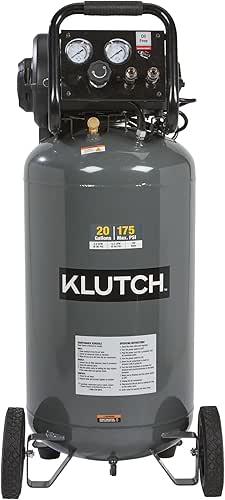
Klutch 20-Gallon Air Compressor, 2 HP, 120 Volts, 175 PSI
March 8, 2026 5:33 am
Need a 120V compressor that still hits 175 PSI? The Klutch 20-Gallon (Model 203001004001) delivers with a 2 HP motor, 5.2 CFM airflow, and 4.2 SCFM at 90 PSI for quick recovery. We like its oil-free pump, 80 dB noise rating, and thermal overload protection. At 90 pounds, it’s portable thanks to large rubber wheels, an ergonomic handle, and rubber foot stabilizers.
Built-in regulator and gauges keep setup simple, and it arrives ready to work. User feedback (4.2/5, 188 ratings) notes quiet, quick fills; occasional leaks or shipping issues were solved by tightening fittings or replacements. Check the 30-day return and warranty details.
Best For: DIYers and pros who need a 120V, portable compressor that can reach 175 PSI for automotive, carpentry, and general shop tasks with low maintenance.
Pros:
- 175 PSI max from a standard 120V outlet; 4.2 SCFM @ 90 PSI for quick recovery
- Oil-free pump, thermal overload protection, and rubber foot stabilizers for reliable, low-maintenance operation
- Portable 20-gallon design with large wheels and ergonomic handle; built-in regulator and gauges
Cons:
- 90 lbs is portable but still heavy for frequent lifting without a ramp or help
- Some reports of minor air leaks or shipping damage; may require tightening fittings or replacement
- 80 dB noise level is quieter than many shop units but not “quiet” for indoor, conversation-level use
Factors to Consider When Choosing Large Air Compressorss
Before we pick a large air compressor, let’s match tank size and type to our tools, then confirm the CFM and PSI meet real workload demands. We’ll choose a power source that fits our shop, weigh noise against placement options, and think about portability for jobsite moves. Finally, we’ll look at maintenance needs—oil vs. oil-free designs—and how they affect uptime and cost.
Tank Size and Type
Few choices affect day-to-day performance more than tank size and type. Tank size dictates runtime before recharging, so stepping up to 20–25 gallons gives us longer tool use between cycles. Design matters, too: a 20‑gallon twin‑tank layout often recovers faster and holds steadier pressure than a single 20‑gallon tank, which helps keep workflows smooth.
We should match tank orientation to our space and mobility needs. Vertical tanks save floor space in tight shops, but they’re taller and heavier to move. Horizontal, more portable units trade footprint for easier transport and better stability on carts or jobsites.
Pump style also plays a role. Oil‑free pumps cut maintenance, but they can run hotter or louder than oil‑lubed systems, influencing perceived durability and tank longevity.
CFM and PSI
How do we match a compressor’s muscle to our tools? We start with CFM and PSI. CFM tells us how much air the pump delivers per minute; PSI tells us the maximum pressure it can sustain. Both determine whether our tools run smoothly. A higher CFM at a given PSI means we can power more or larger tools without pressure sag.
Look at real ratings: many large units list 7.7 CFM at 40 PSI and 6.2 CFM at 90 PSI—airflow drops as pressure rises. We should size for the working PSI our tools require, then ensure the compressor’s CFM at that PSI meets or exceeds the combined CFM of all tools we’ll run at once. Maximum PSI (often 125–200) sets the ceiling, but usable performance hinges on CFM at our operating pressure.
Power Source Choice
Which power source makes our compressor a better fit for the work and workspace? If we’ve got reliable power, electric models on 120V or 240V circuits are convenient and clean. They pair with oil-free or oil-lubed pumps and deliver varied CFM at different psi—some 25-gallon units push around 7.7 CFM at 40 PSI. Gas-powered, wheelbarrow-style units shine for mobility and higher flow, often 11–12 CFM up to 125 PSI, but we must operate them outdoors due to exhaust and CO risk.
We should also match drive type and motor demands to our circuit. Belt-drive motors start smoother and often run more refined than direct-drive. Motor horsepower (2 HP or more) and a 20–25 gallon tank impact startup draw, runtime, and recovery. Oil-free designs cut maintenance; oil-lubed suits heavy, repetitive use.
Noise and Location
After choosing a power source and drive that suits our workload, we should think about where the compressor will live and how loud it’ll be. Noise spans roughly 66–84 dB. At the low end, we can place a unit indoors near workstations; at 79–84 dB, we’ll likely need sound-damping measures, ventilation, or a separate room to meet safety standards.
Location ties to size. Larger 20–25 gallon tanks offer longer run time but demand more floor space and can raise ambient noise. Enclosed shrouds help contain sound, and oil-free designs can cut upkeep while improving comfort. Wheel and foot designs matter: rubber feet reduce vibration transfer, while semi-pneumatic wheels help position the unit where structure-borne noise won’t echo through floors or adjacent walls.
Portability and Maintenance
Where will we move it, and how often? Portability hinges on design and weight. Large “portable” units use wheels, wheelbarrow frames, and handles, but 71–179 pounds still demands planning—ramps, truck beds, and stairs matter. Bigger tanks (20–25 gallons) extend runtime yet add bulk and reduce maneuverability, so we should balance capacity against how frequently we’ll relocate the compressor.
Fuel-powered models boost mobility by freeing us from outlets, but they must run outdoors and require exhaust safety—great for remote sites, not basements. Oil-free pumps cut routine maintenance, though they can be louder and may not match oil-lubed durability over years of heavy use. Finally, consider noise: 66–84 dB units affect shared spaces and neighbors, shaping where and when we can run the machine.
Conclusion
We’ve covered standout large air compressors for 2025 that balance power, capacity, and portability. Whether we need gas muscle for remote jobs, quiet oil-free performance for the shop, or higher PSI and faster recovery, there’s a fit here. Let’s match CFM and PSI to our tools, pick electric or gas for our workspace, and weigh tank size against mobility. Choose wisely, and we’ll get steady pressure, quicker workflows, and gear that won’t quit when projects scale up.