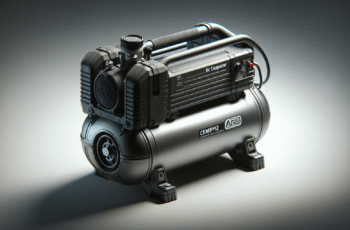
Choosing the right garage air compressor isn’t just about PSI—it’s about how we work. We weighed power, noise, portability, and duty cycle to find options that cover quick tire top-offs, weekend wrenching, and semi-pro setups. From compact inflators to quiet oil-free units and a heavy-duty 20-gallon workhorse, we’ve got a range that matches real needs and budgets. Let’s see which one fits your space, tools, and plans next.
Slime Garage Inflation Station, Wall-Mounted 120V Inflator


June 7, 2026 11:06 am
If you want a no-fuss, always-ready inflator for a busy garage, the wall-mounted Slime 40070 stands out with its 20 ft hose and 120V power that reach the driveway and fill tires fast up to 60 psi. We like how compact it is (about 8.25 x 4.33 x 10.83 in, 2.33 lb) and that the easy-read 0–60 psi dial sits near the tire. It handles cars, bikes, motorcycles, trailers, and inflatables with included adapters. Mount it once, plug in, and it’s ready. Expect modest noise, generally reliable accuracy (±1–2 psi), and quicker fills than portables. Use short duty cycles; an extension cord helps.
Best For: Home garages that want a fixed, always-ready inflator with long reach for cars, bikes, motorcycles, trailers, and inflatables up to 60 psi.
Pros:
- Wall-mounted 120V design with 20 ft hose reaches driveway and inflates faster than most portables
- Compact and lightweight with easy-read 0–60 psi dial gauge positioned near the tire
- Includes adapters for sport balls and inflatables; stable and convenient once installed
Cons:
- Capped at 60 psi, limiting use for some high-pressure applications
- Gauge accuracy can vary by ±1–2 psi; not as precise as digital units
- Requires wall mounting and nearby outlet; cord/hose storage depends on setup and can be messy
WEN Air Compressor, 6-Gallon, Oil-Free, Pancake Style (AP6092)

July 13, 2026 6:41 am
The WEN 6-gallon oil-free pancake compressor (AP6092) suits DIYers and weekend mechanics who want fast refills and low upkeep without a bulky footprint. We get a 6-gallon reinforced steel tank that tops out at 150 PSI and delivers 2.6 SCFM at 90 PSI, solid numbers for nailers, tire inflation, and light pneumatic tasks. The oil-free pump cuts maintenance and mess, while the easy-to-reach drain simplifies daily care. Dual 1/4-inch NPT quick couplers and two gauges let us run and monitor tools efficiently. An 11.5-amp motor and onboard handle aid portability. Backed by a two-year warranty, it’s practical value.
Best For: DIYers and weekend mechanics who need a compact, low-maintenance compressor for nailers, tire inflation, and light pneumatic tasks.
Pros:
- Oil-free pump reduces maintenance and eliminates the need for external lubrication
- 6-gallon tank with 150 PSI max and 2.6 SCFM at 90 PSI provides solid performance for common tasks
- Dual 1/4-inch NPT quick couplers and two gauges enable easy tool swapping and monitoring
Cons:
- Not suitable for high-demand, continuous-use tools (e.g., heavy sanders or grinders)
- Pancake design can be noisy compared to larger, belt-driven units
- Limited to household circuits; 11.5-amp motor may share capacity with other tools on the same breaker
6.3 Gallon Ultra Quiet Oil-Free Air Compressor (2.5HP, 115 PSI)

July 8, 2026 8:45 am
Looking for a compact, quiet workhorse for the garage? This 6.3-gallon Ultra Quiet Oil-Free Air Compressor delivers 2.5HP and up to 115 PSI with 3.2 SCFM at 90 PSI, ideal for nailers, impact wrenches, and spray guns. At 75 dBA, it won’t drown out conversation. The 1100W, 3450 RPM motor, oil-free pump, and dual cooling fans boost reliability and reduce maintenance.
We appreciate the rugged build: reinforced Q235B steel, anti-rust coating, bonded powder finish, seamless welds, and a heat-resistant intake with silicone and braided stainless steel. Mobility’s easy with the wheel kit and handle. It’s great for tires, woodworking, and auto tasks; recovery slows with continuous, high-volume tools.
Best For: DIYers and pros who need a compact, quiet, oil-free compressor for garage projects, tire inflation, and intermittent pneumatic tool use.
Pros:
- Quiet operation at 75 dBA; oil-free pump with dual cooling fans for low maintenance and reliability
- Strong performance for size: 2.5 HP, 3.2 SCFM @ 90 PSI, max 115 PSI powers nailers, impact wrenches, and spray guns
- Durable build with reinforced Q235B steel, anti-rust coating, powder finish, and heat-resistant intake
Cons:
- Slower recovery for continuous, high-volume air tools (e.g., nibblers, sustained spraying)
- 6.3-gallon tank limits runtime compared to larger shop compressors
- Maximum pressure (115 PSI) and 3.2 SCFM may be marginal for heavy-duty, continuous use tools
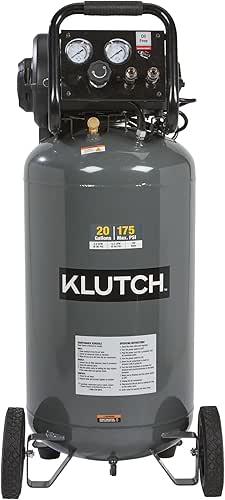
Klutch 20-Gallon Air Compressor, 2 HP, 120 Volts, 175 PSI
March 8, 2026 5:33 am
Power and portability converge in Klutch’s 20-gallon, 2 HP, 120V compressor, making it a smart pick for DIYers and pros who need 175 PSI performance on a standard household circuit. We get quick recovery—4.2 SCFM at 90 PSI—and up to 5.2 CFM airflow for impact wrenches, nailers, and tire work. The oil-free pump cuts maintenance, while thermal overload protection and rubber foot stabilizers boost reliability. At 80 dB and 90 pounds with large wheels and an ergonomic handle, it’s manageable and mobile. Users report fast fills and quiet operation, with occasional leak or shipping issues typically solved by tightening fittings or replacements.
Best For: DIYers and pros who need a portable, oil-free 20-gallon compressor that delivers up to 175 PSI on a standard 120V household circuit for tasks like impact wrenches, nailers, and tire service.
Pros:
- High pressure and solid output: 175 PSI, 4.2 SCFM @ 90 PSI (up to 5.2 CFM) for versatile pneumatic tools
- Low-maintenance, oil-free pump with thermal overload protection and rubber foot stabilizers for reliability
- Portable design with large wheels and ergonomic handle; relatively quiet at 80 dB
Cons:
- 90-pound weight can be cumbersome to lift without wheels
- Occasional reports of leaks or shipping damage; may require tightening fittings or replacement
- 20-gallon tank may be limiting for continuous, high-demand air tools compared to larger stationary units
Shop Air Line Kit HDPE-Aluminum Compressed Air Piping System (3/4″, 100/200/300 ft)

July 7, 2026 2:30 am
Serious DIYers and shop owners who want clean, steady air at up to 200 psi will appreciate this HDPE‑Aluminum shop air line kit. We like its HDPE‑AL‑HDPE triple‑layer tubing: smooth, corrosion‑proof walls with an aluminum core for strength and leak resistance. It’s rated 200 psi at 73°F (160 psi at 140°F) and meets ASTM F1282/F1974. Installation’s quick—no glue or welding—just a screwdriver and two adjustable wrenches. The kit includes tees, elbows, aluminum blocks with brass valves, clips, cutter, and Teflon tape. Mount it on walls or ceilings, or run it underground. Users report steady pressure, easy setup, and durable performance, plus a 30‑day return policy.
Best For: Serious DIYers, small shops, and manufacturing facilities that need a durable, clean, leak‑resistant compressed air system delivering up to 200 psi with flexible installation options.
Pros:
- Triple‑layer HDPE‑Aluminum tubing resists corrosion, maintains smooth airflow, and handles up to 200 psi (73°F); ASTM F1282/F1974 compliant.
- Quick installation with common tools (no glue or welding) and a comprehensive accessory kit (tees, elbows, valves, clips, cutter, Teflon tape).
- Versatile layouts—wall, ceiling, or underground—with proven leak‑free performance and steady pressure per user feedback.
Cons:
- Pressure rating drops at higher temperatures (160 psi at 140°F).
- 3/4″ sizing may be limiting for very high CFM or large industrial setups.
- Initial setup planning and routing still require time and careful measurement despite the easy tool requirements.
Factors to Consider When Choosing Garage Compressors
Let’s weigh the key specs together: power and pressure to match our tools, tank capacity for run time, and noise levels for a comfortable workspace. We’ll also check duty cycle so the motor won’t overheat during longer jobs. Finally, we should balance portability and setup requirements with the space and workflow we have.
Power and Pressure
Dialing in the right power and pressure starts with matching your tools’ needs to a compressor’s specs. We check maximum operating pressure first—most consumer units span 115–200 psi. That ceiling dictates what tools we can run and how much headroom we have before the regulator. Next, we look at CFM at working pressure (often 90 psi). CFM tells us how fast a compressor delivers air and how quickly it recovers during continuous use.
Horsepower and amperage matter, too. Higher HP and appropriate circuit capacity help spin up pumps reliably and sustain airflow for demanding tools. Oil-free pumps cut maintenance and start easily in cold garages, but we still watch duty cycle and heat. If we push continuous loads, we favor models designed for longer, cooler operation.
Tank Capacity
Tank capacity sets the tempo for how we work: it dictates how long tools run before the pump kicks back on and how stable pressure stays under load. We should match tank size to our tasks. Larger tanks—roughly 6–20 gallons—hold more reserve air, support longer continuous operation, and cut cycling frequency, which helps the pump last during extended sessions with impact wrenches, ratchets, or sanders. A bigger reservoir also recovers faster for high-demand bursts.
If we’re doing light-duty jobs—brad nailing, topping off tires, quick blow-offs—sub‑6‑gallon models keep things compact and easy to move without overbuying. Pair capacity with the pressure range we need; the tank must sustain the PSI our tools require so airflow remains consistent throughout the job.
Noise Levels
How much noise can we live with in the garage? Noise levels shape comfort and usability, especially if the garage shares a wall with living space. We should target compressors rated around 60–75 dBA; that’s conversation-level and easier on our ears. Units pushing past 80 dBA feel harsh and intrusive. Ultra-quiet designs at roughly 75 dBA or below are worth it for nighttime or early-morning tasks.
Motor and cooling matter. Oil-free designs typically run cooler and quieter than older oil-lubricated models, which helps during long sessions. Specs alone don’t tell the whole story, though. Let’s weigh measured decibels against real-world reports of vibration and the startup spike—the brief roar when the motor kicks on. Lower vibration and gentler startups reduce fatigue and make the workspace more pleasant.
Duty Cycle
Quiet operation is only half the comfort equation; we also need a compressor that can run as long as the job demands. Duty cycle tells us how long a unit can operate at its rated CFM within an hour without overheating—50%, 70%, or higher. For continuous jobs like nailing or painting, a higher duty cycle (60–100%) reduces cooldown interruptions and keeps workflow smooth.
We should match duty cycle to the task’s runtime. Continuous high-volume work demands a compressor whose duty cycle meets or exceeds the required on-time; otherwise, expect overheating and shutoffs. Tank size, motor capacity, and cooling design all influence achievable duty cycle—larger tanks and efficient cooling usually help. If the duty cycle falls short, plan shorter runs with rest periods or choose a higher-duty model.
Portability and Setup
When we weigh portability and setup, we’re really balancing mobility against readiness. Wheel kits and a sturdy handle make rolling a compressor between bays painless, and ultra-light models around 20–30 pounds lift easily for quick repositioning. Still, tank size changes the calculus: a 6-gallon unit moves fast but refills more often, while a 20-gallon tank recovers quicker yet demands more muscle to relocate.
We also look for features that cut friction. Oil-free pumps eliminate lubrication steps, reducing maintenance and speeding initial setup. Dual couplers and clear, on-board gauges let us run two tools without shuffling the machine, keeping workflow smooth. If floor space is tight, a wall-mounted or compact, low-profile design keeps hoses tidy and access clean, boosting overall garage efficiency.
Conclusion
We’ve covered the best garage air compressors of 2025, from quick tire inflators to durable, high-capacity workhorses and a robust shop air line kit. Let’s match your needs to the right setup: consider tank size, duty cycle, max PSI, noise, and portability. If you’re mostly inflating, go compact; for tools and auto work, step up in capacity. Prioritize quiet if you share spaces. With the right pick, we’ll make every task faster, cleaner, and easier.