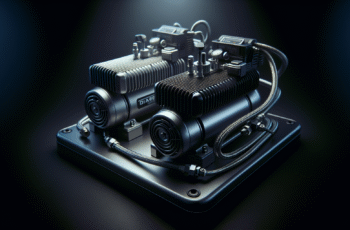
Choosing the right air compressor for a home garage isn’t guesswork—we weigh power, noise, and reliability for real DIY needs. This year’s standouts span compact pancake units to rugged 30-gallon workhorses, with quiet operation and steady CFM for painting, inflating, and light grinding. We highlight oil-free simplicity, oil-lubed durability, and portability where it matters. If you’re torn between PSI, tank size, or noise levels, we’ve compared what actually matters next.
30 Gal Gas-Powered Air Compressor, 13HP, 35 CFM, 125 PSI, ASME Tank
Product offers are temporarily unavailable.
If you run air-hungry tools or need mobile power on a service truck, HPDAVV’s 30-gallon, 13 HP gas compressor stands out with a massive 35 CFM output at a working 105–125 PSI. We like its ASME-certified 30-gallon tank, cast iron pump head, and three-cylinder, 880 rpm design for durability and steady airflow. It’s a one-stage unit with 1/2-inch NPT output, built for mounting on trucks and covering multiple sites. At 429 pounds, it’s heavy but stable. EPA-certified, it suits workshops and construction alike. Note the 30-day returns, online warranty, and mixed reviews—performance is strong, but support and shipping vary.
Best For: Contractors and service-truck operators who need high-volume, mobile compressed air for air-hungry tools at 105–125 PSI across multiple job sites.
Pros:
- High output: 35 CFM at 105–125 PSI handles demanding tools and continuous workflows
- Durable build: ASME-certified 30-gal tank, cast iron pump head, three-cylinder 880 rpm design
- Truck-mount friendly: 1/2″ NPT output, gas-powered independence for remote or multi-site work
Cons:
- Heavy at 429 lb, limiting manual portability and requiring secure mounting
- One-stage design capped at 125 PSI may not suit higher-pressure applications
- Mixed customer feedback on warranty and shipping; only 30-day return window
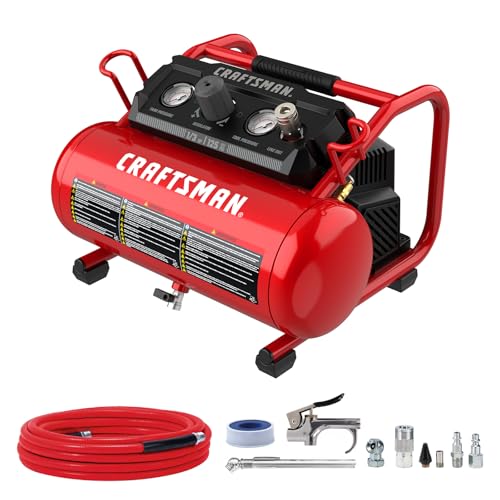
CRAFTSMAN 2 Gallon Portable Air Compressor with Accessory Kit

October 27, 2026 12:51 am
Looking for a compact rig that still tackles real garage chores? We like the CRAFTSMAN 2 Gallon Portable Air Compressor (CMXECXA0200244A) for quick, everyday tasks. It’s a 120V, 1/3 HP, oil-free unit that hits 125 PSI, weighs about 19–24 pounds, and uses a durable metal hot-dog tank. Noise lands around 78 dB.
The included 10-piece kit—hose, thread seal tape, tire gauge, blow gun, coupler, plugs, nozzle—gets you working fast, and two quick couplings speed tool swaps. Expect steady airflow, low upkeep, heat dissipation, and overload protection. It’s great for tire inflation, brad nailing, fastening, and cleanup. User ratings: 4.2/5 from 113 reviews.
Best For: DIYers and homeowners who need a compact, lightweight compressor for quick garage and home tasks like tire inflation, brad nailing, and blow-off cleanup.
Pros:
- Portable 2-gallon, oil-free design with rubber-reinforced handle; about 19–24 lb for easy carry and storage
- Solid performance for small tasks: 125 PSI max, steady airflow, two quick couplings, and a 10-piece starter kit
- Low maintenance and durability features: maintenance-free pump, heat dissipation, and overload protection
Cons:
- Limited tank size and 1/3 HP motor aren’t ideal for continuous-use or high-demand air tools
- Noise around 78 dB may be loud for small indoor spaces
- Accessory list has duplicates (auto plug appears multiple times) and may not cover all fittings some tools require
Klutch 20-Gallon Air Compressor, 2 HP, 120 Volts, 175 PSI

October 27, 2026 1:37 am
Need a compact, high-pressure workhorse for the garage? The Klutch 20-Gallon Air Compressor pushes 175 PSI from a 2 HP, 120V motor, giving us 4.2 SCFM at 90 PSI for quick recovery and 5.2 CFM max airflow. It’s oil-free, so maintenance stays minimal, and the thermal overload protection helps prevent overheating. At 80 dB and 90 pounds, it’s portable thanks to large rubber wheels, an ergonomic handle, and rubber foot stabilizers that cut vibration.
We like the built-in regulator and gauges for easy control. Real-world feedback’s strong (4.2/5): quiet and quick fills, with occasional leaks or shipping dings—usually solved by tightening fittings or replacing units.
Best For: DIYers and pros who need a portable, low-maintenance 120V compressor with high pressure (175 PSI) and quick recovery for garage, shop, and jobsite tasks.
Pros:
- 175 PSI with 4.2 SCFM @ 90 PSI and 5.2 CFM max for strong, versatile performance
- Oil-free pump, thermal overload protection, and built-in regulator/gauges for easy, low-maintenance use
- Portable 20-gallon design with large wheels, ergonomic handle, and rubber foot stabilizers; relatively quiet at ~80 dB
Cons:
- Heavier at 90 lb; still portable but not lightweight
- Occasional reports of air leaks or shipping damage requiring fitting tightening or replacement
- 120V, 2 HP motor limits output compared to larger 240V shop compressors
VEVOR 13-Gallon Oil-Free Air Compressor (2HP, 125 PSI)

October 27, 2026 12:38 am
Quiet power at a bargain stands out here: VEVOR’s 13-gallon, 2 HP oil-free compressor delivers 4.6 SCFM at 90 PSI and peaks at 125 PSI, so we can run nailers, inflate tires, and tackle light spray or impact work without fuss. It fills fast—in under three minutes—and hums at just 66 dB, great for garages. The reinforced valve system helps maintain steady output, while two 7-inch wheels make it easy to move. At 71 pounds, it’s portable enough and low maintenance. Users rate it 4.3/5, praising quiet performance and value, with occasional valve/shipping hiccups. Warranty and 30-day returns apply via VEVOR.
Best For: DIYers, homeowners, and light shop users who need a quiet, portable compressor for inflation, nailers, and light-duty air tools with minimal maintenance.
Pros:
- Quiet operation at 66 dB with fast tank fill in under 3 minutes
- 4.6 SCFM @ 90 PSI and 125 PSI max supports nailers, tire inflation, and light spray/impact tasks
- Oil-free, low maintenance design with reinforced valve system and 7-inch wheels for easy transport
Cons:
- Not enough CFM for continuous heavy-duty tools or pro-level spray rigs
- Occasional customer reports of valve issues and shipping delays
- Heavier than small portables at 71 lb, may be cumbersome on stairs without help
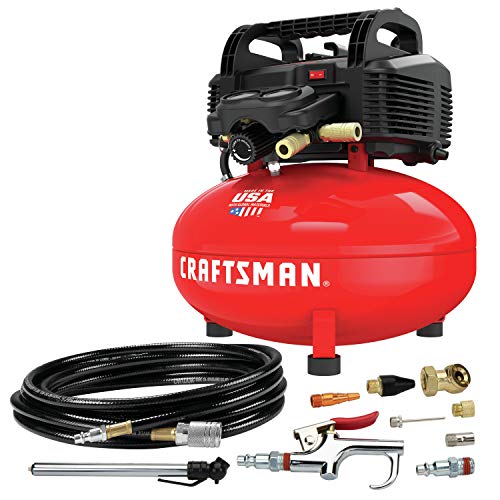
CRAFTSMAN 6-Gallon Oil-Free Pancake Air Compressor with Accessory Kit
October 27, 2026 3:05 am
For DIYers who want a grab‑and‑go compressor that’s powerful enough for nailing, inflating, and quick cleanups, the CRAFTSMAN 6‑Gallon Oil‑Free Pancake (CMEC6150K) hits the sweet spot. We like its 150 PSI max, quick recovery at 2.6 SCFM at 90 PSI, and oil‑free, low‑maintenance pump. At 32.5 pounds with a compact pancake tank, it’s easy to move around the garage and runs a modest 78.5 dB. The 13‑piece kit—25‑ft hose with quick connects, blow gun, tire chuck, and inflators—gets you working fast. It’s ideal for tires, trim nailing, and dusting, but not continuous heavy air‑tool use. Made in USA (with global materials), 1‑year warranty.
Best For: DIYers and homeowners who need a portable, low-maintenance compressor for tire inflation, trim nailing, air brushing, and quick cleanups.
Pros:
- 150 PSI max with 2.6 SCFM at 90 PSI for quick recovery on common tasks
- Lightweight 32.5 lb pancake design with included 13-piece accessory kit for fast setup
- Oil-free pump for durability and maintenance-free operation; relatively quiet at 78.5 dB
Cons:
- Not suited for continuous heavy air-tool use; pressure can drop under sustained demand
- Regulator tops around 140 PSI and airflow (2.6 CFM) limits larger pneumatic tools
- Occasional accessory fit/quality issues and minor cosmetic concerns on gauges/labels
Factors to Consider When Choosing Home Garage Air Compressors
Before we pick a compressor, let’s match our tools’ required CFM and PSI, then size the tank to the jobs we’ll tackle. We’ll also weigh duty cycle, choose between oil-free vs. oil-lube designs, and set expectations for longevity and upkeep. Finally, we’ll check noise level (dB) so we can work comfortably without rattling the whole garage.
Required CFM and PSI
How much air do your tools truly need? We start by matching CFM and PSI to actual requirements. CFM measures airflow; we want a compressor whose continuous CFM at our target PSI meets the tool’s spec, not just peak ratings. Many home tools run well at 90–125 PSI with 2–6 CFM, but spray guns and nailers often need 4–6 CFM at 90 PSI.
PSI reflects maximum pressure; ensure the compressor’s working pressure meets or exceeds the tool’s minimum. For intermittent tasks, more CFM at our target PSI reduces pause-filled cycles. For continuous heavy-duty tools, prioritize higher CFM—and consider staging. One-stage units deliver less CFM at higher PSI than two-stage models. We add a margin above the tool’s CFM at the required PSI for consistent performance.
Tank Size Matters
Why does tank size matter so much? It dictates how long we can run tools before the motor kicks back on. Larger tanks—think 20–30 gallons—store more air, so we get longer continuous run times and fewer interruptions. A common 30-gallon setup with a 125 PSI max can deliver higher CFM for sustained tasks, minimizing restarts compared to compact units.
Smaller 2–6 gallon tanks shine for portability and quick jobs, but they cycle frequently under heavy loads and don’t hold pressure as steadily. For painting and spraying, a larger reservoir helps maintain consistent pressure and smooths out fluctuations that can ruin finishes.
To size correctly, we match the tank to our tools’ combined CFM needs and ensure it can replenish air rapidly between cycles to keep work flowing.
Duty Cycle Rating
When we compare compressors, duty cycle tells us how long a unit can run under load in an hour without overheating—and it directly shapes productivity. It’s expressed as a percentage: 50% means 30 minutes on, 30 minutes off in a 60‑minute window. Higher duty cycles support longer continuous operation, which matters for grinders, sanders, or spraying where airflow can’t dip.
Let’s match rating to real work. For light tasks—brad nailing, topping off tires—a lower duty cycle is fine. For heavier, intermittent jobs—impact wrenches, die grinders—look for 60–100% to avoid constant cooldowns. Always check the duty cycle at the pressure you’ll actually run; a rating at 40 PSI may not hold at 90 PSI. That verification prevents restarts, heat, and premature wear.
Oil-Free vs. Oil-Lube
Duty cycle sets expectations for run time, but the pump style—oil-free or oil-lube—shapes how reliably a compressor meets those demands. Oil-free compressors cut out oil changes, simplify upkeep, and usually weigh less, so they’re great for home garages and portability. The tradeoff: they can run hotter under load, show more pressure drop during sustained demand, and may have shorter lifespans with heavy continuous use.
Oil-lubed (oil-filled) pumps thrive in longer duty cycles. Better lubrication supports continuous tool operation with steadier pressure and less thermal stress, but you’ll need to check levels, change oil, and match the right oil type. When comparing, remember oil-free doesn’t mean maintenance-free—expect periodic component lubrication and seal attention—while oil-lube requires regular oil care to keep reliability high.
Noise Level (Db)
How loud will it be in your garage? Noise level, measured in decibels (dB), directly affects comfort and where we can run a compressor. Small oil-free units often land around 66–70 dB, which suits indoor garages or shared spaces. Larger portable models commonly reach 75–80 dB, and higher-output compressors used for continuous tasks can be louder, sometimes pushing us to add sound-dampening or place them outside.
We should check the spec sheet for a listed dB rating and remember that design matters—pump type, enclosure, and vibration isolation all influence noise. Real-world loudness also depends on distance and room acoustics. If we want conversation-friendly operation, target the high-60s to low-70s dB. For heavier demands, plan placement and damping accordingly.
Power Source/Voltage
Which power source fits our garage and tasks best? Electric compressors are the default for most home garages, running on 120V or 240V circuits. We should match voltage to our breaker capacity and tool demand: 120V units suit light to medium work; 240V supports higher draw and faster recovery. Oil-free electric pumps cut maintenance and noise, typically delivering about 2–6 CFM at 90–125 PSI, depending on tank and pressure.
Gas-powered units, such as 13 HP models, trade outlets for runtime independence. They need fuel planning, engine upkeep, and safe venting—never operate them in enclosed spaces. Remember, horsepower drives recovery speed and sustained CFM, but tank size (roughly 2–30 gallons) and pressure rating (125–175 PSI) also shape performance. Choose the power path that safely meets your tool load.
Portability and Footprint
After we match power and voltage to our tools, we should think about how easily the compressor fits and moves in our space. Transportability starts with weight and handle design: lighter units around 20–32 pounds with reinforced handles are easiest to lift, while heavier 40–100+ pound models benefit from wheels and a sturdy base. For tight garages, footprint matters—compact pancake or slim-line tanks about 6–16 inches wide tuck onto shelves or benches better than large uprights or 30+ gallon tanks.
If we need to move the unit around, rubber wheels and ergonomic handles make crossing floors and loading into vehicles far simpler. Tank size also affects setup: 13–30 gallon tanks run longer but demand more clearance. Lower-noise, vibration-damping designs improve placement flexibility near living spaces.
Regulator and Fittings
Why fuss over regulators and fittings? Because they control how safely and efficiently our compressor feeds air to tools. A good built-in regulator lets us dial in a set output—typically within the 90–125 PSI range—and the gauge shows real-time system pressure so we don’t over-pressurize nailers, sprayers, or impact wrenches.
Fittings matter just as much. Most home units use NPT threads, commonly 1/4″ or 1/2″ NPT. We may need adapters and thread sealant (or PTFE tape) to ensure leak-free connections. Quick-connect fittings are worth it—they make hose and accessory swaps fast without bleeding pressure.
If we’re choosing oil-free pumps for low maintenance, let’s plan to check hoses and joints more often; higher airflow velocities can expose small leaks quickly.
Conclusion
Choosing the right home garage air compressor comes down to matching power, noise, and portability to the jobs we tackle most. Whether we want the brute force of a 30-gallon unit, a quiet oil-free workhorse, or a compact pancake for quick tasks, there’s a fit here. Let’s weigh CFM at 90 PSI, duty cycle, noise levels, and tank size, then pick confidently. With the right compressor, we’ll paint, inflate, and power tools smoothly—without slowing down our projects.