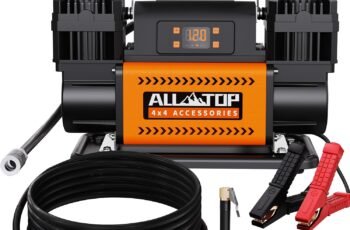
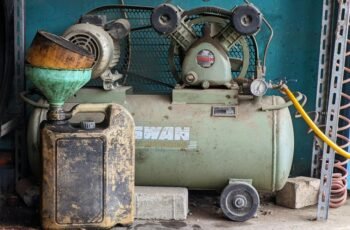
We’ve tested this year’s standout portable compressors that push 5–6 CFM without weighing you down. From a tough pancake unit to ultra-quiet aluminum tanks and trail-ready 12V workhorses, each pick balances airflow, recovery time, and true portability. We’ll cover noise, duty cycles, oil-free vs. oil-lube, and which models power nailers, spray guns, and inflators best. If you want job-site performance you can carry, our short list makes the choice clearer—almost.
DEWALT Pancake Air Compressor, 6 Gallon, 165 PSI (DWFP55126)


July 13, 2026 6:41 am
If you need a compact, jobsite-ready compressor that still delivers solid airflow, DEWALT’s 6-gallon DWFP55126 stands out. We get 2.6 SCFM at 90 PSI from a 0.9 hp, oil-free pump, topping out at 165 PSI for longer tool runtime and quick recovery. At about 30 pounds, it’s easy to move, and the heavy-duty pancake design stays stable. Noise is listed at 78.5 dBA, keeping conversations manageable.
We like the high-flow regulator, two quick-connect outlets, cord wrap, and a removable console cover for service. Cold starts and short 14-gauge extension cords are no problem. It’s great for nailers, light spraying, and drilling. 1-year warranty included.
Best For: Pros who need a portable, low-maintenance jobsite compressor with solid airflow for nailers and light pneumatic tasks.
Pros:
- 2.6 SCFM @ 90 PSI with 165 max PSI for longer tool runtime and quick recovery
- Oil-free, 30 lb pancake design with high-flow regulator, dual outlets, and cord wrap
- Reliable cold starts; suitable for up to 50 ft 14-gauge extension cords
Cons:
- Noise rating varies by source (listed 78.5 dBA vs 75.5 dB), may be louder than expected
- 0.9 hp and 6-gallon tank limit use with high-demand air tools
- Only a 1-year limited warranty
FiveSix PSI Pro Portable 12V Offroad Air Compressor (5.6 CFM)

July 11, 2026 6:32 am
Serious off-roaders who want rapid, controlled fills will love the FiveSix PSI Pro’s 5.6 CFM output and true auto shutoff. We set pressure with +/- and let it stop itself—no babysitting. This 12V single-cylinder unit inflates 35s from 10 to 40 psi in about 12–13 minutes and can handle 1–4 tires at once (we prefer 1–2). It runs an 80% duty cycle (45 on/10 off), draws ~45 amps continuous (70A peak), and stays protected with thermal cutoff and a relief valve. Build highlights include aluminum cylinders, stainless outlet hose, and upgraded heat sinking. Downsides: 4 ft hose limits reach; some valve/chuck compatibility quirks.
Best For: Serious off-roaders and overlanders who want fast, controlled tire fills with true auto shutoff and can power a high-draw 12V compressor.
Pros:
- 5.6 CFM with true auto shutoff; set PSI with +/- and it stops automatically
- Inflates 35” tires from 10–40 psi in ~12–13 minutes; supports 1–4 tires at once (1–2 recommended)
- Robust build and safety: aluminum cylinders, stainless outlet hose, thermal cutoff, relief valve, 80% duty cycle
Cons:
- Short 4 ft hose can limit reach, especially to rear tires
- Some valve/chuck compatibility quirks may require adapters or different chucks
- High current draw (≈45A continuous, 70A peak) requires solid 12V power and proper connections
California Air Tools Ultra Quiet Oil-Free Air Compressor (8010A, 8 Gallon)

July 9, 2026 4:41 pm
Quiet power stands out here: the California Air Tools 8010A delivers 2.2 CFM at 90 PSI while humming at just 60 dB, making it ideal for garages, studios, and job sites where noise matters. We get an 8-gallon aluminum tank, a 1.0 HP motor at 1680 RPM, and 120 PSI max. At 37.25 lbs with wheels, it’s easy to move.
The oil-free dual piston pump yields clean air, long life (3,000+ hours), and fast performance: full in 165 seconds, 90–120 PSI recovery in about 60 seconds. Setup’s simple with push-to-connect fittings and dual gauges. Users praise its quiet, portable build; minor tweaks aside, it’s a reliable 110V workhorse.
Best For: DIYers, makers, and contractors who need a portable, ultra-quiet, oil-free compressor for indoor garages, studios, or noise-sensitive job sites.
Pros:
- Ultra-quiet operation at 60 dB with 2.2 CFM at 90 PSI; suitable for indoor use
- Lightweight 8-gallon aluminum tank (about 37 lbs) with wheel kit for easy transport
- Oil-free dual piston pump provides clean air, fast fills (165s to full), and long life (3000+ hours)
Cons:
- Max pressure capped at 120 PSI, limiting some high-demand pneumatic tools
- Out-of-the-box setup may require minor tweaks (e.g., fittings, water traps for airbrushing)
- Corded 110V power only; no battery option for fully cordless use
Cordless Portable Tire Inflator Air Compressor with Gauge and Auto Shutoff

July 14, 2026 3:01 pm
Need a grab-and-go inflator that hits 150 PSI and tops up a car tire from 25 to 36 PSI in about a minute? This cordless Aneson CZK-DC04 moves 34 L/min, weighs just 1 lb, and runs on battery or 12V DC with USB-C charging. We loved the auto shutoff, dual LCDs for real-time and target readings, and bright visibility in sunlight. Presets and memory for cars, motorcycles, bikes, and balls speed setup. It handles up to 18 inflations per charge, stays quiet at 60 dB, and includes adapters, tube, cords, fuse, and bag. The LED work/emergency light adds roadside confidence.
Best For: Drivers, cyclists, and commuters who want a compact, cordless inflator with fast top-ups, accurate auto shutoff, and dual power (battery or 12V) for everyday use and roadside emergencies.
Pros:
- Rapid inflation (34 L/min) to 150 PSI; tops up a car tire from 25–36 PSI in ~1 minute and up to 18 inflations per charge
- Auto shutoff with dual LCDs for real-time and target pressure, plus bright sunlight visibility and useful presets/memory
- Lightweight 1 lb, quiet ~60 dB, USB-C charging, and included adapters, cords, fuse, tube, and storage bag
Cons:
- Plastic build may feel less premium or rugged than metal-bodied compressors
- Maximum airflow is optimized for cars/bikes; not suited for large truck tires or high-volume inflatables
- Battery runtime depends on temperature and usage; may need 12V DC backup for extended sessions
California Air Tools 10020CAD Ultra Quiet 10-Gallon Oil-Free Air Compressor

July 12, 2026 8:44 pm
Looking for ultra-quiet output without sacrificing usable airflow? We like California Air Tools’ 10020CAD for its 70 dB noise rating and solid CFM: 6.4 at 40 PSI and 5.3 at 90 PSI. The 2.0 HP, 1680 RPM motor draws 14A on 110V, starts easily in the cold, and hits 125 PSI in a 10-gallon steel tank. The oil-free dual piston pump is clean-running and rated for 3,000+ hours.
Portability’s respectable at 82.5 pounds with wheels. Usability shines: two gauges, push-to-connect fittings, Easy Start Valve, and an Auto Drain Valve to curb moisture. Note: the drain vent can be loud—route outside. One-year warranty.
Best For: Pros and hobbyist users who need an ultra-quiet, reliable 10-gallon compressor with solid CFM for shop, garage, or jobsite use.
Pros:
- Ultra quiet at 70 dB with strong airflow: 6.4 CFM @ 40 PSI and 5.3 CFM @ 90 PSI
- Oil-free dual piston pump rated 3,000+ hours; easy cold starts with 2.0 HP, 1680 RPM motor (14A, 110V)
- Usability extras: Easy Start Valve, Auto Drain Valve, two gauges, push-to-connect fittings; portable wheel kit
Cons:
- Auto drain vent can be loud; may need to route the hose outside
- Heavier at 82.5 lb; still portable but not grab-and-go
- Max pressure capped at 125 PSI, limiting some high-demand pneumatic tools
Factors to Consider When Choosing High CFM Portable Air Compressors
Before we pick a compressor, let’s match our required CFM and PSI to the tools we’ll run and check the duty cycle rating for sustained workloads. We should also choose a power source that fits our job sites, keep noise level (dB) in mind for comfort and compliance, and confirm portability and weight for easy transport. With these factors set, we can shortlist models that perform reliably without slowing us down.
Required CFM and PSI
A compressor’s CFM and PSI work together to determine whether it can actually run your tools, and how well. CFM tells us how much air the unit delivers at a set pressure; PSI tells us the maximum pressure it can maintain. Most portable models operate around 90–125 PSI, which covers many pneumatic tasks.
To size correctly, match the compressor’s delivered CFM at your target PSI to the tool’s requirement—meet or exceed it for steady performance. For framing nailers and spray guns, 6–8 CFM at 90 PSI is a reliable baseline. Ratings of 4–6 CFM at 90 PSI can run lighter tools but may struggle with high-demand applications.
For inflation and burst-demand tools, choose higher CFM to avoid rapid pressure drop and short cycling.
Duty Cycle Rating
While CFM and PSI tell us what a compressor can deliver, the duty cycle tells us how long it can do it without overheating. It’s the percentage of a 60‑minute window the unit can run at rated load—so an 80% duty cycle means 45 minutes on and 15 minutes off. For high‑CFM work, we should look for higher duty cycles to keep tools running steadily.
Let’s match tool demand to duty rating. If our sanders or grinders run nearly continuously, an 80% (or higher) duty cycle helps prevent heat buildup and protects compressor life. Remember, ambient temperature, motor load, and tank size affect real‑world runtime; hot job sites shorten effective cycles. Overrunning the rating accelerates wear. When comparing models, verify the stated duty cycle at full load and plan cooldown intervals accordingly.
Power Source Options
How do we keep high CFM portable without starving tools of power? We start with the plug. Most portable high-CFM units run on 120V AC and deliver about 5–6 CFM at 40–90 PSI—plenty for nailers, small DA sanders, and on-site or garage tasks. To keep that output, we use a proper extension cord: 14 AWG or larger up to 50 ft to minimize voltage drop.
Oil-free pumps pair well with portability—they cut maintenance and avoid oil changes on the road. For off-grid work, battery or 12V/DC compressors cover inflations and light pneumatic tasks, but their duty cycles and sustained CFM are limited. Dual-power (AC + DC) adds flexibility; just remember sustained high-CFM draws need robust batteries or a strong vehicle alternator.
Noise Level Db
Curious what “quiet” really means for high-CFM portables? Noise levels typically span 60–78 dB, and models billed as “ultra-quiet” often land between 60–70 dB. Lower dB generally means easier conversation, less fatigue, and fewer complaints on shared jobsites.
We look for designs that achieve high airflow without the roar. Oil-free pumps are common in quieter builds, trimming mechanical noise and cutting maintenance. Dual-piston assemblies, optimized mufflers, and smart intake paths can keep sound down even as CFM climbs—high output doesn’t have to equal high noise.
Consider the whole operating profile. Duty cycle affects how long you’ll hear the compressor at volume, while startup surge can spike perceived loudness. If you’re cycling frequently, consistent low-dB performance matters more than a single spec.
Portability and Weight
Quiet performance only pays off if you can get the compressor where it’s needed. We look closely at weight, balance, and features that make moving a unit practical. Sub-30 lb compressors are easy to carry between jobs, but they often trade off sustained CFM. Heavier 30–50+ lb models typically keep high airflow going longer, yet they demand better transport aids.
Design matters. Pancake and compact drum layouts keep a low profile, so they’re easier to maneuver through doorways and truck beds without adding much weight. We favor wheel kits and sturdy carry handles; they tame stairs, gravel, and long walks to the work area. For site mobility, integrated cord wrap and compact dimensions reduce snags, clutter, and trips—helping us move fast and work safer.
Tank Size/Material
Why does tank size and material matter so much for high-CFM portability? Because tank capacity dictates runtime and pump cycling. Larger tanks store more air, letting us sustain high-CFM tools without pressure dips or constant restarts. When CFM demands rise, pairing them with a bigger tank helps maintain steady pressure under load.
Material is the other lever. Steel is durable and budget-friendly, but heavier. Aluminum trims weight for easier carry or roll, though it typically costs more. For true portability, pancake-style tanks are compact, but their limited reserve can’t match the staying power of larger horizontal or vertical designs.
Finally, check max PSI—commonly 125–165 PSI. Higher PSI extends usable air at high CFM before pressure drops, improving recovery cadence and overall workflow.
Hose and Fittings Compatibility
How do we keep high CFM from getting choked off before it reaches the tool? We match hose diameter and fittings to the compressor’s outlets. A 0.25″ hose with standard quick-connects is fine for light draws, but higher-flow tools benefit from larger ID hoses that reduce pressure drop at 90 PSI and above.
We also look for dual outlets. Two connections let us run separate hoses or tools, but they split available CFM—plan loads accordingly. Quick-connect and push-to-connect fittings must be high-flow types; restrictive couplers waste capacity. Brass push-to-connects typically seal well and flow better.
Hose length and routing matter. Shorter runs with gentle curves prevent losses and snag points. Finally, included hoses and adapters—like Presta/Ball—simplify compatibility across our tool kit.
Conclusion
We’ve covered standout picks that blend high CFM, manageable weight, and dependable performance. Whether we’re framing with the DEWALT pancake, airing down trails with the FiveSix PSI Pro, or keeping noise low with California Air Tools’ ultra-quiet units, these compressors deliver steady airflow and quick recovery. Add smart features like dual outlets and auto shutoff, and we’re set for job sites or weekend projects. Choose the CFM, tank size, and portability that match how we actually work.