We’ve tested what matters for shops and garages: real 2.0 HP output, oil-free pumps that cut maintenance, and steady 115–125 PSI for nailers, LVLP guns, and everyday tools. Noise levels near 60–70 dB keep indoor work civil, while sturdy 20-gallon tanks and dual-piston designs boost longevity. We’ll highlight models with reliable gauges, clean couplers, and solid warranties—so you can choose with confidence. One pick quietly outperforms the rest in value—let’s find it.
14 Gallon Ultra Quiet Oil-Free Air Compressor (2HP, 115 PSI, 70dB)


October 27, 2026 1:37 am
Looking for ultra-quiet power without a bulky tank? We’d shortlist Nessxa’s 14 Gallon Ultra Quiet Oil-Free Air Compressor. Its 2HP, 110V motor spins at 3450 RPM, delivering a rated 8.75 CFM up to 115 PSI, while dual silencers keep noise to 70 dB. At 59.9 pounds with wheels and a handle, it’s easy to move. The Q235B steel tank features seamless welding, anti-rust coating, and automatic shutdown, pressure relief, and restart below 70 PSI.
Performance impresses: double cylinders fill the 14-gallon tank in about 60 seconds. With two quick couplers and an included tool kit, it’s great for tires, airbrushing, and light shop tasks.
Best For: Home garages and small shops that need a portable, ultra-quiet compressor for tire inflation, airbrushing, and light pneumatic tasks up to 115 PSI.
Pros:
- Ultra-quiet operation at 70 dB with dual silencers; suitable for indoor use
- Strong performance for size: 2HP oil-free motor, 8.75 CFM, fast ~60s tank fill
- Portable and durable: 59.9 lb with wheels/handle, Q235B steel, anti-rust coating, auto safety shutoff/restart
Cons:
- Max pressure capped at ~115 PSI; not ideal for high-pressure or heavy-duty air tools
- Approx. 50% duty cycle under continuous draw limits sustained use
- Heavier and larger than small pancake units; still requires storage space
14 Gallon Ultra Quiet Oil-Free Air Compressor (2HP, 115 PSI, 70dB)
October 27, 2026 1:37 am
Prefer quiet power without the bulk? Nessxa’s 14 Gallon Ultra Quiet Oil-Free Air Compressor delivers a 2HP, 110V motor, 8.75 CFM at up to 115 PSI, and just 70 dB. It weighs 59.9 lb and measures 30.5 x 18.5 x 18 inches, so we can roll it easily with the handle and wheels.
We like the durable Q235B steel tank, seamless welds, anti-rust coating, dual cooling fans, overheat protection, auto shutoff/relief, and auto-restart below ~70 PSI. The double-cylinder intake fills the tank in about 60 seconds. Dual quick couplers, a tool kit, and adjustable 0–115 PSI suit tires, airbrushing, light tools, and quiet shop work.
Best For: DIYers, home shops, and light-duty pros who need a portable, ultra-quiet, oil-free compressor with fast tank fill and enough airflow for tires, airbrushing, and light pneumatic tools.
Pros:
- Quiet operation at 70 dB with dual silencers, suitable for garages and indoor use
- Strong performance: 2HP motor, 8.75 CFM up to 115 PSI; ~60-second tank fill
- Durable, portable build: Q235B steel tank, anti-rust coating, handle and wheels, dual quick couplers
Cons:
- Max pressure capped around 115 PSI, limiting some higher-pressure tools
- About 50% duty cycle in practical use may constrain continuous heavy tool operation
- Heavier than small portables at 59.9 lb; still requires space (30.5 x 18.5 x 18 in)
California Air Tools 20-Gallon Ultra Quiet Oil-Free Air Compressor (20020)

October 27, 2026 2:10 am
Quiet power hunters, this is our pick: California Air Tools’ 20020 pairs a true 2.0 HP motor with an ultra-quiet 70 dB operation, delivering 6.4 CFM at 40 PSI and 5.3 CFM at 90 PSI from a 20-gallon, oil-free, dual-piston system. We like its 125 PSI ceiling for LVLP spraying, nailing, and general shop tasks, plus 110V simplicity. The oil-free pump’s 3,000+ hour life cuts maintenance, and no-flat wheels ease moves despite its 114–135 lb heft. Dual gauges, two push-to-connects, and thermal overload protection boost usability. Do note mixed customer service, a 1-year warranty, and isolated reports of wiring-related safety issues.
Best For: DIYers and pros who need a quiet, 110V, shop-ready compressor with enough CFM for LVLP spraying, nailers, and general pneumatic tasks without the upkeep of oil-lubed units.
Pros:
- Ultra-quiet 70 dB operation with true 2.0 HP output; 6.4 CFM @ 40 PSI and 5.3 CFM @ 90 PSI handle many shop tools
- Oil-free dual-piston pump with 3,000+ hour life reduces maintenance and performs across temperatures
- 20-gallon tank, dual gauges, two push-to-connect couplers, thermal overload protection, and no-flat wheels for usability
Cons:
- Max pressure capped at 125 PSI may limit some high-demand or continuous-use air tools
- Heavy (about 114–135 lb) and bulky despite wheels; takes floor space
- Mixed customer service reports and isolated wiring/insulation safety concerns; only 1-year warranty
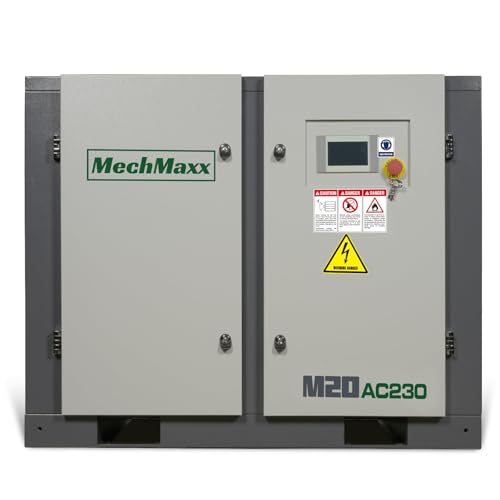
20HP Rotary Screw Air Compressor (Model M20AC230)
October 27, 2026 2:10 am
Serious shops that outgrow portable 20-gallon units will appreciate MechMaxx’s M20AC230—a 20HP rotary screw delivering 78 CFM at up to 230 PSI with fully automatic load/unload control. We’re talking industrial-grade performance on 230V 3-phase with an IP54, fully enclosed motor, SKF bearings, and high starting torque for tough duty cycles. The airend’s precision tolerances boost reliability and longevity. An EPC intelligent controller automates load/unload, diagnoses faults fast, and even shuts down when demand drops, trimming energy costs. Oil-gas separation keeps discharge under 3 ppm, protecting tools. At 726 pounds, it’s a stationary workhorse. Includes filter and manual, with warranty support.
Best For: Industrial and commercial shops needing continuous-duty, high-CFM compressed air on 230V 3-phase with automated load/unload control and low oil carryover.
Pros:
- 78 CFM at up to 230 PSI with 20HP rotary screw performance for demanding, continuous-duty applications
- Intelligent EPC controller with automatic load/unload and auto shutdown to reduce energy costs and provide quick fault diagnostics
- Robust build: IP54 enclosed motor with SKF bearings and precision airend; oil-gas separation keeps discharge oil content below 3 ppm
Cons:
- Requires 230V 3-phase power and stationary installation; not suitable for small shops without appropriate electrical service
- Heavy (726 lb) and large footprint limits portability and space flexibility
- Higher upfront cost and maintenance complexity compared to smaller piston or portable units
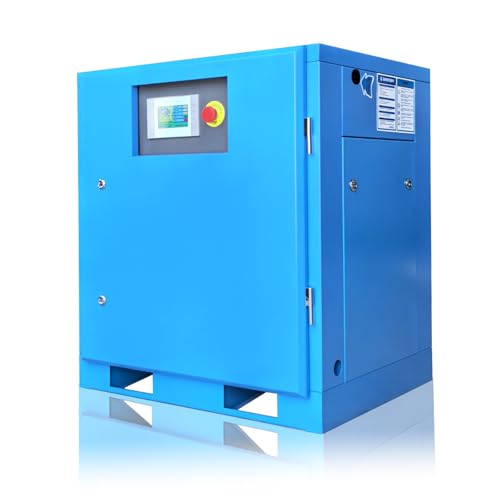
10HP 460V 3-Phase Variable Speed Rotary Screw Air Compressor (39 CFM, 120 PSI)
October 27, 2026 2:10 am
Looking for a high-duty compressor that holds rock-steady pressure while cutting energy costs? We like this 10HP, 460V, 3-phase variable-speed rotary screw from Bilowk for shops that need consistent air. It delivers 39 CFM at up to 120 PSI, adjusts motor speed in real time, and starts soft to reduce spikes and wear. Expect about 70 dB, stable pressure, and 3/4-inch NPT output.
It’s pre-debugged—connect power and air, then go. Plan annual filter and oil changes. Keep it indoors or add a roof outside. At 326 pounds with a cast-iron build, it’s built for industrial duty: CNC, auto repair, sanding, and more.
Best For: Industrial and commercial shops with 460V 3-phase power that need steady 120 PSI air with variable-speed efficiency for continuous-duty tools like CNC, sanding, and auto repair.
Pros:
- Variable-speed drive maintains stable pressure and reduces energy use with soft-start operation
- 39 CFM at up to 120 PSI with 3/4″ NPT outlet; low 70 dB noise for a rotary screw unit
- Pre-configured setup; connect power and air to run, with touchscreen and included filters
Cons:
- Requires 460V 3-phase power; not compatible with phase converters for single-phase
- Heavy (326 lb) and sizable; best suited for fixed, indoor installations
- Ongoing maintenance needed (annual oil and filter replacements)
Factors to Consider When Choosing Rated 20 Gallon Air Compressors
As we compare 20-gallon units, we’ll weigh power and CFM against the tools you plan to run and the maximum PSI they require. We’ll also factor in noise level and portability features like wheels, handles, and footprint for shop or jobsite use. Finally, we’ll look at duty cycle to gauge how long the compressor can work without overheating.
Power and CFM
Why does power matter so much? Because horsepower and CFM dictate whether our 20-gallon compressor keeps tools fed without constant pauses. Higher horsepower usually delivers higher CFM, which means longer runtime between fills and steadier performance for continuous-demand tools.
CFM tells us how much air the pump supplies at a stated pressure. For context, a 14-gallon unit hitting 8.75 CFM at 115 PSI shows how mid-size systems can push serious airflow. With 20-gallon models, we’re balancing tank size with duty cycle: a larger tank stretches operation between cycles, while strong CFM shortens recovery after pressure dips.
Design matters, too. Dual-piston and twin-cylinder pumps can boost CFM at the same pressure. Match CFM to tasks—airbrushing, nailing, tire inflation—so we get capability without overspec.
Maximum PSI
How high should max PSI go for a 20-gallon compressor? Maximum PSI is the ceiling pressure the pump can deliver, and it dictates which tools we can run. For most 20-gallon models, 115–125 PSI covers standard automotive and general shop tasks like impact wrenches, nailers, and blow guns. If we plan to run higher-demand tools or want quicker tank recovery, stepping up in max PSI can help, but it typically requires a heavier-duty pump and motor.
We should also remember that practical operating pressure is usually set below the stated maximum for safety and longevity. Let’s match our tools’ recommended operating pressures to the compressor’s capabilities to avoid starving tools or overworking the unit. When in doubt, confirm both tool PSI requirements and the compressor’s rated limits.
Noise Level
After setting realistic PSI targets, we should weigh noise just as carefully—especially if we work in garages or basements. Noise is rated in decibels (dB); for 20‑gallon compressors, quiet models typically land around 60–70 dB. Lower dB means quieter operation, which reduces fatigue and makes enclosed spaces more comfortable.
Some units hit 70 dB or less by using dual silencers, effective mufflers, or oil‑free pump designs tuned for lower acoustic output. Still, rated dB doesn’t tell the whole story. Real‑world sound shifts with airflow, attachments, and load. Unloaded operation can seem quieter—or sometimes harsher—depending on intake and exhaust design.
When comparing, verify that manufacturers measured dB under standardized conditions: fixed microphone distance, comparable load, and consistent test environments for fair assessments.
Portability Features
Even before we plug in a tool, we should judge how easily a 20‑gallon compressor moves and sets up. We’ll prioritize built‑in wheels and a carry‑friendly handle so rolling the unit between bays or across a driveway is simple. Compact dimensions and a manageable weight—often 60 to 120+ pounds—help us navigate doorways and tuck the tank where we need it.
Wheel design matters. Dual‑axle or well‑spaced single‑axle setups track better over rough surfaces, while integrated foot stabilizers keep the compressor steady during loading and hose pulls. We also value a reinforced, powder‑coated steel tank with solid welds to withstand bumps and lifts. Finally, smart placement of quick‑connects and an accessible drain valve lets us reposition, hook up, and purge condensate without wrestling the machine.
Duty Cycle
Mobility gets us to the job, but duty cycle keeps us working. Duty cycle tells us what fraction of a given period the compressor can run versus rest without overheating or wearing out. Most 20-gallon units target a 50% duty cycle at full load—about half running, half cooling. That’s fine for intermittent tasks, but it can bottleneck continuous work.
We match duty cycle to our load profile. Auto repair, spray finishing, or long grinding sessions demand higher duty-cycle ratings to minimize cooldown pauses. Tire inflation or nailers can live with lower ratings.
We also look beyond the label. Tank size, CFM at our target PSI, and cooling and thermal protection all influence real-world duty cycle. Better airflow, fins, and smart shutoffs extend safe, continuous operation.
Conclusion
In the end, we’ve zeroed in on 20-gallon air compressors that balance power, performance, and value—quiet operation, oil-free reliability, and true 2.0 HP efficiency. Whether we’re spraying, framing, or tackling shop tasks, these picks deliver steady PSI, durable tanks, and low maintenance. We’ve also flagged what really matters: noise, duty cycle, airflow, and warranty. The result? Confident choices for DIYers and pros alike. Ready to upgrade your workflow with a compressor that won’t hold you back?