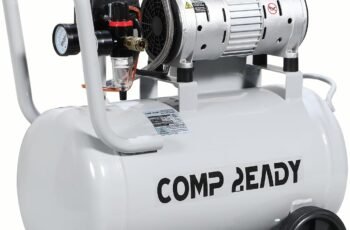
We’ll assess the Makita AC001 as a compact compressor for finish work, focusing on its 1.2-gallon tank, 125 PSI maximum pressure, and modest airflow. Its 23.1-pound frame and roll cage make it portable and protected, while the 79 dB operating level is relatively quiet but still noticeable indoors. We’ll examine its pump, practical strengths, and limitations—and explain when frequent cycling may become a problem.
Key Takeaways
- The Makita AC001 is a compact, 23.1-pound compressor with a 1.2-gallon tank, making it easy to move between work areas.
- Its 1/6-hp induction motor delivers up to 125 PSI, with airflow of 0.58 CFM at 40 PSI and 0.45 CFM at 90 PSI.
- It suits finish work and short bursts with compatible tools, but limited airflow and tank capacity restrict sustained use.
- A protective roll cage, maintenance-friendly drain, and relatively quiet 79 dB operation are practical advantages.
- Frequent cycling can interrupt extended tasks, and its noise remains audible indoors; check tool airflow needs before buying.

November 24, 2026 4:37 am
1.2-Gallon Tank Capacity
The Makita AC001’s 1.2-gallon tank keeps the compressor compact and portable, but limits how long it can supply air before pressure drops and the motor needs to refill it. This Tank Size provides a modest Air Reserve for short bursts of finish work, rather than sustained, high-demand operation.
We can use it for intermittent tasks, but pressure may fall quickly when an accessory draws air continuously. The compressor delivers 0.58 CFM at 40 PSI and 0.45 CFM at 90 PSI, so we should compare those rates with our tool’s requirements. If demand exceeds supply, we’ll need to pause or choose a larger compressor.
Detailed features
Built for portable finish work, the Makita AC001 combines a 1/6-hp induction motor with a cast-iron pump and Big Bore cylinder and piston, delivering up to 125 PSI and recovering air at 0.58 CFM at 40 PSI or 0.45 CFM at 90 PSI.
We can use its 1.2-gallon tank for cutting, grinding, or spraying when tool demands match its output. The 23.1-pound unit measures 14 by 15 by 15 inches and operates at 79 dB. Roll cage protection shields the pump and motor assembly.
A lever-handle ball-valve drain lets us release tank air and perform routine maintenance; the universal 1/4-inch quick coupler connects compatible fittings.
November 24, 2026 4:37 am
Pros and Cons
We’ll weigh the AC001’s portability, 79 dB noise level, and protective roll cage against its limited 0.45 CFM output at 90 PSI and 1.2-gallon tank.
This balance will help us assess whether it suits your finish-work needs. We’ll also note where its airflow may limit tool choice.
Pros
Where does the Makita AC001 stand out? Its low noise operation, easy portability, and practical air delivery make it well suited to finish work and indoor tasks.
At 23.1 pounds, we can move its compact 14-by-15-by-15-inch frame between work areas without much effort. The 1.2-gallon tank reaches 125 PSI, while output measures 0.58 CFM at 40 PSI and 0.45 CFM at 90 PSI.
We can pair it with compatible tools for cutting, grinding, or spraying. Its low-amp-draw induction motor helps reduce startup breaker trips, and the roll cage protects the pump and motor assembly during transport and use.
Cons
Despite its portability, the Makita AC001’s 0.45 CFM at 90 PSI and 1.2-gallon tank limit how long it can run air-hungry tools before pressure drops and recovery is needed. This Limited airflow makes the compressor a poor match for sustained spraying, grinding, or cutting when accessories demand more air than it supplies.
Its modest capacity also means frequent cycling during extended tasks, interrupting work while pressure rebuilds. We’ll need to check each tool’s airflow requirements and reduce usage or choose a higher-output compressor if they exceed the AC001’s delivery. At 79 dB, it’s also audible indoors despite its relatively quiet operation.
Concluding thoughts
For finish work and light-duty tasks, the Makita AC001 offers a portable, low-noise option with a 1.2-gallon tank, 125 PSI maximum pressure, and a roll cage that protects its pump and motor. At 23.1 pounds and 79 dB, it balances Everyday portability with indoor usability.
We can use its 0.58 CFM at 40 PSI for compatible tools, but its modest output limits sustained, air-hungry applications. The cast-iron pump and lever-handle drain support durability and routine maintenance.
Before buying, we should compare tool requirements with its airflow and pressure ratings. Choose the AC001 when compact size and quieter operation matter more than high-volume output.
November 24, 2026 4:37 am
Frequently Asked Questions
What Accessories Are Included With the Makita AC001?
We find the Makita AC001 includes a 1/4-inch universal male quick coupler; no Included air hose or other packaged accessories are specified. Check your unboxing checklist, and confirm accessory compatibility before connecting tools or hoses.
What Warranty Does Makita Provide for This Compressor?
Makita provides a one-year warranty for the AC001. For Warranty coverage details and the claim process, we recommend consulting the owner’s manual or contacting Makita directly; the available product information doesn’t specify exclusions or claim steps.
How Can I Reduce Air Leaks at the Fittings?
To stop air leaks, let’s nip them in the bud: inspect fitting connections, replace worn seals, apply thread sealant carefully, and tighten connections properly. We should avoid overtightening, which can damage threads and worsen leaks.
What Should I Do if My Air Tool Needs More Airflow?
Check tool requirements against the AC001’s airflow: 0.58 CFM at 40 PSI and 0.45 CFM at 90 PSI. If your tool needs more, reduce air use or use a larger compressor that meets its specifications.
Where Can I Find the Compressor’s Maintenance Instructions?
Like a map for the machine, we’ll find the AC001’s maintenance instructions in its owner’s manual; consult Makita’s website or contact Makita support. For locating the maintenance schedule, check the manual’s maintenance section and follow its guidance.
November 24, 2026 4:37 am
Conclusion
We find the Makita AC001 best suited to brief finish-work tasks, where its 1.2-gallon tank, 125 PSI maximum, and portable 23.1-pound frame offer practical convenience. Its 79 dB operation is comparatively quiet, and its cast-iron Big Bore pump supports dependable performance. However, limited airflow means more cycling, less sustained tool use, and more interruptions. Choose it for portability, not production: it’s compact for transport, capable for short jobs, and constrained for continuous demand.