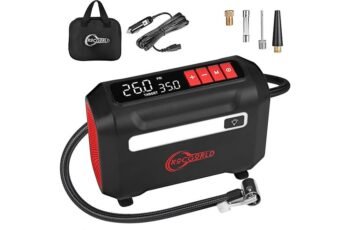
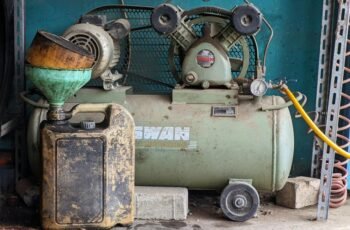
ALL-TOP 12V Air Compressor Review: Quick Overview
Reinflating oversized off-road tires far from a service station is where small emergency inflators often feel out of their depth. The ALL-TOP 12V Air Compressor takes a different approach: it is a heavy-duty, battery-powered 12V compressor rather than a compact cigarette-lighter pump. With dual cylinders, a claimed PSI maximum, 12.35 CFM airflow, an LCD control panel, preset-pressure auto-stop, battery alligator clamps, a carrying case, and an insulated handle, it is built around repeated use on large tires.
Listed at $269.99 and shown as in stock, the central question is whether that output and control system justify paying more than we would for a compact portable inflator. The ALL-TOP 12V Air Compressor looks especially suitable for overlanding, crawling, trucks, SUVs, trailers, and recreational vehicles that regularly air down and reinflate. For occasional passenger-car top-ups, however, its size, price, and direct battery connection may be more than we need.
Our short assessment is straightforward: the ALL-TOP 12V Air Compressor is designed for fast, repeated tire inflation when portability and strong airflow matter more than low cost. It deserves consideration for serious trail use, but shoppers should verify electrical details, warranty support, and real-world inflation performance before ordering.

Product Specifications and What Comes in the Package
The listing confirms the core specification set, but it does not provide every detail a technical buyer may want. The following table separates the advertised features from information that remains unconfirmed.
| Specification | Listed detail |
|---|---|
| Price | $269.99 |
| Availability | In Stock |
| Power source | 12V battery connection through alligator clamps |
| Maximum pressure | 150 PSI |
| Claimed airflow | 12.35 CFM |
| Compressor type | Dual-cylinder design with heavy-duty motors |
| Display and controls | Digital LCD control panel |
| Pressure units | PSI, kg/cm², BAR, and KPA |
| Protection systems | Thermal cut-off above 221°F and circuit-breaker protection above amps |
| Filter | Cleanable sponge filter |
| Base | Anti-vibration metal base |
| Handle | Insulated carrying handle |
| Storage | Heavy-duty hand-carry bag |
The ALL-TOP 12V Air Compressor’s PSI figure describes its maximum capability, not the speed we should expect at every pressure or with every tire. Similarly, 12.35 CFM is the headline airflow claim; practical results depend on tire volume, starting pressure, target pressure, duty-cycle limits, temperature, valve restriction, and hose arrangement.
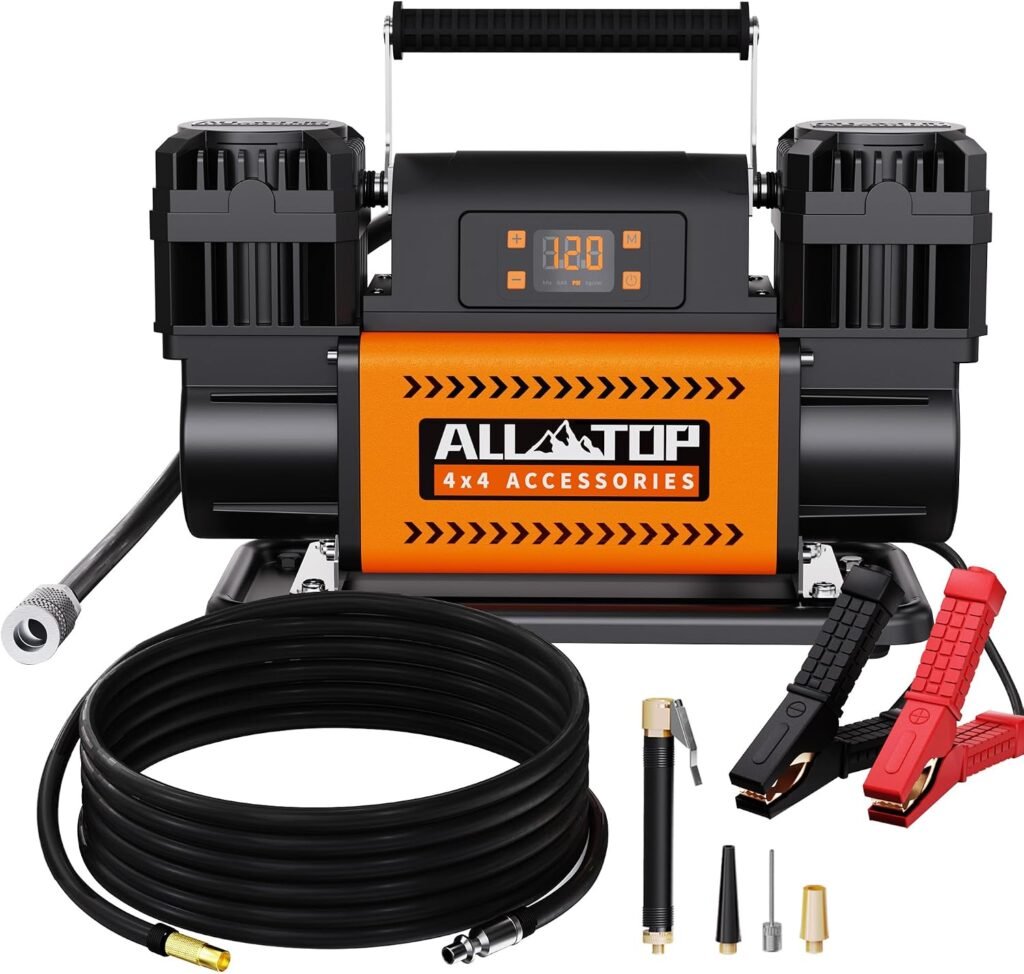
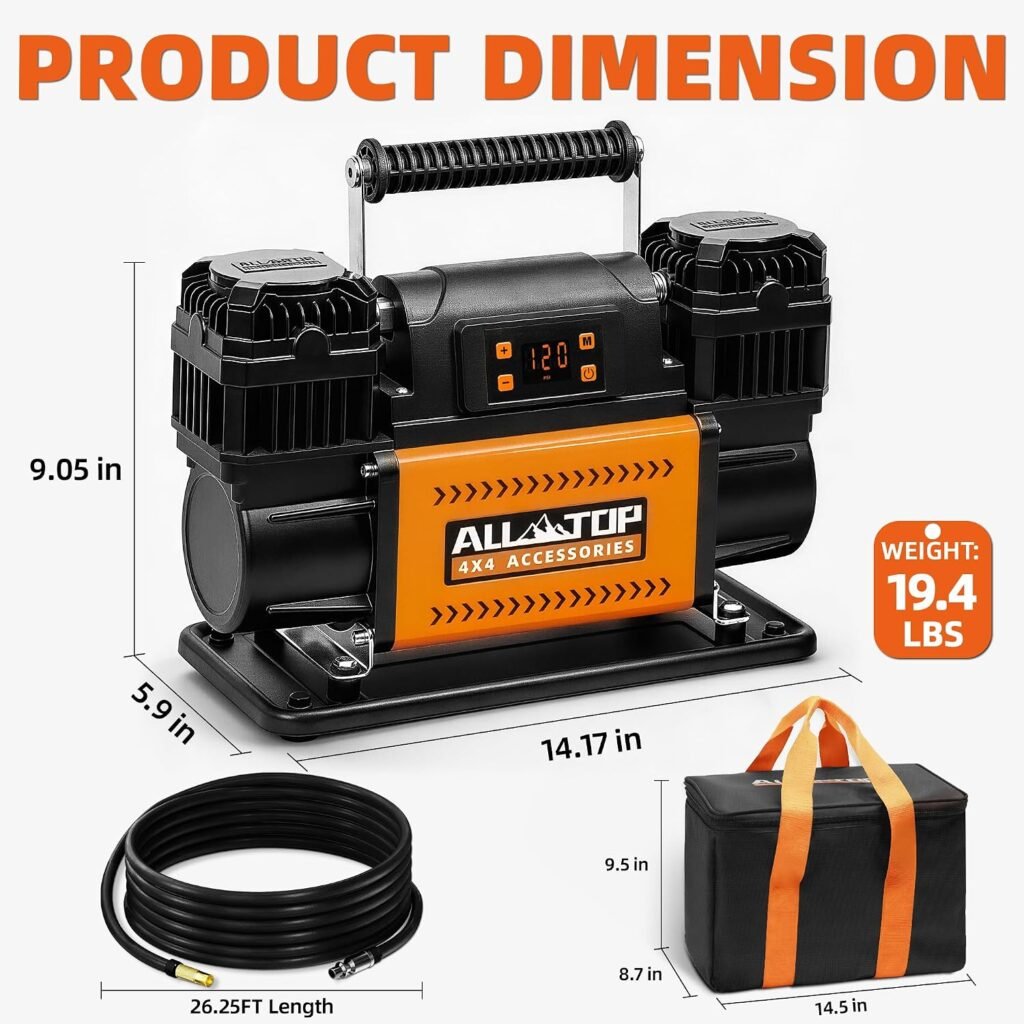
Physical equipment confirmed by the listing includes heavy-duty clamps, the cleanable filter, the metal base, insulated handle, and storage bag. Exact inflation times, hose length, clamp-lead length, decibel output, and warranty duration are not supplied. We should treat those as items to confirm through the current listing and detailed customer feedback rather than assume them from the advertised airflow.
In practical terms, the ALL-TOP 12V Air Compressor package appears aimed at field service rather than glove-box storage. The bag should make transport easier, while the base and handle address stability and handling. Neither feature, though, tells us how quickly a particular tire will inflate; only a like-for-like test or detailed buyer report can answer that.
ALL-TOP 12V Air Compressor Key Features in Detail
The dual-cylinder motor and large-cylinder construction are the main reasons this unit is more relevant to off-road vehicles than to ordinary bicycles or small car tires. Greater claimed airflow can reduce the time spent recovering from low trail pressures, particularly when several large tires need attention before we return to the road.
The LCD control panel supports four pressure units: PSI, kg/cm², BAR, and KPA. PSI is the most familiar choice for typical North American drivers, while BAR and KPA may be preferable for users following vehicle or tire information expressed in metric units. The display should make the target easier to read than a basic analog gauge, but the listing does not provide a stated accuracy tolerance.
The ALL-TOP 12V Air Compressor offers two operating approaches. In pressure-presenting mode, we set a target and allow the unit to stop automatically. Direct inflating mode is intended for users who prefer manual control. To use the automatic function, connect the compressor to the battery, attach the tire chuck, choose the pressure unit, set the target, start inflation, and check the final pressure after shutdown.
The listing says the compressor makes two to four intentional pauses during each inflation cycle. Those pauses are designed to improve pressure-reading accuracy, so they should not automatically be interpreted as a fault. We should observe whether the pause pattern is consistent and whether the unit resumes without intervention.
The anti-vibration metal base should help when the compressor is used on firm ground, while its mounting potential may suit a permanent vehicle installation. A cleanable sponge filter is also useful in dusty or muddy environments. We would inspect it after dirty trips, clean it according to the supplied instructions, let it dry completely if washed, and reinstall it correctly before use.
For trail users, the ALL-TOP 12V Air Compressor’s strongest feature combination is the large-cylinder design plus preset control. For a buyer who only needs occasional topping up, those advantages may be less valuable than a smaller, simpler pump.

Power, Safety, and Real-World Operating Limits
This compressor connects to a 12V battery through heavy-duty alligator clamps, so it is better matched with a vehicle battery or auxiliary battery than with a dashboard accessory socket. That arrangement can support demanding operation, but it also requires more care than plugging in a low-current emergency inflator.
The listed automatic thermal cut-off activates when the unit reaches an unsafe operating temperature above 221°F. Circuit-breaker protection is listed for unsafe current above 120 amps. These safeguards can reduce damage risk, but they do not replace correct polarity, secure cable placement, ventilation, or safe handling around a battery.
We would use the ALL-TOP 12V Air Compressor in this order:
- Park away from traffic, engage the parking brake, and keep the vehicle secure.
- Place the compressor on a stable, dry surface with airflow around it.
- Inspect the hose, clamps, leads, and tire connection before switching on.
- Connect the positive clamp to positive and the negative clamp to negative.
- Start the compressor and monitor its sound, heat, pressure display, and cable position.
- Allow cooling time if thermal protection activates or the housing becomes excessively hot.
High-current operation can bring heat buildup, noise, vibration, and battery load. Long hose runs may reduce convenience, cold weather can affect equipment and battery behavior, and loose sand or standing water is unsuitable for the compressor’s operating surface.
Several practical specifications remain unknown: exact duty cycle, hose length, sound level, clamp-lead length, and warranty duration. Before purchasing the ALL-TOP 12V Air Compressor, we would confirm those details, especially if planning permanent mounting or repeated multi-vehicle use.
Inflation Performance for Overlanding and Large Tires
The advertised 12.35 CFM airflow and dual-cylinder design point toward common overlanding jobs: airing up several tires after a trail run, topping up truck tires, or servicing trailers and recreational vehicles. Airflow generally matters more than the headline maximum PSI for routine tire inflation because most of our time is spent moving air into a tire, not approaching the compressor’s pressure ceiling.
Maximum pressure still matters for compatibility with higher-pressure applications, but it should not be mistaken for a guaranteed inflation-time figure. Actual results from the ALL-TOP 12V Air Compressor will vary with tire size, starting pressure, target pressure, valve restrictions, ambient temperature, hose setup, and whether the unit is moved between multiple tires.
We recommend establishing a personal baseline during first use:
- Record the tire size and starting pressure.
- Set a target pressure using the compressor’s preferred display unit.
- Use a stopwatch to record the inflation time.
- Note each intentional pause and whether the unit resumes automatically.
- Record any cooling breaks before testing the next tire.
- Confirm the final pressure with an independent, trusted gauge.
The preset function is convenient, but it should not replace a separate pressure check when tire safety, heavy loads, or highway travel is involved. A displayed stop point is an aid to consistency, not proof that the reading matches every external gauge.
That distinction separates this model from compact emergency inflators, which typically emphasize low weight and accessory-plug convenience. The ALL-TOP 12V Air Compressor instead accepts the inconvenience of battery clamps in exchange for a claimed airflow level and construction intended for larger, repeated jobs.
For occasional users, the ALL-TOP 12V Air Compressor may be unnecessarily substantial. For a driver who routinely airs down several large tires, its design is much more relevant than a pump selected only by its maximum PSI number.
What Customers Are Saying
The supplied product information does not include a star rating, review count, verified-purchase breakdown, inflation-time sample, or failure-rate statistic. We therefore cannot responsibly claim that buyers consistently praise or criticize a specific aspect. The right conclusion is not that the compressor has no customer evidence, but that the available data here is insufficient for a numerical review summary.
When reading published feedback about the ALL-TOP 12V Air Compressor, we would look first for repeated reports involving large-tire inflation speed, LCD accuracy, auto-stop reliability, clamp durability, hose quality, heat behavior, noise, portability, and long-term performance. Comments that identify tire size, starting pressure, target pressure, and cooling intervals are much more useful than short statements saying only that the unit is “powerful.”
We would also separate setup problems from confirmed product faults. Incorrect polarity, a weak battery, a restricted valve, poor ventilation, or an unsuitable surface can produce a disappointing experience without proving that the compressor itself failed. Conversely, repeated reports of premature thermal cut-off, circuit-breaker trips under normal use, a display that differs materially from an independent gauge, or auto-stop failure deserve more weight.
Accessory-focused feedback matters too. Buyers may comment on whether the carrying bag protects the unit, whether the insulated handle remains comfortable, whether the metal base stays stable, and whether the sponge filter is easy to remove and clean. Those details affect ownership even though they do not appear in the airflow headline.
Our review-reading method would be simple: sort comments by most recent, compare verified-purchase reviews, search for the actual tire sizes being serviced, and give detailed long-term reports more weight than first-impression comments. Until those patterns are confirmed, the ALL-TOP 12V Air Compressor should be judged primarily from its stated specifications rather than invented customer statistics.
How the ALL-TOP 12V Air Compressor Compares With Alternatives
The VIAIR 400P and Smittybilt are sensible names to compare, but current competitor specifications and prices should be checked immediately before publication because listings and packages can change. We should compare intended use, power connection, claimed airflow, maximum pressure, controls, duty-cycle expectations, supplied accessories, storage, mounting options, warranty support, and actual buyer feedback—not just the largest number on a product page.
Compared with the VIAIR 400P, the ALL-TOP 12V Air Compressor is positioned around dual-cylinder construction and a preset LCD stop function. The VIAIR alternative may appeal more to shoppers who prioritize an established brand, a familiar heavy-duty 12V format, or a smaller footprint, depending on the current version and package. We should verify its exact airflow, pressure rating, cable arrangement, price, and warranty rather than rely on a general reputation.
The Smittybilt offers another heavy-duty comparison point. Its appeal depends on how its airflow claim, expected duty cycle, controls, accessories, mounting or storage convenience, and current price compare under the same test conditions. A higher advertised airflow is not automatically better if it is measured differently or accompanied by shorter operating limits.
For a fair comparison, we would use the same tire size and starting pressure, measure inflation time independently, record thermal limits, inspect clamp quality, assess noise, and read detailed long-term reviews. The ALL-TOP 12V Air Compressor is the stronger candidate for shoppers who specifically want preset LCD control, dual cylinders, and the claimed 12.35 CFM output.
An alternative may still be preferable for someone wanting a more established service network, a different duty cycle, lower cost, reduced storage space, or easier accessory-power compatibility. The ALL-TOP 12V Air Compressor is not a universal winner; the better choice depends on whether we value rapid multi-tire work, portability, controls, support, or total cost.
Who Should Buy the ALL-TOP 12V Air Compressor?
The best candidates are overlanders, off-road drivers, crawler owners, truck and SUV users, trailer owners, and anyone who regularly airs down and reinflates multiple large tires. These users can benefit from a heavy-duty compressor designed for repeated field inflation rather than a pump intended mainly for emergencies.
The battery-clamp connection suits vehicles with a properly accessible 12V battery or auxiliary power system. It is less convenient for someone expecting a plug-and-play cabin accessory, particularly if the battery is difficult to reach or the user does not want to open the bonnet during every inflation session.
We would choose the ALL-TOP 12V Air Compressor when repeated, demanding inflation makes the claimed 12.35 CFM airflow, dual cylinders, thermal protection, and metal base more valuable than compact size. It is a poor fit for cyclists, standard passenger-car owners, and emergency-only users who want minimal storage space and the lowest upfront cost.
Our decision process would be:
- Identify the tire sizes we normally service.
- Count how many tires are typically reinflated in one outing.
- Check how easily we can reach a suitable 12V battery.
- Decide whether preset auto-stop is genuinely useful to us.
- Compare the $269.99 price with expected use frequency.
- Confirm vehicle compatibility, electrical requirements, hose reach, storage space, and warranty terms.
For the right vehicle, the ALL-TOP 12V Air Compressor can be a practical recovery tool. For a seldom-used passenger-car kit, a lighter alternative will probably make more sense.
Price, Value, and Ownership Costs
At $269.99, the unit asks us to pay for more than a compressor body. The package includes dual-cylinder construction, a claimed PSI maximum, 12.35 CFM airflow, LCD preset control, battery clamps, a cleanable filter, anti-vibration metal base, thermal and circuit protection, insulated handle, and carrying bag.
The value case rests on time saved across repeated inflation sessions, not on the maximum-pressure number alone. If we regularly air up several large tires, reducing time beside the vehicle can justify a higher purchase price. If the compressor will sit unused until one rare roadside emergency, the ALL-TOP 12V Air Compressor may be poor value compared with a smaller and cheaper inflator.
Ownership considerations include battery strain, filter cleaning, dry storage, cooling pauses, and the possibility of permanent mounting. We would also investigate whether replacement hoses, clamps, and electrical parts are readily available. Those support details can matter more over several years than a small difference in advertised airflow.
Our value summary looks like this:
- Frequent overlanding and large tires: potentially strong value if real-world speed, thermal behavior, and durability match the listing.
- Occasional truck or trailer use: reasonable only if the convenience of heavy-duty output and preset control offsets the size and price.
- Emergency-only passenger-vehicle use: likely excessive unless we specifically want battery-clamp power and heavy construction.
The final judgment should include verified durability reports, warranty coverage, and current competitor pricing. The ALL-TOP 12V Air Compressor is attractive as a complete package, but the advertised airflow alone cannot establish long-term value.
Setup and Maintenance Advice for Long-Term Use
Before taking the unit on a trail, we would inspect the compressor and bag, confirm that all listed accessories are present, place it on a stable surface, and check the clamps and hose for damage. We would also power it briefly in a safe location to test the LCD controls before depending on it away from home.
To use the preset mode, choose the correct pressure unit, set a conservative target, attach the chuck securely, and watch the compressor through its pauses and automatic shutdown. After it stops, check the tire with a separate gauge and adjust manually if necessary. This process lets us learn how the display behaves before a heavily loaded vehicle is back on the road.
The ALL-TOP 12V Air Compressor’s sponge filter should be inspected after dusty or muddy trips. Clean it using the supplied guidance, allow it to dry fully if washing is permitted, and reinstall it correctly before operating the motor. A blocked or damp filter is not something we should ignore.
For storage, keep the unit dry in its heavy-duty bag, avoid sharp bends in the hose and clamp leads, and protect it from prolonged extreme heat. We would record actual inflation times and thermal behavior for our own tires so future trips can be planned around realistic cooling intervals rather than the headline specification.
Permanent mounting requires space for vibration, airflow, battery-cable routing, moisture protection, filter access, and control-panel visibility. The ALL-TOP 12V Air Compressor can be used individually or mounted, but a rushed installation could make maintenance and safe operation harder. A removable setup is preferable when several vehicles share the equipment.
Pros and Cons
Pros
- Dual-cylinder design and claimed 12.35 CFM airflow target demanding large-tire inflation.
- LCD control panel supports preset-pressure auto-stop and four selectable pressure units.
- Heavy-duty battery alligator clamps avoid reliance on a dashboard accessory socket.
- Thermal cut-off above 221°F and circuit-breaker protection above amps are listed.
- Anti-vibration metal base, insulated handle, cleanable sponge filter, and carrying bag support field use.
Cons
- The $269.99 price is high for occasional passenger-car or emergency-only use.
- Battery-clamp operation is less convenient than a cigarette-lighter or accessory-plug inflator.
- Exact duty cycle, hose length, noise rating, clamp-lead length, warranty duration, and inflation times are not supplied.
- The claimed 12.35 CFM figure does not by itself guarantee a specific inflation speed on a particular tire.
- High-current operation can involve heat, noise, vibration, battery strain, and required cooling breaks.
Final Verdict
Key Takeaways
- The compressor is designed for repeated inflation of large off-road, truck, SUV, trailer, and recreational-vehicle tires rather than occasional low-demand use.
- Its key advertised features are dual cylinders, a PSI maximum, claimed 12.35 CFM airflow, LCD preset auto-stop, battery clamps, and multiple protection systems.
- The battery-clamp connection and high-current operation require more planning than a cigarette-lighter inflator, including safe placement, correct polarity, ventilation, and cooling time.
- At $269.99, the value depends heavily on how often we reinflate multiple large tires and whether real-world performance matches the listing.
- Exact duty cycle, hose length, noise level, warranty duration, customer rating, review count, and inflation times should be verified before purchase.
Frequently Asked Questions
Is the ALL-TOP 12V Air Compressor suitable for large off-road tires?
Its dual-cylinder construction and claimed 12.35 CFM airflow are aimed at heavy-duty inflation and large off-road tires. Actual speed will depend on tire size, starting pressure, temperature, valve restriction, hose setup, and cooling requirements.
Does it stop automatically at the selected pressure?
Yes. The listing describes a pressure-presenting mode with an LCD control panel that stops at a preset target. It also states that the compressor may make two to four intentional pauses during inflation to improve pressure-reading accuracy.
Can it plug into a cigarette-lighter socket?
The supplied product details specify heavy-duty alligator clamps for a 12V battery connection. They do not describe dashboard accessory-plug operation, so buyers should not assume that connection method is supported.
What safety protection does the compressor include?
The listing specifies automatic thermal cut-off above 221°F and circuit-breaker protection for unsafe current above amps. We still need to use correct polarity, ventilation, stable placement, and safe battery-handling practices.
Is $269.99 good value?
It may be reasonable for frequent overlanding, truck, SUV, trailer, or multi-tire use where heavy-duty construction and preset control save time. It is less compelling for occasional passenger-car emergencies, where a smaller compressor may meet the need at lower cost.
Disclosure: As an Amazon Associate, I earn from qualifying purchases.