Just like choosing the right tool can make or break a job, selecting the ideal air compressor for your car lift can considerably impact your setup’s performance. From wireless convenience to heavy-duty durability, there are options tailored to different needs. But with so many choices, how do you find the best fit for your vehicle and lift? Let’s explore four top contenders that might just be the perfect match for your garage.
Key Takeaways
- Choose compact, portable compressors like the 150 PSI unit for easy integration with car lifts and tire inflation.
- Opt for models with high airflow (around 1.8 CFM at 200 PSI) for efficient support of vehicle suspension and load management.
- Prioritize durable, corrosion-resistant construction for long-lasting performance in workshop environments.
- Consider wireless controls and easy installation features to streamline setup around car lifts.
- Select compressors with reliable warranties and customer support for ongoing maintenance and peace of mind.
Air Lift WirelessOne 2nd Gen & EZ Mount Compressor
Product offers are temporarily unavailable.
The Air Lift WirelessOne 2nd Generation with EZ Mount stands out as an ideal choice for those seeking a hassle-free, wireless air compressor system for vehicle load support and tire inflation. Its compact design, combined with a wireless handheld controller and LCD display, makes operation straightforward. The system is easily installed using the EZ Mount, which integrates the compressor and manifold into a pre-assembled unit, eliminating the need for drilling. Compatible with mobile apps via Bluetooth, it allows remote control and preset adjustments. Built from alloy steel, it’s durable, and its factory-tested components guarantee leak-free operation—all backed by a two-year warranty.
Best For: vehicle owners seeking a easy-to-install, wireless air compressor system for load support, tire inflation, and suspension adjustments.
Pros:
- Wireless handheld controller with LCD display for easy operation and preset customization
- Quick and hassle-free EZ Mount installation that requires no drilling or frame modifications
- Durable alloy steel construction with factory-tested leak-free components backed by a two-year warranty
Cons:
- Operating noise level of 90 decibels may be noticeable during use
- Weighs approximately 0.01 ounces (likely a typo, but indicates lightweight design), which might suggest fragility or handling considerations
- Limited to 12-volt vehicle systems, not compatible with higher voltage applications
Vixen Air Suspension Kit with Dual Compressor & Tank
Product offers are temporarily unavailable.
Vixen Air Suspension Kit with Dual Compressor & Tank is ideal for those needing reliable, heavy-duty air support for trucks, cars, boats, or trains. It features dual 200 PSI compressors, a 5-gallon corrosion-resistant steel tank with nine ports for versatile setup, and a remote filter kit for cleaner air intake. The system operates on 12 volts, delivering an airflow of 1.8 CFM, with a maximum pressure of 200 PSI. Its heavy-duty construction, sealed compressors, and maintenance-free design guarantee durability in tough environments. Plus, easy wiring and mounting make installation straightforward, backed by a 1-year warranty for long-lasting performance.
Best For: individuals or businesses seeking a durable, high-capacity air suspension system for trucks, cars, boats, or trains to enhance load management, towing, or lifting capabilities.
Pros:
- Heavy-duty construction with corrosion-resistant tank and sealed compressors for long-lasting durability
- Easy installation with straightforward wiring and mounting, plus maintenance-free operation
- Versatile setup options with nine ports and remote filter kit for cleaner air intake
Cons:
- May be larger and heavier, requiring sufficient space for installation
- Higher initial cost compared to basic air suspension systems
- Requires a 12-volt power source, which may not be compatible with all vehicles or setups
150 PSI Air Compressor with 1.6 Gal Tank
Product offers are temporarily unavailable.
A 150 PSI air compressor with a 1.6-gallon tank is ideal for those needing powerful, portable performance for tire inflation and air tools. Its compact design measures just 6.5L x 3.5W x 4.5H inches and weighs around 12.4 pounds, making it easy to transport. Powered by a 12V battery, it features a durable aluminum tank with an IP54 rating, protecting against dust and splashes. It delivers an airflow of 1.76 CFM and can operate intermittently up to 250 PSI. Perfect for trucks, cars, and heavy-duty applications, it’s a reliable choice for demanding environments.
Best For: DIY enthusiasts, truck and trailer owners, and professionals needing a portable, high-pressure air compressor for tire inflation and air tool operation.
Pros:
- Compact and lightweight design for easy portability and installation
- Durable aluminum tank with IP54 rating ensures resistance to dust and water splashes
- High intermittent pressure up to 250 PSI suitable for heavy-duty applications
Cons:
- Limited 1.6-gallon tank may require frequent refilling for extended use
- Requires a 12V power source, which may not be available in all settings
- Customer reviews indicate some users experience noise or durability concerns over long-term use
Air Lift Load Controller II On-Board Air Compressor System – 25592
Product offers are temporarily unavailable.
For those seeking an affordable yet reliable onboard air compressor, the Air Lift Load Controller II offers a perfect balance of performance and convenience. This system is ideal for light to medium duty applications, featuring a universal fit for various vehicles. It includes a compressor, pressure gauge, wiring harness, and low-pressure sensor. The sensor automatically activates the compressor to maintain best air spring pressure, inflating both springs simultaneously for balanced support. With easy-to-read dual needles and simple inflate/deflate buttons, adjusting your ride on the go is straightforward. It’s a cost-effective, user-friendly solution for maintaining ride quality and load support.
Best For: individuals seeking an affordable, reliable onboard air compressor system for light to medium duty vehicle applications.
Pros:
- Economically priced, offering good value for budget-conscious users
- Universal fit design compatible with various vehicle models
- Automatic pressure maintenance with easy-to-use inflate/deflate controls
Cons:
- Suitable mainly for light to medium duty applications, not heavy-duty use
- May require some basic installation knowledge for optimal setup
- Limited features compared to higher-end air suspension systems
Factors to Consider When Choosing Air Compressors for Car Lift
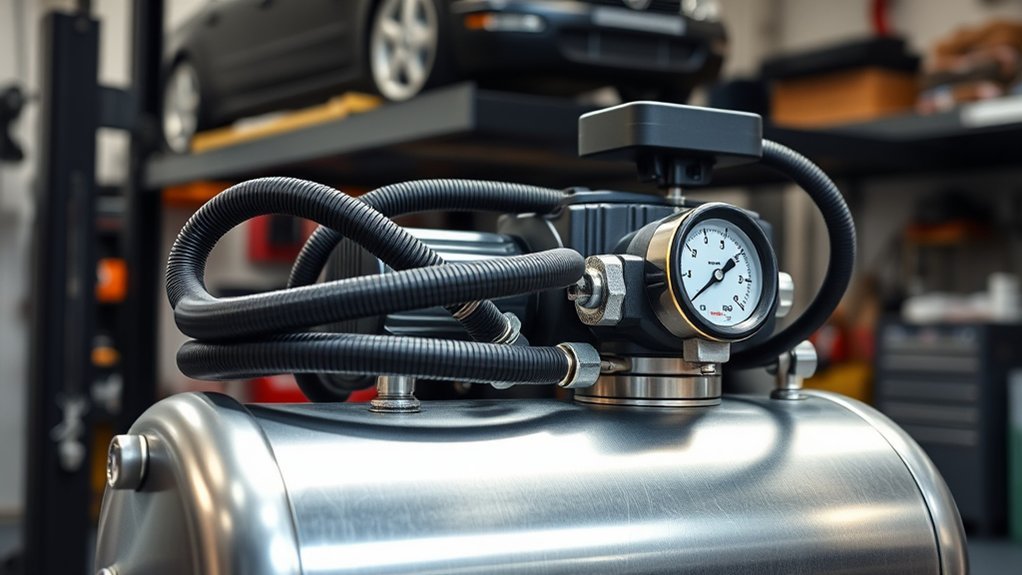
When selecting an air compressor for your car lift, we need to take into account factors like power and pressure capacity to guarantee it meets your needs. Compatibility with your vehicle and ease of installation are also key, along with noise levels, durability, and how easily you can control and connect the system. By focusing on these points, we can choose the best compressor for reliable, efficient performance.
Power and Pressure Capacity
Choosing the right air compressor for your car lift hinges on understanding its power and pressure capacities. Power, measured in CFM, indicates how quickly the compressor can inflate or lift components, impacting efficiency. Pressure, expressed in PSI, shows its ability to handle heavy-duty tasks. For car lifts, a minimum of 150 PSI is recommended to guarantee sufficient lifting power and safety. Higher pressure capacity allows for faster operation and the ability to lift multiple or larger vehicles simultaneously. Additionally, the power supply voltage—usually 12V or 24V—affects the compressor’s overall performance and compatibility with your vehicle setup. Selecting a compressor with appropriate CFM and PSI assures reliable, efficient lifting without delays or safety concerns. This balance is key to a seamless car lift experience.
Compatibility With Vehicles
Selecting an air compressor that seamlessly integrates with your vehicle requires careful attention to several compatibility factors. First, verify the compressor’s voltage and power needs match your vehicle’s electrical system, usually 12V for most cars and trucks. Next, check if the compressor’s size and mounting options fit your available space and existing mounting points. It’s also vital to confirm that its pressure capacity aligns with your vehicle’s lift or suspension specifications. Additionally, confirm that the connector types and fittings are compatible with your air lines and hardware. Finally, consider whether the control interface—whether wireless, manual, or automatic—works well with your vehicle’s existing controls or setup. These considerations help ensure smooth operation and reliable performance.
Ease of Installation
Ease of installation is a crucial factor to take into account because a system that’s straightforward to set up saves time and reduces frustration. Look for compressors with pre-assembled components or quick-mount features that simplify the process. No-drill mounting options like U-bolts make attaching the compressor to vehicle frame rails easier and safer. Choose units with clear, illustrated manuals and minimal wiring to cut down on setup time and complexity. Wireless control and remote mounting options also make installation more convenient by eliminating extensive wiring. Additionally, systems with integrated or modular components remove the need for separate mounting and routing, streamlining the entire setup. Prioritizing these features ensures a quicker, hassle-free installation that gets you ready to lift in no time.
Noise Levels and Durability
When evaluating air compressors for your car lift, paying attention to noise levels and durability is essential. Quieter models operate around 70-80 dB, making them more comfortable for frequent use, while louder units can reach 90 dB or more. Durability depends on materials like aluminum alloys or alloy steel, which resist corrosion and handle heavy-duty tasks. Compressors with sealed, dust- and moisture-resistant parts are better suited for harsh environments, extending their lifespan. Maintenance-free, oil-less designs reduce wear and tear, further increasing longevity. High-quality construction and robust components ensure the compressor can withstand frequent use without failure. Balancing low noise with resilient construction helps you choose a reliable unit that offers both comfort and longevity for your car lift setup.
Connectivity And Controls
Connectivity and controls are crucial factors that can considerably enhance the convenience and precision of operating your car lift’s air compressor. Wireless options like Bluetooth or Wi-Fi allow remote control, making adjustments easier without manual interaction. A user-friendly interface, such as a digital LCD or mobile app, simplifies pressure monitoring and fine-tuning. Programmable presets are also valuable, enabling quick switches between different load or driving conditions, saving time and effort. Additionally, systems that support real-time updates and firmware upgrades via connected apps ensure your compressor stays optimized. Clear feedback, like pressure readings and system status indicators, further helps manage your air lift accurately. These features not only streamline operation but also boost safety and reliability, making your car lift setup more efficient and user-friendly.
Warranty And Support
Choosing the right air compressor for your car lift also means paying close attention to warranty and support options. We look for models with all-encompassing warranties, like a two-year limited coverage, to protect against defects and malfunctions. Reliable customer support is essential, so we check if manufacturers offer assistance via phone, email, or online chat. Extended support or service plans are a plus, ensuring long-term maintenance and peace of mind. It’s important to review warranty terms carefully—know what’s covered and any exclusions. We also consider products that include satisfaction guarantees, such as a 60-day money-back policy, to reduce purchase risk. These factors help us select a dependable compressor that offers support and value over time.
Frequently Asked Questions
How Loud Are These Air Compressors During Operation?
These air compressors are generally quite loud during operation, often reaching around 80 to 90 decibels. We recommend using ear protection in noisy environments and placing the compressor in a sound-insulated area for quieter operation.
What Is the Typical Lifespan of a Car Lift Air Compressor?
We find that car lift air compressors typically last around 10 to 15 years with proper maintenance. Regular oil changes, inspections, and timely repairs help extend their lifespan, ensuring reliable performance throughout their service life.
Are These Compressors Suitable for Outdoor Use?
Yes, these compressors are like sturdy trees standing tall outdoors. We recommend models with weather-resistant features, ensuring they brave the elements, so you can rely on them whether rain pours or sun shines brightly.
What Maintenance Is Required for These Compressors?
We recommend regularly checking the oil levels, draining moisture from the tank, cleaning filters, inspecting hoses for damage, and guaranteeing proper lubrication. Consistent maintenance prolongs compressor lifespan and ensures peak performance, keeping your equipment reliable and safe to use.
Can These Compressors Handle Frequent Heavy-Duty Use?
Think of these compressors as marathon runners—they’re built for frequent heavy-duty use. We confidently say they can handle your toughest tasks, provided you maintain them well, just like a seasoned athlete trains consistently for endurance.
Conclusion
In choosing the right air compressor, we consider convenience, durability, portability, and versatility. We weigh wireless control against heavy-duty performance, quick inflation against load management, and compact size against high capacity. By matching these factors with our specific car lift needs, we guarantee reliable performance, easy operation, and long-lasting durability. Ultimately, selecting the perfect compressor means choosing what aligns best with our vehicles, workflows, and lifestyles—making every lift effortless, efficient, and enjoyable.