Have we ever wished our air compressor could actually run in the background without taking over the entire room with noise?
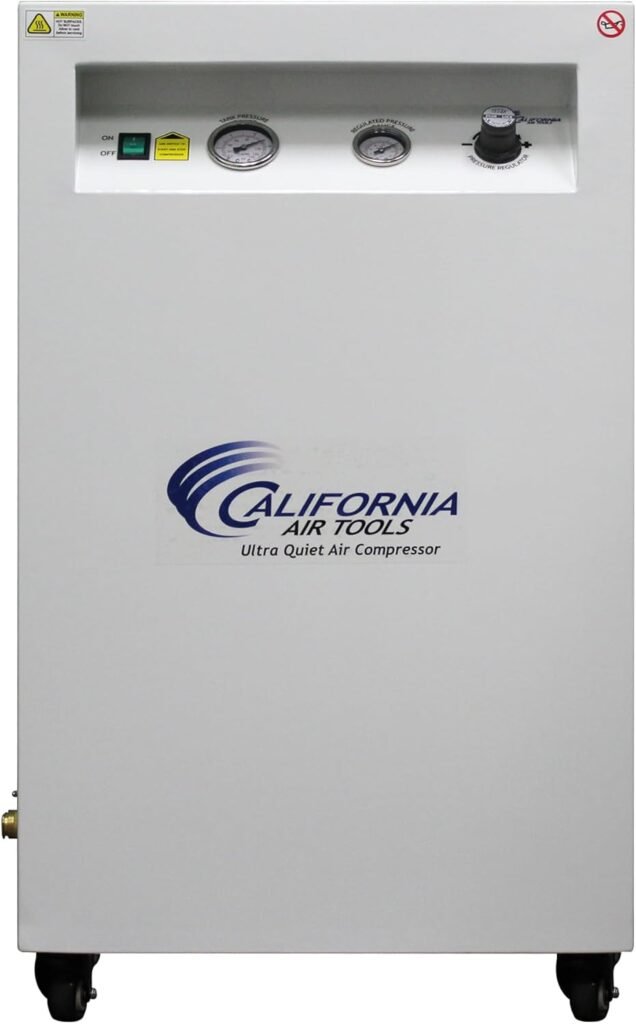

What Is the California Air Tools 20040SPCAD and Who Is It For?
This model is a 4.0 HP, ultra quiet, oil-free air compressor with a 20-gallon tank, all housed in a sound proof cabinet with an auto drain valve, running on 220V / 60Hz. It is built for serious users who want strong air output with minimal noise and reduced maintenance.
We see it as a solid choice for workshops, garages, small industrial spaces, and even indoor applications where noise is a real concern. If we run tools often, need consistent airflow, and share space with others or work in a noise-restricted environment, this unit immediately stands out.
Key Specifications at a Glance
To make things easier to understand, we can summarize the most important specs in a simple table.
| Feature | Specification |
|---|---|
| Model | California Air Tools 20040SPCAD |
| Horsepower | 4.0 HP (twin 2.0 HP motors) |
| Pump Type | Oil-free dual piston |
| Voltage / Frequency | 220V / 60Hz |
| Noise Level | 65 dB |
| Tank Size | 20-gallon steel tank |
| Airflow @ 40 PSI | 12.80 CFM |
| Airflow @ 90 PSI | 10.60 CFM |
| Pump Life Cycle | Over 3000 hours |
| Cabinet | Sound proof cabinet with two latching doors |
| Mobility | 4 swivel caster wheels |
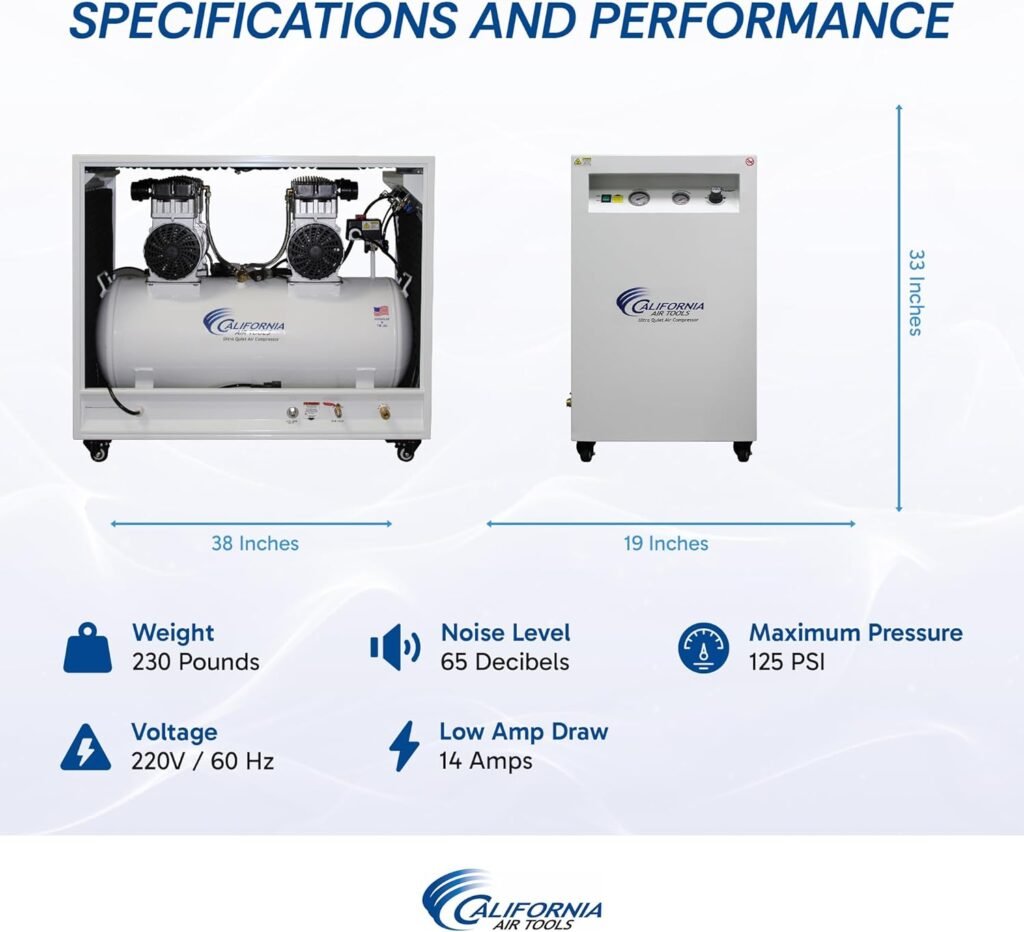
| Approx. Weight | About 230 lbs |
| Dimensions (L x W x H) | 19″ x 38″ x 33″ |
| Special Feature | Auto drain valve for automated tank draining |
This quick snapshot gives us a clear sense of what we are getting: serious air delivery, reduced noise, and a heavy-duty build arranged in a mobile cabinet format.
Noise Level: How Quiet Is 65 dB Really?
One of the biggest reasons to consider this compressor is the ultra quiet feature. The manufacturer lists the noise level at 65 dB, which is impressively low for a 4.0 HP machine.
In real terms, 65 dB is roughly equivalent to a normal conversation or a quiet office. That is dramatically less noise than traditional piston compressors, which can easily reach 80–90 dB or more. For anyone who has spent time with a traditional shop compressor, we know how much of a difference this can make.
Why a Quiet Compressor Matters in Real Use
When we are working in a shared workspace, attached garage, or small shop, sound becomes more than an annoyance; it can be a barrier to productivity. With this unit, we can keep running air tools, sprayers, and equipment without needing ear protection all day or disturbing everyone nearby.
We can also run it closer to where we work without rearranging the entire layout just to get the compressor out of earshot. This convenience adds up over time, especially on long projects.
Oil-Free Dual Piston Pump: Low Maintenance, Cleaner Air
Another standout feature is the oil-free dual piston pump. Unlike oil-lubricated compressors, we do not need to worry about changing oil or dealing with oil carryover into airlines.
The oil-free design simplifies our maintenance routine. According to the specs, the pump has a life cycle of over 3000 hours, which is strong for an oil-free system. That means more uptime and less tinkering over the lifespan of the compressor.
Benefits of Oil-Free for Our Tools and Environment
Because the pump is oil-free, the air we get is cleaner. For painting, finishing, or running sensitive pneumatic tools, cleaner air means less contamination and less risk of defects in coatings or finishes. We are also less likely to deal with oily residue in our hoses or air tools.
Additionally, oil-free compressors handle a wider range of temperatures and terrains without the complexities that oil viscosity brings. For climates with seasonal swings or variable workshop conditions, this flexibility can be reassuring.
Power and Performance: 4.0 HP and Strong CFM Output
Under the cabinet, this unit carries two 2.0 HP motors that combine for a total of 4.0 HP. They run at 1680 RPM, which is lower than many conventional compressors. Lower RPM reduces both noise and wear on components.
In terms of airflow, we get:
- 12.80 CFM at 40 PSI
- 10.60 CFM at 90 PSI
These numbers tell us we are dealing with a serious machine suitable for a good range of air-hungry tools.
What Can We Run With This Compressor?
With over 10 CFM at 90 PSI, we can comfortably run:
- Impact wrenches (1/2″ and some 3/4″)
- Ratchets and air hammers
- Framing nailers, roofing nailers, and finish nailers
- Spray guns (HVLP and conventional, depending on requirements)
- Die grinders and some sanders (with appropriate duty cycling)
For continuous-use tools like air sanders or blast cabinets, we will still need to check specific CFM needs. However, for most small shops, automotive work, and general construction or woodworking tasks, this compressor has the muscle to keep up.
20-Gallon Steel Tank: Capacity and Practicality
The 20-gallon tank offers a solid balance between size, capacity, and footprint. It is large enough to reduce frequent compressor cycling for many tasks and small enough to remain relatively compact.
The steel tank is built to handle regular pressurization cycles, and the cabinet enclosure protects it and the pump from accidental bumps and dust.
How Tank Size Affects Our Work
With 20 gallons, we have a buffer of stored air that helps smooth out demand spikes. If we are driving a series of nails, running shorter bursts of an impact wrench, or using a blow gun, the compressor can often keep up without running constantly.
For tasks that require longer continuous flow, such as spraying or grinding, the tank gives us a cushion. The more consistent the airflow, the less we find ourselves pausing to wait for pressure to recover.
Sound Proof Cabinet: Design and Function
One of the truly distinctive elements of this product is the sound proof cabinet. The compressor is enclosed in a dedicated cabinet, which plays a big role in achieving the 65 dB noise rating.
The cabinet includes:
- Two latching doors for easy access
- Two exhaust fans to remove hot air
- Sound-damping materials to contain noise
We can open the doors to reach controls, check connections, and perform basic maintenance, while the overall structure contains a large portion of the mechanical noise.
Heat Management and Internal Airflow
Any time we enclose a motor and pump, heat becomes a concern. That is why the cabinet has two exhaust fans built in. These fans help draw warm air out of the enclosure and reduce heat buildup around the motor and pump.
Proper ventilation is important for the lifespan of the compressor and for safety. As we use the unit, we will want to leave enough clearance around the cabinet so those fans and vents can do their job effectively.
Auto Drain Valve: Automation for Better Maintenance
Condensation in the tank is unavoidable when we compress air, especially in humid environments. Over time, water in the tank can lead to corrosion and reduce tank life if it is not removed regularly.
This unit includes an auto drain valve that automates tank draining. Instead of crawling under the tank and manually opening a valve, we can let the system handle it.
Why Automated Draining Helps Us Long-Term
Automated draining is more than just a convenience; it helps protect our investment. When we are busy, it is easy to forget to drain the tank, especially if the compressor is tucked away in a corner. With the auto drain, water is regularly cleared, reducing rust and internal tank damage.
We will still want to occasionally inspect the drain and make sure everything is working properly, but this feature takes one recurring chore off our plate.

Mobility and Size: Moving a 230-Pound Cabinet
At around 230 pounds, the California Air Tools 20040SPCAD is not light, but the design helps offset that. The sound proof cabinet sits on four swivel caster wheels, making it easier to move around smooth floors.
This is helpful if we want to reposition the compressor as our workspace changes. We can roll it closer to the action when needed, or tuck it further out of the way once we have our airlines set up.
Footprint and Space Planning
With dimensions of approximately 19″ (L) x 38″ (W) x 33″ (H), the cabinet has a fairly compact footprint for what it delivers. We can position it along a wall, near a corner, or in a service area without taking up excessive floor space.
We should account for:
- Clearance for the doors to open
- Ventilation space for the exhaust fans
- Access to the power connection (220V)
- A convenient path for air lines or a hose reel
Thoughtful placement will let us take full advantage of its quiet operation while maintaining easy access for service and use.
Build Quality and Durability
California Air Tools has a reputation in the compressor market for quiet, efficient, and relatively low-maintenance machines. With this particular model, the build reflects that focus.
Key durability points include:
- Steel tank construction
- Oil-free pump with 3000+ hour life cycle
- Lower RPM motors (1680 RPM) to reduce wear
- Enclosed cabinet to offer some protection from shop dust and impacts
We still need to follow basic maintenance guidelines, but the combination of components suggests this unit is built for regular, long-term service.
What We Can Expect Over Time
Over years of usage—especially in a small business or busy hobbyist setting—the greatest wear points will usually be:
- Pump components
- Motor bearings
- Electrical connections
- Drain and valves
The oil-free design eliminates oil changes, but we will still want to keep the unit clean, monitor for leaks, and respect duty cycles during heavy work. With the cabinet helping reduce dust ingress and impacts, we can reasonably look at this as a long-term workstation tool rather than a short-lived gadget.
Ease of Use and Daily Experience
Day to day, what matters most is how straightforward the compressor is to operate and live with. This model is clearly targeted at users who want simplicity alongside performance.
We benefit from:
- Simple on/off operation
- Enclosed, quieter running
- Automatic draining
- Easy mobility on casters
The overall user experience leans toward “set it and forget it,” especially once we have our airlines and power connected correctly.
Starting, Running, and Shutting Down
Once installed, we can:
- Make sure the unit is connected to the proper 220V / 60Hz circuit.
- Confirm that the drain and cabinet doors are properly closed.
- Switch on the compressor and allow it to build pressure in the tank.
- Attach our air tools or distribution system to the output.
- Monitor the pressure gauge and operate within the intended PSI range.
Shutting down is just as simple: powering off the unit and ensuring that the system is not left pressurized if we will not be using it for an extended period. The auto drain helps keep moisture down without extra daily steps.
Power Requirements: 220V / 60Hz Considerations
This compressor is not a standard 120V plug-in device. It requires 220V / 60Hz, which is typical for more powerful shop equipment. For some of us, that is already part of our setup; for others, it may require a dedicated circuit.
We will want to confirm:
- Our workshop or garage has a suitable 220V outlet.
- The circuit is properly rated for the starting and running loads.
- Wiring and breakers meet local electrical codes.
Why a 220V Compressor Makes Sense
The step up to 220V makes it possible to run a 4.0 HP compressor with higher CFM while keeping current levels reasonable. This often means better efficiency and performance for heavy-duty tasks.
If we are running welders, large saws, or other serious equipment, adding this compressor to our 220V lineup fits the profile of a more professional or semi-professional workspace.
Use Cases: Where This Compressor Shines
This model is especially well-suited for:
- Auto repair shops and body shops
- Woodworking shops with nailers, sprayers, and sanders
- Home garages where noise is a concern
- Indoor workspaces, basement shops, and small production spaces
- Light manufacturing or assembly areas using multiple pneumatic tools
The combination of low noise and robust performance makes it a strong match for people who both work often and share space with others.
Indoor and Residential Settings
If we have neighbors close by or family working or relaxing near our shop, noise control is not optional. The 65 dB rating—along with the sound proof cabinet—helps us maintain a more peaceful environment.
We can keep working early or late without worrying about the compressor constantly interrupting conversations or disturbing the household every time the tank refills.
Pros and Cons of the California Air Tools 20040SPCAD
Every tool has tradeoffs, and it helps to look at both sides before we commit. Here is how we see the main strengths and weaknesses of this compressor.
Advantages
- Ultra quiet operation (65 dB): Much less intrusive than traditional compressors.
- Oil-free dual piston pump: Reduced maintenance, no oil changes, cleaner air.
- Strong airflow for the size: 12.80 CFM @ 40 PSI and 10.60 CFM @ 90 PSI.
- 4.0 HP with twin 2.0 HP motors: Serious power at a reasonable RPM (1680).
- Sound proof cabinet: Better noise containment, cleaner appearance, protection.
- Auto drain valve: Helps protect the tank and remove moisture automatically.
- 20-gallon steel tank: Solid capacity and durable construction.
- Mobility with caster wheels: Easier positioning in a shop or garage.
Potential Drawbacks
- Requires 220V / 60Hz power: Not compatible with a standard 120V outlet.
- Heavier unit (around 230 lbs): Mobile but not easy to lift; best on smooth surfaces.
- Cabinet needs space for ventilation: We must plan for airflow and clearance.
- Higher initial cost than small portable units: Built for more serious, ongoing use.
Weighing these points, we see this compressor as a better fit for committed users—pros, semi-pros, and dedicated hobbyists—rather than occasional, light-duty users with basic 120V needs.
How It Compares to More Basic Compressors
If we currently use a small pancake compressor or a standard, uncovered shop compressor, the practical differences will be clear.
Compared to a basic portable:
- We get far more CFM and tank capacity.
- Noise is dramatically lower, especially with the sound proof cabinet.
- Maintenance is simplified with the oil-free pump and auto drain.
Compared to a traditional big-box shop compressor:
- Sound levels are much friendlier for indoor or close-quarters work.
- The cabinet and dual fans provide a more refined, professional setup.
- The oil-free design removes the need for oil checks and changes.
We trade a bit of portability (and possibly pay a higher upfront price) for a quieter, more powerful, and more maintainable machine.
Maintenance and Care Tips
While the California Air Tools 20040SPCAD is designed to reduce maintenance burdens, we still need to give it some attention to keep it running at its best.
We would recommend:
- Periodically checking for air leaks at fittings and hoses.
- Making sure the auto drain valve is functioning properly and not blocked.
- Keeping the cabinet doors and seals clean so they close snugly and keep noise in.
- Inspecting the exhaust fans and vents for dust buildup and cleaning them as needed.
- Confirming that electrical connections remain secure and cords are not damaged.
Extending the Life of the Compressor
We should also be mindful of duty cycles. Even though this is a robust machine, no compressor is meant to run non-stop without rest. For extremely heavy continuous use, spacing out tool usage or adding an additional compressor may be wise.
Proper care will help us get the full benefit of the 3000+ hour pump life projection and keep performance consistent over time.
Safety Considerations
Any time we work with pressurized air and electrical equipment, safety comes first. This compressor contains powerful motors, a large tank, and high-pressure systems.
We should:
- Always use appropriate breakers and wiring for the 220V connection.
- Avoid using damaged cords or outlets.
- Keep flammable materials away from the compressor.
- Allow adequate ventilation so heat can escape the cabinet.
- Never modify the tank or bypass safety valves.
- Follow all safety instructions and pressure limits in the manufacturer’s documentation.
Being cautious with installation and operation will protect both us and the equipment.
Real-World Workflow Improvements
When we think beyond the specs and look at our actual daily routines, this compressor offers some very practical advantages for how we work.
Noise reduction means:
- We can listen to music, podcasts, or conversations without drowning them out.
- Clients or customers are more comfortable if our shop is attached to a retail space.
- We can work longer hours without the mental fatigue of constant compressor noise.
Automated draining and fewer maintenance steps free up our attention for the tasks that matter. Instead of worrying about whether we remembered to drain the tank or check oil, we can focus on finishing projects on time.
Mobility and compact footprint allow us to rearrange the shop as our needs change. If we add new machines or workstations, repositioning the compressor is a realistic option instead of a full reinstallation.
Is the California Air Tools 20040SPCAD Right for Us?
To decide whether this model makes sense, we can ask ourselves a few questions:
- Do we need strong airflow (around 10+ CFM at 90 PSI) for demanding tools?
- Are we working in a noise-sensitive environment (home, shared shop, indoor space)?
- Do we have or can we install a 220V / 60Hz power source?
- Do we prefer low-maintenance, oil-free operation?
- Are we ready to invest in a more professional, long-term solution?
If we answer yes to most of these, this compressor aligns well with our needs. If we mostly use light-duty tools occasionally and only have 120V power, a smaller compressor might still be sufficient.
Our Overall Verdict
The California Air Tools 20040SPCAD 4.0 HP Ultra Quiet and Oil-Free Air Compressor with a 20-gallon tank and sound proof cabinet is a thoughtfully designed solution for serious users who want strong performance without the usual noise and maintenance headaches.
We appreciate:
- The very low 65 dB noise rating.
- The oil-free dual piston pump and long projected life.
- The ample CFM output for a wide range of pneumatic tools.
- The sound proof cabinet with dual exhaust fans and auto drain valve.
- The compact yet robust steel tank and mobile cabinet design.
We recognize the main constraints:
- The need for a proper 220V / 60Hz connection.
- The weight of the unit, which is better suited to rolling than lifting.
- The higher commitment compared to basic consumer-level compressors.
For workshops, garages, small commercial setups, and serious hobbyists who want a quieter, cleaner, and more professional air system, this model offers a compelling balance of power, convenience, and refinement. If we value our ears, our time, and our workspace comfort, this compressor is very much worth considering as the heart of our air system.

Disclosure: As an Amazon Associate, I earn from qualifying purchases.