Have we ever wished we could run our tools or inflate tires in the garage without waking the entire household—or the neighbors?

Understanding the Schulz of America 931.1312-0 CSD 9/08 Oil-Less Air Compressor
This air compressor from Schulz of America, with the model number 931.1312-0 CSD 9/08, aims to give us reliable compressed air with minimal fuss. It is an oil-less, single-stage unit with a direct-drive motor designed to keep maintenance low and operation quieter than many traditional models.
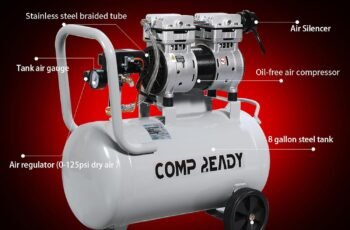
We are looking at a 1.5 HP compressor running at 1680 RPM, rated for up to 120 PSI, delivering 9 CFM, powered by a 110-volt supply, and built around an 8-gallon ASME-approved pancake tank. Let us talk through what that combination really means in everyday use.

Key Specifications at a Glance
Sometimes it helps to see the essentials in one place. These specs shape how we can use the compressor, which tools it will support, and what we can reasonably expect from it in a home or light commercial setting.
| Feature | Specification |
|---|---|
| Product Name | Schulz of America 931.1312-0 CSD 9/08 Oil-Less Air Compressor |
| Type | Oil-less, single-stage, direct drive |
| Horsepower (HP) | 1.5 HP |
| Motor Speed | 1680 RPM |
| Maximum Pressure | 120 PSI |
| Air Delivery (CFM) | 9 CFM (cubic feet per minute) |
| Power Supply | 110 Volts |
| Tank Capacity | 8 Gallon ASME pancake tank |
| Notable Features | Low noise, low vibration, low maintenance |
| Typical Use | Home garage, light workshop, hobby use, small job sites |
These numbers do not tell the whole story, but they give us a solid starting point. Next, we will walk through how each of these elements plays out in practical, everyday scenarios.
Design and Build Quality
The first thing we notice about this compressor is that it is clearly set up for convenience and reliability rather than brute industrial power. It is compact, practical, and built around an 8-gallon pancake-style tank that keeps the footprint manageable while still offering enough capacity for many common tasks.
We may not get a polished showpiece for a designer shop wall, but we do get a sturdy, functional machine that feels ready for real work. The ASME rating on the tank adds a layer of reassurance about pressure safety and construction quality.
Pancake Tank and Footprint
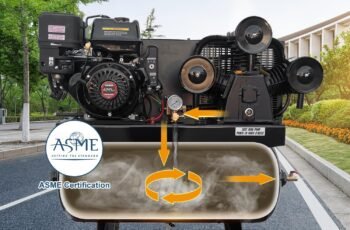
The 8-gallon ASME pancake tank is a major part of this compressor’s identity. Pancake tanks are wider and flatter than vertical hot-dog-style tanks, which helps keep the unit stable and easier to place in tight areas.
In a typical garage or small workshop, that shape means we can tuck it along a wall, under a bench, or in a corner without worrying about it tipping easily or hogging vertical space we might want for shelving.
Materials and Durability
While we are not dealing with a heavy industrial compressor meant for a factory floor, the construction is solid where it counts. The ASME tag on the tank indicates it has been built and tested to meet recognized standards for pressure vessels, which matters when we are routinely filling it to 120 PSI.
Housings, shrouds, and fittings feel more utilitarian than luxurious, but we are buying a tool, not a piece of furniture. What matters here is that connections hold, the tank resists corrosion with reasonable care, and the moving parts are protected well enough for regular use in a shop or garage environment.
Performance: Power, PSI, and CFM
Where this compressor really earns its keep is in the balance between power, air delivery, and usability. The combination of 1.5 HP, 9 CFM, and 120 PSI at 110 volts positions it as a serious step up from tiny portable inflators, but still accessible for a standard household circuit.
We can think of it this way: it is not built to run a professional body shop with multiple air tools going all day, but it will handle a surprising number of tasks around the house, garage, and small workshop.
Horsepower and RPM
The 1.5 HP motor running at 1680 RPM is interesting because that RPM is lower than many budget compressors that scream along at 3000+ RPM. Lower RPM usually translates into less noise, less heat, and longer life, provided the compressor is designed well.
From a user perspective, 1.5 HP gives us enough muscle to fill an 8-gallon tank in a reasonable amount of time, power light-to-medium-duty air tools, and maintain 120 PSI without straining too hard. We are not competing with 5 HP shop units, but we are far beyond the tiny “emergency inflator” level.
Pressure (PSI) and Air Delivery (CFM)
Maximum pressure of 120 PSI is plenty for most home and hobby applications. Many air tools, inflators, and nailers operate comfortably within the 90–110 PSI range, so we have wiggle room to keep performance stable, even as the tank cycles.
The 9 CFM rating tells us how much volume of air the compressor can deliver. This is a key number when matching tools:
- Light tools (e.g., brad nailers, finish nailers, staplers) need very little CFM.
- Some impact wrenches, die grinders, and spray guns can be quite demanding, often requiring higher continuous CFM than smaller compressors can provide.
With 9 CFM, we can operate:
- Nailers for carpentry, trim, and framing with ease.
- Blow guns for cleanup and light air blasting.
- Tire inflators for cars, bikes, lawn equipment.
- Some light spray guns and modest impact tools, especially for intermittent use.
Where we need to be realistic is with high-demand, continuous-use tools; for those, we may find the compressor cycling often and needing pauses to catch up.
Oil-Less Technology and Maintenance
Oil-less air compressors are increasingly popular for home and light commercial users, and this model fits squarely into that category. Instead of requiring us to check, top up, or change oil in the pump, the design uses materials and internal construction that run without conventional lubrication.
The main trade-offs with oil-less compressors are usually noise and longevity under very heavy use, but this unit mitigates noise nicely and is clearly targeted for moderate duty.
What Oil-Less Means for Us
With an oil-less compressor, we get:
- No oil changes to track on a schedule.
- No oil level checks before use.
- Reduced risk of oil carryover in the air stream.
This makes ownership simpler, especially for those of us who only use the compressor occasionally. It also makes the unit more appealing for applications where we want cleaner air, such as finish work or certain light painting tasks (though serious painting still benefits from proper filtration and moisture control).
Low Maintenance Design
The direct-drive, oil-less system means fewer user-serviceable parts. The absence of belts, pulleys, or oiling points translates into:
- Less time spent on mechanical adjustments and fluid checks.
- Fewer consumables to purchase over the life of the unit.
- Simpler operation for users who are not mechanically inclined.
We still need to drain condensation from the tank regularly and inspect hoses and fittings, but the heart of the compressor is largely “set and forget” for normal use patterns.
Noise and Vibration
The product is explicitly described as low noise and low vibration. For many of us, this is the single biggest quality-of-life factor in choosing a compressor. Traditional models can be loud enough to make conversation impossible and may cause complaints if used in a neighborhood setting.
While exact decibel ratings are not listed here, several design points support quieter operation:
- Lower pump RPM (1680 RPM instead of very high-speed designs).
- Direct drive with fewer moving parts that can rattle and squeal.
- Oil-less pump technology that can be tuned for smoother operation.
What Low Noise Means in Practice
In a real-world garage or workshop, low noise does not necessarily mean whisper quiet, but it does make a big difference. We can generally expect:
- Easier conversation while the compressor cycles.
- Less ear fatigue during longer projects.
- More acceptable noise levels if we are working in the evening or early morning.
For those of us in shared spaces or attached garages, that reduction in noise and vibration can be critical. It may not be silent, but compared to older or cheaper high-RPM models, we will likely feel much more comfortable running it regularly.
Reduced Vibration and Stability
Low vibration is not just about comfort; it also affects durability and ease of use. With less shaking:
- The compressor is less likely to “walk” or shift on the floor during operation.
- Components and fittings experience less mechanical stress over time.
- Tools and accessories sitting near the unit are less likely to rattle or fall.
This calmer behavior makes it easier to integrate the compressor into a tidy, organized workspace where everything has its place.
Direct Drive System
Direct drive means the motor shaft is directly connected to the pump with no belts in between. This approach is common in compact, lower-maintenance compressors and particularly suits home and light professional use.
We trade some flexibility and serviceability (no belt changes or ratio adjustments) for simplicity and reliability. In day-to-day use, this is often a welcome trade.
Benefits of Direct Drive
With a direct-drive setup, we gain:
- Fewer wearable parts: No belts to crack, slip, or squeal.
- Consistent performance: No belt stretch affecting pump output.
- Compact design: Fewer external components make for a tighter footprint.
For those of us who do not want to tinker or adjust belts as they age, direct drive feels like a relief. We plug it in, flip the switch, and let it do its job.
Tank Capacity and ASME Certification
The 8-gallon capacity may sound modest compared to massive shop tanks, but for many light-duty applications, it is a sweet spot. It stores enough air to handle bursts of tool use while still remaining portable and easy to accommodate.
ASME certification indicates compliance with recognized standards for pressure vessels, offering peace of mind when we are running the compressor up to 120 PSI on a regular basis.
Practical Impact of an 8-Gallon Tank
An 8-gallon tank lets us:
- Fire nailers repeatedly without waiting between every single shot.
- Inflate tires and sports equipment quickly without the compressor cycling constantly.
- Use blow guns and small tools for short bursts with reasonable recovery times.
If we plan to run high-demand tools continuously, we may notice frequent cycling. For most occasional users, though, the 8-gallon capacity hits a comfortable balance between convenience and capability.
Safety and the ASME Rating
Tank failures under pressure are dangerous, so having an ASME-rated tank is more than just a label. It suggests:
- Shock and pressure resistance tested to standard benchmarks.
- Better quality assurance in manufacturing and weld integrity.
- Additional confidence in long-term use when properly maintained.
We still need to drain condensation and avoid corrosion, but starting with an ASME-approved tank gives us a stronger foundation for safe operation.
Power Requirements and Portability
This unit runs on standard 110-volt power, which is a major advantage for home and light commercial users. We do not need special wiring, and we can plug into typical outlets in a garage, basement, or job site with suitable extension cords.
It is also compact enough that most of us will be able to move it around when needed, though it is not a tiny handheld compressor. It is portable in a practical sense for adult users who are comfortable lifting or rolling mid-sized tools.
110-Volt Convenience
By sticking with 110 volts, we are not forced into:
- Installing dedicated 220-volt lines.
- Limiting use to only one or two specialized outlets.
- Hauling heavy generator systems to job sites for basic tasks.
This means we can lend the compressor to a friend, carry it to another part of the property, or use it at a small job location without complex planning. A standard outlet and a correctly rated extension cord are usually enough.
Mobility Around the Workspace
While we do not have every dimension and weight measurement here, compressors of this class are generally built to move:
- The pancake tank shape keeps the center of gravity low and stable.
- Handles and possibly wheels (depending on configuration) help with maneuvering.
- The overall design is compact enough to store when not in use.
We should expect to be able to roll or carry it short distances without too much effort, though prolonged carrying up and down stairs might be tiring.
Everyday Use Cases
Where this compressor shines is in the real-world tasks most of us face regularly. It is powerful enough for serious hobby and home shop projects, but not overkill for simpler jobs like tire inflation and light cleanup.
We can think about its strengths in terms of typical scenarios we might encounter in a garage, basement, shed, or small workshop.
Automotive and Garage Tasks
For automotive and garage work, the Schulz 931.1312-0 CSD 9/08 can be a very handy tool. With 9 CFM and 120 PSI as a baseline, we can:
- Inflate car, truck, motorcycle, and bicycle tires quickly.
- Use a blow gun to clean engine bays and parts (with appropriate safety gear).
- Power some impact wrenches for lug nuts or suspension work, especially on an intermittent basis.
- Run small air ratchets, air chisels, or inflators intermittently for repairs and maintenance.
We should be aware that heavy continuous use with large impact tools may push the compressor to cycle often, but for typical home mechanic work, it will often feel like a big step up from manual tools.
Carpentry, Trim, and Home Improvement
For carpentry-focused users, this compressor does an excellent job feeding nailers and staplers:
- Brad nailers and finish nailers for trim and cabinetry.
- Framing nailers for occasional structural work or deck building.
- Flooring nailers for certain types of installation (depending on tool requirements).
Because nailers use short bursts of air rather than continuous flow, the combination of 8-gallon tank and 9 CFM output works efficiently. We can fire multiple nails in succession without waiting for the compressor to catch up, especially during moderate workloads.
Hobby, Craft, and Light Shop Work
In a hobby shop or craft setting, having compressed air on demand unlocks several possibilities:
- Airbrushes and small spray guns for models, artwork, or light finishing.
- Blow-off tools to clear sawdust, chips, and debris from benches and machines.
- Inflation of sports equipment, pool toys, and various household inflatables.
Here, the relatively quiet operation and oil-less design become even more attractive, especially if the compressor sits near living spaces or other people who are working nearby.
Pros and Cons Overview
To decide whether this compressor suits our needs, it helps to lay out the major advantages and limitations clearly. No single tool is perfect for everyone, but understanding the trade-offs helps us make a confident decision.
Advantages
The Schulz of America 931.1312-0 CSD 9/08 offers a compelling mix of convenience, power, and low maintenance. For many users, these strengths will stand out:
- Low noise and vibration: Easier on our ears and our nerves in a home environment.
- Oil-less pump: Minimal maintenance and cleaner air delivery.
- Direct drive: Fewer wearable components and simpler ownership.
- 9 CFM output: Stronger than many small portable inflators, suitable for a wide range of tasks.
- 120 PSI max pressure: Enough for most home, hobby, and light professional needs.
- 8-gallon ASME pancake tank: Good capacity with a stable, compact footprint.
- 110-volt compatible: Plugs into standard outlets, no special wiring required.
Together, these features make the compressor particularly attractive for homeowners, DIYers, and small-shop users who value practicality and reliability over sheer industrial power.
Limitations
There are also real constraints we should factor in before committing to this model:
- Not ideal for heavy industrial or continuous professional use: The 1.5 HP motor and 8-gallon tank are not meant for full-time production environments.
- Limited for very high CFM tools: Some spray guns, grinders, and sanders may demand more sustained airflow than this unit comfortably provides.
- Portability with weight: While manageable, it is still a substantial piece of equipment, not an ultra-light portable inflator.
If we plan to outfit a full professional body shop or a large fabrication business, we will likely want more horsepower and a larger tank. For most home and hobby users, though, these limitations will not be deal-breakers.
Comparing to Typical Alternatives
When we look at this compressor in context, it sits somewhere between very small, inexpensive “pancake” models and larger, stationary shop units. That middle ground can be a sweet spot for users who need more than a tiny inflator but do not have the space or budget for an industrial machine.
We can think about the alternatives this way:
- Versus small 1–3 gallon inflators: This Schulz compressor offers far more CFM, a larger tank, and much better support for real air tools.
- Versus large 20–60 gallon shop units: It is more portable, easier to power on typical outlets, and usually quieter and simpler to maintain.
- Versus belt-driven oil compressors: It trades some customization and heavy-duty longevity for oil-less convenience, quieter lower-RPM operation, and less upkeep.
For many users, this model represents a smart compromise: enough air capacity and power to feel like a real shop tool, but without demanding industrial infrastructure or advanced mechanical know-how.
Using the Compressor Safely and Effectively
Owning a compressor always involves some responsibility. While we do not have a full manual in front of us, we can still lay out some core practices that will help us get the best from this unit while staying safe.
We want to treat compressed air as the serious energy source it is, respecting the tank, the hoses, and the tools it powers.
Basic Safety Practices
A few habits go a long way in keeping our compressor use safe:
- Wear eye protection when using blow guns, nailers, or any tool that can send debris flying.
- Avoid direct skin contact with high-pressure air, which can be dangerous even if it feels harmless.
- Inspect hoses and fittings regularly for cracks, leaks, or loose connections.
- Keep the compressor on a stable surface, away from standing water or flammable materials.
- Know the duty cycle if specified, and avoid running the compressor continuously beyond its recommended operating pattern.
Respecting these basics helps us enjoy the utility of compressed air without unwanted surprises.
Care and Longevity
To keep the Schulz of America 931.1312-0 CSD 9/08 running well over the long term, we should:
- Drain condensation from the tank frequently, especially in humid environments.
- Store the compressor in a dry area, away from corrosive chemicals or extreme temperatures.
- Check electrical cords and plugs to ensure they are not frayed or damaged.
- Use appropriate extension cords rated for the current draw and distance when needed.
Because the compressor is oil-less and direct drive, we avoid oil changes and belt maintenance entirely, which simplifies our checklist. The main focus becomes tank care, hose condition, and safe electrical use.
Who This Compressor Is Best For
Matching the right compressor to the right user is always about lifestyle and workload. With its particular blend of power, noise control, and convenience, this model targets a specific audience very well.
We can picture the ideal owners:
- Home mechanics and car enthusiasts who want something stronger than a tiny inflator but still friendly to a garage setting.
- DIYers and remodelers who run nailers, staplers, and blow-off tools and appreciate lower noise in the home.
- Hobbyists and craft workers who need reliable compressed air without dedicating half the shop to a giant stationary tank.
- Light professional users on small job sites who value portability, 110-volt compatibility, and low maintenance.
For those of us who fall into these groups, the Schulz of America 931.1312-0 CSD 9/08 can function as an everyday workhorse. It will not overwhelm us with complexity, yet it offers ample capability for most common shop and home tasks.
Final Thoughts: Is the Schulz 931.1312-0 CSD 9/08 Worth It?
When we put all the pieces together—oil-less operation, 1.5 HP motor, 1680 RPM, 9 CFM, 120 PSI, 110-volt power, and an 8-gallon ASME pancake tank—we end up with a compressor that is tailored for practical, real-world use.
We get:
- Enough power for a broad range of tools and tasks.
- Quieter, smoother operation than many older designs.
- Minimal maintenance thanks to oil-less, direct-drive engineering.
- A compact, stable tank with a recognized safety certification.
We give up:
- The raw, continuous power of large shop units.
- Some suitability for very high-demand, heavy-duty industrial tools.
- Ultra-light portability compared to tiny inflators.
If our priorities include reliability, ease of use, household compatibility, and sufficient performance for automotive, carpentry, and general workshop duties, this model fits the bill nicely. We can set it up in our garage or shop, plug it into standard power, and feel confident that it will handle most of the tasks we throw at it without demanding constant attention in return.
In our view, the Schulz of America 931.1312-0 CSD 9/08 Oil-Less Air Compressor is a thoughtful choice for those of us who want serious compressed air capability in a friendly, low-maintenance package tailored to everyday life rather than industrial extremes.

Disclosure: As an Amazon Associate, I earn from qualifying purchases.