Quincy Air Compressor Review: What This 60-Gallon Model Offers
Is a 3.5 HP stationary compressor with a 60-gallon receiver and 12.4 CFM at PSI enough for a serious home garage or small workshop? The answer is potentially yes for intermittent pneumatic work, but buyers planning continuous grinding, sanding, or blasting should look at higher-output equipment. The Quincy air compressor under review is the Quincy Single-Stage Air Compressor, Model Q13160VQ, and its fixed workshop design makes it a very different proposition from a portable jobsite machine.
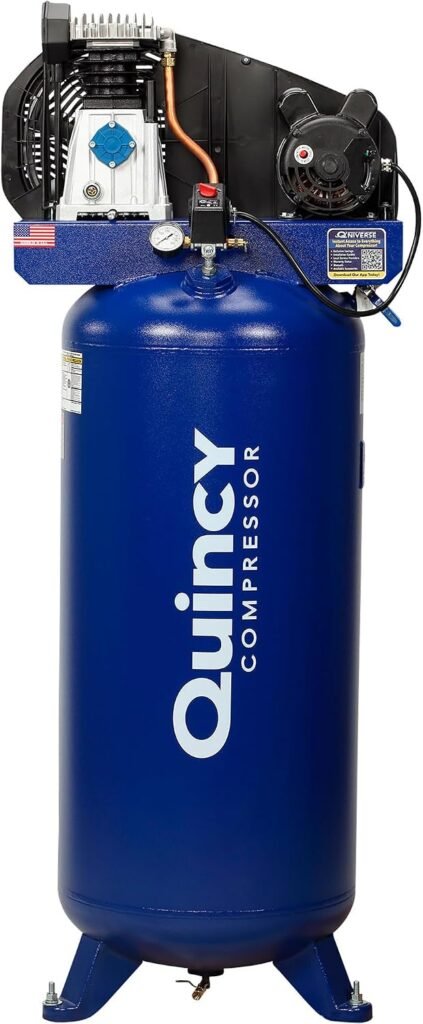
This is a vertical-tank unit with a single-stage reciprocating pump, a stated pump speed of 1,250 RPM, maximum pressure of PSI, and a/2-inch air outlet. The central specification is the delivered-air figure rather than the motor label: 12.4 CFM at PSI gives us the most useful starting point for judging tool compatibility.

Quincy Air Compressor Specifications at a Glance
The published specification set positions the Quincy air compressor as a substantial stationary appliance rather than a compact utility compressor. Here is the information supplied for the Q13160VQ:
| Specification | Published detail |
|---|---|
| Motor | 3.5 HP |
| Tank | 60 gallons |
| Orientation | Vertical |
| Pump | Single-stage reciprocating |
| Pump speed | 1,250 RPM |
| Delivered air | 12.4 CFM at PSI |
| Maximum pressure | 145 PSI |
| Voltage | 220 volts in the product name; volts in the description |
| Phase | Single phase |
| Outlet | 1/2 inch |
The 12.4 CFM figure and the PSI figure describe different things. CFM at PSI indicates the air the pump is stated to deliver under a working pressure, whereas PSI is the maximum tank-pressure ceiling. We should compare a compressor with a tool at the tool’s required pressure, not assume the maximum tank figure represents usable airflow.
A 60-gallon vertical receiver stores a useful reserve while taking less floor width than a horizontal tank, although it remains a large fixed installation. The 1,250 RPM pump speed is also relevant when considering heat, noise, duty cycle, and wear, but the listing does not confirm how this model behaves in those areas. Before purchase, record the actual outlet fitting, wiring and cord requirements, breaker requirements, and included accessories from the complete listing. The Quincy air compressor specifications are useful, but they do not answer every installation question.
Horsepower is only a rough sizing clue. The Quincy air compressor’s stated delivered-air rating is the practical number for estimating whether a nailer, impact tool, or other accessory can operate without excessive recovery time.
Key Features of the Quincy Air Compressor Explained
The single-stage pump compresses air in one step. That arrangement generally suits ordinary shop duties, but it is not the same configuration as a higher-output two-stage compressor, where air is compressed progressively through multiple stages. We should therefore treat this model as a moderate-capacity workshop machine rather than assume it belongs in the same performance class as larger industrial units.
The 3.5 HP motor sits in a middle ground for stationary workshop equipment. It merits comparison with 5.5 HP and 7.5 HP compressors, particularly when the intended tools have sustained air demand. Meanwhile, the 60-gallon receiver can smooth intermittent use: stored air supplies short bursts so the pump does not need to respond instantly to every trigger pull.
That combination looks most sensible for inflation, blow-off, pneumatic fastening, light automotive work, and other intermittent tasks. We would not promise spray-painting, sandblasting, impact-wrench performance, or continuous-duty operation without the relevant tool requirements and complete manufacturer information. The PSI figure is a ceiling, not a guarantee that a tool receives that pressure while operating.
The/2-inch outlet should be checked against the intended hose, regulator, and coupler. We should not assume accessories are included. A sensible setup sequence is to confirm voltage and phase, position the unit on a level ventilated surface, have the correct electrical protection installed by a qualified professional, connect a suitably rated air line, and drain moisture after use.
The Quincy air compressor listing does not confirm pump material, lubrication, noise, duty cycle, recovery time, thermal protection, warranty, or included controls. The Quincy air compressor should be judged on those points only after the full listing or manual verifies them. The Quincy air compressor is therefore promising in concept, but not fully documented in the supplied data.
How the Quincy Air Compressor Performs for Common Workshop Tasks
We would anchor every tool decision to the stated 12.4 CFM at PSI rather than claim that the Quincy air compressor powers every pneumatic accessory. Start by listing each tool, then record its required CFM and operating PSI from the tool manual. Add a reasonable operating margin and compare that demand with the compressor’s published delivered-air figure at a similar pressure.
Intermittent tools are the most natural match. Nailers, staplers, blow guns, and short bursts from an impact wrench draw air in cycles, allowing the receiver to provide a reserve between pump cycles. Grinders, sanders, extended spray painting, and other continuous-use equipment place a much heavier load on the pump; a large tank may delay pressure loss, but it cannot replace insufficient ongoing airflow.
For a practical test after installation, set the regulator to the tool’s required pressure, observe how quickly tank pressure falls during the intended work, and measure how long the pump takes to restore working pressure. Repeat the test with the longest planned hose and normal couplers. Long lines, restrictive fittings, filters, regulators, cold temperatures, and leaks can all reduce pressure at the tool.
Our buying method is straightforward:
- List every planned pneumatic tool.
- Record CFM at the required PSI for each one.
- Identify the highest continuous demand, not merely the largest tank draw.
- Choose a larger compressor if that demand approaches the full 12.4 CFM rating.
The Quincy air compressor can make short tasks feel smoother because of stored air, while the Quincy air compressor may struggle to sustain a tool whose demand remains close to the pump’s full output. The Quincy air compressor is best assessed by recovery behavior under the buyer’s actual workload.

Installation, Electrical Requirements, and Maintenance
The first installation issue is the voltage conflict: the product title identifies volts, but the supplied description identifies volts, single phase. We would confirm the nameplate and manual before arranging wiring. A stationary receiver of this size will normally call for a dedicated circuit and professional installation, but the supplied information does not verify breaker size, wire gauge, plug type, or current draw, so none should be guessed.
Our safe installation plan begins with delivery inspection. Look for shipping damage, then place the machine on a stable, level surface with ventilation and enough service clearance. Provide convenient access to the tank drain, install an appropriate air line, and test the connections for leaks before attaching tools. The Quincy air compressor should not be commissioned until its electrical identity is resolved.
Moisture management matters because compressed air can collect water in a receiver, especially in humid conditions. Drain the tank at the interval specified by the manual, and add a properly rated separator or dryer when the application requires cleaner, drier air. We would also check oil level if the pump is confirmed to be oil-lubricated, plus belt and guard condition if belt drive is confirmed.
Routine checks should include fastener tightness, hose wear, pressure-switch operation, and unusual vibration or noise. The Quincy air compressor must never be treated as maintenance-free, quiet, belt-driven, or oil-lubricated unless documentation confirms those characteristics. Before service, isolate power and release stored air; never exceed rated pressure or modify pressure controls and safety valves.
These precautions are not optional extras. The Quincy air compressor combines mains electricity with stored pneumatic energy, so professional electrical work and disciplined maintenance are central to safe ownership.
What Customers Are Saying About the Quincy Air Compressor
The supplied product data includes no Amazon star rating, review count, or individual customer comments for this model. We therefore cannot state that buyers praise its delivery, startup, recovery, noise, controls, leak resistance, or durability. Any such conclusion would be unsupported, and the Quincy air compressor should not be presented as having an established ownership record on the information available here.
If review text becomes available at publication, we would group model-specific comments by delivery and packaging, installation, startup, pressure recovery, noise and vibration, leaks, controls, and long-term durability. We would distinguish first-hand ownership reports from questions, unexplained star ratings, and comments about unrelated Quincy models. A reviewer who identifies the tool used, operating pressure, installation date, duty cycle, and climate provides more useful evidence than a one-line impression.
We would also search the comments for the 220-versus-230-volt labeling issue, missing accessories, damaged tanks, unclear instructions, and electrical setup difficulties. Positive and negative patterns should be reported with the number of reviews supporting each theme when that information is available, while small samples require cautious wording.
The Quincy air compressor review should be updated if the listing’s rating, review count, price, or verified-buyer comments change during 2026. Until then, the Quincy air compressor has confirmed specifications but no supplied sentiment evidence. The Quincy air compressor should be compared using documentation and model-specific comments, not reputation borrowed from other products in the brand’s range.
Who Should Buy This 60-Gallon Quincy Compressor?
The best-fit buyer is a homeowner, repair enthusiast, farm user, or small workshop owner with a permanent location, compatible single-phase power, and mostly intermittent pneumatic-tool demands. The Quincy air compressor makes most sense where the machine can remain installed and provide a dependable reserve for tire inflation, blow-off, nailers, staplers, light automotive service, and short tool cycles.
Its vertical format may appeal to shoppers who want meaningful stored-air capacity without the wider floor footprint of a horizontal tank. That does not make it portable, however. Delivery planning, adequate floor space, ventilation, and maintenance access remain part of the purchase decision.
Poor-fit scenarios include mobile jobsite work, locations without the required electrical service, continuous grinding or sanding, heavy sandblasting, and applications whose airflow exceeds 12.4 CFM at the relevant pressure. A receiver can cover brief peaks, but it cannot turn a moderate pump into a continuous high-output system.
Before ordering, we would complete this checklist:
- Measure the proposed installation area and access route.
- Verify the nameplate voltage and phase with an electrician.
- List tool CFM requirements at their operating pressures.
- Confirm the outlet, hose connections, and included accessories.
- Review delivery conditions and calculate wiring and air-treatment costs.
The Quincy air compressor should be selected for pump output and recovery, not tank size alone. The Quincy air compressor is a reasonable candidate when the workshop’s actual demand, power supply, and maintenance access all align.
Final Buying Checks Before Ordering the Quincy Air Compressor
The strongest confirmed reasons to investigate this model are its 3.5 HP motor, 60-gallon vertical receiver, 12.4 CFM delivery at PSI, PSI maximum pressure, and stationary workshop orientation. Those figures describe a machine aimed at moderate fixed-location shop work, not a portable compressor or an automatic guarantee of high-demand continuous performance.
Several details still need confirmation from the live listing or manufacturer documentation: whether the correct supply is or volts, exact electrical draw, pump lubrication, noise, duty cycle, warranty, included components, dimensions, weight, and delivery method. The Quincy air compressor should not be ordered until those points are clear enough for the intended installation.
We would use this five-step final check:
- Compare every planned tool’s CFM and operating pressure with the delivered-air specification.
- Verify electrical compatibility from the nameplate and have the circuit assessed professionally.
- Confirm the current price and total delivered, installed cost.
- Read model-specific reviews, separating detailed ownership reports from brief ratings.
- Check warranty, service, delivery, and return terms before committing.
Our conditional recommendation is favorable for a permanent garage or small workshop with intermittent demand, provided the electrical discrepancy is resolved and the delivered-air rating fits. The Quincy air compressor is not the obvious choice for sustained high airflow, where two-stage alternatives deserve closer comparison. In 2026, availability, price, ratings, and review counts can change, so the Quincy air compressor should be reassessed against the live listing immediately before purchase.
Pros and Cons
Pros
- Large stored-air reserve for intermittent workshop tasks
- Vertical format can reduce floor width compared with a horizontal receiver
- Published delivered-air and pressure figures make tool matching possible
- Stationary design suits a permanent garage, farm, or small workshop installation
Cons
- Electrical information conflicts between volts and volts in the supplied listing
- No current currency-denominated price was supplied, making value impossible to confirm
- Customer rating, review count, and model-specific ownership comments were not provided
- Single-stage configuration may be unsuitable for sustained high-demand pneumatic equipment
- Dimensions, weight, warranty, controls, lubrication, noise, and included accessories remain unverified
Final Verdict
Key Takeaways
- The Q13160VQ is a stationary 3.5 HP, 60-gallon vertical compressor rated at 12.4 CFM at PSI.
- Its delivered-air rating matters more than horsepower when matching pneumatic tools.
- Resolve the 220- versus 230-volt discrepancy before arranging electrical work.
- It appears best suited to intermittent garage and small-workshop duties, not sustained high-CFM applications.
- Confirm the live price, total installation cost, warranty, accessories, and model-specific customer feedback before ordering.
Frequently Asked Questions
Who makes the best gallon air compressor?
There is no universal best choice because the right compressor depends on required CFM, pressure, power, tank format, and budget. The Ingersoll Rand 2475N7.5 is the stronger option among the supplied comparisons for sustained high-demand work, while a Quincy model can be more proportionate for moderate stationary workshop use.
What is the best stationary air compressor?
The best stationary compressor is the one whose delivered CFM at your tools’ operating pressure includes a sensible margin, while fitting your electrical service and workspace. This Quincy model is worth considering for intermittent shop duties, but continuous grinders, sanders, and blasting equipment may require a larger two-stage unit.
Is there an gallon air compressor available for sale?
Yes, 80-gallon stationary compressors are available in the market, including larger two-stage models such as the Ingersoll Rand 2475N7.5 referenced in this comparison. Availability and pricing change, so confirm the current listing, delivery arrangements, and electrical requirements before ordering.
Are Ingersoll Rand air compressors any good?
Ingersoll Rand offers models covering both garage and higher-demand workshop applications, but quality and suitability should be judged by the specific model’s CFM, pressure, configuration, warranty, and service support. The supplied 2475N7.5 figures make it more relevant to sustained high-CFM work than this smaller single-stage Quincy model.
Disclosure: As an Amazon Associate, I earn from qualifying purchases.