Have we ever wished our air compressor could keep up with our projects without rattling our ears, tripping a breaker, or demanding constant maintenance?
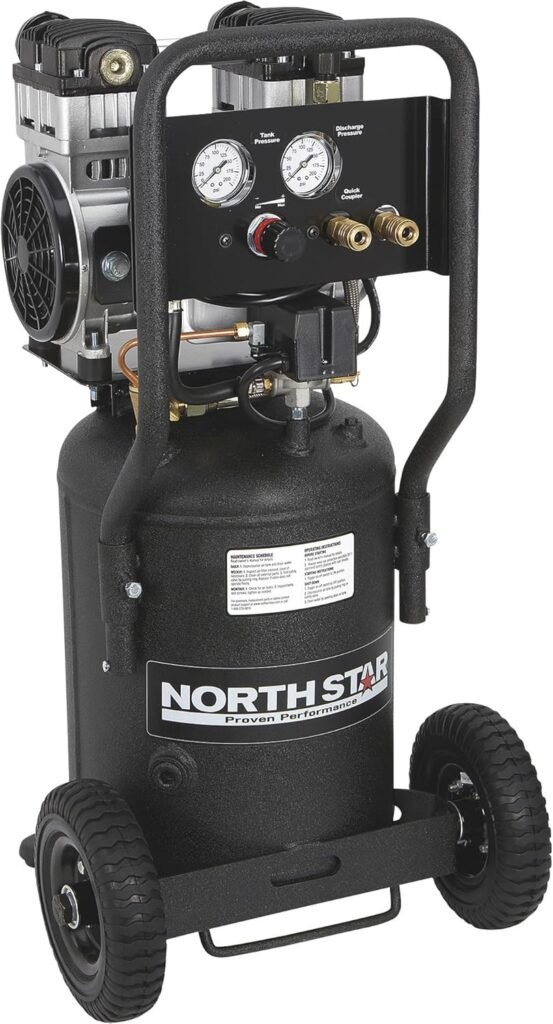

Why We Chose the NorthStar Electric Air Compressor
When we were searching for a compact yet capable compressor, we wanted something that felt more like a reliable partner than a loud, finicky machine. The NorthStar Electric Air Compressor – 1.5 HP, 8-Gallon Vertical Tank, Portable, Quiet Operation immediately stood out because it balances power, portability, and low noise in a way that fits real-world garages, workshops, and home projects.
This model is clearly targeted at users who want pro-style results without the hassle of big-shop equipment. As we looked closer at its features, it became clear that it’s built to serve both serious DIY users and light professional work where reliability and quiet operation matter.
Key Specifications at a Glance
Before we get into how it feels to use, it helps to lay out the core specs in a simple format. We like seeing everything side by side so we know what we’re really working with.
| Feature | Specification |
|---|---|
| Product Name | NorthStar Electric Air Compressor |
| Motor Power | 1.5 HP |
| Power Supply | 115V |
| Current Draw | 12 Amps |
| Motor Speed | 1750 RPM |
| Tank Capacity | 8-Gallon Vertical Tank |
| Pump Type | Oil-free dual piston pump |
| Air Delivery @ 90 PSI | 4 CFM |
| Air Delivery @ 40 PSI | 5.4 CFM |
| Operating Noise Level | About 70 dB |
| Portability | Portable vertical design |
| Maintenance | Maintenance-free, oil-free operation |
Looking at the specs, we can see that this unit is built for users who need a balance of airflow, pressure, and convenience, rather than extreme industrial output. It’s ideal for air tools in the small-to-medium range, inflation tasks, and general shop use.
First Impressions and Build Quality
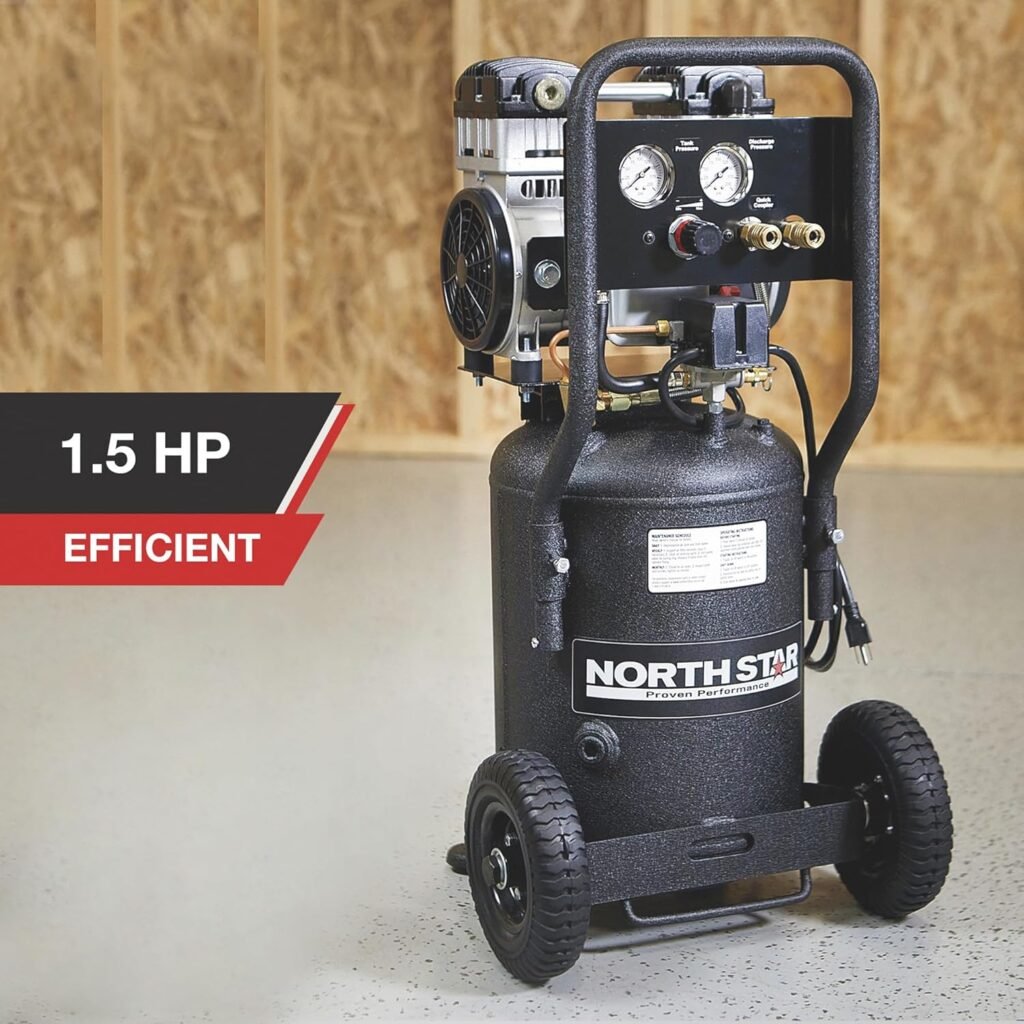
When we first look at this compressor, the 8-gallon vertical tank and compact footprint strike us immediately. The vertical design makes it more space-efficient than a typical horizontal portable compressor, which is a major plus in tight garages or workshop corners.
The components feel solid and well put together. The frame, tank, and fittings give the impression that this machine is designed to handle regular use, not just occasional hobby tasks. We get the sense that NorthStar is aiming for long-term reliability rather than a disposable-feeling tool.
Motor Power and Electrical Requirements
1.5 HP Motor: What That Means in Practice
A 1.5 horsepower motor may not sound huge compared to large shop units, but for a portable compressor, it’s a sweet spot between performance and draw. We find this power rating more than enough for tasks like running nailers, blowing dust out of crevices, inflating tires, and using some light to moderate-duty air tools.
In use, this motor has enough strength to refill the tank in a reasonable amount of time and maintain pressure during bursts of work. We don’t feel like we’re constantly waiting around for pressure to recover between tasks, especially when using tools that have intermittent use cycles.
115V, 12 Amp Operation
Because it runs on 115V and draws 12 amps, we can plug this compressor into a standard household circuit in most US homes and small shops. That means we don’t need a special 220V line or an upgraded panel, which is a big relief for many of us.
We still need to be mindful of what else is on that circuit, of course. Running this along with other large appliances on a single 15A circuit could risk tripping a breaker. But in typical garage or workshop conditions, with mindful planning, it fits well into standard electrical setups.
Oil-Free Dual Piston Pump
Cleaner Air and No Messy Oil Changes
One of the most attractive features for us is the oil-free dual piston pump. Since the pump doesn’t require oil, we don’t have to deal with checking levels, buying compressor oil, or cleaning up spills. That alone makes the maintenance aspect far less stressful.
Because it’s oil-free, the air coming out of the tank is cleaner and less likely to contain oil mist. That helps when we’re using the compressor for tasks like:
- Finishing work with air tools near painted or stained surfaces
- Blowing dust off workpieces or electronics
- Powering small paint sprayers (with appropriate filters and dryers)
We still recommend using inline filters for ultra-sensitive tasks or painting, but starting with an oil-free system means we’re less likely to contaminate our work.
Dual Piston Efficiency
The dual piston design is intended to improve efficiency and longevity over single-piston units. In actual operation, this means it fills the tank more quickly and runs more smoothly than some cheaper single-piston models we’ve used.
The motion feels more balanced, which likely contributes to the noise level and vibration reduction. Over time, a well-designed dual piston pump should help maintain performance without the slow decline we sometimes experience with budget compressors.

Quiet Operation: About 70 dB
What 70 dB Sounds Like in Real Life
Noise level is one of the biggest potential annoyances with air compressors. At around 70 dB, this unit is dramatically quieter than many traditional portable models. Many of those can easily hit 90 dB or more, which becomes uncomfortable quickly and can demand hearing protection.
At 70 dB, this compressor is more like a loud conversation or a running dishwasher rather than a roaring machine. We can still hear it, of course, but it’s not overwhelming. We can carry on a conversation nearby, listen to music, or work indoors without feeling like we’re in a factory.
Why Lower Noise Matters
For us, noise isn’t just about comfort; it’s about when and where we can work. With a quieter compressor:
- We can use it earlier in the morning or later at night without upsetting neighbors.
- We feel less fatigued after longer work sessions.
- We can move it indoors or into a basement workshop when necessary.
If we’re working out of a shared garage, small shop, or home space, the low noise level alone might make this machine worth considering.
Air Delivery and Performance
CFM Ratings: 4 CFM @ 90 PSI and 5.4 CFM @ 40 PSI
The NorthStar delivers:
- 4 CFM at 90 PSI
- 5.4 CFM at 40 PSI
These numbers tell us how much usable air the compressor can deliver at different pressure levels. The 90 PSI number is especially important because many air tools are rated around that pressure.
With 4 CFM at 90 PSI, we’re comfortably in the range for:
- Brads and finish nailers
- Framing nailers (for intermittent use)
- Staplers
- Blow guns
- Tire inflators
- Some light air ratchets and smaller impact tools (with a mindful duty cycle)
What It Can and Cannot Realistically Support
This is not a heavy industrial compressor meant for running multiple high-consumption tools simultaneously. Instead, it’s a solid match for:
- Home garages
- Woodworking shops
- Light automotive work
- Construction punch-list jobs
- Hobby workshops
Continuous-use tools like large sanders or grinders that need high CFM over long periods might outpace this unit, but for intermittent, typical DIY and light professional tasks, the performance is well-balanced.
8-Gallon Vertical Tank: Capacity and Design
Practical Tank Size for Real-World Use
With an 8-gallon vertical tank, we get a comfortable buffer of stored air without making the compressor unwieldy. Many very small portable units have 1–3 gallon tanks, which cycle constantly and quickly run out of air, especially when powering air tools.
At 8 gallons, we can run tools in short bursts and complete smaller tasks without feeling like the compressor never stops. When we’re using nailers or intermittently blowing off surfaces, the tank size feels well-matched to the motor output.
Vertical Footprint and Stability
The vertical tank design keeps the unit’s footprint compact, which helps in tighter spaces. We can tuck it against a wall, under a bench overhang, or near a corner without it dominating the floor.
The layout also helps with storage and transport. With a well-designed handle and wheel setup (if applicable for our configuration), moving it in and out of a work area becomes manageable, more like rolling a compact appliance than wrestling with a bulky machine.
Portability and Everyday Handling
Portable Without Being Fragile
The compressor is marketed as portable, and in practice, that description holds up. It’s not feather-light, but as a powered air tank with a metal frame and an 8-gallon volume, it’s about as convenient as we can reasonably ask. We can wheel it around a garage or campsite, load it into a vehicle with some effort, and relocate it as needed on a job site.
We appreciate that the vertical style gives us more control when tilting and rolling it. It feels more like moving a small upright hand truck than a lopsided piece of equipment.
Where Portability Really Helps
We find ourselves appreciating its size and mobility most in scenarios like:
- Taking it out to a driveway for tire and suspension work
- Moving between a basement workshop and a main-level work area
- Shifting around a larger shop when rearranging projects
- Bringing it to a friend’s place or a small job site for punch-list tasks
For those of us used to dragging around a small pancake compressor, this feels like a step up in capability without becoming “too big to move.”
Noise, Vibration, and Comfort During Use
Low Vibration Compared to Cheaper Units
We notice that this compressor doesn’t rattle and shake the way many budget models do. The lower RPM motor (1750 RPM instead of 3450 RPM common on cheaper compressors) and dual-piston pump help reduce harsh vibration.
This makes it feel more refined and less stressful to operate. Our tools still produce their usual noise, but the compressor itself doesn’t add a jarring mechanical clatter on top of everything.
Working Comfort Over Time
Over longer sessions, the softer sound profile and reduced vibration mean we feel less worn down. It’s easier to focus on the actual task instead of the machine running in the background. We can stand closer if we need to monitor gauges or adjust settings without feeling like we’re in a deafening zone.
This is especially helpful when we’re working indoors, teaching someone else, or collaborating in a shared workshop where keeping conversation possible matters.
Maintenance and Reliability
Oil-Free Means Less Ongoing Work
Because of its oil-free design, routine maintenance is noticeably simplified. We don’t have to schedule oil changes, keep track of oil levels, or worry that someone else using it might forget basic care.
Instead, the main maintenance tasks are straightforward:
- Draining condensation from the tank regularly
- Checking hoses and fittings for leaks
- Keeping the intake filter clean (if applicable)
- Inspecting power cords and connections
This simplicity makes the compressor approachable for less-experienced users while still being reliable enough for more serious work.
Durability Expectations
NorthStar generally has a reputation for sturdy equipment when treated properly. With regular tank draining and reasonable usage patterns, we would expect this compressor to last through many years of service in home and light professional environments.
As with any compressor, we should avoid running it continuously at maximum duty cycle. Giving it breaks and respecting its capacity will go a long way toward preserving the motor and pump.
Practical Uses: Where This Compressor Shines
Around the Garage and Home
For many of us, the first tasks that come to mind are in and around the garage. This compressor excels at:
- Inflating car, truck, bike, and trailer tires
- Powering a blow gun to clean filters, radiators, or shop surfaces
- Running impact wrenches and ratchets for lug nuts and light mechanical jobs (within its CFM limits)
- Operating small air chisels for occasional work
Because it’s fairly quiet, we can run it in the garage without feeling like the sound is echoing through the entire neighborhood.
Woodworking and Finish Carpentry
In woodworking or trim projects, we appreciate:
- Reliable power for brad and finish nailers
- Adequate air for framing nailers on intermittent duty
- The cleaner output that helps keep oil contamination away from wood surfaces
Since many woodworking shops are attached to homes or are in shared spaces, the low 70 dB noise rating becomes a huge advantage. We can build projects and install trim without overwhelming the rest of the house.
Hobby and Craft Applications
Hobbyists and crafters can also make good use of this compressor. Some examples include:
- Powering small airbrushes (with appropriate regulators and filters)
- Inflating sports equipment and inflatables
- Cleaning tools and machinery
- Supporting light pneumatic engraving or carving tools
The balance of portability and quiet operation makes it suitable even for basement or spare-room workshops, as long as we have good ventilation and follow safety guidelines.
Setup, Controls, and Ease of Use
Getting It Ready the First Time
Initial setup is quite straightforward. Usually, we need to:
- Attach any handles, wheels, or feet that ship detached.
- Ensure all factory-installed fittings are snug.
- Plug into a properly rated circuit (preferably a dedicated 15A or 20A line).
- Run the compressor once to bring the tank up to pressure and check for any leaks.
Because there’s no oil-filling step, initial setup goes faster and feels less intimidating for users who haven’t worked with compressors before.
Controls and Gauges
The control layout typically includes:
- A pressure gauge for tank pressure
- A regulated outlet gauge for tool pressure
- A pressure regulator knob
- An on/off switch
- One or more quick-connect couplers
We find these controls intuitive even for beginners. Adjusting output pressure for different tools is as simple as turning the regulator knob while watching the outlet gauge. This makes it easy to switch from one task to another without over-pressurizing tools.
Safety Considerations
Respecting Pressure and Electrical Limits
Air compressors are powerful tools, and we always want to operate them with safety in mind. For this model, that means:
- Making sure the outlet and extension cords (if used) are properly rated for 12A loads.
- Keeping the compressor on a stable, level surface.
- Not tampering with pressure relief valves or safety devices.
- Draining the tank regularly to prevent corrosion.
Because it’s a relatively quiet compressor, we might be tempted to treat it as harmless background noise. But the internal pressures are still high, and basic caution is important.
Noise and Hearing Protection
At 70 dB, many of us may feel comfortable working without hearing protection, especially over short periods. However, if we’re using additional loud tools in combination, or working for long sessions, hearing protection is still a wise precaution.
Being able to choose to wear hearing protection based on our tasks, not just the compressor, is a meaningful upgrade from louder models.
Pros and Cons of the NorthStar Electric Air Compressor
What We Like Most
Here are the major strengths we notice:
- Quiet operation (about 70 dB) makes it suitable for indoor and residential use.
- Oil-free dual piston pump means cleaner air and essentially maintenance-free pumping.
- Standard 115V, 12A power works on typical household circuits.
- 8-gallon vertical tank balances capacity with a small footprint.
- 4 CFM @ 90 PSI is enough for most home and light professional air tools in intermittent use.
- Portable design lets us move it easily around a shop or job site.
- Lower RPM motor (1750 RPM) tends to mean less noise and potentially longer life.
Collectively, these points make it an excellent choice for people who want genuinely usable compressed air without going into heavy industrial territory.
Where It May Fall Short
No product is perfect, and this compressor has limitations we should keep in mind:
- It is not suitable for high-CFM, continuous-duty tools like large sanders and grinders.
- The 8-gallon tank is generous for a portable but not ideal for running multiple tools simultaneously.
- The 115V, 12A draw still requires a well-rated circuit and may not pair well with several other large devices on the same line.
- While quiet for a compressor, it’s not silent; we will still notice it in smaller rooms.
For users with a body shop, a large-scale cabinet shop, or production-level air needs, a larger, stationary compressor would be more appropriate.
Comparing NorthStar’s Position in the Market
How It Stacks Up Against Small Pancake Compressors
Compared with typical 3–6 gallon pancake compressors, this NorthStar offers:
- More air capacity (8 gallons vs. 3–6).
- Significantly quieter operation.
- A more stable vertical stance.
- A potentially longer service life with the dual piston design.
Pancake units may be lighter and cheaper, but they cycle more often, are generally much louder, and may not keep up as well with air-hungry tools.
How It Compares to Large Stationary Units
Compared with big 60–80 gallon stationary compressors:
- This one is much more portable and space-efficient.
- It has far less air capacity and power, as expected.
- It suits home and light professional use better than big-shop, multi-user environments.
If our needs are mostly home and small workshop tasks, this NorthStar unit is a more practical choice than investing in a massive stationary system.
Energy Use and Efficiency
Power Consumption in Daily Use
Running at 115V and 12A, the compressor’s electrical draw is moderate. We don’t expect it to break our utility budget when used reasonably. The lower RPM motor can be more efficient in some cases, and the 1.5 HP rating aligns with a practical middle ground: not underpowered, not overkill.
We also find that because it fills the tank efficiently and holds pressure well, it doesn’t need to run constantly for light tasks. That intermittent cycling pattern helps moderate energy use over time.
Efficient Use Habits
To get the best energy performance, we try to:
- Match tools to the compressor’s CFM output.
- Avoid air leaks in hoses and fittings.
- Turn off the compressor when we’re done with a session.
- Use appropriate air pressure rather than running everything at maximum PSI.
This way, the unit not only lasts longer but also uses electricity more responsibly.
Who This Compressor Is Best For
Ideal Users and Work Environments
Based on its design and performance, we think this compressor is perfect for:
- Home mechanics who frequently work on vehicles and equipment.
- DIY enthusiasts who build furniture, do trim work, and manage home projects.
- Hobbyists in woodworking, metalworking, and crafts needing moderate air power.
- Light professional trades doing punch-list work, finish carpentry, or small repairs.
- Shared or residential spaces where quiet operation is a priority.
In these contexts, the NorthStar feels well matched to our needs, providing enough power without overwhelming our space or our ears.
Who Might Need Something Else
On the other hand, we might consider a different solution if we are:
- Running multiple air tools at once in a busy commercial shop.
- Operating high-CFM tools for long, continuous periods.
- Looking for an ultra-light travel compressor for occasional inflations only (a much smaller unit might suffice there).
For heavy industrial or multi-bay garage work, a larger, high-CFM stationary compressor will deliver better long-term value.
Longevity, Warranty, and Support Considerations
Long-Term Ownership Experience
We care not just about how the compressor feels on day one, but how we’ll feel on day 1,000. The combination of a slow-speed motor, dual-piston oil-free pump, and solid tank construction suggests that with normal use, this model should be a stable part of our workshop for years.
The key factors that influence longevity will be:
- Regular tank draining to control moisture and prevent rust.
- Reasonably limiting duty cycles for continuous tools.
- Keeping the compressor in a dry, clean, moderate-temperature environment.
Access to Parts and Service
With a recognizable brand like NorthStar, replacement parts, service information, and technical support are usually easier to find than with unbranded imports. This can make a huge difference years down the road if a valve, switch, or fitting needs replacement.
We always recommend checking the specific warranty terms and available service centers when we buy, especially if we plan heavy or frequent use.
Our Overall Verdict on the NorthStar Electric Air Compressor
After looking at the features, specifications, and practical use cases, we see the NorthStar Electric Air Compressor – 1.5 HP, 8-Gallon Vertical Tank, Portable, Quiet Operation as a well-balanced, thoughtfully designed option for serious home users and light professionals.
We especially appreciate:
- The quiet 70 dB operation, which makes it far more pleasant to live and work with.
- The oil-free dual piston pump, which simplifies ownership and keeps the air cleaner.
- The 8-gallon vertical tank, giving us a useful reservoir without swallowing our floor space.
- The 115V, 12A compatibility, letting us use typical outlets rather than special wiring.
- The respectable 4 CFM @ 90 PSI performance, which covers a wide variety of common tools.
For anyone who wants a compressor that we can comfortably use in a garage, basement, or small shop without constant noise, maintenance headaches, or space problems, this NorthStar model is a very compelling choice. It doesn’t pretend to be an industrial powerhouse, but it delivers exactly what many of us need: reliable, clean, quiet compressed air in a portable, easy-to-live-with package.

Disclosure: As an Amazon Associate, I earn from qualifying purchases.