Ingersoll Rand 7.5 HP Compressor: Quick Overview
A demanding workshop can outgrow a portable compressor surprisingly quickly, so the central question is whether a permanently installed machine is justified. The Ingersoll Rand 7.5 HP compressor is aimed at that situation: a high-volume shop-air system rather than a casual household appliance.
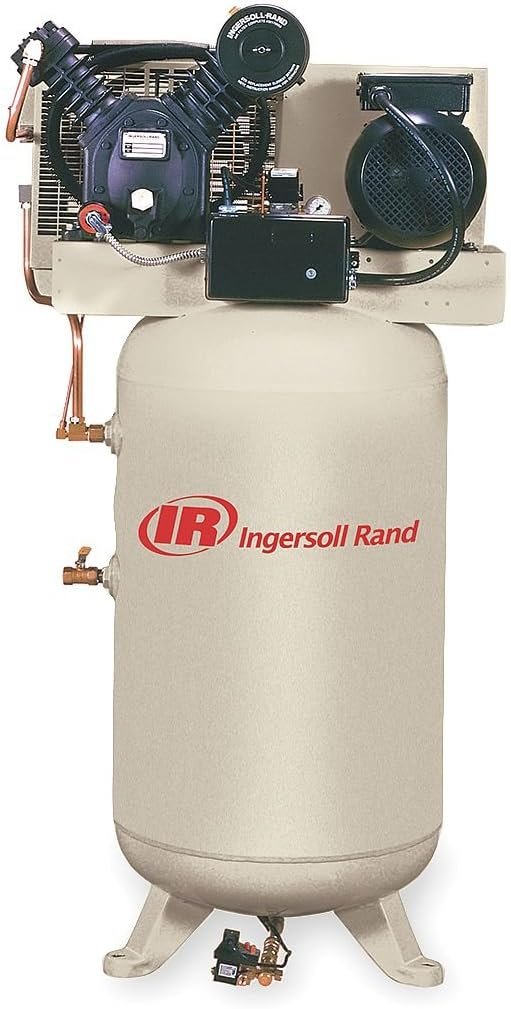
The product is identified as the Ingersoll-Rand Electric Air Compressor, 7.5 hp, Stage 2475N7.5-P-230-1 – Each. Its supplied specifications include a 7.5 hp motor, CFM at PSI, 230V single-phase power, an 80-gallon stationary tank, and a stated operating sound level of dB. That combination points toward automotive, fabrication, agricultural, and maintenance work where air demand is regular rather than occasional.
Our early view is straightforward: the Ingersoll Rand 7.5 HP compressor deserves consideration for a fixed workshop with suitable electrical service and floor space, but it makes little sense for renters, mobile contractors, or light-duty DIY use. It is not a plug-and-play garage accessory, and the installation budget matters almost as much as the compressor itself.
For this buying decision, we assess the specification sheet, the customer-feedback evidence available for this listing, installation demands, ownership considerations, and comparable 80-gallon machines. The Ingersoll Rand 7.5 HP compressor looks capable on paper, but the missing live price, warranty details, and several installation specifications prevent an unconditional recommendation.

Product Specifications and What They Mean in Practice
The headline output is 24 CFM at PSI. That is the figure we would use when judging suitability for continuous pneumatic work, not the motor horsepower by itself. A tool marked at CFM at its operating pressure leaves considerably more capacity than one requiring CFM continuously, while intermittent tools can tolerate a different duty pattern because the receiver supplies short-term reserve.
For the Ingersoll Rand 7.5 HP compressor, buyers should write down the CFM requirement and working pressure for every regularly used tool. Compare the highest continuous demand with delivered CFM at the same pressure, then allow a sensible margin for recovery, leaks, colder conditions, and simultaneous use. A 7.5 hp label cannot compensate for a tool demand that exceeds the compressor’s actual output.
The two-stage pump compresses air in successive stages rather than taking it from intake pressure to final pressure in one step. That arrangement generally supports more efficient high-pressure operation, although the supplied listing does not state maximum pressure, pump speed, or duty-cycle figures. The 80-gallon receiver reduces rapid starts during intermittent work and supplies reserve air for brief bursts; it does not increase the pump’s sustained output.
The required 230V single-phase supply deserves professional attention. Before ordering, we would have an electrician confirm circuit capacity, conductor sizing, disconnect arrangement, breaker selection, grounding, motor-starting requirements, and local code compliance. The dB sound rating is also meaningful: place the unit away from occupied offices, use hearing protection nearby, and expect conversation to be less comfortable during operation.
Several useful facts are not supplied here, including exact dimensions, shipping weight, motor amperage, maximum pressure, duty-cycle information, warranty terms, and installation clearances. We would verify each item in the current listing or manual before paying, because those details affect delivery access, electrical cost, and whether the system suits a particular building. The Ingersoll Rand 7.5 HP compressor should be assessed from its complete documentation rather than the headline horsepower.
Key Features Deep-Dive: Packaged Industrial Air System
This package is more complete than a bare compressor pump and motor. The E-series motor starter is described as mounted and wired, which can reduce assembly work and remove some uncertainty during setup. That does not eliminate electrical design responsibility: the incoming supply and protective equipment still need to match the motor and local regulations.
On the Ingersoll Rand 7.5 HP compressor, the relief valve and discharge ball valve are supplied mounted and piped. The relief valve provides pressure protection when correctly installed and maintained, while the ball valve gives the installer a controlled connection point to the shop-air piping. We would still use appropriately rated downstream components and never treat the valve arrangement as permission to modify the pressure vessel.
The air-cooled aftercooler lowers discharge-air temperature before air travels farther into the system. Cooler air can help moisture condense where it can be drained, but effective moisture control also requires suitable drains, filtration, and possibly a dryer matched to the application. Spray finishing and sensitive pneumatic equipment are especially unforgiving of water and oil carryover.
A mounted and wired low-oil-level shutdown switch adds protection by stopping operation when lubrication is insufficient. It is a useful safeguard, not a replacement for checking oil before use, following the specified lubricant instructions, or investigating repeated shutdowns. The ASME tank construction signals pressure-vessel compliance; preserve safety labels, follow inspection guidance, and never drill, weld, or otherwise alter the tank.
Our installation sequence would be:
- Choose a level, ventilated location with service access and stable support.
- Anchor or stabilize the unit as required by the manual and local practice.
- Install the correctly designed electrical supply and disconnect.
- Connect appropriately sized, pressure-rated air piping.
- Add drains, filtration, and drying equipment appropriate to the tools.
- Pressurize the system, test the controls, and check every joint for leaks.
These packaged features make the Ingersoll Rand 7.5 HP compressor easier to specify than an incomplete pump-and-motor assembly, but they do not turn it into a self-installing appliance.
How the Ingersoll Rand 7.5 HP Compressor Performs for Workshop Tasks
With the listed airflow, this system is suited to demanding workshop tasks when the tools are correctly matched. Automotive impact wrenches, air ratchets, tire-service equipment, and blow-off work are plausible applications. Sandblasting may be practical in suitable bursts, while spray finishing requires clean, dry air and carefully selected filtration rather than compressor capacity alone.
The receiver helps the Ingersoll Rand 7.5 HP compressor handle short peaks: a tool can draw from stored air while the pump catches up. High-demand continuous tools remain a different case. They may require duty-cycle planning, recovery pauses, a larger compressor, or an auxiliary receiver. A dryer is also necessary when moisture would damage a finish, instrument, or production process.
The vertical 80-gallon format favors a fixed shop. It can provide a useful workflow advantage by reducing starts during intermittent jobs and keeping air available for several brief tasks, but it is not a practical machine to move between jobsites. Buyers should plan delivery and placement before the unit arrives, especially because the supplied information does not include shipping weight or exact dimensions.
We would size the system in four steps:
- List each tool’s CFM requirement at its actual operating pressure.
- Identify the highest continuous demand, not merely the largest advertised horsepower.
- Add a margin for leaks, recovery, and occasional overlapping use.
- Compare that result with delivered CFM at PSI.
Startup load, ventilation, vibration, sound exposure, condensate handling, and the manufacturer’s break-in procedure all affect real performance. The Ingersoll Rand 7.5 HP compressor should therefore be judged as part of a complete air system, not as an isolated motor rating. For a serious fixed workshop, that approach is likely to produce steadier productivity than cycling several small machines.

What Customers Are Saying About the 2475N7.5-P-230-1
The supplied product information does not include a live star rating, review count, or a sufficiently detailed review record, so we cannot honestly assign a customer score or claim a majority opinion. That limitation matters for an expensive stationary machine. Shoppers should inspect the current listing for repeated comments and distinguish long-term ownership reports from one-line delivery reactions.
Where customer feedback discusses this type of package positively, the themes worth looking for are strong air delivery for shop tools, the convenience of a preassembled starter, industrial-style construction, and the practical reserve provided by a large receiver. Those observations are most useful when reviewers identify the tools used, the operating pressure, and how long the compressor has been in service. A comment saying “powerful” tells us less than a report describing sustained use with a particular impact gun or production tool.
Potential cautions include shipping damage, unclear installation instructions, electrical setup complexity, operating noise, oil-related maintenance, and difficulty positioning a stationary pressure vessel. We would separate complaints about a freight carrier or seller response from evidence of pump, motor, control, or tank defects. A damaged crate is a delivery problem; repeated overheating or failed pressure controls is a product-performance concern.
For the Ingersoll Rand 7.5 HP compressor, our review-reading method is simple:
- Prioritize repeated patterns over isolated anecdotes.
- Check whether the reviewer used comparable pneumatic tools.
- Separate setup mistakes from mechanical failures.
- Look for ownership reports covering months or years.
- Read recent comments for changes in packaging, support, or availability.
Customer reviews can add valuable context, but without supplied rating and count figures, we would not describe the sentiment as verified-buyer consensus. The Ingersoll Rand 7.5 HP compressor remains a specification-led purchase until the live listing provides stronger review evidence.
Ingersoll Rand 7.5 HP Compressor Compared With Alternatives
The Ingersoll Rand 2475N7.5 7.5 HP Two-Stage Air Compressor is the closest named comparison. Its stated package includes CFM at PSI, an 80-gallon vertical tank, 230V single-phase power, a mounted starter, an aftercooler, and safety controls. The supplied information does not establish its maximum pressure, warranty, footprint, or total installed cost, so we would confirm whether the exact package is identical before comparing checkout prices.
The Ingersoll Rand 7.5 HP compressor can also be compared with the Quincy Compressor QT Air Compressor — 7.5 HP, 80-Gallon, 2-Stage, 230V, Phase, Model# 2020040716. Quincy is a close stationary alternative, but current CFM, pressure, included controls, warranty, and price are not provided here. Those are not minor details: a longer warranty or better local support could outweigh a modest difference in airflow.
The NorthStar Air Compressor, 7.5 HP, CFM, 80-Gal. Capacity, Quiet Armor is another useful benchmark because its stated airflow is CFM. We would verify its noise-control design, electrical configuration, package contents, and installation requirements rather than assuming the higher figure automatically means better workshop performance.
Smaller Ingersoll Rand models serve different purposes. The SS3J5.5GH-WB is a 5.5 hp gas compressor with 11.8 CFM at PSI and twin 8-gallon tanks, while the P1.5IU-A9-H Garagemate is a portable-format 7.5 hp model with 5.2 CFM at PSI and a 20-gallon horizontal tank. Neither is a direct substitute for a fixed high-volume system.
Our comparison table would include:
- Delivered CFM at the intended pressure
- Tank capacity and orientation
- Voltage and phase
- Sound level and included starter
- Aftercooler, drains, and safety controls
- Maximum pressure, warranty, footprint, and installed cost
The best choice depends on air demand, electrical service, noise tolerance, mobility, and support. Horsepower alone cannot decide between the Ingersoll Rand 7.5 HP compressor, Quincy, and NorthStar.
Who Should Buy This Stationary Compressor?
The strongest fit is a workshop that uses pneumatic equipment frequently and can dedicate a permanent installation area. Automotive shops, fabrication spaces, farm workshops, maintenance departments, and serious home shops are the likely audience. The combination of high motor power, substantial air delivery, and a large receiver is better aligned with sustained pneumatic work than small portable machines, provided actual tool demand stays within the system’s capacity.
We would avoid the Ingersoll Rand 7.5 HP compressor if we were renting, moving between jobsites, limited to ordinary household power, or using air tools only a few times per month. Buyers seeking a quiet compressor for an occupied workspace should also investigate the sound specification and placement options before committing. Large stationary equipment can be productive, but it needs a suitable building and a realistic installation plan.
Before ordering, we would complete this checklist:
- Confirm compatible 230V single-phase service with an electrician.
- Measure the intended area and allow access for maintenance.
- Verify doors, delivery routes, and handling equipment.
- Calculate the highest continuous tool CFM demand.
- Budget for wiring, piping, filtration, drainage, and drying.
- Confirm warranty coverage and replacement-part support.
An 80-gallon pressure vessel also requires responsible placement, regular condensate management, and compliance with local safety requirements. The packaged starter, valves, aftercooler, and shutdown switch may justify choosing this unit over a bare package, particularly when reducing assembly work has practical value.
The Ingersoll Rand 7.5 HP compressor makes the most sense when we expect frequent, stationary use. If the machine will spend most of its life idle, a smaller model may offer a better balance of cost, space, and maintenance.
Pros and Cons
Pros
- High-capacity stationary format for demanding workshop air use
- Two-stage design with a packaged mounted and wired motor starter
- Air-cooled aftercooler, relief valve, discharge ball valve, and low-oil shutdown included
- Large receiver tank can reduce cycling during intermittent tasks
- ASME tank construction and industrial-oriented configuration
Cons
- Requires 230V single-phase electrical planning and professional installation
- Stationary 80-gallon format is difficult to move and unsuitable for mobile work
- 79 dB operating sound level may be intrusive in occupied spaces
- Maximum pressure, dimensions, shipping weight, duty cycle, amperage, and warranty details are not supplied
Final Verdict
Key Takeaways
- This is a permanently installed, high-volume workshop compressor rather than a portable or light-duty garage machine.
- The supplied CFM at PSI should be compared with tool requirements at the same pressure, while the 80-gallon tank mainly provides reserve capacity and reduces cycling.
- A suitable 230V single-phase circuit, professional installation, air treatment, ventilation, and condensate management are essential.
- Quincy and NorthStar are credible comparison points, but the final choice should reflect airflow, support, noise, mobility, and complete installed cost.
Frequently Asked Questions
Who makes the best gallon air compressors?
There is no single best maker for every shop. Ingersoll Rand, Quincy, and NorthStar all offer relevant 80-gallon formats, but buyers should compare delivered CFM, warranty, noise, controls, service support, and total installed cost rather than horsepower alone.
What is the best stationary air compressor?
The best stationary compressor is the one that exceeds your highest continuous tool demand at the required pressure and fits your electrical service, space, noise tolerance, and maintenance budget. This Ingersoll Rand package is a strong candidate for demanding fixed workshops, subject to confirming the live price and omitted specifications.
Is there an gallon air compressor available for sale?
Yes, 80-gallon stationary compressors are sold in several configurations, including two-stage electric models from Ingersoll Rand, Quincy, and NorthStar. Availability and pricing can change, so confirm the current listing, delivery terms, warranty, and included components before ordering.
Are Ingersoll Rand air compressors any good?
Ingersoll Rand has a strong reputation in industrial compressed-air equipment, and this package offers a substantial receiver, two-stage design, packaged starter, aftercooler, and safety controls. Its suitability still depends on correct sizing, electrical installation, maintenance, support, and the final transaction price.
Disclosure: As an Amazon Associate, I earn from qualifying purchases.