Have we ever wished we could handle low tire pressure without hunting for a gas station or wrestling with a bulky corded compressor?
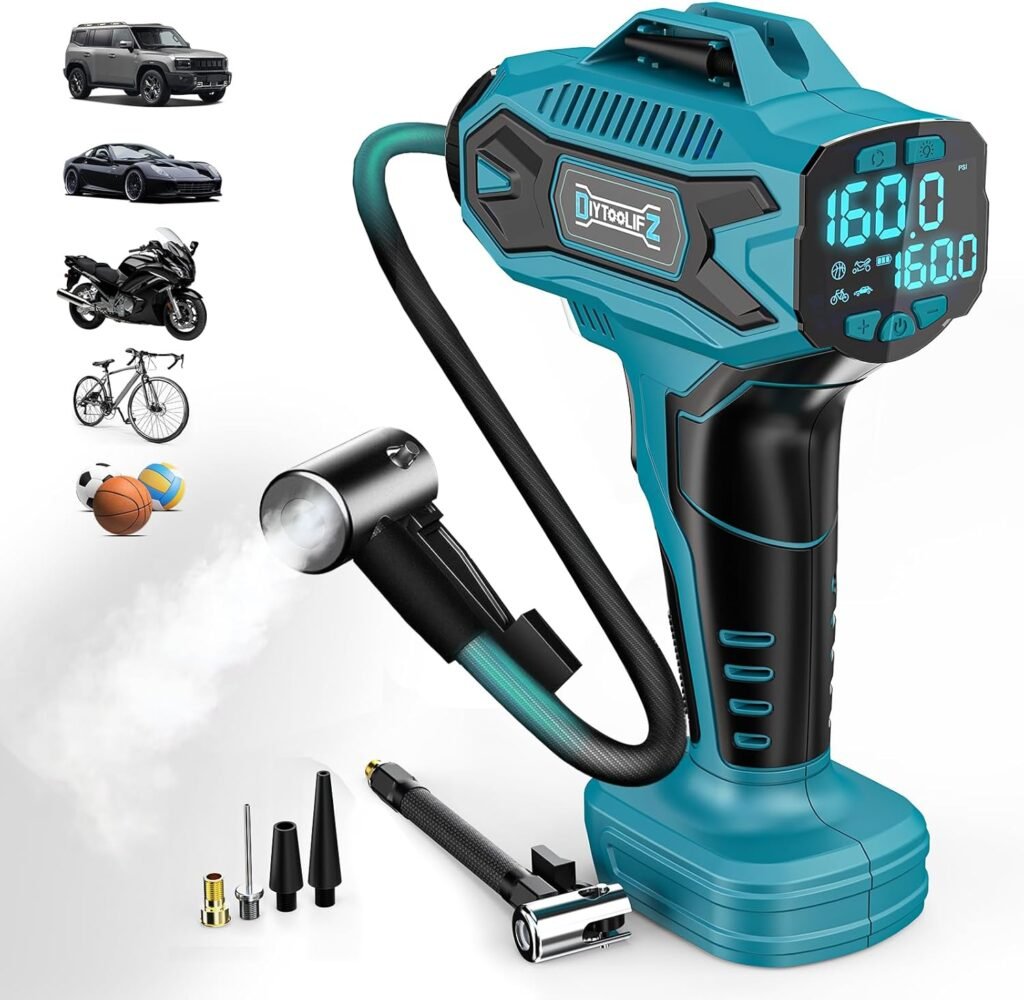

What Makes This Cordless Tire Inflator Stand Out?
When we think about portable inflators, we usually picture slow, noisy gadgets that barely get the job done. This Cordless Tire Inflator Air Compressor Compatible with Makita 18V Battery feels different right away. It’s built for real-world situations—late-night flats, early-morning commutes, weekend trips—and it aims to give us fast, accurate, and cordless inflating power wherever we are.
What truly sets it apart is the blend of strong performance, smart design, and Makita 18V battery compatibility. For those of us already using Makita tools, this can slide right into our existing ecosystem with no extra chargers or batteries to buy.
Key Features at a Glance
Before we talk about how it feels to use, it helps to see the main specs in one place. This gives us a snapshot of what we’re working with and helps us decide whether it fits our needs.
| Feature | Details |
|---|---|
| Power Source | Compatible with Makita 18V Lithium-ion battery (battery not included) |
| Max Pressure | 160 PSI |
| Inflation Speed | Up to 30 L/min |
| Tire Example | 195/65/R15 inflated in about 3.5 minutes |
| Motor Type | Brushless motor |
| Air Cylinder | 25mm metal air cylinder |
| Run Time | Up to ~20 minutes continuous operation |
| Pressure Accuracy | ±1 PSI with automatic shut-off |
| Lighting | Built-in LED light with steady and SOS modes |
| Hose Material | Durable, frost-resistant, heat-resistant nylon-woven material |
| Use Cases | Cars, motorcycles, bikes, and small inflatables |
| Form Factor | Cordless, portable, bare tool design |
This overview already tells us the inflator is not a toy gadget. It’s meant to handle real automotive tasks quickly and consistently, while still being compact enough to keep in the trunk or garage.
Compatibility with Makita 18V Batteries
If we already use Makita 18V tools, this is where the product really starts to shine. The inflator is designed to work with Makita 18V Lithium-ion batteries, leveraging the power platform many of us already own.
This means we can grab the same battery we use for our drill or impact driver and snap it onto the inflator. No need to learn another charging system or juggle another proprietary battery pack. One thing to remember clearly, though: this is a bare tool, so the battery is not included.
Why Battery Compatibility Matters
We often underestimate how annoying extra batteries and chargers can be. With this inflator, we keep our ecosystem simple. If we have two or three Makita 18V batteries in rotation, we’re more or less set—one on a tool, one charging, and one on this inflator when we need it.
That flexibility can turn this compressor into something we actually rely on regularly, rather than a “just-in-case” device we never charge or use.
Cordless Convenience: Inflating Wherever We Are
Corded inflators force us to stay close to a wall outlet or depend on a 12V socket in the car. That can be limiting, especially if we are dealing with a flat in a driveway, on a campsite, or out on a trail.
With a cordless inflator powered by an 18V battery, we gain freedom. We can walk around the vehicle easily, reach all four tires without stretching cables, and even carry it over to a bike rack or a motorcycle parked away from the car.
Real-World Scenarios Where Cordless Power Helps
- In our driveway: We don’t need to drag extension cords from the garage or reposition the car.
- On road trips: We can top off tire pressure at a rest stop, even if there’s no power outlet nearby.
- With multiple vehicles: We move seamlessly from car to motorcycle to bike without plugging and unplugging.
- In emergencies at night: The built-in light plus cordless design means we focus on safety rather than juggling cables.
This ease of use encourages us to maintain proper tire pressure more consistently, which can improve fuel efficiency, tire life, and handling.
Fast Inflation Performance
Speed is where this model clearly tries to prove its worth. With a 25mm air cylinder and a brushless motor capable of up to 30L/min, it’s built for quick top-ups and full inflations.
The manufacturer notes that it can inflate a 195/65/R15 tire in about 3.5 minutes. For a cordless inflator, that’s an impressive benchmark. It suggests that we’re not stuck waiting forever while the machine struggles to push out air.
Why Inflation Speed Matters
When we’re standing by the side of the road or running late, we don’t want to babysit a compressor for ages. Faster inflation means:
- Less time exposed on the shoulder of a highway.
- Less frustration in bad weather or at night.
- More willingness to check and adjust tire pressure regularly.
For routine maintenance—like topping up from 30 PSI to 35 PSI—the process becomes very quick. That alone can turn pressure checks into a 5–10 minute weekend habit instead of a chore we keep putting off.
Brushless Motor and Metal Air Cylinder
Inside the unit, the brushless motor and metal air cylinder work together to provide both durability and strong output. These are not small details; they directly affect how long the inflator can run and how well it holds up over time.
Brushless motors are generally more efficient and longer-lasting than brushed ones. They can maintain speed and power without wearing out carbon brushes, which can be a major advantage for tools we want to keep for years.
Benefits of This Internal Design
- Higher efficiency: Longer run time per battery charge versus less efficient designs.
- Durability: Less internal wear and tear, which is especially useful for a tool that may see bursts of heavy use.
- Stable pressure output: The motor can keep pushing consistent air pressure up to the 160 PSI limit.
The metal air cylinder and gear construction supports pressures up to 160 PSI while running continuously for about 20 minutes. For typical automotive and bike use, that’s plenty of headroom and ensures the inflator won’t be straining at normal tire pressures.

Maximum Pressure and Run Time
With a maximum pressure rating of 160 PSI, this inflator covers most of what we need for car tires, motorcycle tires, and bicycle tires (including many road-bike setups). It also offers enough capacity for other small inflatables that require higher PSI.
The stated continuous run time is around 20 minutes. In practical terms, that might be enough to:
- Inflate several car tires from low to normal pressure.
- Completely fill a flat compact or standard car tire.
- Top off multiple bike or motorcycle tires.
How This Affects Everyday Use
We rarely run an inflator continuously for 20 minutes unless all tires are badly underinflated. In more typical scenarios—quick top-ups on one or two tires—we’re only using it in short bursts.
The 20-minute rating mostly gives us confidence. It tells us that, in a worst-case scenario, we’re unlikely to overtax the machine just by dealing with a small emergency or doing a full check of all tires.
Automatic Shut-Off and Pressure Accuracy
Tire inflators used to require us to squat down, keep checking an analog gauge, and hope we didn’t overdo it. This model removes that guesswork with an automatic shut-off and built-in digital gauge.
We can set our target pressure, connect the hose, and start the inflator. Once the compressor reaches that PSI, it shuts off automatically, with an accuracy of about ±1 PSI. For vehicle and bike tires, that margin is comfortably precise.
Why Automatic Shut-Off Feels So Helpful
This feature can transform the user experience in several ways:
- Hands-free operation: We don’t have to sit there staring at the gauge; we can step back slightly and stay aware of our surroundings.
- Reduced risk of over-inflation: Particularly useful when we’re unsure of how fast the inflator is working.
- Consistency: Each tire can be inflated to the same pressure, helping handling and tire wear.
For newer drivers or family members who may be unsure of how to read a manual gauge, this kind of automatic control is especially reassuring.
Digital Pressure Gauge and Readability
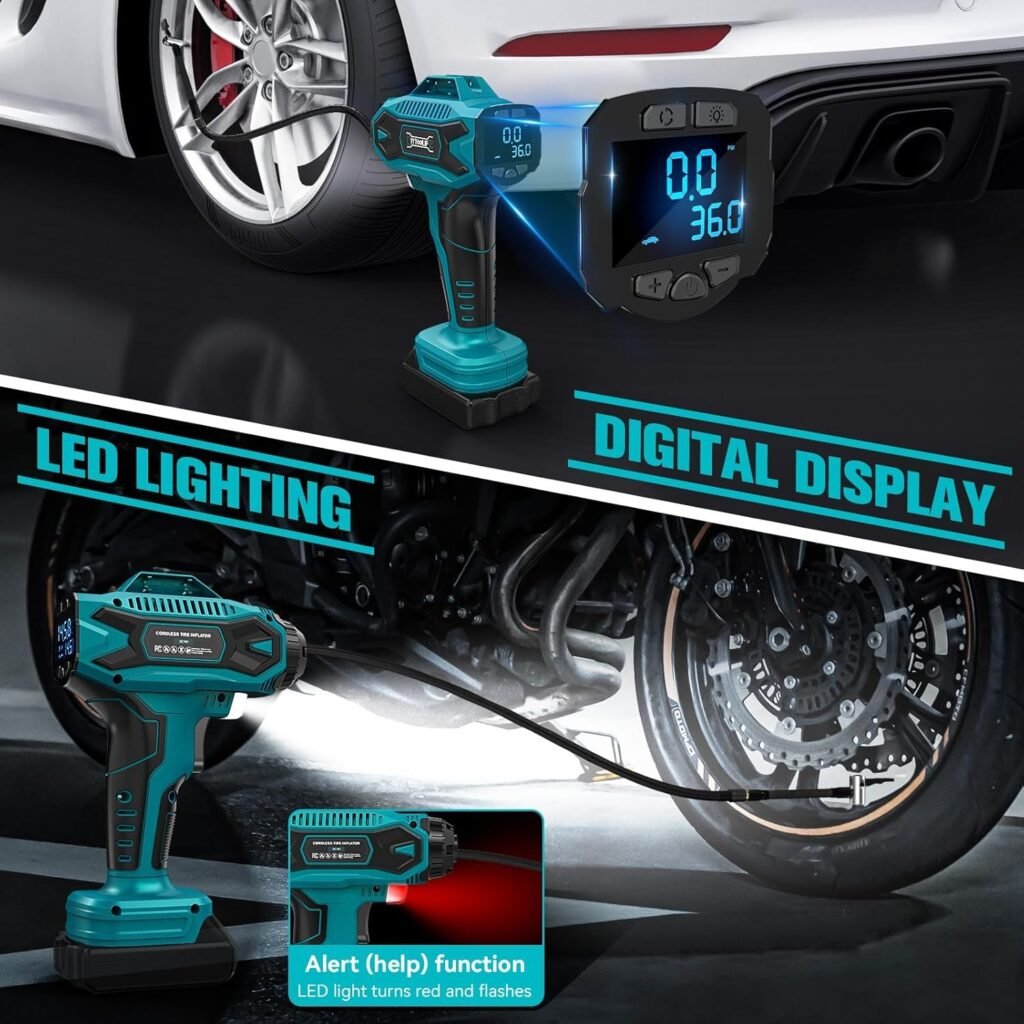
The digital pressure gauge is the center of the user interface. It shows us exactly what the current PSI is and confirms our target level.
Having a clear digital readout means less squinting, especially at night or in dim parking lots. We don’t have to rely on tiny analog dials that are hard to read or easily misinterpreted.
Everyday Benefits of a Digital Gauge
- Quick checks: We can use the inflator simply as a pressure checker, even if we don’t need to add air.
- Night-time clarity: When paired with the LED work light, the gauge remains legible in low light.
- Confidence: Seeing exact numbers rather than “around 35 PSI” builds trust in our tire maintenance routine.
This turns what used to be an occasional, uncertain chore into a more precise and controlled process.
Built-In LED Work Light with SOS Mode
We might not think we need a built-in light until we’re on the side of a dark road. This inflator includes an LED work light designed to make tire inflation safer and easier in poor lighting.
There are two main modes:
- A steady work light for general illumination.
- An SOS mode that can be used as a distress signal in emergencies.
How the Light Improves Safety and Usability
The LED light serves more than one purpose:
- Illumination of the valve area: Connecting the hose to a tire valve at night becomes much easier.
- Increased visibility to others: The light can make our presence visible to oncoming traffic.
- Emergency signaling: The SOS mode may attract attention or indicate that we need help.
For a portable device likely to be stored in a trunk, having its own light source adds value beyond inflation. We can treat it as a part-time work light if we’re inspecting the car in the dark.
Durable, Weather-Resistant Hose and Build
The hose on this inflator uses a nylon-woven material that resists frost and heat. Many cheap inflators use thin, plasticky hoses that stiffen or crack over time, especially in cold weather.
By contrast, a more robust, woven design gives us better flexibility and resilience across seasons. If we keep the inflator in a trunk that heats up in summer and cools down in winter, having a temperature-resistant hose helps it survive that temperature cycling.
Why the Hose Quality Matters
- Less risk of cracking or leaks: A failed hose makes any inflator useless, no matter how strong the motor is.
- Consistent performance in winter: We’re especially likely to see low tire pressures in colder months.
- Long-term reliability: A tougher hose indicates a focus on longevity, not just short-term function.
Along with the sturdy metal cylinder and gears, the hose choice supports the idea that this is designed as a long-term part of our car toolkit.
Ease of Use and Everyday Handling
A powerful compressor is only as good as its ease of use. From what this design suggests, the inflator aims to keep the process simple:
- Attach our Makita 18V battery.
- Connect the hose to the tire valve.
- Set the desired PSI on the digital gauge.
- Start the inflator and let it automatically stop at the target pressure.
Ergonomics and Handling
While the exact shape varies by model, cordless inflators like this are often shaped somewhat like a compact cordless drill, with a comfortable handle and a balanced weight distribution thanks to the battery at the base.
That design usually makes it easy to:
- Hold the inflator in one hand and manage the hose with the other.
- Carry it around the vehicle without fatigue.
- Store it neatly in a trunk, toolbox, or on a garage shelf.
The fewer steps and awkward motions required, the more likely we are to use it frequently instead of avoiding tire checks.
Versatility: Cars, Motorcycles, Bikes, and More
Even though the product description focuses mainly on cars, motorcycles, and bikes, the broader 160 PSI capability and portable design give us flexibility across several scenarios.
We can:
- Inflate car tires to manufacturer-recommended PSI.
- Maintain proper pressure on motorcycle tires, where accuracy matters a lot for stability.
- Adjust bicycle tire pressure for different riding styles (higher PSI for road, moderate for hybrids, lower for certain off-road setups).
- Top off smaller inflatables that need a precise PSI range.
What We Should Still Keep in Mind
This inflator is primarily built for tires and similar loads, not for large air mattresses or pool inflatables with huge volume but low pressure. It can handle those tasks in a pinch, but with its pressure-focused design, it might not be as fast as a dedicated high-volume, low-pressure blower for very large items.
Still, as an all-around emergency and maintenance tool, it covers almost everything with wheels in our household.
Safety Considerations and Reliability
Whenever we’re dealing with high-pressure air, safety features matter. This inflator takes a couple of meaningful steps in that direction:
- Automatic shut-off: Prevents over-inflation if we set the correct target PSI.
- Accurate gauge: Reduces guesswork and prevents “just a bit more” errors.
- LED light and SOS: Helps keep us visible and oriented in low light.
- Sturdy construction: Metal cylinder, strong gears, and a durable hose reduce the chance of sudden failures.
How to Use It Safely
If we adopt a few simple habits, we can maximize both safety and tool life:
- Always check the manufacturer’s recommended tire pressure (usually on a door jamb sticker or owner’s manual).
- Avoid running the inflator beyond its recommended continuous use time back-to-back; let it cool slightly between long sessions.
- Store it in a relatively dry place when possible to protect electronics and hose material, even though it’s built to handle regular temperature swings.
Combined with responsible use, these features make the inflator a trustworthy option for both everyday maintenance and emergency situations.
Advantages of a Portable Inflator in Our Vehicle
Keeping a cordless inflator in the trunk changes how we think about tire issues. Instead of minor low-pressure warnings turning into stressful events, they become quick tasks we can handle almost anywhere.
Here are some day-to-day benefits:
- We’re not tied to gas station air pumps, which might be broken, crowded, or coin-operated.
- We react faster to tire-pressure warnings, improving safety and fuel economy.
- We support better tire wear, since underinflated tires can wear unevenly and more quickly.
- We can assist others, whether it’s a friend, neighbor, or stranger with a soft tire.
Having this tool close at hand adds a layer of independence and preparedness to our driving routine.
Who Will Appreciate This Inflator the Most?
Not every tool is right for everyone, but this compressor has a pretty clear audience. We can think about who gains the most from its feature set and design choices.
Ideal Users
- Makita 18V tool owners: Clearly the biggest winners, since they can reuse existing batteries.
- Drivers who value self-sufficiency: Those of us who prefer to handle basic car maintenance ourselves.
- Motorcycle and bike riders: Riders often care deeply about precise tire pressure and appreciate cordless flexibility.
- Frequent travelers and commuters: Anyone who spends a lot of time on the road benefits from an emergency-ready inflator.
For households with multiple vehicles and bikes, this single tool can become a shared maintenance companion.
Potential Limitations to Consider
No product is perfect, and it helps to be aware of what might not suit our situation before we commit.
What Might Be a Drawback for Some of Us
- Battery not included: If we don’t already own Makita 18V batteries, we’ll need to invest in at least one battery and charger, which increases the total cost.
- Not designed for heavy industrial use: While robust, it’s still a portable consumer-grade inflator, not a shop compressor for running air tools all day.
- Continuous use time is finite: About 20 minutes of continuous operation is generous for inflating tires, but it’s not meant for long, uninterrupted industrial tasks.
As long as we understand these points up front, we’re less likely to be disappointed and more likely to see this inflator as part of a broader toolkit rather than a one-and-only air source for every possible job.
Comparison with Typical 12V Car Inflators
Many of us already have (or have considered) a 12V inflator that plugs into the car’s cigarette lighter. It’s worth comparing that style with this Makita-compatible cordless option.
How This Cordless Model Measures Up
-
Power Source:
- 12V inflators depend on vehicle power; this one depends on an 18V tool battery.
- With a dead car battery or limited access to the 12V socket, a cordless inflator offers an advantage.
-
Mobility:
- Cordless use is more flexible when reaching rear tires, trailers, or bikes stored away from the vehicle.
- No wires to tangle or trip over.
-
Performance:
- The brushless motor and 25mm cylinder allow faster inflation than many budget 12V options.
- 160 PSI capability provides more headroom for higher-pressure use cases.
-
Convenience:
- Automatic shut-off and digital gauge are also found on some 12V models, but this unit combines those with Makita battery compatibility and a sturdy build.
If we’re already invested in Makita 18V batteries, this cordless option often edges out basic 12V inflators in speed, freedom of movement, and integration with our existing tools.
Using It as Part of Our Maintenance Routine
An inflator like this is not just an emergency device; it can become part of a regular maintenance schedule that keeps our vehicles running efficiently.
Simple Routine We Might Adopt
-
Weekly or bi-weekly pressure check:
Use the digital gauge to check all four car tires plus spare. Top up as needed. -
Before long trips:
Confirm pressure on all vehicle and trailer tires the day before leaving. -
Seasonal changes:
When temperatures drop or rise significantly, use the inflator to adjust pressure according to the vehicle’s recommended values.
Turning these steps into a habit reduces surprises such as uneven tire wear, reduced fuel economy, or TPMS warnings at inconvenient times.
Storage and Long-Term Ownership
Where and how we store the inflator can influence how long it serves us reliably. Because it’s cordless and fairly compact, storage is simple compared with full-size compressors.
Good Storage Practices
-
In the car:
Keep it in the trunk or a side compartment, ideally in a small bag or case to protect it from loose items. -
In the garage:
Store it on a shelf or with other cordless tools, with the Makita batteries kept on a proper charger rotation. -
Battery care:
If we’re not using the inflator frequently, it’s wise to keep at least one battery partially charged and check on it monthly, in line with good Lithium-ion care.
With occasional quick test runs and cleaning of dust from vents, we can keep the inflator ready for years.
Environmental and Cost Considerations
By maintaining proper tire pressure, we not only protect our tires but also potentially reduce fuel consumption. Underinflated tires increase rolling resistance, which can quietly waste fuel over time.
Indirect Benefits
-
Fuel efficiency:
Even a small improvement adds up over countless miles. -
Tire longevity:
Better pressure management means more uniform wear, reducing how often we need to replace tires. -
Reduced dependency on disposable services:
Instead of repeatedly paying for air at gas stations or driving out of our way to find a working pump, we take control with a reusable tool.
Over the life of our vehicles, these small savings can offset the cost of the inflator and batteries, all while giving us greater independence and convenience.
Summary: Is This Cordless Tire Inflator Worth It for Us?
Looking at the full picture, this Cordless Tire Inflator Air Compressor Compatible with Makita 18V Battery, 160PSI Portable Air Pump with Digital Pressure Gauge, Fast Inflation for Cars, Motorcycles, Bikes (Bare Tool) delivers a strong combination of performance, convenience, and smart design.
We get:
- Fast inflation speeds with a 25mm air cylinder and brushless motor (up to 30L/min).
- Up to 160 PSI with about 20 minutes of continuous run time.
- Automatic shut-off with ±1 PSI accuracy for worry-free inflation.
- A digital pressure gauge for easy reading day or night.
- A built-in LED work light with steady and SOS modes for safety and convenience.
- A durable, frost- and heat-resistant nylon-woven hose and robust metal internals.
- Seamless compatibility with Makita 18V Lithium-ion batteries (battery not included).
If we already own Makita 18V tools, this inflator fits naturally into our tool lineup and becomes a high-utility, low-hassle solution for tire maintenance and roadside readiness. Even if we’re just starting out with Makita batteries, the cordless freedom, strong performance, and safety features make this a compelling choice as our go-to portable tire inflator.
For those of us who value independence, preparedness, and reliable gear, this tool can become a trusted part of our everyday and emergency toolkit.

Disclosure: As an Amazon Associate, I earn from qualifying purchases.