Are we looking for a serious air compressor that can keep up with demanding tasks without sounding like a jet engine taking off in our garage?

Our Overall Impression of the California Air Tools 20015HP
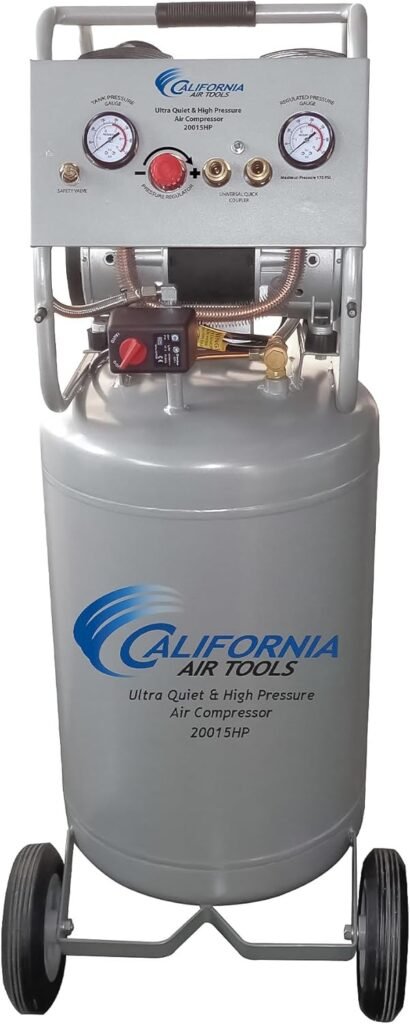
We see the California Air Tools 20015HP 1.5 HP Ultra Quiet, Oil-Free, 175 PSI High Pressure Air Compressor with Wheels, 20 Gallon Tank Capacity, 70 dB Noise Level, Electric, Portable as a strong choice for anyone who wants high pressure, reasonable airflow, and low noise in a package that is still portable. It is clearly designed for home workshops, small businesses, and pros who care about noise levels as much as performance.
From our perspective, this model hits a really nice balance between power, capacity, and convenience. It is not a tiny “carry it with one hand” unit, and it is not a huge stationary shop compressor either. It lives right in the middle, which makes it appealing for those of us who want serious air power but still need to move it around.
Key Features at a Glance
Before we get into the details, we find it useful to summarize the main specs in an easy-to-read way. This gives us a quick feel for what we can realistically expect from this compressor.
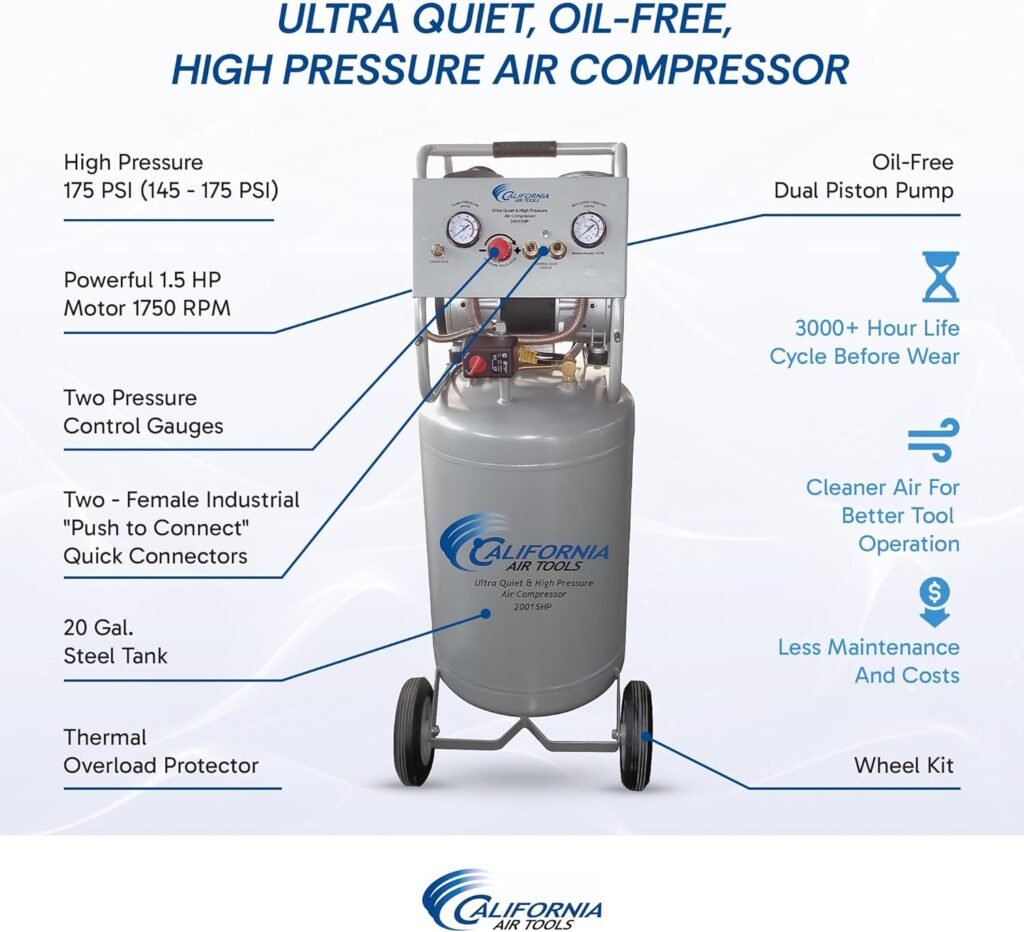
| Feature | Specification |
|---|---|
| Brand & Model | California Air Tools 20015HP |
| Motor Power | 1.5 HP high pressure motor |
| Pump Type | Oil-free, dual piston, 2-stage pump |
| Maximum Pressure | 175 PSI |
| Air Delivery (CFM) | 4.00 CFM @ 40 PSI / 3.80 CFM @ 90 PSI |
| Tank Capacity | 20-gallon steel tank |
| Noise Level | 70 dB (Ultra Quiet series) |
| Pump Life Cycle | Over 3000 hours |
| Voltage / Frequency | 110V / 60 Hz |
| Amp Draw | 12 amps |
| RPM | 1750 RPM |
| Portability | Wheeled, 113 lbs |
| Dimensions (L x W x H) | 19.3″ x 19.5″ x 46.7″ |
| Additional Features | Thermal overload protection, pressure control gauges, oil-free operation |
This quick snapshot shows us we are dealing with a high-pressure, relatively quiet, mid-size unit that should be suitable for most serious DIY and light professional tasks.
Noise Level: How Quiet Is 70 dB Really?
Noise is often the first thing we care about when shopping for a compressor we will use in a garage, basement, or small shop. The 20015HP is part of California Air Tools’ Ultra Quiet line, and the 70 dB rating is a big selling point.
Working Around 70 dB in Real Life
At around 70 dB, we are in the range of a normal conversation or a household vacuum cleaner. This is much quieter than many traditional oil-lubed cast-iron compressors that can easily hit 80–90 dB or more.
In practical terms, we can comfortably work near this compressor without feeling like we need to shout to each other. It is still audible, of course, but it is not that harsh, rattling blast of sound we often associate with older shop compressors. For home garages and small workshops, that makes a huge difference.
Why the Lower RPM Matters
One of the reasons this unit stays quieter is the relatively low motor speed of 1750 RPM. Many compressors run at higher RPMs to achieve similar outputs, but that usually comes with higher noise and faster wear. By running slower, this compressor keeps both sound and mechanical stress down, which we see as a nice design choice for longevity.
Oil-Free Dual Piston Pump: Maintenance and Air Quality
The 20015HP uses an oil-free, 2-stage dual piston pump. That combination is aimed at giving us reasonable performance, low maintenance, and clean air output.
Benefits of Oil-Free Operation
Since the pump is oil-free, we are not dealing with oil changes, oil levels, or the risk of oil mist getting into our air lines. That is particularly helpful if we are:
- Painting or running HVLP spray guns
- Using air tools where oil contamination would be a problem
- Running small pneumatic equipment in a cleaner indoor environment
It also simplifies ownership. We do not have to schedule oil changes or keep compressor oil on the shelf. For many of us, that is one less chore to remember.
Dual Piston, 2-Stage Pump Efficiency
The dual piston, 2-stage design is meant to improve efficiency and performance at higher pressures. By compressing air in stages, the unit handles the jump up to 175 PSI more effectively than a basic single-stage pump that tops out around 125–135 PSI.
California Air Tools rates this pump with a life cycle of over 3000 hours, which is significantly more than many small consumer-grade compressors. While real-world life will always depend on how we use and maintain it, that number suggests the internal components are built with durability in mind.

High Pressure Capability: Working Up to 175 PSI
One of the standout features is the 175 PSI maximum pressure. Many common consumer compressors stop at 125–150 PSI, so hitting 175 PSI gives us more headroom.
Why Higher Pressure Matters
Running up to 175 PSI means we can:
- Use tools and equipment that benefit from higher supply pressures
- Store more usable air in the same 20-gallon tank
- Extend the working time of certain tools between compressor cycles
The compressor turns on and off between 145 and 175 PSI according to the product description. That means it does not constantly run at max load, and we get a fairly wide operating range.
Practical Implications for Tools
For most small shop and DIY applications—like impact wrenches, brad nailers, framing nailers, blow guns, and some light spray painting—this pressure range is more than adequate. Many tools are rated to run comfortably at 90 PSI, which this compressor provides at 3.80 CFM.
The extra capacity up to 175 PSI gives us better recovery behavior. We can fill the tank to a higher pressure, then work down from there, which can lead to fewer starts and stops in some usage patterns.
CFM Performance: What We Can Actually Run
The CFM numbers are often more important than PSI when it comes to matching tools. The California Air Tools 20015HP is rated at:
- 4.00 CFM @ 40 PSI
- 3.80 CFM @ 90 PSI
Matching CFM to Real-World Tasks
At roughly 3.8 CFM @ 90 PSI, we are in a good range for:
- Brad nailers, finish nailers, and staplers
- Many impact wrenches used intermittently
- Air ratchets for light to moderate use
- Tire inflation for cars, bikes, and small trucks
- Blow guns and simple cleaning work
- Occasional light-duty HVLP spraying (within the gun’s requirements)
We would not consider this a heavy continuous-use compressor for high-demand tools such as sandblasters, large die grinders, or industrial spray rigs. Those often need 8–12+ CFM sustained, which is outside this unit’s design. But for typical shop and garage work where tools run in bursts rather than continuously, the 20015HP can be a very solid partner.
Where It Shines Best
Where we think this compressor really makes sense is in tasks that demand:
- Moderate CFM
- Frequent but not constant tool use
- Quiet operation so we can still talk, listen to music, or work inside shared spaces
If we tend to rotate between tasks—nailing, then hand work, then air again—the compressor has time to recover, and the 20-gallon tank helps smooth out the load.
20-Gallon Tank: Capacity and Practical Use
The 20-gallon steel tank is another important part of the equation. It places this model firmly in the mid-sized class—larger than the 6–8 gallon portable units, but smaller than big stationary 60+ gallon shop systems.
Why 20 Gallons Is a Sweet Spot
With 20 gallons, we get:
- Longer run time between cycles compared to small pancake or hot-dog compressors
- Better stability in pressure when using intermittent tools
- Enough volume to handle several tasks without constant refilling
For example, if we are doing trim work with a brad nailer, the compressor may run periodically rather than constantly, giving us a more relaxed workflow. The tank size also makes this compressor far more suitable for multiple tasks over a day’s work, rather than being something we only bring out for a quick tire top-up.
Trade-Offs of Tank Size vs. Portability
Of course, more tank capacity also means more weight. At 113 pounds, this is not something most of us will pick up and carry around. That is where the wheels come in, which we will cover next. We see the 20-gallon capacity as a very practical choice for stationary-but-movable workshop use.
Portability and Design: Moving a 113-Pound Compressor
Portability often means trade-offs, and this model tries to keep things practical with a vertical tank, wheels, and a fairly compact footprint.
Wheeled Design for Shop Mobility
The 20015HP has wheels that allow us to roll it around the jobsite, shop, or garage rather than lifting it. Combined with its vertical, upright design (46.7 inches tall), this makes it:
- Easier to store along a wall or in a corner
- Easier to move across relatively smooth surfaces
- More manageable in tight spaces than a horizontal tank of similar size
We should be honest: 113 pounds is still substantial. Rolling it over rough terrain, gravel, or up stairs is not going to feel effortless. But within a flat garage or shop, the wheeled design should be perfectly fine for repositioning or tucking it away when not in use.
Dimensions and Footprint
With dimensions of 19.3″ (L) x 19.5″ (W/D) x 46.7″ (H), the unit is fairly compact for a 20-gallon compressor. That makes it a good fit for:
- Home garages with limited floor space
- Small professional workshops where every square foot counts
- Mobile uses where we might roll it onto a trailer or into a van
We just need to keep the height in mind when planning storage and transport, especially under low shelves or in tight-height enclosures.
Power Requirements and Low Amp Draw
Knowing how we are going to power a compressor is just as important as its pressure and CFM.
Standard 110V / 60 Hz Compatibility
This compressor runs on standard 110V / 60 Hz power, which means we can plug it into typical household or shop outlets in North America. We do not need special 220V lines or dedicated industrial circuits, which makes installation simple for most of us.
12-Amp Draw and What It Means
The compressor draws about 12 amps, which is fairly modest for a unit of this size. That gives us a few advantages:
- Higher likelihood of running on a typical 15-amp household circuit (ideally dedicated)
- Reduced risk of tripping breakers compared with some higher-amp units
- Easier to use on extension cords, if necessary, as long as we choose proper gauge and length
We still want to be careful. Running the compressor on the same circuit as heavy power tools, heaters, or other big electrical loads can lead to breaker trips. Ideally, we give it its own circuit or at least avoid stacking too many large loads together.
Durability and Protection Features
When we invest in a compressor of this size, we want to feel confident it will last. Several design points give us reassurance on durability.
Pump Life Cycle and Build Expectations
The manufacturer lists a pump life cycle of more than 3000 hours. For a home or small shop environment, that represents a significant lifespan. Even using it regularly, it would typically take years to accumulate that many hours.
Combined with the lower 1750 RPM speed and oil-free dual piston design, we see this unit as being oriented toward longevity rather than just hitting impressive specs on paper.
Thermal Overload Protection
The built-in thermal overload protection is there to protect the motor from overheating. In real-world use, if we push the compressor too hard or operate it in very hot conditions, this feature can shut the unit down to prevent serious damage.
We still want to ensure reasonable ventilation around the compressor, but having this kind of safeguard makes us more comfortable about long sessions of use.
Ease of Use: Controls, Gauges, and Everyday Operation
A compressor can have great specs, but if the controls are confusing or awkward, we may end up frustrated. This model aims to keep operation straightforward.
Pressure Control Gauges
The presence of pressure control gauges means we can:
- See tank pressure at a glance
- Monitor output pressure to our tools
- Adjust regulator settings to fit what we are running
Being able to fine-tune the output pressure is especially important when we switch between tools that need different levels—for example, going from an impact wrench to a brad nailer or a spray gun.
Simple Start-Up and Routine Use
Since this is an electric, oil-free compressor, the start-up routine is simple:
- Plug it in to a suitable outlet
- Ensure the power switch is in the correct position
- Let it build pressure up to the cut-out level
- Adjust the regulator and connect our tools
We do not need to add oil or prime anything, which keeps early ownership friction low. Drain the tank regularly and keep basic safety in mind, and we should have a fairly worry-free daily experience.
Where This Compressor Fits Best
Not every compressor is right for every user. The 20015HP sits in a particular niche that makes it well-suited for certain roles more than others.
Ideal Users and Environments
We think this model is especially good for:
- Home workshop enthusiasts who want professional-level performance without harsh noise
- Small auto shops or detailers needing a relatively quiet compressor near customer areas
- Woodworkers using nailers, staplers, and some finishing tools
- Contractors needing a portable high-pressure unit for finish work or punch lists
- Hobbyists doing light painting or airbrushing within the CFM limits
Anywhere noise is a concern—like shared garages, attached homes, or small commercial spaces—this compressor earns extra points.
Applications Where It May Be Less Ideal
We would not choose this unit for:
- Heavy industrial environments with constant pneumatic tool usage
- Sandblasting, large grinders, or high-CFM paint guns used non-stop
- Situations where ultra-lightweight portability is essential (like rooftop work where we must carry the unit frequently)
For those tasks, we would want either a bigger, higher-CFM stationary system or a smaller, lighter unit that trades capacity for extreme portability.
Pros and Cons: Our Balanced Take
Putting everything together, we can summarize the strengths and trade-offs of the California Air Tools 20015HP.
What We Really Like
- Very quiet operation (70 dB): Much easier on our ears and surroundings than many traditional compressors.
- High pressure up to 175 PSI: Gives us more stored air and flexibility with tools.
- Oil-free dual piston pump: Low maintenance, cleaner air, and no oil changes to worry about.
- Solid air delivery for its class: 3.8 CFM @ 90 PSI is respectable for a 1.5 HP, 20-gallon unit.
- Decent pump life rating: Over 3000 hours suggests thoughtful engineering and durability.
- Portable with wheels: Manageable to move around a garage or shop despite the 113-pound weight.
- Low amp draw (12 amps): Works with standard 110V household outlets and reduces electrical hassle.
- Vertical design: Conserves floor space and fits better into compact workshops.
Where We See Limitations
- Weight (113 lbs): Portable, but not something we want to lift; better for rolling than carrying.
- Moderate CFM only: Not built for heavy continuous-demand tools like large sanders or sandblasters.
- Wheels best on smoother surfaces: Rolling over rough jobsite terrain can still be a challenge.
- Requires good circuit planning: Even at 12 amps, sharing a circuit with other big loads can still trip breakers.
We consider these trade-offs reasonable given the target user: someone who values quiet and quality over raw industrial power.
Practical Scenarios: How We Might Use It
To make the specs feel more real, we find it helpful to picture some actual tasks and how this compressor would handle them.
Home Garage and Automotive Work
For automotive enthusiasts, this compressor can comfortably handle:
- Inflating car and truck tires
- Running a 3/8″ or 1/2″ impact wrench intermittently
- Powering an air ratchet or small grinder in short bursts
- Cleaning engine bays or work areas with a blow gun
The quiet operation is a huge plus when working in attached garages where family or neighbors are nearby. We can work late or early without creating the kind of noise that shakes the house.
Woodworking and Finish Carpentry
In woodworking and carpentry settings, we see this unit as excellent for:
- Brad nailers and finish nailers for trim work
- Framing nailers used intermittently
- Staplers for upholstery or cabinet backing
- Occasional spraying of finishes with low to moderate air demand guns
The 20-gallon tank gives enough buffer that we are not starting and stopping the compressor every few seconds. The quiet running also makes it easier to listen to instructions, podcasts, or music while we work.
Small Business or Light Commercial Use
For small shops—like detailing businesses, bike shops, small fabrication spaces—this compressor offers a good mix of professionalism and courtesy to others:
- It looks and feels like real shop equipment, not a tiny consumer gadget.
- It runs quietly enough that customers or office staff nearby are less disturbed.
- It handles day-to-day tasks without demanding extensive maintenance.
As long as CFM demands stay within its range and we are not trying to run multiple high-demand air tools simultaneously all day, it can serve as a very capable core compressor.
Maintenance and Longevity Tips
Even though the 20015HP is oil-free and requires less ongoing work than an oil-lubed compressor, good habits still matter if we want to enjoy that 3000+ hour rated lifespan.
Regular Tank Draining
Air compression produces moisture, and that moisture collects in the tank. We want to:
- Drain the tank regularly, ideally after each day of use
- Open the drain valve fully to let condensed water out
- Prevent internal tank rust by not letting water sit for long periods
This simple step goes a long way toward preserving the tank’s integrity.
Ventilation and Environment
To help the compressor last:
- Keep it in a reasonably cool, dry spot
- Allow space around it for air circulation
- Avoid covering it with cloths or storing it in dusty, enclosed corners without airflow
Even with thermal overload protection, better cooling means less stress on the motor and pump over time.
Checking Fittings and Hoses
We should also:
- Periodically inspect hoses and fittings for leaks
- Tighten loose connections (within reason)
- Replace worn or cracked hoses
Air leaks make the compressor work harder than necessary, cut into performance, and can shorten its working life.
How It Compares in Its Class
We find it useful to place the 20015HP within the broader world of compressors most of us consider.
Against Small Pancake Compressors
Compared to common 6-gallon pancake units:
- The 20015HP offers more tank capacity (20 vs. 6 gallons).
- It usually runs quieter, especially under load.
- It provides more sustained working time and generally better suitability for larger tasks.
- It is heavier and less grab-and-go, but far more capable for serious shop use.
If we have outgrown a small pancake compressor and want a “real” workshop unit without going fully industrial, this is a logical upgrade.
Against Big Stationary Shop Compressors
Compared to large 60–80 gallon, 220V stationary compressors:
- The 20015HP is much easier to install and move around.
- It runs on standard power and does not require special wiring.
- It is quieter in many cases, but also offers less CFM and total capacity.
We would not pick this if we are running a full professional auto shop with multiple techs and constant air demand. But for individual users or small operations, the simplicity and lower noise can make more sense than going full industrial.
Our Final Verdict on the California Air Tools 20015HP
Putting every aspect together—noise level, performance, pressure, capacity, maintenance, and portability—we see the California Air Tools 20015HP 1.5 HP Ultra Quiet, Oil-Free, 175 PSI High Pressure Air Compressor with Wheels, 20 Gallon Tank Capacity, 70 dB Noise Level, Electric, Portable as a very strong option for serious DIYers, hobbyists, and small professional shops that value quiet performance and reliability.
We are not looking at a giant industrial machine, and we are not looking at a tiny budget compressor either. This unit targets that middle ground where many of us actually work: we want enough power to run real tools, we want the convenience of wheels and standard power, and we really appreciate not having to shout over the compressor when it cycles on.
If our needs align with moderate CFM, high pressure, low maintenance, and a quieter, more pleasant workspace, this compressor deserves a spot near the top of our shortlist.

Disclosure: As an Amazon Associate, I earn from qualifying purchases.