Humming in a corner like a steady engine, the right stationary compressor keeps our workflow smooth and our tools hungry for air. This year’s standouts balance high CFM, quiet operation, and rugged builds without bloating footprint or maintenance. We’ll compare PSI ceilings, tank sizes, duty cycles, and smart features that actually help on the shop floor—so you can match performance to your workload and budget. One model’s versatility may surprise you next.
Key Takeaways
- Maxair C5160V1-MAP: 5HP, 60-gallon, 170 PSI, 18.5 CFM at 100 PSI; cast-iron pump and cooling features for demanding shop use.
- DEWALT 60-Gallon Vertical: 5 HP, 175 PSI, 14.6 CFM at 90 PSI, ~70 dB; space-saving ASME tank for pro shops.
- PRAFF7.5 10HP Rotary Screw package: 39 CFM at 150 PSI with tank and refrigerated dryer; turnkey, low-maintenance, 75 dB operation.
- VEVOR 80-Gallon 2-Stage Oil-Free: 6.5 HP, 15.5 SCFM at 90 PSI, 86 dB; rapid fill and durable 4 mm steel construction.
- DEWALT 60-Gallon 3.7 HP Industrial: 175 PSI, 11.5 CFM at 90 PSI; oil-lubed reliability with 208/230V spread-voltage motor.
Maxair C5160V1-MAP 60-Gallon 170 PSI Max Electric Stationary Compressor


February 25, 2026 3:20 am
Looking for serious shop air without going two-stage? We like the Maxair C5160V1-MAP for its 5HP motor, 60-gallon tank, and 170 PSI max. It delivers 18.5 CFM at 100 PSI, so we can run sprayers, grinders, plasma cutters, and bead blasting without starving tools. The cast iron, single-stage pump, copper finned tubes, and a big flywheel keep things cool. Usability stands out: extended front oil drain, sight gauge, regulator with quick connects, and a large liquid-filled gauge. Bolt it down using the slotted base. Inspect the three filters and drain valve on delivery. Backed by a limited 2-year warranty.
Best For: Serious DIYers and small shop owners who need high-pressure, high-CFM shop air from a durable single-stage, 5HP, 60-gallon stationary compressor without stepping up to a two-stage unit.
Pros:
- Strong performance: 18.5 CFM at 100 PSI and 170 PSI max supports sprayers, grinders, plasma cutters, and bead blasting.
- Durable, cool-running build: cast iron single-stage pump, copper finned tubes, and large fan/flywheel.
- User-friendly features: extended front oil drain, easy-view sight gauge, regulator with quick connects, large liquid-filled gauge; 2-year limited warranty.
Cons:
- Heavy and stationary (280 lbs); requires bolting to concrete and planned placement.
- Single-stage design may not match sustained heavy-duty two-stage performance for continuous industrial use.
- Reports of delivery issues; buyers should inspect for the three filters and drain valve and may need to address component replacements.
Metabo HPT Gas Powered Wheeled Air Compressor (EC2510E)

February 21, 2026 7:05 pm
Serious framers and roofers who need off-grid power will appreciate the Metabo HPT EC2510E’s Honda GX engine and 8-gallon tank that delivers a steady 116–145 PSI for big nailers without babysitting the pressure. We like its cast iron cylinder, oversized oil sight glass, and pneumatic throttle control that keeps output responsive and reliable. The integrated control panel protects gauges and plumbing, and the full-size 3/8-inch locking regulator comes preinstalled—though some users report 1/4-inch outlets. At 144 pounds with a wheeled, durable frame, it’s jobsite-ready and reasonably quiet at 70 dB. Included oil and parts simplify setup. Backed by a 1-year warranty.
Best For: Contractors and serious DIYers who need a portable, gas-powered compressor with steady 116–145 PSI output for framing, roofing, and siding nailers on off-grid jobsites.
Pros:
- Honda GX engine and cast iron cylinder deliver reliable, high-performance compression for heavy-duty tools
- Integrated control panel with preinstalled 3/8-inch locking regulator; protected gauges and centralized controls
- Jobsite-ready build: wheeled 8-gallon tank, 70 dB operation, included oil and parts for easier setup
Cons:
- Heavy at 144 lb, which can be cumbersome to load/unload despite wheels
- Mixed user reports on outlet size (3/8 vs 1/4 NPT) may require fittings/adapters
- Only a 1-year warranty, shorter than some pro-grade competitors
7.5KW/10HP Rotary Screw Air Compressor with 80 Gallon Tank and Refrigerated Dryer
February 25, 2026 3:20 am
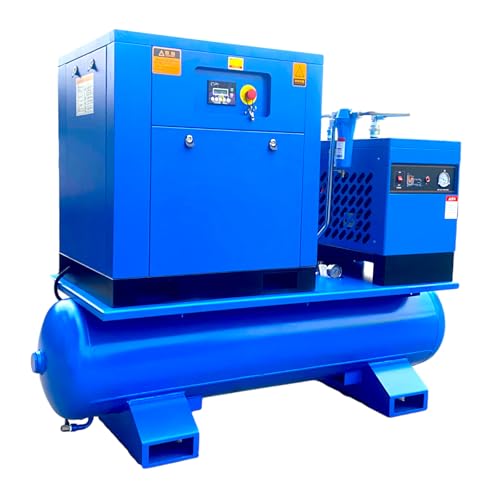
For shops that need clean, steady air without extra add-ons, this 7.5 kW/10 HP rotary screw unit bundles a refrigerated dryer and 80-gallon ASME tank for turnkey performance. We like its 39 CFM at 150 PSI, 230V/60Hz/3-phase power, and 10 bar max pressure—strong output for spraying and general industrial duty. The direct-coupled drive runs at 3600 rpm, hitting 75 dB, and reduces maintenance versus belts. It’s pre-debugged: plug-and-run with included oil, filter, air tank, and dryer. Specs: NPT 1/2-inch outlet, 70x35x60 inches, 990 pounds, cast iron. Model PRAFF7.5-230V by DCYL. Warranty: 1 year with remote diagnostics and emergency parts.
Best For: Small to mid-size shops needing clean, steady air for spraying and general industrial work, with a turnkey all‑in‑one rotary screw system that includes an 80-gallon tank and refrigerated dryer.
Pros:
- All-in-one package (compressor, 80-gal ASME tank, refrigerated dryer, oil, filter) for plug-and-run setup
- Direct-coupled drive at 3600 rpm reduces maintenance vs belt-driven; 39 CFM @ 150 PSI with 10 bar max
- Compact footprint for capacity (70x35x60 in), 75 dB noise level, NPT 1/2″ outlet
Cons:
- Requires 208–230V, 60Hz, 3-phase power; cannot convert from single-phase via a converter
- Heavy (990 lb) stationary unit; not portable
- 1-year machine warranty may be short for round-the-clock industrial use
DEWALT 60 Gallon Vertical Air Compressor, 5 HP, 175 PSI (Single Stage, 240V)

February 24, 2026 10:59 am
Need a high-capacity shop workhorse that stays relatively quiet? We like DEWALT’s 60 Gallon Vertical Air Compressor (DXCM603.COM) for its 5 HP, single-stage punch and 70 dB operation. It delivers 17 CFM at 40 PSI and 14.6 CFM at 90 PSI, topping out at 175 PSI—plenty for sanding, drilling, blow cleaning, and more.
The ASME-certified 60-gallon tank and oil-lubed pump provide steadier pressure, smoother operation, and longer life. Its vertical footprint saves floor space, while the 240V, 60 Hz induction motor thrives in demanding shops. Setup is straightforward with on/off switch, gauge, and large outlet. Warranty: 2-year pump, 1-year parts. Users praise airflow; watch shipping and motor QC.
Best For: Pro and serious DIY shops needing high CFM, 175 PSI capacity, and a relatively quiet, space-saving 60-gallon compressor for continuous pneumatic tool use.
Pros:
- Strong airflow: 17 CFM @ 40 PSI and 14.6 CFM @ 90 PSI; 175 PSI max for demanding tools
- Quieter 70 dB operation and oil-lubed pump for smoother, longer-lasting performance
- Vertical ASME 60-gallon tank saves floor space; robust 240V induction motor for shop duty
Cons:
- Requires 240V power and proper wiring; not plug-and-play for standard 120V outlets
- Heavy (222 lbs) and tall, making placement and transport more involved
- Some reports of shipping damage or motor QC issues in reviews
Rotary Screw Air Compressor TK11-8 (11kW/15HP, 230V 3-Phase, 125 PSI)

February 25, 2026 3:20 am
Powering 60.39 CFM at 125 PSI with a variable-speed drive, the LRSD TK11-8 (11kW/15HP, 230V 3-phase) stands out for shops that demand continuous, energy-smart air without the noise—just 72 dB. We like its LRSD inverter, which trims energy use by matching motor speed to demand. The oil-injected rotary screw design runs cooler and smoother, and its efficient cooling system helps extend service life. Built from alloy steel and weighing 610 pounds, it’s truly industrial-grade. It measures 42 x 29 x 38 inches, draws 20 amps, and is 60 Hz only. Note: it can’t be converted to single-phase. Amazon’s 30-day return policy applies.
Best For: Industrial shops needing continuous-duty, energy-efficient compressed air at 125 PSI on a 230V 3-phase supply, with lower noise and precise VSD control.
Pros:
- Variable-speed drive matches motor speed to demand, improving energy efficiency and reducing operating costs
- Delivers 60.39 CFM at 125 PSI with stable, cooler, oil-injected rotary screw performance at just 72 dB
- Rugged alloy-steel build and efficient cooling system enhance durability and extend service life
Cons:
- Requires 230V 3-phase power and cannot be converted from single-phase
- Heavy (610 lbs) and stationary; footprint of 42 x 29 x 38 inches limits portability
- 60 Hz only; not suitable for regions requiring 50 Hz without additional considerations
DEWALT 60 Gallon Vertical Air Compressor

February 25, 2026 3:20 am
Serious DIYers and small shops will appreciate the DEWALT 60 Gallon Vertical Air Compressor’s blend of power and longevity. We like its 3.7 HP motor and 175 max PSI, which deliver 11.5 CFM at 90 PSI—enough for impact wrenches, sanders, and sprayers. The oil-lubricated pump cuts wear and keeps performance consistent, while stable pressure delivery avoids tool hiccups.
Its spread-voltage motor accepts 208V or 230V, making installation straightforward in varied shop setups. The ASME-certified tank adds peace of mind and durability. If you need industrial-grade reliability in a garage or workshop, this DEWALT stands out for efficient operation and long-term value.
Best For: Serious DIYers and small shops needing an industrial-grade, long-lasting compressor with stable pressure for continuous use of impact wrenches, sanders, and sprayers.
Pros:
- 3.7 HP motor with 175 max PSI delivers 11.5 CFM at 90 PSI for a wide range of pneumatic tools
- Oil-lubricated pump reduces wear and enhances long-term reliability
- Spread-voltage motor (208V/230V) simplifies installation; ASME-certified tank for safety
Cons:
- Requires hardwired 208/230V power; not plug-and-play for standard household outlets
- Oil-lubricated design needs regular maintenance and oil changes
- Large 60-gallon vertical tank takes significant floor-to-ceiling space
Portable 12V Air Compressor Tire Inflator with Auto Shut-Off and LED Light
February 25, 2026 3:20 am
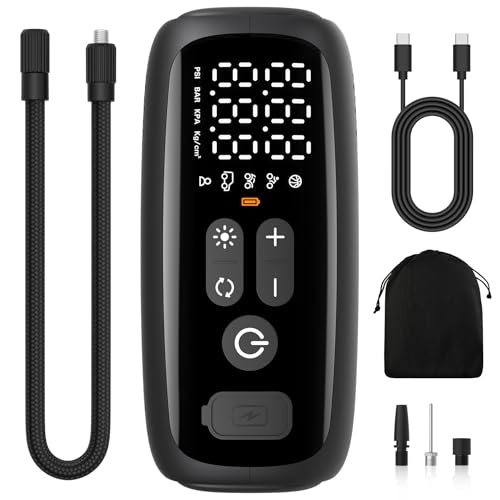
Looking for a palm-sized inflator that still punches above its weight? We like this 12V tire inflator for quick, reliable top-ups between shop sessions. Its 28-cylinder 140W motor pushes 40 L/min, inflating SUV tires (315/40 R21) from 0 to 36 PSI, with a 150 PSI ceiling. Set a target and the auto-stop shuts it down precisely; it also powers off after 3 minutes idle. We get Type-C charging for car or home, plus overcharge protection. It’s 5 x 2 x 4 inches with a storage bag, included valve cores, and smart presets. Real-time pressure, LED light (on/flashing/SOS), and one-click operation round it out.
Best For: Drivers, cyclists, and outdoorsy travelers who want a compact, fast, and auto-stop inflator for quick top-ups and emergency use.
Pros:
- Fast inflation: 140W motor delivers 40 L/min, handling SUV tires (315/40 R21) from 0–36 PSI
- Smart safety and control: real-time pressure with precise auto-stop, 3‑minute auto power-off, overcharge protection
- Ultra-portable and versatile: 5 x 2 x 4 inches with storage bag, Type‑C charging, preset modes for cars/bikes/balls/motorcycles, LED light (on/flashing/SOS)
Cons:
- 150 PSI max may be insufficient for some high-pressure specialty applications
- Type‑C charging still requires access to power; not a fully cordless, high-capacity battery solution
- Best for top-ups and standard tires; extended fills from 0 PSI on large tires may take longer despite 40 L/min rate
XtremepowerUS 13HP 30-Gallon Gas-Powered Air Compressor

February 25, 2026 3:20 am
Built for service trucks and heavy shop use, the XtremepowerUS 13HP 30-gallon gas-powered compressor stands out with a rugged two-stage, cast-iron pump delivering up to 35 CFM—plenty for running multiple air tools in high-demand environments. We like its 3-cylinder, cast-iron construction, removable cylinders, and finned flywheel for cooler, smoother operation. Designed for truck-bed mounting, it’s ideal for auto body, ag, and construction crews needing dependable air on-site.
Know before you buy: at roughly 392 pounds, it’s not plug-and-play. Expect drilling and alignment work—mounting holes, pulley/RPM setup, and fittings may require tweaks. Keep it oiled, check rotation, and you’ll get durable performance.
Best For: Contractors and service-truck crews who need a rugged, high-output, gas-powered compressor for on-site, high-demand air tool use.
Pros:
- Strong performance: two-stage, 3-cylinder cast-iron pump delivers up to 35 CFM for multiple tools.
- Durable, serviceable build: cast-iron cylinders, finned flywheel, and removable cylinders for cooler, smoother operation and easier maintenance.
- Truck-bed ready: designed for heavy shop and service-truck applications in auto body, ag, and construction.
Cons:
- Heavy and not plug-and-play: ~392 lbs with likely drilling, alignment, and fitment tweaks required.
- Setup sensitive: pulley/RPM alignment and rotation checks are critical; requires regular oiling.
- Potential mounting/compatibility issues: hole patterns and air outlet fittings may differ from prior units.
VEVOR 80-Gallon 2-Stage Oil-Free Air Compressor (3-Phase)

February 25, 2026 3:20 am
Power-hungry shops that run multiple tools at once will appreciate VEVOR’s 80-gallon, 2-stage, oil-free workhorse, driven by a 6.5 HP motor and 3-phase power. We like its 15.5 SCFM at 90 PSI, which keeps nail guns, impact wrenches, and spray guns fed without drama. Dual-stage compression and a rapid 3300 rpm help it hit pressure fast—expect quick inflation in about six minutes. The 80-gallon tank delivers stable, continuous air, while the 86 dB rating stays manageable for industrial spaces. Built from 4 mm high-strength steel and leak-checked, it’s tough and dependable. Running single-phase? You’ll need an inverter.
Best For: High-demand commercial and industrial shops needing a durable, oil-free, 3-phase compressor to run multiple pneumatic tools continuously with fast recovery.
Pros:
- 15.5 SCFM at 90 PSI and dual-stage compression keep multiple tools supplied without pressure drops
- Large 80-gallon tank and rapid 3300 rpm deliver quick inflation (about 6 minutes) and stable, continuous air
- Robust 4 mm steel construction with leak checks; relatively low noise for industrial use (86 dB)
Cons:
- Requires 3-phase power; single-phase users must buy an inverter separately
- 86 dB may still require hearing protection in many shops
- Stationary, heavy unit limits portability and requires dedicated installation space
Stark USA 10 Gallon Ultra Quiet Air Compressor (3.5HP)
February 21, 2026 9:38 pm
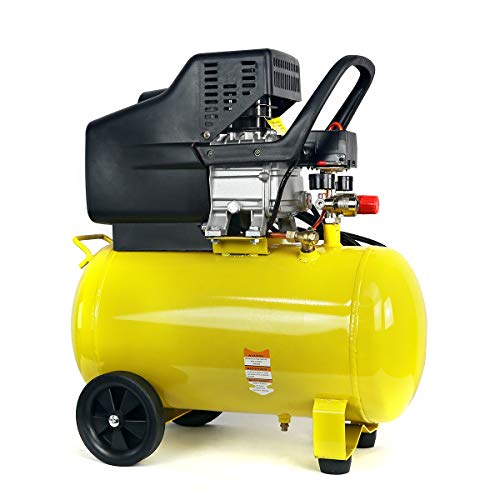
Need an ultra-quiet workhorse for a garage or basement shop? The Stark USA 10 Gallon Ultra Quiet Air Compressor delivers 62 dB operation, 3.5 HP power, and 8.37 CFM for DIY and pro tasks without disturbing the household. We like its adjustable pressure, 125 PSI max, and rapid recovery—refilling the 10-gallon tank in minutes to keep nailers, impact wrenches, spray guns, and drivers moving.
Built from structural steel with seamless welding, it’s engineered to resist leaks and withstand demanding use. At 3450 r/min, it’s ready for woodwork nailing, tire inflation, auto repair, and spray painting—ideal for contractors, carpenters, mechanics, and serious hobbyists.
Best For: Contractors, mechanics, and serious DIYers who need an ultra-quiet, durable 10-gallon compressor for garage or basement use powering nailers, impact wrenches, spray guns, and drivers.
Pros:
- Ultra-quiet 62 dB operation suitable for residential spaces
- Strong performance: 3.5 HP, 8.37 CFM, 125 PSI with rapid tank recovery
- Durable structural steel construction with seamless welding for leak resistance
Cons:
- 10-gallon capacity may be limiting for extended high-demand air use
- Horizontal tank design can take more floor space than vertical units
- Imported unit; parts/service availability may vary by region
Factors to Consider When Choosing Stationary Air Compressors
Before we pick a model, let’s match our tools’ required air flow (CFM) and maximum pressure (PSI) to real workloads. We’ll also check power source compatibility and decide between single- or two-stage designs for efficiency and duty cycle. Finally, we’ll balance tank size with available space so the compressor fits and performs as expected.
Required Air Flow (CFM)
How much air your tools actually consume per minute matters most, which is why we focus on CFM at the pressure you’ll run. CFM is the volume of air delivered each minute, and tools with higher air demand need higher CFM to avoid performance dips. Manufacturers typically publish ratings like 18.5 CFM at 100 PSI; we should match our tool’s requirement to the compressor’s CFM at or near its operating pressure.
Running multiple tools? Add their CFM needs and choose a compressor whose continuous CFM exceeds that combined demand for stable results. Remember, some models post impressive CFM numbers only at lower pressures, so verify the rating at your actual working pressure. A larger tank extends run time between cycles, but it won’t raise continuous CFM output.
Maximum Pressure (PSI)
CFM tells us how much air we can deliver; PSI sets how hard that air works. Maximum pressure is the highest pressure a compressor can supply, and most stationary units land between 125 and 175 PSI. We should match that ceiling to the toughest tool we plan to run, ensuring the compressor’s max PSI meets or exceeds the requirement.
Power Source Compatibility
Ultimately, power source compatibility decides where and how we can run a stationary compressor. We should start by confirming motor type and electrical needs. Most electric units use 5 HP-class motors and call for 208–230V or 240V service, in single-phase or three-phase. That impacts breaker size, wire gauge, and whether we need a dedicated circuit or panel upgrades. Some compressors are built exclusively for three-phase, delivering higher CFM at a given PSI—great for industrial shops but incompatible with typical residential power.
If we’re off-grid or mobile, gas-powered models (gasoline or propane) make sense. They add flexibility for jobsites but demand ventilation, safe fuel storage, and routine engine maintenance. Always verify voltage, frequency, and phase, and plan for any required inverters or infrastructure before buying.
Single Vs Two-Stage
When we’re choosing between single- and two-stage compressors, the decision hinges on pressure and duty cycle. Single-stage models deliver higher CFM at lower pressures, so they’re great for tools that live under roughly 135 PSI. They’re simpler, lighter, and cheaper to buy and maintain, which helps when we want straightforward air delivery without max-pressure demands.
Two-stage compressors shine when we need higher final pressure and long, continuous runs. By compressing twice—first to an intermediate pressure, then higher—they improve efficiency at peak pressures and shed less heat per CFM. That translates to better performance and longevity in heavy-use shops.
The trade-offs: two-stage units typically cost more, are more complex to service, and take up more room. Choose based on required PSI, duty cycle, and budget.
Tank Size and Space
How much tank do we really need—and where will it live? Tank size, measured in gallons, sets how much air we can store and how long we run between cycles. For most shops, 60–80 gallons offers comfortable buffer time, but those larger tanks take real estate and may need bolting to a concrete pad for stability.
We also have to think orientation. Vertical tanks free up floor space and fit tighter layouts, while horizontal tanks can ease hose routing but demand more footprint. Weight matters too—60‑gallon units often top 200 pounds, so plan for moving equipment, anchoring, and a safe path to the installation spot.
Leave ample clearance for airflow, mounting hardware, and service access around the compressor to prevent heat buildup and simplify maintenance.
Duty Cycle Rating
Why does duty cycle matter so much? It tells us how long a compressor can run within a set period without overheating. If we’re spraying, sanding, or blasting for extended stretches, a higher duty cycle keeps airflow steady and prevents frustrating cooldowns. Industrial-duty models, often rated 50% to 100% at reduced pressures, handle long-running tasks far better than consumer units.
We also need to match duty cycle with our tank size and CFM needs. A larger tank smooths demand, letting the pump rest between bursts and reducing runtime pauses. That means fewer heat cycles and more consistent output.
Always confirm the stated duty cycle at the pressure we’ll actually use. If the rating doesn’t match our operating PSI and runtime requirement, we’ll face stalls, heat, and premature wear.
Noise Level and Damping
Duty cycle keeps us running; noise keeps us sane. Let’s target a comfortable sound profile before we buy. Stationary compressors span roughly 62 dB (ultra‑quiet) to 86 dB (louder oil‑free industrial units). That difference matters for shared shops and hearing protection.
Oil‑lubed pumps generally run smoother and quieter because oil cushions moving parts; oil‑free designs often sound sharper due to higher air recirculation noise. If we must go oil‑free, we can still tame sound with good damping.
Prioritize enclosures, intake silencers, and sound‑dampening housings to cut operational noise. Larger 60–80 gallon tanks help by smoothing pressure delivery and reducing pump cycling, which steadies overall sound. Finally, control vibration: add rubber isolation feet or mount to a stable concrete base to limit transfer and perceived noise.
Maintenance and Warranty
Even before we compare CFM and tank size, we should weigh maintenance demands and warranty strength because they dictate long‑term cost and downtime. Let’s start with coverage: look at warranty length and scope—Maxair’s C5160V1-MAP, for instance, carries a limited 2‑year warranty—so we can forecast support and repair exposure.
We also verify serviceability. Are filters, drain valves, and regulator parts easy to source? Reviewers flag parts availability as a durability proxy. Maintenance-friendly touches matter: oil drains, sight gauges, and accessible tank drain bases speed routine checks and reduce idle time.
Next, confirm the maintenance schedule. Oil‑lubed units need timely oil and filter service; oil‑free designs cut that burden. Finally, assess claim ease—clear documentation, simple registration, and nearby authorized centers minimize disruption when issues arise.
Conclusion
Choosing the right stationary air compressor is like picking the heartbeat for our shop—it keeps everything pulsing smoothly. From quiet rotary screws to rugged two-stage workhorses, we’ve mapped the standouts that blend power, durability, and smart design. If we match CFM, PSI, tank size, and noise to our workflow, we’ll run tools like a well-tuned orchestra. Let’s invest once, maintain well, and keep projects humming—steady air, fewer hiccups, and productivity that never loses its rhythm.