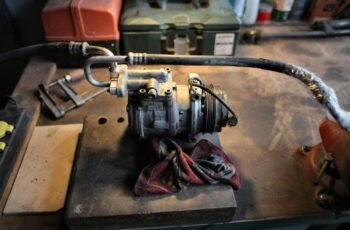
When we’re picking a small gas-powered air compressor for 2025, we want reliable starts, steady air, and a build that survives job-site abuse. Compact tanks from 4 to 13.2 gallons, dual outlets, and precise regulators can make or break productivity. Honda-class engines, cast-iron pumps, and smart safeguards like low-oil shutoff add confidence. We’ve narrowed five standouts for pros and DIYers—and one unexpected choice may change how you outfit your next project.
VEVOR 13.2 Gallon Gas Powered Air Compressor


February 25, 2026 4:39 pm
If you need a compact gas unit that still pushes real air, the VEVOR 13.2 Gallon stands out with 9 CFM at 115 PSI and dual outlets—great for pros and serious DIYers running two nailers or swapping between an impact wrench and a sander on the fly. We like its 7HP piston pump, fast inflation (about two minutes), and steady output that reduces stop-start cycling. The cast iron build, oil-low shutoff, and wheeled chassis add durability and mobility. It’s 131.8 pounds, 13.2 gallons, and suits framing, spraying, sanding, and tire service. Note mixed reviews: it’s loud, and some users reported delivery and reliability issues.
Best For: Pros and serious DIYers who need a portable gas compressor with enough airflow to run two pneumatic tools or handle framing, sanding, spraying, and tire service on job sites without power.
Pros:
- Strong output for size: 9 CFM at 115 PSI with 7HP piston pump; inflates fast (~2 minutes)
- Dual outlets let you run two tools or swap quickly between tasks
- Durable cast iron build, oil-low shutoff, and wheeled chassis for mobility and protection
Cons:
- Loud operation noted in reviews
- Mixed reliability feedback and some shipment/delivery issues reported
- Heavier unit (131.8 lb) and only 13.2-gallon tank may limit sustained high-demand use compared to larger compressors
Ingersoll Rand Pilot Unloader Check Valve for T30 Gas-Powered Air Compressors

February 22, 2026 2:25 am
Pros who demand reliable auto control at the tank will appreciate Ingersoll Rand’s OEM inline piloted unloader check valve (49816283-C), factory set to cycle at 145–175 PSI. We like this solid brass, made-in-USA valve for keeping T30 gas-powered compressors responsive and protected.
It combines a check valve, piloted unloader, and relief function in one inline package. Installation’s straightforward: a 5/8-inch inverted flare inlet, 1/2-inch female NPT tank port, and a 1/8-inch female NPT throttle control valve port. Because it’s an OEM part, fitment and calibration are spot-on for T30 systems. If you’re chasing consistent cut-in/cut-out and smooth throttling, this is the right upgrade.
Best For: Pros and maintenance techs running Ingersoll Rand T30 gas-powered air compressors who need reliable, OEM-calibrated tank-side auto control and protection.
Pros:
- OEM fit and calibration for T30 gas-powered compressors; factory set 145–175 PSI for consistent cycling
- All-in-one design (check valve, piloted unloader, relief) reduces components and simplifies plumbing
- Durable solid brass construction; made in USA
Cons:
- Compatibility limited to T30 gas-powered models
- Fixed factory pressure range may not suit custom pressure requirements without reconfiguration
- Requires specific fittings (5/8 in. inverted flare, 1/2 in. FNPT, 1/8 in. FNPT) which may necessitate adapters in some setups
Metabo HPT 8-Gallon Gas Powered Wheeled Air Compressor (EC2510E)

February 21, 2026 7:05 pm
Need a gas unit that can run framing, roofing, and siding nailers all day without babying it? We like the Metabo HPT EC2510E. Its Honda GX engine, cast iron cylinder, and 8-gallon tank deliver a steady 116–145 PSI, with low oil carryover that helps tools last. The baseplate-integrated control panel protects gauges and plumbing, and the full-size 3/8-inch locking regulator is convenient—though some users report a 1/4-inch outlet, so verify fittings. At 144 pounds with a wheeled frame and handle, it’s built to travel. Noise is a manageable 70 dB. Included oil and parts simplify setup. Backed by a 1-year warranty.
Best For: Pros who need a durable, gas-powered jobsite compressor to run framing, roofing, and siding nailers continuously with reliable pressure and portability.
Pros:
- Honda GX engine and cast iron cylinder deliver reliable, high-performance compression (116–145 PSI) for heavy-duty nailers
- Integrated control panel protects components; full-size 3/8-inch locking regulator and centralized controls for easy setup
- Portable wheeled design with handle; manageable 70 dB noise and included oil/parts streamline initial setup
Cons:
- Heavy at 144 lb; still requires effort to load/unload despite wheels
- Mixed reports on outlet size (3/8 vs 1/4 NPT) may require adapter or verification before use
- Only a 1-year warranty, shorter than some pro-grade competitors
DeWalt 4 Gallon Portable Gas-Powered Air Compressor (DXCMTA5590412)

February 25, 2026 4:39 pm
Looking for rooftop-ready portability with real jobsite muscle? We like DeWalt’s 4 Gallon Portable Gas-Powered Air Compressor (DXCMTA5590412) for its compact pontoon design and serious output. The Honda GX160 OHV 163cc engine and oil-free, direct-drive pump deliver 6.9 SCFM at 40 psi and 5.0 SCFM at 90 psi, topping out at 155 psi—enough for nailers and framing crews.
Two 2-gallon tanks add stability, while a patented 2-piece cooling system with multi-chamber exhaust cuts noise and improves cooling. At 93 pounds, it’s manageable to hoist. We get a 1/4-inch regulator, gauges, and a one-hand quick coupler. Minimal maintenance, maximum portability.
Best For: Contractors and framing crews needing a rooftop-ready, gas-powered compressor with strong CFM output and minimal maintenance for jobsite pneumatic tools.
Pros:
- Honda GX160 OHV engine and oil-free direct-drive pump deliver 6.9 SCFM @ 40 psi and 5.0 SCFM @ 90 psi up to 155 psi
- Twin 2-gallon pontoon tanks improve stability; compact 93 lb build with quick-coupler and gauges for easy use
- Patented 2-piece cooling with multi-chamber exhaust reduces noise and enhances cooling for durability
Cons:
- At 93 pounds, still heavy for frequent solo lifting despite portable design
- Gas-powered operation adds fuel handling, emissions, and noise versus electric models
- Single 1/4 in regulator and one quick-coupler limit out-of-the-box multi-tool use
6.5HP Portable Gas-Powered Air Compressor, 12 CFM, 9-Gallon, 125 PSI

February 22, 2026 2:25 am
Packing 12 CFM at 125 PSI with a rugged 6.5 HP gasoline engine, this HPDMC wheelbarrow-style compressor stands out for pros who need real portability without a generator. The 9-gallon twin tank, cast-iron pump, and 880 rpm speed deliver steady air for framing, roofing, and service work. At 199 pounds with 1/4-inch NPT dual outlets, it’s truck-mount friendly and easy to position on-site.
We appreciate the automatic start/stop switch, manual on/off, and high-efficiency finger valves for reliable control. Noise is a loud 95 dB, so hearing protection’s a must. EPA-certified, it ships 48 x 31 x 20 inches and includes Amazon’s 30-day return window.
Best For: Contractors and mobile pros who need a generator-free, truck-mountable gas air compressor delivering steady 12 CFM at up to 125 PSI for framing, roofing, and service work.
Pros:
- Gas-powered 6.5 HP engine provides true portability and independence from site power
- Durable cast-iron pump and 9-gallon twin tanks deliver steady 12 CFM at 125 PSI
- Dual 1/4-inch NPT outlets, automatic start/stop, and manual on/off enhance workflow
Cons:
- Loud at 95 dB; hearing protection required
- Heavy at 199 lb, making solo loading and frequent repositioning challenging
- 125 PSI max may be insufficient for some high-pressure pneumatic tools
Factors to Consider When Choosing Small Gas Powered Air Compressors
Before we pick a model, let’s match CFM and PSI to our tools, then balance tank size with how long we need continuous air. We’ll weigh engine quality and fuel efficiency against portability and weight so the unit fits our workflow. Finally, we’ll factor in noise levels and build durability to ensure comfort and long-term reliability.
CFM and PSI Needs
How do we match a small gas compressor to our tools without guesswork? We start with two numbers: CFM and PSI. PSI tells us the maximum pressure; CFM tells us how much air volume the compressor delivers at a given pressure. Our compressor must meet or exceed the tool’s required PSI and deliver enough CFM at that same PSI.
If a tool needs 90 PSI at 5 CFM, we pick a unit rated around 90–100 PSI that provides at least 5 CFM at 90 PSI. More CFM at the target PSI means steadier performance and fewer pressure dips under load.
Running multiple tools? Add their CFM needs and compare to the compressor’s CFM at the operating PSI. Remember: stated CFM typically falls as pressure nears max.
Tank Size Matters
Why does tank size matter so much? It dictates how long we can run tools before refilling. Larger tanks—think 9–13.2 gallons—deliver longer continuous operation than 4–8 gallon models, which is clutch for nailers, impact wrenches, or short bursts on ratchets. Bigger tanks also smooth pressure swings, supplying steadier airflow during peak demands so tools stay consistent through a cycle.
There’s a tradeoff. More capacity adds weight and reduces portability for hand-carried rigs. Larger tanks also take longer to reach target pressure, increasing startup time between bursts. When we compare small gas-powered units, we should match CFM at operating pressure to the tank’s ability to sustain it for typical one-shot tasks—fence stapling, roofing shots, or lug removal—so pressure doesn’t dip mid-task.
Engine and Fuel Efficiency
A well-matched engine makes a small gas-powered compressor feel effortless rather than thirsty. We look at displacement, RPM, and fuel type because they dictate how efficiently the engine drives the pump. More horsepower boosts output, but if it’s not matched to the load, it burns fuel and adds noise without real gains.
For portable units, 6.5–7 HP hits a sweet spot—fast pressure build, fewer throttle swings, and better fuel economy. Duty cycle and max PSI matter, too: if the tools demand frequent recovery, the engine runs more, wasting gas. Pair that with a right-sized tank to reduce starts and keep delivery steady.
Engine design counts. Oil lubrication, effective cooling, and smart unloader valves cut wear and throttling losses, translating directly to fewer refuels.
Portability and Weight
Portability starts with weight, and small gas compressors still tip the scales at 90–145 pounds, so smart design matters. We look for wheel kits and push handles that let one person load, roll, and reposition without wrestling the frame. Two large, pneumatic wheels track better over gravel; a balanced axle keeps the center of gravity low and stable.
Tank size plays a role too. Typical 4–9 gallon tanks influence how often we pause to refuel or let pressure recover, which affects workflow between locations. Dual outlets help mobility by letting us run two tools at once, reducing trips back to swap hoses.
Finally, compact footprints—about 24–42 inches long, 18–22 inches wide, under 30 inches tall—make transport, truck bed layout, and shop storage straightforward.
Noise and Durability
How loud is too loud, and what lasts in the long run? Gas-powered compressors typically run between 70–95 dB, so we should plan for hearing protection and check jobsite limits. Some models tame the bark with multi-chamber exhausts and integrated control panels, but even then they’re louder than electric units.
For durability, we look for cast iron cylinders and frames. They resist wear, keep tolerances tight, and extend pump life under heavy use. An automatic low-oil shutoff is nonnegotiable—it safeguards the pump during long sessions when lubrication drops. Dual outlets reduce constant coupler swaps, cutting wear on fittings. Sturdy wheeled frames and solid handles protect components during transport and stairs. Together, these features keep performance consistent and downtime minimal.
Conclusion
Choosing the right small gas-powered air compressor comes down to how we work and where we’ll use it. Whether we want a rugged 13.2-gallon bruiser, a wheeled 8-gallon job-site hauler, or a compact 4-gallon pro unit, today’s picks deliver reliable engines, steady air, and smart controls. Let’s match CFM, PSI, tank size, and portability to our tools and tasks, prioritize safety features like low-oil shutdown, and invest in durability so we spend more time working—and less time waiting.