Choosing the right small gas-powered air compressor can save us time, fuel, and frustration. We’re weighing tank size, engine quality, CFM, and portability to match framing crews, roofers, and serious DIYers. Some models prioritize low noise and oil-free upkeep, others push higher duty cycles with rugged pumps. From compact 4-gallon units to twin-pontoon workhorses, each pick serves a distinct need. Let’s compare the standouts and see which ones actually keep tools running without hiccups.
Metabo HPT 8-Gallon Gas Wheeled Air Compressor (EC2510E)


March 15, 2026 4:43 am
Looking for a compact gas unit that still drives framing, roofing, and siding nailers without breaking a sweat? We like Metabo HPT’s EC2510E. It packs an 8-gallon tank, 116–145 PSI operating range, and a professional-grade Honda GX engine. The cast iron cylinder, oversized oil sight glass, and pneumatic throttle control signal durability and easy checks. At 144 pounds with wheels and a handle, it’s jobsite portable and runs at a reasonable 70 dB. The integrated control panel protects gauges and simplifies setup, with a pre-installed 3/8-inch locking regulator. Note mixed feedback on 3/8 vs 1/4 NPT outlets. Backed by a 1-year warranty.
Best For: Contractors and serious DIYers who need a compact, portable gas air compressor that reliably powers framing, roofing, and siding nailers on demanding jobsites.
Pros:
- Powerful Honda GX engine and 116–145 PSI range drive heavy-duty nailers with ease
- Durable cast iron cylinder, oversized oil sight glass, and integrated control panel for protected, simplified operation
- Portable 8-gallon, wheeled design at 144 lb with 70 dB operation for reasonable jobsite noise
Cons:
- Mixed feedback on outlet size (3/8 vs 1/4 NPT) may require adapters
- Heavier than small electric units; still 144 lb despite wheels
- Only a 1-year warranty, shorter than some pro-grade competitors
VEVOR 13.2 Gallon Gas Powered Air Compressor (7HP, 115 PSI)

March 15, 2026 8:34 am
Need two-tool capability without a bulky rig? The VEVOR 13.2 Gallon Gas Powered Air Compressor delivers 9 CFM at 115 PSI from a 7HP piston pump, giving us steady air for nailers, sprayers, and an impact wrench. Dual outlets let two users work at once, and the 13.2-gallon tank smooths cycles for fewer starts. Cast iron cylinders and frames boost longevity; an automatic low-oil shutoff protects the pump. It’s portable with wheels and a push handle, though 131.8 pounds isn’t featherweight. Expect fast inflation—about two minutes—and high noise. Mixed reviews cite delivery and reliability hiccups. EPA COC: PCLGS.2121GM-008. Warranty available.
Best For: Contractors or DIYers who need a portable, gas-powered compressor with dual-tool capability for on-site work like framing, spraying, and light impact tasks without a full trailer rig.
Pros:
- 9 CFM at 115 PSI with dual outlets supports two tools simultaneously
- Cast iron cylinders/frame and automatic low-oil shutoff enhance durability and protection
- Portable design with wheels and handle; fast inflation (~2 minutes)
Cons:
- Loud operation noted; not ideal for noise-sensitive environments
- Heavy at 131.8 lb, so “portable” still requires effort to move
- Mixed reliability and shipping feedback in reviews
ALL-TOP Dual Cylinder 12V Portable Air Compressor with Digital Gauge

March 15, 2026 6:53 am
For off-roaders and fleet techs who want fast, repeatable fills without babysitting a toggle, the ALL-TOP Dual Cylinder 12V Portable Air Compressor stands out with its digital inflator and 12.35 CFM output up to 150 PSI. We like the heavy-duty hollow metal shell, aluminum cylinders for cooling, and sand-proof power switch. The digital inflator’s built-in gauge lets us hold to fill and release to stop, inflating multiple tires without cycling the compressor.
Safety’s covered: auto-thermal cut-off, pressure relief valve, and four anti-vibration feet. In the box: 26 ft hose, 6.5 ft power cord, adapters. Backed by a 2-year warranty and lifetime support.
Best For: Off-roaders, fleet techs, and DIYers who need fast, repeatable tire fills with a digital gauge and minimal babysitting.
Pros:
- High 12.35 CFM output up to 150 PSI for quick inflation
- Digital inflator with built-in gauge; hold to fill, release to stop; inflate multiple tires without cycling the compressor
- Heavy-duty build with aluminum cylinders, sand-proof switch, and stability from four anti-vibration feet
Cons:
- 12V power limits use to vehicles or 12V sources (no built-in battery)
- Bulkier/heavier than compact single-cylinder inflators
- Digital inflator requires holding the handle during operation (no hands-free auto-stop)
DeWalt 4 Gallon Gas-Powered Air Compressor (DXCMTA5590412)

March 15, 2026 8:34 am
Built around a Honda GX160 engine and an oil-free, direct-drive pump, DeWalt’s 4-gallon pontoon compressor (DXCMTA5590412) suits pros who need reliable rooftop or framing power without babying maintenance. We get 6.9 SCFM at 40 psi and 5.0 SCFM at 90 psi, topping out at 155 psi—plenty for nailers, staplers, and trim guns. The dual 2-gallon tanks stabilize the 93-pound unit, while the patented two-piece cooling system and multi-chamber exhaust help reduce heat and noise. A 1/4-inch regulator, dual gauges, and a one-hand quick coupler speed setup. It’s compact at 24.5 x 21.5 x 22 inches and built to work.
Best For: Pros and contractors who need a portable, gas-powered, low-maintenance air source for framing, roofing, and jobsite pneumatic tools without access to electricity.
Pros:
- Honda GX160 163cc engine with oil-free, direct-drive pump for reliable performance and low maintenance
- 5.0 SCFM at 90 psi and 155 psi max supports nailers, staplers, and many jobsite tasks
- Dual 2-gallon pontoon tanks and compact footprint improve stability and portability for rooftop work
Cons:
- 93-pound weight can be cumbersome to lift or carry solo
- Gas engine produces fumes and noise; not ideal for enclosed indoor use
- Limited 4-gallon capacity may not suit high-demand, continuous-air applications
Contractor 4 Gallon Gas Air Compressor with Kohler SH270 Engine

March 15, 2026 7:02 am
Quiet power in a compact frame makes the Industrial Air Contractor 4 Gallon with Kohler SH270 a smart pick for pros and serious DIYers who work in noise‑sensitive areas. We like its 196cc Kohler SH270 engine for easy starts and reliable output, plus a direct-drive, oil-free pump that cuts maintenance. The twin 2-gallon pontoon tanks deliver 4 gallons total at up to 155 PSI, with a 2-piece cooling system to manage heat. At a claimed 55 dB, it’s impressively quiet. Cushioned handles, compact 24 x 23 x 22-inch build, and 86.8-pound weight aid transport. Warranty support and a 30-day return policy add confidence.
Best For: Professional contractors and serious DIYers who need a portable, low‑maintenance, ultra‑quiet gas air compressor for job sites and noise‑sensitive environments.
Pros:
- 196cc Kohler SH270 engine with easy starts and reliable power up to 155 PSI
- Oil-free, direct-drive pump with 2-piece cooling system for lower maintenance and improved heat management
- Quiet 55 dB operation with compact, portable design and cushioned handles
Cons:
- Heavier than some portable units at 86.8 lbs, which may limit single-person portability
- Mixed customer reviews and mid-pack best-seller ranking indicate uneven user satisfaction
- Gas-powered engine may not be suitable for indoor use where exhaust and ventilation are a concern
DV-10A Rotary Screw Air Compressor, 10HP 460V 3-Phase (125 PSI, 35 CFM)

March 15, 2026 12:47 pm
Need steady 125 PSI with around 33–35 CFM for continuous-duty tools? The DV-10A rotary screw delivers exactly that. It’s a 10HP, 460V/3-phase unit (7.5 kW) rated for 33 CFM at 125 PSI, perfect for body shops, small fabrication, machining, car washes, and light sandblasting. We like the IP54 motor for dust and splash resistance, plus a 1.15 service factor for short overloads. Class B temperature rise keeps thermal headroom in check.
Maintenance stays simple: an external combination valve and easy-access layout reduce downtime. With a 3/4-inch NPT outlet, it integrates cleanly into shop air systems that need reliable, continuous flow.
Best For: Small to mid-size shops needing continuous 125 PSI and ~33–35 CFM air—such as auto body, small fabrication/machining, car washes, and light sandblasting—on 460V 3‑phase power.
Pros:
- Delivers steady 33 CFM at 125 PSI for continuous-duty tools; ideal for reliable shop airflow
- IP54 motor with 1.15 service factor for dust/splash resistance and short-term overload capacity
- Easy maintenance with external combination valve and 3/4″ NPT outlet for straightforward integration
Cons:
- Requires 460V 3‑phase power, limiting suitability for locations without industrial electrical service
- 33 CFM may be insufficient for larger sandblasting or multiple high-demand tools running simultaneously
- Class B temperature rise is adequate but not as robust as higher class ratings for extreme environments
6.5HP Portable Gas-Powered Air Compressor, 12 CFM, 9-Gallon, 125 PSI

March 16, 2026 12:58 am
Serious jobsite users who want truck-mount flexibility will zero in on this 6.5HP, 12 CFM, 9-gallon wheelbarrow-style unit that hits 125 PSI and keeps framing guns, impact wrenches, and blow tools fed without babysitting. We like that HPDMC pairs a cast-iron pump and sleeves with an automatic start/stop switch and manual on/off, so it’s durable and easy to live with. At 199 pounds with 0.25-inch NPT dual outlets, it’s built for service trucks and remote sites. The 880 rpm pump helps longevity; the 95 dB noise is expected for gas. EPA certified, no batteries needed, and backed by Amazon’s 30-day return window.
Best For: Contractors and serious DIYers who need a durable, portable, truck-mountable gas air compressor to run framing guns, impact wrenches, and general pneumatic tools at remote jobsites.
Pros:
- Robust cast-iron pump and sleeves with 880 rpm operation for longevity and lower wear
- Dual 1/4-inch NPT outlets and automatic start/stop with manual on/off for convenient multi-tool use
- Portable wheelbarrow design with 6.5 HP gas power and 12 CFM output for off-grid flexibility
Cons:
- Heavy at 199 pounds, requiring two-person handling or permanent vehicle mounting
- Loud at 95 dB, typical of gas units and may require hearing protection
- 9-gallon tank and 125 PSI max may be limiting for high-demand, continuous-duty applications
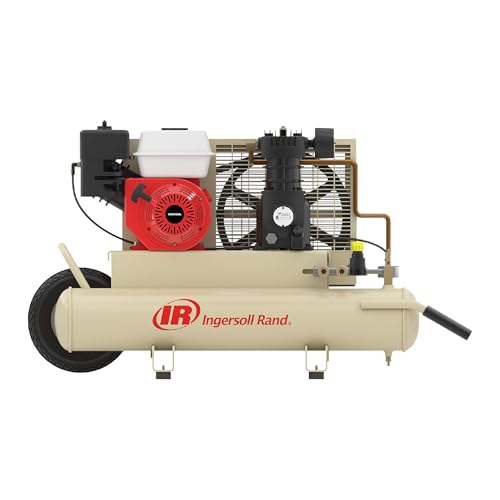
Ingersoll-Rand 5.5 HP 8-Gallon Gas Twin Pontoon Air Compressor
March 15, 2026 8:34 am
Built for crews who work where outlets don’t exist, the Ingersoll-Rand SS3J5.5GH-WB pairs a 5.5 HP Honda engine with an 8-gallon twin-pontoon, wheelbarrow chassis to deliver 135 psi and true 100% continuous duty. We like its cast-iron durability, oil-lubed single-stage pump, and dual quick disconnects for running two tools. It’s rated 89 dB and weighs 226 lb, so it’s stout but portable enough for jobsites.
Performance suits framing nailers, impact wrenches, tire work, and grinding. Reviews praise first-pull starts and versatility, though some report leaks, vapor lock after running dry, and warranty hassles. One-year coverage applies; keep receipts and maintain it diligently.
Best For: Contractors and serious DIYers who need a durable, gas-powered, portable compressor for jobsites without electrical access and continuous-duty tool use.
Pros:
- 5.5 HP Honda engine with 100% continuous duty and cast-iron, oil-lubed pump for durability
- Dual quick disconnects and 135 psi max support running two tools and demanding applications
- Wheelbarrow twin-pontoon design provides portable stability for rugged jobsite use
Cons:
- Heavy at 226 lb and rated 89 dB, making it loud and cumbersome to move
- Some user reports of leaks, vapor lock after running out of fuel, and intermittent issues
- Warranty service can be challenging; only 1-year coverage and requires diligent maintenance/receipts
6.5HP Gas Powered Air Compressor with 20-Gallon Tank (125 PSI, 17 CFM)

March 16, 2026 12:58 am
Looking for truck-mount power that still feels portable? We like HPDAVV’s 6.5HP Psiton gas compressor with a 20-gallon tank, rated 125 PSI and 17 CFM. It’s purpose-built for service trucks and jobsite mobility with a wheelbarrow-style, two-wheel frame, manual on/off, and an automatic pressure switch. The cast iron frame, pump head, and cylinder sleeves run at a modest 880 rpm for longevity under daily use.
Specs that matter: 1/2-inch NPT outlet, single-stage design, gasoline power, and EPA certification (RKHXS.1961GA-036). At 244 pounds, it’s stout yet mountable. Ideal for construction, mechanics, farm, and light industrial tasks. Thirty-day return via Amazon policies.
Best For: Service truck operators and jobsite crews who need a durable, gas-powered, truck-mountable compressor with solid airflow (17 CFM) and portability for construction, farm, and mechanic work.
Pros:
- 17 CFM at 125 PSI with 1/2-inch NPT outlet supports most air tools on jobsites
- Durable cast iron frame, pump head, and cylinder sleeves running at 880 rpm for longevity
- Wheelbarrow-style, two-wheel design and automatic start/stop switch for mobile, truck-mount use
Cons:
- Heavy at 244 lb, requiring two-person handling or permanent mounting
- Single-stage design limits maximum pressure and high-demand multi-tool use compared to two-stage units
- Gas engine adds noise, fumes, and maintenance versus electric alternatives
Ingersoll Rand Pilot Unloader Check Valve for T30 Gas-Powered Air Compressors

March 16, 2026 12:58 am
Need rock-solid control on a T30 gas unit? We like Ingersoll Rand’s inline piloted unloader check valve with relief valve (part 49816283-C). It’s a brand-new OEM component, made in the USA from solid brass, and it’s built to keep your T30 running smoothly and safely.
Connections are straightforward: a 5/8-inch inverted flare inlet and a 1/2-inch female NPT tank port. You also get a 1/8-inch female NPT throttle control valve port for precise governor control. The factory setpoints are dialed at 145–175 PSI, giving reliable ON/OFF control. If you’re refreshing a T30, this is the correct, drop-in control valve.
Best For: Owners and technicians of Ingersoll Rand T30 gas-powered air compressors who need a reliable, OEM drop-in pilot unloader check valve with precise throttle control.
Pros:
- OEM Ingersoll Rand part (49816283-C), solid brass, made in USA for durability and fit
- Factory-set 145–175 PSI ON/OFF for dependable, consistent control
- Straightforward connections: 5/8″ inverted flare inlet, 1/2″ FNPT tank, 1/8″ FNPT throttle port
Cons:
- Compatibility limited to T30 gas-powered units
- Fixed factory setpoints may not suit custom pressure ranges without adjustment
- Brass construction adds weight and cost compared to some aftermarket alternatives
Factors to Consider When Choosing Small Gas Powered Air Compressors
Before we pick a compressor, let’s match tank size and capacity to our tasks and confirm the PSI and CFM the tools require. We’ll weigh engine type and build quality against portability and weight, so it’s powerful yet easy to move. Finally, we should factor in noise and maintenance needs to keep jobs efficient and hassle-free.
Tank Size and Capacity
How much air do we really need on tap? Tank size sets our runtime between refills, so it’s a primary decision point. Small gas-powered units often land at 8–9 gallons, a sweet spot that balances portability and usable air. Step up to 9–13 gallons and we gain a larger reserve and steadier pressure for continuous tools, with fewer cycles—great for longer stretches on nailers or light grinders.
There’s a trade-off: every extra gallon adds weight and trims maneuverability, which matters when we’re hauling across a job site. Capacity also interacts with maximum pressure to determine total usable air; push higher pressures and we can drain faster under heavy demand. For dual-tool or stop‑and‑go tasks, a solid 8–9 gallon tank typically delivers the best mix of weight, cost, and availability.
PSI and CFM Needs
So where do PSI and CFM actually matter? PSI tells us the maximum pressure a compressor can deliver—most small gas units sit around 115–155 PSI. That range dictates tool compatibility and how hard we can push finish nailers, roofing guns, and sprayers. CFM measures airflow at a given pressure; higher CFM keeps tools fed during continuous work or when we run two lines.
For demanding tasks, we look for roughly 9–11 CFM at 115–125 PSI to keep spray guns and heavy nailers from starving. Duty cycle and horsepower influence whether the compressor can hold that CFM without overheating. Tank size still helps smooth peaks, but airflow is king. Finally, match outlets and regulators—3/8-inch vs 1/4-inch NPT—and add adapters so delivered PSI reaches the tool.
Engine Type and Build
Naturally, engine type and build decide how portable, durable, and maintenance-friendly a small gas compressor feels on the job. Gas engines in the 5–7 HP range typically pair with 4–13.2 gallon tanks to deliver about 115–155 PSI, which covers framing guns, roofing, and light sanders. We also look at how the engine couples to the pump: direct-drive designs cut parts and often cut maintenance, while belt-drive adds serviceable components some pros prefer.
Pump style matters, too. Oil-free pumps simplify upkeep and cold starts, but oil-lubed configurations can offer longevity if we’re willing to manage oil. Finally, noise varies widely—roughly 55–95 dB—so we’ll match engine and pump choices to the jobsite’s tolerance for sound without sacrificing required pressure and duty cycles.
Portability and Weight
Engine and pump choices set the tone, but portability determines whether we’ll actually use a compressor across jobs. Weight swings dramatically—from roughly 86.8 pounds to about 244—so we should match mass to how often we load, unload, and roll over rough ground. Wheelbarrow-style frames and wheeled carts with sturdy handles make heavier units manageable, especially on gravel or ramps.
Tank size matters for both heft and workflow. Compact 4–6 gallon models are easier to lift, while 10–20+ gallon tanks reduce refills but demand wheels and balance. Dual-tank (pontoon) layouts add ballast and stability, helping prevent tip-overs when we pivot or curb-hop. Built-in regulators, gauges, and control panels add ounces, not pounds, but they streamline adjustments mid-move and cut trips back to the truck.
Noise and Maintenance
How loud is too loud—and how much upkeep can we stomach day to day? Noise varies widely: some gas compressors push around 95 dB, while quieter designs sit notably lower, making conversations easier and reducing fatigue. If we work near clients or in tight crews, quieter models pay off.
Maintenance depends on pump type. Oil-free pumps cut routine service, though wear items still matter. Oil-lubed designs need regular checks and changes, but often run cooler and longer when maintained. We also look for reliable startups and smart throttle control—pneumatic throttle or easy-start systems reduce cranking and fuel burn. Safety features like low-oil shutdowns and over-temp protection prevent costly failures. Simpler layouts with fewer exposed parts save time, though complex cooling or dual tanks can raise long-term upkeep.
Conclusion
We’ve covered the best small gas-powered air compressors of 2025, from compact 4-gallon units to rugged twin-pontoon workhorses. Whether we’re running roofing guns, framing nailers, or light pneumatic tools, matching CFM, PSI, duty cycle, and portability keeps jobs moving. Consider oil-free vs. oil-lubed pumps, noise, smart regulators, and engine reliability. If we size the tank and output to our tools, we’ll avoid downtime, save fuel, and get pro-grade performance wherever the work takes us.


