As drivers, we value compact tools that work fast and don’t fail when it counts. In 2025’s small auto air compressors, we look for dual-power flexibility, precise digital gauges, auto shut-off, and enough reach to hit every tire without hassle. We’ve narrowed the field to five standouts that balance speed, safety, and durability for cars, SUVs, and bikes. If you’ve ever faced a low tire far from home, you’ll want to see which models truly deliver.
AstroAI Portable Tire Inflator Air Compressor (150 PSI, 12V/110V, Yellow)


February 25, 2026 9:29 am
Need a compact inflator that works at home and on the road? We like AstroAI’s 150 PSI Portable Tire Inflator (model ATJ-8366). It runs on 12V DC or 110V AC, packs dual metal motors and a metal cylinder, and weighs just 4.27 pounds. In high-pressure mode, it takes car tires from 0–36 PSI in about 6 minutes; the large-volume mode moves up to 350 L/min for air mattresses. It’s ideal for cars, bikes, sedans, and mid-sized SUVs—just skip heavy-duty trucks. We get auto shut-off, four pressure units, LED light, memory recall, OmniVent cooling, hose/cord storage, and adapters, plus a replacement fuse.
Best For: Drivers and cyclists who want a compact, dual‑power (12V DC/110V AC) inflator for home and on‑the‑go use across car, bike, and mid‑size SUV tires, plus occasional inflatables.
Pros:
- Dual power options (12V car socket and 110V household) with auto shut-off, memory recall, and LED light for convenient, accurate use anywhere
- Two modes: fast high-pressure tire inflation (0–36 PSI ~6 minutes) and large-volume mode up to 350 L/min for air mattresses
- Durable build with dual metal motors/metal cylinder, OmniVent cooling, and built-in cord/hose storage with included adapters (Presta, needle, nozzles)
Cons:
- Not suitable for heavy-duty truck tires
- Duty cycle limited to 15 minutes continuous use followed by a 10-minute cooldown
- Shorter hose length (about 27.5 inches) may require repositioning the unit around the vehicle
EPAuto 12V DC Portable Air Compressor Pump, Digital Tire Inflator
February 22, 2026 9:20 am
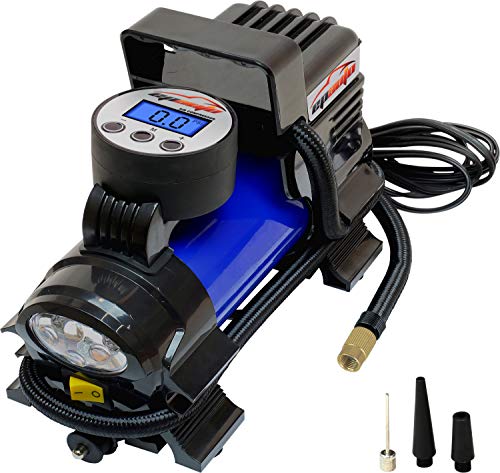
Looking for a glovebox-friendly inflator that plugs into your car and just works? EPAuto’s 12V DC Digital Tire Inflator (X1351D2) is a compact, 1–2 lb unit that runs off your cigarette lighter (12V, up to 180W). It handles cars, bikes, sedans, and midsize SUVs (≤3.5L), with a universal Schrader connector and ball/kayak adapters. Set your target and let auto shut-off handle accuracy; the backlit display reads PSI, KPA, BAR, or KG/CM, and an LED light helps at night. It reaches rear tires, delivers 1.06 CFM to 70 PSI, and includes overheat protection. Not for truck/LT tires; allow cooling between multiple tires.
Best For: Drivers who want a compact, glovebox-friendly 12V inflator for standard cars, bikes, and midsize SUVs (≤3.5L) with simple set-and-forget auto shut-off.
Pros:
- Plugs into car’s 12V socket and auto shut-off ensures accurate inflation with PSI/KPA/BAR/KG/CM display
- Compact, lightweight, long cord reaches rear tires; includes LED flashlight and adapters for balls/kayaks
- Solid performance (1.06 CFM up to 70 PSI) with overheat protection and strong user ratings
Cons:
- Not for truck/LT or heavy-duty tires; max 70 PSI and 180W limits
- Can overheat if used on multiple tires back-to-back; needs cooling breaks
- Screw-on Schrader connector can be a bit fiddly for some users
Digital Air Compressor Portable Tire Inflator (DC 12V)

February 25, 2026 8:11 pm
Drivers who want a fast, foolproof inflator for everyday tires will appreciate this 12V Digital Air Compressor’s auto shut-off and bright LED display. We plug it into a car’s 12V outlet, set a target PSI on the large digital screen, and press start—then it stops precisely at pressure. With 35 L/min airflow and 150 psi max, it inflates a 195/65R15 from 0–35 psi in under five minutes. The 10 ft cord, 3 m hose, and four nozzles cover cars, bikes, SUVs, ATVs, balls, and inflatables—not trucks. It’s 1.9 lb, 75 dB, and can warm during extended use, so allow cool-downs. Overall rating: ~4.3/5.
Best For: Drivers who need a quick, easy-to-use 12V tire inflator with accurate auto shut-off for everyday cars, bikes, compact/midsize SUVs, and inflatables (not trucks).
Pros:
- Fast inflation: 35 L/min airflow; 0–35 psi on a 195/65R15 in under 5 minutes
- Auto shut-off and large digital display for precise, foolproof results
- Long reach with 10 ft power cord and 3 m hose; includes 4 nozzles and LED light
Cons:
- Not suitable for trucks or motor lorries
- Can get warm during extended use; requires cool-down periods
- Noise level around 75 dB and cord length may feel short for some setups
AstroAI AC/DC Portable Tire Inflator Air Compressor (CZK-3666)

February 23, 2026 6:02 pm
For anyone who wants a compact inflator that works at home and on the road, the AstroAI CZK-3666 stands out with true AC/DC versatility. We can plug into a 12V car socket or a 110/120V wall outlet, then set a target pressure on the backlit LCD and let auto-shutoff handle the rest. Its 120W double-cylinder design delivers up to 150 psi, inflating a 195/65R15 from 0–36 psi in about five minutes.
At 2.2 lb, it’s easy to store, with hose and tips tucked inside. We appreciate the memory function, multi-unit readout, and included adapters, though the cords and bag pockets could be sturdier. Cool it 10 minutes after 15.
Best For: Drivers and homeowners who want a compact, easy-to-use tire inflator with both 12V car and 110/120V wall power for reliable inflation at home or on the road.
Pros:
- True AC/DC versatility with included 12V and 120V power cords for car or home use
- Auto-shutoff with preset pressure and memory function; clear backlit LCD with PSI/BAR/KG/CM²
- Fast inflation up to 150 psi; inflates 195/65R15 from 0–36 psi in ~5 minutes; compact with onboard storage and multiple adapters
Cons:
- Requires 10 minutes of cooling after every 15 minutes of use
- Some users note cords and carry bag compartments could be sturdier
- 80 dB noise level may be loud for indoor or nighttime use
AstroAI Portable Tire Inflator Air Compressor (12V, Digital Gauge, LED, Yellow)

February 20, 2026 5:52 am
Need a glovebox-sized inflator that sets and forgets? AstroAI’s 12V Portable Tire Inflator delivers. We plug it into the cigarette lighter, start the car, set our target psi with the M and +/- buttons, and it auto shuts off at pressure. The backlit digital gauge shows psi, bar, kPa, or kg/cm2, and the independent LED flashlight helps at night.
It’s compact, about 2.2 pounds, with a 9.8 ft cord and 3 m hose. ToughUltra metallurgy boosts durability, and users report quick top-offs to 32–35 psi. Expect some noise and heat; run it under 15 minutes, let it cool, and you’re good.
Best For: Drivers who want a compact, 12V plug-in tire inflator that can preset a target pressure and automatically shut off for quick, hassle-free top-offs.
Pros:
- Programmable target pressure with auto shut-off and readable backlit digital gauge (psi, bar, kPa, kg/cm2)
- Compact and lightweight with long reach (9.8 ft cord + 3 m hose) and built-in LED flashlight for night use
- Durable ToughUltra metallurgy for longer service life; reliably tops off to common ranges like 32–35 psi
Cons:
- Can get noisy and hot; recommended to limit continuous use to about 15 minutes
- Requires a running vehicle and a 12V cigarette lighter outlet (not battery-powered)
- Maximum pressure of 100 psi and modest airflow mean it’s best for car tires and small inflatables, not heavy-duty jobs
Factors to Consider When Choosing Small Auto Air Compressors
Let’s weigh the essentials before we pick a compact compressor: power source options (12V, battery, or AC) and the maximum pressure rating you actually need. We’ll also look at inflation speed and duty cycle limits so we know how fast it works and how long it can run without overheating. Finally, we’ll factor in noise level because quiet operation matters in garages, driveways, and roadside use.
Power Source Options
Wondering which power source fits your inflator plans? Let’s match power to how and where we inflate. A 12V DC compressor plugs into the car’s cigarette lighter, drawing from the vehicle battery. It’s road-ready and portable, but for longer sessions we may need the engine running to avoid draining the battery.
At home, a 110/120V AC model delivers steady power and typically faster performance, though we’ll sacrifice portability unless we carry an inverter or generator. Dual‑power units combine both inputs, giving us flexibility for driveway top‑offs and roadside fixes.
Watch wattage: most small units pull about 120–420W. Higher draw generally means quicker fills but can stress weak outlets or thin vehicle circuits. Reliable power also supports features like automatic shut‑off, which depend on stable current and precise sensors.
Maximum Pressure Rating
A compressor’s maximum pressure rating tells us the highest psi it can reach, and it’s a quick filter for what we can safely inflate. Most small auto inflators span roughly 70–150 psi, and that ceiling determines fit: cars and motorcycles are fine at the lower end, while larger SUVs or light-truck (LT) tires often need more capability than many compacts provide. If we run performance or winter tires that target 35–40 psi, a higher max helps us confidently reach spec without straining the unit.
We also care about accuracy and safety. A trustworthy gauge and auto shut-off at the target psi prevent over-inflation as the compressor nears its maximum. Match the stated rating to your vehicle types, not air mattresses or heavy-duty tires.
Inflation Speed
Dialing in inflation speed helps us pick a compressor that won’t waste time at the curb. We look at how fast a unit raises PSI, since high‑pressure modes usually climb faster than large‑volume modes. For small car tires, solid performers move 0–36 PSI in about 6–7 minutes; some compact inflators hit 0–35 PSI in roughly 5–7 minutes.
Airflow rate tells us a lot: higher L/min (or CFM) typically means quicker inflation to the same target pressure. We also pay attention to real‑world setup time. Longer power cords and hoses—around 3 meters each—let us reach all four tires without shuffling the car, shaving minutes from the process.
Finally, continuous operation limits can stretch total time if we’re filling from flat.
Duty Cycle Limits
How long can we run a compressor before it needs a breather? Duty cycle answers that. It’s the fraction of time a unit can run before cooling—often 10–15 minutes on, then about 10 minutes off. If we push past the spec, heat builds, motors strain, and pump life drops. Some models state a firm 15-minute limit no matter the weather; others expect shorter bursts with planned cooldowns.
We should match duty cycle to our tasks. Topping off one tire? A low-duty model is fine. Inflating multiple tires or accessories? A higher-duty unit handles longer continuous use, though it’s usually pricier and bulkier. Respect cooldown intervals to avoid thermal shutoffs, keep airflow steady, and guarantee the compressor performs reliably for the next inflation.
Noise Level
Keeping duty cycle in mind, we should also weigh noise. Most small inflators run between 75 and 90 dB, a range that feels like loud conversation to a lawnmower. Manufacturers sometimes publish a dB figure for typical operation, which lets us compare how intrusive a unit will be in a garage or inside the car.
Higher-wattage motors usually sound louder because increased airflow and RPMs push dB upward. Quieter designs often trade speed for comfort, so noise can signal inflation rate and overall efficiency. We should also consider conditions: reviewers frequently report that heat and prolonged runs raise perceived loudness. When we compare options, let’s balance output versus sound, verify stated dB ratings, and favor designs that meet our comfort threshold without sacrificing required performance.
Hose and Cord Length
Why obsess over hose and cord length? Because reach determines convenience. With compact compressors, hoses often span about 27 inches to 3 feet—just enough for front tires, but tight for rear valves on larger vehicles. We look for longer power cords, ideally 9–10 feet, so we can hit all four tires from a single outlet without repositioning the car. Still, a long cord with a short hose can bottleneck usability. Balanced lengths deliver true coverage.
We also value smart storage. Built-in hose reels or cavities protect the hose from kinks and punctures and keep the kit tidy. Internal cord storage and compact housings cut trunk clutter and help us stow the compressor without tangles. Prioritize total reach, then prioritize how neatly it packs away.
Auto Shut-Off Accuracy
When we talk auto shut-off accuracy, we’re talking protection and consistency: the compressor should stop right at the target PSI to avoid overinflation and tire wear. We look for models that hit the mark and repeat it, not just get close once.
Most quality units claim ±0.5 to ±1 psi precision, but sensor calibration and build quality determine whether they deliver. Preset recall or last-used memory helps us repeat inflations quickly with the same cutoff behavior, useful for seasonal swaps or fleet routines. Still, we don’t rely blindly on the sensor; we verify with a trustworthy gauge to catch drift.
Heat matters. After extended use, internal temperatures can skew readings, so we allow cooldowns to keep shut-off triggers accurate and consistent.
Accessories and Adapters
Accurate shut-off only helps if the right connector’s on the hose, so we also look at what the compressor ships with and how well it fits. We prefer bundles that include Presta-to-Schrader, a needle valve, and ball pump tips, so one kit covers car tires, bikes, balls, and inflatables. Compatibility matters: adapters should seal cleanly on Schrader and Presta valves without hissing or wiggle.
We check for built-in storage that secures nozzles and the hose inside the housing or case, so pieces don’t disappear in the trunk. A dedicated inflation needle and cone adapters for kayaks, pool toys, and other gear expand usefulness. Finally, we confirm auto-shutoff safeguards adapters by preventing overinflation, especially when switching between delicate Presta setups and bulkier cone tips.
Conclusion
We’ve explored five compact, powerful air compressors that make tire care simple and safe wherever we go. With dual-power options, accurate digital gauges, auto shut-off, and LED lights, these picks deliver reliability and speed without overheating. Their 9–10 ft cords and 3 m hoses reach every tire, and PSI ratings up to 150 handle cars, SUVs, bikes, and light trucks. Let’s choose based on power source, portability, gauge accuracy, duty cycle, and accessories—so we’re always ready for the road.