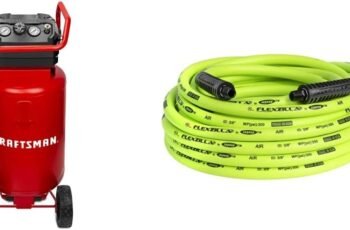
When we talk portable industrial air compressors in 2025, we’re focused on real jobsite needs: sustained CFM, rugged construction, smart controls, and manageable footprints. From gas units with big ASME tanks to rotary screws with auto load/unload, the best options balance mobility and uptime. We’ll compare high-duty cycles, IP-rated builds, noise, and serviceability—plus where cordless fits. If you value power without compromise, the picks ahead make that decision clearer.
50HP Rotary Screw Air Compressor (Model M50AC460)


July 8, 2026 6:55 am
If you need serious airflow without babysitting the machine, MechMaxx’s 50HP Rotary Screw Air Compressor (M50AC460) stands out for high-demand shops and production lines. We get 220 CFM at 116 PSI from a 50HP, 460V 3-phase motor with IP54 protection, SKF bearings, and high starting torque. The airend’s micron-level accuracy boosts reliability, while oil-gas separation keeps discharge under 3 ppm. The EPC intelligent control auto-loads, unloads, and shuts down when idle, cutting energy costs and wear. At 1,485 pounds with a compact footprint, it’s built for continuous duty. Automatic shut-off, digital control, included filter, and clear support complete the package.
Best For: High-demand industrial shops and production lines needing continuous, low-maintenance compressed air at 220 CFM and 116 PSI with efficient automatic control.
Pros:
- Powerful 50HP, 460V 3-phase motor with IP54 protection and SKF bearings for durability and continuous duty.
- EPC intelligent control with auto load/unload and idle shutdown reduces energy costs and wear.
- High-quality airend and oil-gas separation deliver reliable performance with <3 ppm oil carryover.
Cons:
- Heavy unit at 1,485 lbs requires proper handling and installation space.
- Requires 460V 3-phase power, limiting compatibility in some facilities.
- Listed maximum operating pressure of 460 PSI conflicts with 116 PSI performance spec and may cause confusion.
ETENWOLF VORTEX S6 Portable Tire Inflator Air Compressor

July 13, 2026 4:08 am
Designed for drivers who need rapid, cordless inflation on heavy-duty tires, the ETENWOLF VORTEX S6 packs a dual‑cylinder, 100% duty cycle system that delivers 1.5 CFM (42 L/min) and brings a 31-inch tire from 30 to 35 PSI in about a minute. We like its 0.75 HP output, ±1 PSI gauge accuracy, and auto‑stop with seven preset modes and memory. The 19,200 mAh battery inflates up to 18 F‑150 tires per charge and recharges fast via 45W USB‑C, doubling as a power bank. At 6 lb, it’s portable, includes nozzles, ball needle, and Presta adapter, plus a 1000‑lumen lantern. Not for SUPs. 2‑year warranty.
Best For: Drivers who want a fast, cordless inflator for trucks, SUVs, off‑road rigs, and everyday tires—plus bikes and sports gear—without being tied to a 12V outlet.
Pros:
- Ultra-fast dual‑cylinder inflation: 1.5 CFM (42 L/min), 31″ tire 30→35 PSI in ~1 minute; 100% duty cycle
- Big 19,200 mAh battery with 45W USB‑C in/out; inflates up to 18 F‑150 tires per charge; doubles as power bank
- Accurate (+/‑1 PSI) auto‑stop with seven preset modes and memory; bright 1000‑lumen light; portable 6 lb kit with accessories
Cons:
- Not suitable for stand‑up paddleboards (SUPs)
- Can be noisy per some user feedback
- Heavier and pricier than small, basic cordless inflators
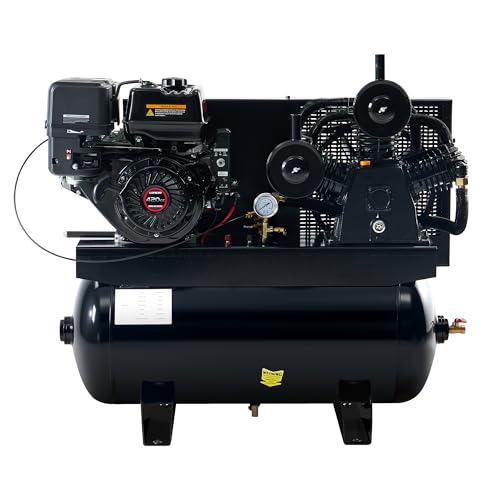
Albott 13HP Gas-Powered Air Compressor, 30 Gallon (18 CFM, 180 PSI)
July 14, 2026 6:40 am
Looking for serious on-site air without a plug? We like the Albott 13HP Gas-Powered Air Compressor for mobile crews that need real volume and pressure. Its 420cc Loncin engine drives a durable 3-cylinder cast iron pump, delivering 18 CFM at 90 PSI and topping out at 180 PSI. The 30-gallon ASME-certified tank evens out demand and cuts run time.
We appreciate the large sight glass for quick oil checks, pump protection, and an automatic safety valve for reliable control. The cast iron cylinders and frame resist wear and deformation. It’s ready for nailers, spray guns, and industrial tools on trucks and job sites.
Best For: Mobile contractors and service crews who need high-volume, high-pressure compressed air on job sites without access to electrical power.
Pros:
- 13HP 420cc Loncin engine and 3-cylinder cast iron pump deliver 18 CFM @ 90 PSI with 180 PSI max for demanding tools
- 30-gallon ASME-certified tank smooths airflow and reduces engine run time
- Durable cast iron construction with large sight glass, pump protection, and automatic safety valve
Cons:
- Gas-powered unit adds fuel costs, emissions, and more maintenance than electric models
- 30-gallon, engine-driven setup can be heavy/bulky for tight spaces
- Noise levels likely high compared to quieter electric or rotary screw alternatives
DEWALT 20V MAX Portable Tire Inflator (DCC020IB)

July 12, 2026 5:11 pm
Compact yet versatile, the DEWALT 20V MAX Portable Tire Inflator (DCC020IB) stands out for pros and DIYers who want three-way power flexibility—20V MAX battery, 12V DC, or 110V AC—to handle tires, tools, and inflatables anywhere. We appreciate its high-pressure mode with automatic shutoff up to 160 psi, plus high-volume inflate/deflate for mattresses and rapid takedown. The digital gauge, threaded chuck, and high-pressure hose keep inflation precise and secure. Onboard LED, accessory storage, and rubber feet boost usability. Note the tool-only setup: battery, charger, and AC adapter are separate. At 6.39 pounds, it’s compact, loud at 92 dB, and widely praised (4.6/5).
Best For: Pros and DIYers who want a compact, high-performance inflator with three-way power (20V MAX battery, 12V DC, or 110V AC) for tires and inflatables, plus precise auto-shutoff up to 160 psi.
Pros:
- Three power options (20V battery, 12V DC, 110V AC) for use anywhere
- High-pressure auto-shutoff and digital gauge for accurate, hands-free inflation
- High-volume inflate/deflate modes, threaded chuck, LED light, and onboard accessory storage
Cons:
- Tool-only: battery, charger, and AC adapter sold separately
- Loud operation at 92 dB
- Heavier than some compact inflators at 6.39 lb and requires extra accessories for full versatility
106CFM Industrial Rotary Screw Air Compressor (M30AC230)

July 11, 2026 8:55 pm
For shops that need steady, high-volume air without babysitting the machine, MechMaxx’s 106 CFM M30AC230 stands out with 30HP muscle, 116 PSI, and an EPC intelligent control system that automatically loads, unloads, and even shuts down to match demand. We like how it trims energy costs while maintaining consistent pressure. The IP54 motor, F-class insulation, and SKF bearings promise durability, high starting torque, and heat resistance. Its precision airend and efficient oil-gas separation keep oil carryover below 3 ppm for cleaner air tools. At 230V, 3-phase, and 1,056 pounds, it’s stationary, not portable, but it’s a shop workhorse. Includes filter and manual.
Best For: High-demand shops and small industrial facilities needing steady, high-volume compressed air with low babysitting thanks to automatic load/unload and shutdown controls.
Pros:
- 106 CFM at 116 PSI with 30HP provides consistent, high-volume output for multiple tools.
- EPC intelligent control system auto load/unload and shutdown reduces energy use and operating costs.
- Durable build: IP54 motor, F-class insulation, SKF bearings; clean air with <3 ppm oil carryover.
Cons:
- Heavy (1,056 lb) and stationary; requires 230V 3-phase power—not portable or plug-and-play.
- Maximum operating pressure capped at 116 PSI, limiting applications needing higher PSI.
- Warranty specifics not detailed beyond standard Amazon returns; may require vendor follow-up.
DEWALT 25 Gallon Vertical Air Compressor

July 11, 2026 8:25 am
Delivering 200 PSI from a belt-driven, oil‑lubed pump, DEWALT’s 25-gallon DXCM251.COM targets users who need higher-pressure performance without sacrificing portability. We like its 2 HP motor, 79 dB operation, and steady delivery: 7.7 CFM at 40 PSI and 6.2 CFM at 90 PSI. The aluminum head, valve plate, and flywheel improve heat dissipation, airflow, and startup efficiency. A high-flow regulator and coupler maximize tool performance, while 10-inch pneumatic wheels make the 179.6-pound vertical unit maneuverable across shops and job sites. It’s a solid fit for inflating, nailers, impacts, and general air tools. Warranty available on request.
Best For: DIYers and pros who need a portable, higher-pressure (200 PSI) compressor for running nailers, impacts, and general pneumatic tools in shops or on job sites.
Pros:
- Strong performance for size: 7.7 CFM @ 40 PSI and 6.2 CFM @ 90 PSI supports many air tools
- Durable, efficient build: oil‑lubed pump with aluminum head/valve plate and flywheel for heat dissipation and smoother starts
- Portable vertical design with 10″ pneumatic wheels; quieter belt drive at 79 dB
Cons:
- Heavy at 179.6 lb; still cumbersome to load or lift despite wheels
- 120V, 2 HP motor may struggle with continuous-duty, high-CFM tools
- Oil-lubed maintenance required; not ideal for those wanting low upkeep
Portable 12V 150PSI Double-Cylinder Tire Inflator Air Compressor

July 10, 2026 11:57 pm
Need fast, reliable roadside inflation without lugging a shop compressor? We like the UUP SS02006 Portable 12V 150PSI Double-Cylinder Tire Inflator. At 6.6 lb and 8.66 x 3.15 x 7.1 inches, it’s compact yet powerful: 70 L/min airflow, max 150 psi, and it inflates 200/70/R18 tires from 0–40 psi in about 3 minutes. The double pistons, alloy/ABS build, and 70 dB noise level make it sturdy and relatively quiet.
We appreciate the LED light, AC/DC adaptability, battery clamps, and included kit—nozzles, valve extender, quick connector, fuse, bag, and manual. Keep the vehicle running during heavy use; lighter fuses can trip. High ratings back its speed and reliability.
Best For: Drivers of trucks, SUVs, cars, and RVs who want a fast, portable 12V compressor for roadside tire inflation and outdoor gear.
Pros:
- Fast inflation with double cylinders (70 L/min), takes a 200/70/R18 from 0–40 psi in ~3 minutes
- Sturdy alloy/ABS build with relatively low 70 dB noise and built-in LED emergency light
- Complete kit (battery clamps, nozzles, valve extender, quick connector, fuse, bag) and AC/DC adaptability
Cons:
- Can trip cigarette lighter fuses under heavy load; best used with battery clamps and engine running
- Shorter power cord noted by some users may limit reach around larger vehicles
- Occasional reports of fuse/solder issues; max 175W draw may strain weaker 12V outlets
13HP Gas Air Compressor with 30-Gallon ASME Tank (24 CFM, 180 PSI)

July 14, 2026 6:40 am
Serious crews chasing high output without tying to shore power will appreciate this 13HP gas unit pushing 24 CFM at up to 180 PSI into a 30-gallon ASME tank. We like its two-stage, 3-cylinder cast-iron pump running at 880 rpm for cooler operation and long life. The ASME-certified tank and EPA-compliant design add safety and environmental confidence. At 79 dB and with a 1/2-inch NPT outlet, it’s ready for body shops, construction, agriculture, and field service. Mounted on a truck or rolled site-to-site, it delivers steady air without constant cycling. Feedback calls it “duradero y de muy buena potencia.” Warranty details are online.
Best For: Crews and shops needing high-output, portable air without shore power—ideal for truck-mounted service, construction, auto body, agriculture, and field work requiring up to 180 PSI and 24 CFM.
Pros:
- High capacity and pressure: 24 CFM, 180 PSI from a two-stage, 3-cylinder cast-iron pump for demanding pneumatic tools.
- Durable build: ASME-certified 30-gallon tank, cast iron components, EPA-compliant design, and cooler 880 rpm operation.
- Portable and versatile: Suitable for truck mounting or rolling site-to-site with stable output and reduced cycling.
Cons:
- Gasoline engine requires fuel, maintenance, and emissions considerations versus electric units.
- 79 dB noise level may be loud for enclosed or noise-sensitive environments.
- Larger footprint and weight than small portable compressors; may be overkill for light DIY tasks.
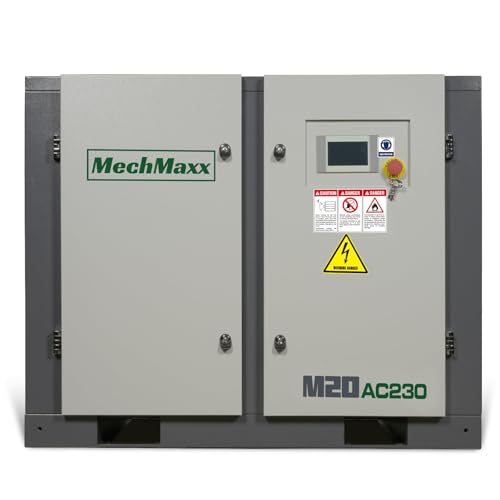
20HP Rotary Screw Air Compressor (Model M20AC230)
July 8, 2026 6:55 am
Looking for high, steady airflow without babysitting the controls? We like MechMaxx’s 20HP Rotary Screw Air Compressor (M20AC230) for its 78 CFM delivery and intelligent automation. It runs at 230V three-phase, with EPC control that loads/unloads to match demand, then auto-shuts down to cut energy costs. The IP54, dust-proof motor with SKF bearings brings high starting torque and heat resilience, while the precision airend is built to microns for long life.
Air quality is solid: the specialized oil-gas separation keeps discharge oil below 3 ppm. At 726 pounds, it’s stationary-tier portable. Includes a filter and manual, plus warranty support.
Best For: Industrial shops and facilities needing continuous, high-volume compressed air with minimal operator intervention and energy-saving automation.
Pros:
- 78 CFM at 116 PSI with EPC intelligent load/unload control and auto-shutdown reduces energy costs
- Durable IP54, dust-proof motor with SKF bearings and precision airend built to microns for long service life
- Oil-gas separation delivers clean air with discharge oil content below 3 ppm
Cons:
- Requires 230V three-phase power, limiting compatibility in some locations
- Heavy (726 lb) and large footprint makes relocation and installation more involved
- Maximum operating pressure listed as 230 PSI may cause confusion given 116 PSI airflow rating
20HP Rotary Screw Air Compressor (Model M20AC460)

July 11, 2026 8:55 pm
For crews that demand steady, high-volume air without babysitting the controls, MechMaxx’s 20HP Rotary Screw Air Compressor (M20AC460) delivers 78 CFM at 116 PSI with a smart EPC system that auto loads/unloads to match demand. We like its 460V three-phase setup for shop power, IP54 motor protection, and SKF bearings that shrug off heat and dust. The airend’s micron-level tolerances boost reliability and service life. Oil-gas separation keeps discharge under 3 ppm, protecting tools. The digital controller speeds fault diagnosis and cuts idle energy with automatic shutoff. At 726 pounds, it’s a stationary workhorse ideal for bolting lines and continuous duty.
Best For: Industrial shops with 460V three‑phase power that need continuous, high‑volume air for bolting or production lines with minimal operator input.
Pros:
- 78 CFM at 116 PSI with EPC automatic load/unload and idle shutoff reduces energy use and oversight
- IP54 motor, SKF heavy-duty bearings, and precision airend for long service life and reliability
- Oil-gas separation keeps discharge oil content below 3 ppm, protecting downstream tools
Cons:
- Requires 460V three-phase power, limiting use in facilities without that service
- Heavy (726 lbs) and large footprint; best suited for stationary installation
- Maximum operating pressure listing shows 460 PSI, but output spec is 116 PSI, which may confuse pressure expectations
Factors to Consider When Choosing Portable Industrial Air Compressors
Before we pick a model, let’s match the power source to our jobsite and confirm the CFM and PSI our tools actually need. We’ll check the duty cycle rating to ensure it can run as long as our workflow demands, then balance portability and size for real-world mobility. Finally, we’ll factor in noise and durability so the compressor lasts and keeps crews comfortable.
Power Source Options
How do we pick the right power source without over- or under-spec’ing the compressor for the job? We start with where we’ll operate and how long we’ll run. Gasoline or diesel units deliver true independence far from outlets; a 13 HP engine with a 24–30 gallon tank keeps tools moving but brings fuel handling, higher maintenance, and emissions. If we have reliable power on-site, electric compressors—single- or three-phase (230V or 460V)—offer steady output, lower noise, and fewer emissions, provided the infrastructure matches the plug and amperage. For quick tasks and mobility, 12V or 20V battery inflators shine, but runtime depends on battery capacity and charging access. We also look for intelligent controls that modulate load/unload and optimize power draw to cut energy use.
CFM and PSI
Clarity starts with two numbers: CFM and PSI. CFM (cubic feet per minute) tells us how much continuous airflow a compressor delivers; PSI (pounds per square inch) defines the maximum pressure it can sustain. We match a tool’s required CFM at its operating PSI. If we skimp on either, nailers misfire, grinders bog, and sprayers sputter.
We also check that the compressor’s maximum operating pressure meets or exceeds the tool’s pressure spec. Real-world results hinge on pressure regulation: regulators, valves, hose losses, and airend efficiency can trim delivered CFM at a given PSI. For portable units, balance is everything—enough CFM at the PSI you’ll actually run. Oversize for brief margins; undersize and expect stalling, slow cycle times, and inconsistent results.
Duty Cycle Rating
Matching CFM and PSI gets us in the ballpark; duty cycle keeps us there. Duty cycle tells us what percentage of a given period the compressor can run without overheating—critical for distinguishing continuous from intermittent use. A 100% duty cycle is ideal for long, uninterrupted runs and minimizes cooldown pauses.
For portable industrial units, duty cycle works alongside tank size and cooling design to determine how long we can sustain output before pressure sags or thermal limits kick in. We should match the duty cycle to our actual runtime and load so the compressor won’t overheat or starve tools under heavy, continuous demand.
Look for models that pair higher duty cycles with automatic load/unload or shutoff. These controls align output with demand and boost reliability over long shifts.
Portability and Size
When we talk portability and size, we’re really balancing weight, footprint, and power source against the worksite’s realities. Small 12V inflators under 7 pounds slip into a service van and tackle quick tasks, while 106 CFM units can exceed 1,000 pounds and demand trailers or forklifts. Tank volume matters: tankless or small tanks keep weight down but require more frequent cycling; 20–30 gallon ASME tanks extend run time between refills but add bulk.
Drive type shapes mobility. Corded electric models excel where outlets are reliable; gas-powered piston pumps roam remote sites but add fuel logistics; battery-powered units deliver true grab‑and‑go convenience within pack limits. Finally, consider form factor—compact horizontals stow easily, while vertical 25‑gallon designs load better and fit tighter spaces.
Noise and Durability
How loud is too loud, and what keeps a compressor alive after years of bumps and dust? On busy sites, noise matters. Portable industrial units typically run between 79 and 92 dB; we should target the low 80s when teams work nearby or indoors, and accept higher levels only with hearing protection and distance.
Durability starts with protection and build quality. IP54-protected motors, dust-proof insulation, SKF heavy-duty bearings, and cast-iron components resist grit, vibration, and heat. Two-stage or high-compression designs maintain output without overworking parts, while robust oil-gas separation keeps internals cleaner. Large, ASME-certified tanks—30 gallons or more—reduce cycling and stabilize air delivery. Finally, automatic shut-off and intelligent load/unload controls curb idle wear, smoothing fluctuations and extending service intervals and component life.
Conclusion
We’ve covered the portable industrial air compressors that deliver real-world power, durability, and smart control. Whether we need high-CFM rotary screw performance, a rugged 13HP gas unit with an ASME tank, or a compact cordless inflator for quick jobs, there’s a fit for every workflow and worksite. Let’s match CFM, duty cycle, voltage, and protection ratings to our demands, then invest with confidence—so our tools stay supplied, our uptime stays high, and our projects keep moving.