We’re sizing up the best portable air compressors for pneumatic tools in 2025 with a clear focus: power that keeps pace, portability that doesn’t slow us down, and performance we can trust. We’ll compare oil-free designs, quiet operation for indoor work, and tank sizes that match real workflows. Expect practical picks from 1 to 8 gallons with the CFM and PSI that matter. Let’s start with five standouts—and where each one makes the most sense.
VEVOR 2.1 Gallon Oil-Free Air Compressor


March 15, 2026 4:21 pm
Looking for a compact, low‑maintenance compressor that still drives nailers and light spray work? We like VEVOR’s 2.1‑gallon oil‑free unit for its balance of power, size, and price. The 900W (1.2HP) motor delivers 2.2 CFM at 90 PSI with a 116 PSI max, enough for brad nailers, staplers, small spray guns, and routine tire inflation. It’s portable at 27 lb, 70 dB quiet, and includes two silencers, handle, and foot pads.
Build quality stands out: Q235B steel tank, triple‑layer coating, seamless welds, stainless‑braided intake, and dual cooling with overheat and pressure protection. Note mixed longevity feedback under heavy, continuous use.
Best For: DIYers and pros who need a compact, quiet, low‑maintenance compressor for nailers, light spray jobs, and routine tire inflation without the bulk or cost of larger units.
Pros:
- Oil‑free 900W (1.2HP) motor delivering 2.2 CFM at 90 PSI; max 116 PSI covers brad nailers, staplers, small spray guns, and tire inflation
- Portable and relatively quiet: 27 lb with handle, ~70 dB, includes two silencers and foot pads
- Durable build: Q235B steel tank with triple‑layer coating, seamless welds, stainless‑braided intake, dual cooling, and overheat/pressure protection
Cons:
- 2.1‑gallon tank limits runtime for continuous or high‑demand air tools
- Mixed longevity reports under heavy, continuous use
- Not suitable for large spray guns or high‑CFM tools beyond light to moderate workloads
California Air Tools 8010 Ultra Quiet Oil-Free Air Compressor (8 Gallon)

March 15, 2026 3:47 pm
Quiet power in a portable package makes the California Air Tools 8010 a smart pick for homeowners and pros who need indoor-friendly air without the racket. We like its 60 dB operation, 1.0 HP oil-free dual piston pump, and 8-gallon steel tank delivering 3.0 CFM at 40 PSI and 2.2 CFM at 90 PSI up to 120 PSI. It fills in about 165 seconds and recovers from 90 to 120 PSI in 60 seconds. At 48 lbs with a wheel kit, it’s easy to move. Maintenance is minimal, with a 3,000+ hour lifecycle, auto shut-off, included filter, and a 1-year limited warranty.
Best For: Homeowners and pros who need a quiet, portable, low-maintenance compressor for indoor work like nailing, brad/finish tools, and general light air tool tasks.
Pros:
- Ultra-quiet 60 dB operation suitable for garages, basements, and noise-sensitive spaces
- Oil-free dual piston pump with 3,000+ hour lifecycle and minimal maintenance
- Quick performance: 165-second fill, 60-second recovery; lightweight 48 lbs with wheel kit
Cons:
- Limited airflow (2.2 CFM @ 90 PSI) not ideal for high-demand tools like sanders or grinders
- 120 PSI max may constrain certain pneumatic applications
- Basic assembly and standard 1/4-inch hose hookup required before first use
VEVOR 1-Gallon Oil-Free Portable Air Compressor (120V)

March 15, 2026 5:38 am
For DIYers and pros who need a compact, low‑maintenance inflator for light air tools, the VEVOR 1‑Gallon Oil‑Free Portable Air Compressor hits a sweet spot of portability and performance. We like its 1 HP, 120V motor delivering 1.5 CFM at 90 PSI with a 120 PSI max—enough for nailers, small impact work, and tire top‑offs. At about 30.9 lb and roughly 15 x 14 x 13 inches, it’s easy to stash and carry. Noise stays reasonable at 78 dB thanks to a muffler system. Oil‑free design, Q235B steel frame, and overheat/pressure protection boost reliability. Best for small to mid‑scale tasks, not heavy industrial use.
Best For: DIYers and pros who need a compact, quiet, low‑maintenance compressor for tire inflation and light air tools like nailers and small impact tasks.
Pros:
- Portable and compact: ~30.9 lb with a small 1-gallon steel tank; easy to carry and store
- Quiet operation at about 78 dB with muffler system; oil‑free design for low maintenance
- Solid performance for size: 1 HP motor, 1.5 CFM @ 90 PSI, 120 PSI max with overheating/pressure protections
Cons:
- Limited air capacity (1 gallon) and CFM not suited for continuous or heavy-duty industrial use
- May cycle frequently with air‑hungry tools or extended spray painting
- Single included component (compressor only); accessories/hoses and region-specific safety valve may vary
Ultra Quiet Portable 1 Gallon Air Compressor (1.5HP, 60 dB)

March 17, 2026 4:25 pm
If you need a compact, low-noise workhorse for indoor tasks, this 1-gallon, 60 dB, 1.5HP unit hits the sweet spot. Greteefor’s violet NS1015 packs a 4-pole motor for quieter operation and longer life, delivering up to 120 PSI and around 3–4 CFM at 90 PSI. It quick-fills in 13 seconds from empty and snaps back to 120 PSI in about 4 seconds, great for nailers, inflation, and airbrushing.
At 23.7 pounds and 11 x 10.6 x 12.6 inches, it’s easy to move. The oil-free pump reduces upkeep and starts well in cold weather. Use a direct wall outlet, and appreciate robust protections and included quick connector and sealing tape.
Best For: DIYers, hobbyists, and pros who need a quiet, ultra-portable compressor for indoor tasks like nailers, tire inflation, airbrushing, and light pneumatic tools.
Pros:
- Ultra-quiet 60 dB operation with a durable 4-pole motor and oil-free, low-maintenance design
- Fast performance: fills from 0 to full in ~13 seconds; recovers to 120 PSI in ~4 seconds
- Compact and portable (23.7 lbs; 11 x 10.6 x 12.6 in) with included quick connector and sealing tape
Cons:
- Small 1-gallon tank limits sustained use with high-demand tools
- Some users report issues with fittings/pressure regulator quality
- Must plug directly into a wall outlet (no power strips/extensions), which can limit placement options
PORTER-CABLE Air Compressor, 6-Gallon, Pancake, Oil-Free (C2002-ECOM)
March 1, 2026 1:23 am
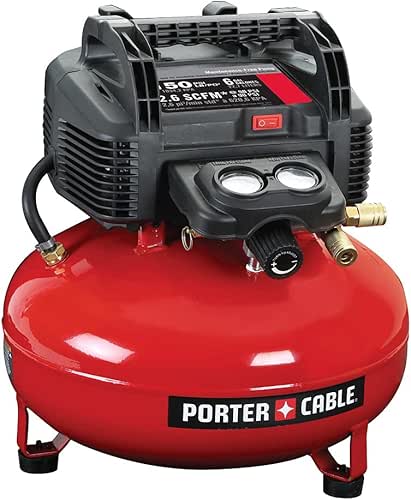
Need a no-fuss, jobsite-tough compressor that keeps nailers and small pneumatic tools running? We like PORTER-CABLE’s 6-gallon pancake (C2002-ECOM) for its blend of power, portability, and reliability. The oil-free pump needs no maintenance and lasts, while the pancake tank adds stability and easy carry. It hits 150 psi max and delivers 2.6 SCFM at 90 psi for quick recovery and longer runtimes.
The low-amp 120V motor starts in cold weather and handles extension cords. Rubber feet help it stay put, and the water drain valve simplifies upkeep. It’s Made in the USA with Global Materials and ships in protective e-commerce packaging.
Best For: Pros who need a portable, low-maintenance compressor for nailers and small pneumatic tools, with reliable cold-weather starts and quick recovery on jobsites or DIY projects.
Pros:
- Oil-free, maintenance-free pump with durable, jobsite-ready design; Made in the USA with Global Materials
- Strong performance: 150 psi max and 2.6 SCFM at 90 psi for quick recovery and longer tool runtimes
- Easy to use and move: stable 6-gal pancake tank, low-amp 120V motor starts in cold weather/with extension cords, rubber feet, and water drain valve
Cons:
- 6-gallon capacity and 2.6 SCFM may be insufficient for high-demand, continuous-use air tools
- Can be louder than larger, belt-driven or quieter specialty compressors
- No included accessories like hoses or nailers; requires separate purchase
Factors to Consider When Choosing Portable Air Compressors for Pneumatic Tools
Let’s size an air compressor that actually matches our tools by looking at airflow (CFM) and PSI first. We’ll balance tank capacity, noise level, and portability features so we can work efficiently without fatigue or complaints. Finally, we’ll check the duty cycle to ensure the compressor can run as long as our tasks demand without overheating.
Airflow and PSI
Curious how airflow and PSI shape a compressor’s real-world performance? They’re the core specs we match to our tools. Airflow is measured in CFM at a stated PSI; many small portables deliver about 2–3 CFM at 90 PSI, enough for nailers and light spray work. PSI reflects the maximum pressure the unit can maintain—most portable models target 90–120 PSI for common pneumatic tasks.
Tank Capacity
Airflow and PSI set the power, but tank capacity dictates how long we can keep tools running between refills. For portable compressors, capacity is measured in gallons—common sizes are 1, 2.1, and 8. Bigger tanks deliver longer duty cycles, so the motor cycles less and we pause less for recharges. They also buffer pressure drops when high-draw tools—like nail guns or impact wrenches—hit hard, keeping output steadier.
Smaller tanks keep weight down and maneuverability up, but they need more frequent top-ups to sustain PSI during continuous work. Let’s match tank size to each tool’s CFM and our expected run time: short, intermittent bursts can thrive on 1–2.1 gallons; extended fastening or light impact work benefits from 8 gallons. Choose the balance that fits our workflow.
Noise Level
How much noise can we tolerate where we’ll work? Noise level matters most indoors, where portable compressors span roughly 60 dB to 70–78 dB. Ultra-quiet designs around 60 dB let us run tools in homes or workshops without disrupting conversations or neighbors. As we compare models, we should verify the stated decibel rating at full load, since that reflects real tool operation, not idle.
There’s a trade-off: higher noise often accompanies more power or faster recovery. If we need quick cycling for demanding tools, we may accept 70–78 dB. If we prioritize comfort, a quieter unit helps protect hearing and reduces fatigue.
Many quiet compressors pair oil-free pumps with low maintenance. That convenience doesn’t inherently raise noise, so we can get both.
Portability Features
Where will we carry and stash the compressor, and how often will we move it? Portability starts with weight: models in the 20–50 lb range strike a sweet spot for one-person transport without sacrificing basic performance. We should look for integrated mobility features—molded handles for secure grips and wheel kits that make crossing a garage or jobsite effortless.
Tank size matters. Compact 1–6 gallon tanks shrink the footprint and fit under benches or in vehicle trunks, but they’ll require more frequent refills between tool cycles. Design helps, too. Vertical and pancake configurations stand stable on uneven floors and slide into tight storage spaces.
For simpler upkeep on the go, lighter units often use oil-free pumps, cutting maintenance and mess when we’re frequently repositioning the compressor.
Duty Cycle
Mobility gets us to the work; duty cycle keeps us working. Duty cycle tells us how long a compressor can run within 60 minutes at a given pressure without overheating. A 50% duty cycle means 30 minutes on, then 30 minutes off. For sustained fastening, sanding, or spraying, we should favor higher duty cycle ratings—60% to 100%—to minimize forced cooldowns.
Duty cycle isn’t fixed. Heat and pressure eat into it: hotter ambient temps or higher PSI typically reduce the effective duty cycle. To keep tools fed during long bursts, we can step up to a higher duty cycle unit or add a larger tank that buffers short pauses.
Above all, confirm the compressor can maintain the needed CFM at our target PSI without overrunning its duty cycle.
Power Requirements
Ultimately, we size power to the air our tools demand. Motor horsepower, tank size, and max PSI work together to produce CFM at the pressure our tools require. As a baseline, 1.0–1.5 HP typically delivers about 2–4 CFM at 90 PSI—fine for brad nailers, staplers, and intermittent tasks. For impact wrenches, grinders, or continuous spraying, we step up to higher-HP units that sustain greater CFM at operating pressure.
We also match electrical input to workload. Most portable compressors run on 110–120V; heavier-duty or dual-voltage models draw 220V to maintain higher output. Tank capacity and duty cycle dictate recovery and runtime, while the PSI/CFM curve confirms tool compatibility. We verify CFM at our target PSI, then size tank and power to minimize cycling and downtime.
Conclusion
Choosing the right portable air compressor comes down to matching power and airflow to our tools, while keeping weight, noise, and maintenance in check. The models we highlighted span 1–8 gallons, oil-free pumps, and quiet operation for indoor jobs, with smart designs for easy carry or roll. If we size the tank and CFM to our workflow, we’ll spend less time waiting and more time working—confident our compressor will start fast, run reliably, and keep projects moving.