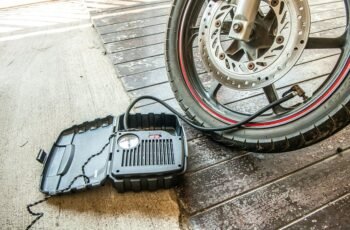
We’ve all seen a pancake compressor keep a framing crew on pace while a quiet 5-gallon unit hums in a garage. In 2025, the best air compressors pair steady CFM at 90 PSI with quick recovery, low noise, and rugged, oil-free designs. We’ll compare portable pancakes to cordless inflators, plus mid-size workhorses built for nailers, grinders, and spray guns. If you value power without hassle, the right pick might surprise you next.
VEVOR 2.1 Gallon Oil-Free Air Compressor (1.2HP, 116 PSI)


March 15, 2026 4:21 pm
Looking for a compact, low‑maintenance compressor that still delivers real tool power? We like VEVOR’s 2.1‑gallon oil‑free unit for portable jobs where space and noise matter. Its 900W (1.2HP) motor delivers 2.2 CFM at 90 PSI with a 116 PSI max, enough for nailers, light spray work, tire inflation, and quick auto repairs. At 27 pounds with a handle, it’s easy to move. Dual cylinders and double tubes speed fill times, while two silencers keep noise near 70 dB. Safety’s solid: auto overheat protection, pressure relief, dual cooling fans, and a rugged, coated Q235B steel tank. Great value; just avoid heavy, continuous duty.
Best For: DIYers, homeowners, and mobile technicians who need a quiet, portable, low‑maintenance compressor for nailers, tire inflation, light spray tasks, and quick repairs—not heavy continuous duty.
Pros:
- Oil-free 1.2HP motor delivers 2.2 CFM at 90 PSI; up to 116 PSI for common pneumatic tools
- Lightweight (27 lb) with handle, dual-cylinder fast fill, and about 70 dB operation with silencers
- Strong safety/durability: dual cooling fans, overheat/pressure protection, coated Q235B steel tank
Cons:
- Small 2.1-gallon tank limits run time for continuous or high-demand tools
- Not designed for extended heavy-duty/industrial use; mixed longevity reports under hard use
- 110V only; airflow may be insufficient for larger spray guns or impact tools needing higher CFM
Quiet 5-Gallon Oil-Free Electric Air Compressor (68dB, 2.8 CFM @ 90 PSI)

March 15, 2026 5:48 am
Need an ultra-quiet, low-maintenance shop companion for trim work, light spraying, and tire duty? This 5-gallon oil-free electric compressor delivers 2.8 CFM at 90 PSI (4 CFM at 40 PSI) with a 120 PSI max and just 68–70 dB. We like the 1.2 HP, low-RPM induction motor that starts reliably in cold weather and sips power on 110V.
It fills from empty in about 80 seconds and recovers in roughly 25, so brad nailers, staplers, and airbrushes keep moving. The kit includes a 25 ft PVC hose, 1/4 quick-connect, 13-piece accessories, and wheels. At 41.8 lb, it’s portable, oil-free, well-rated (4.5/5), and backed by a reported 3-year warranty.
Best For: DIYers and pros who need a quiet, portable, low-maintenance compressor for trim carpentry, light spraying/airbrushing, and general shop/tire tasks on standard 110V power.
Pros:
- Ultra-quiet operation (68–70 dB) with a low-RPM 1.2 HP induction motor that starts well in cold weather
- Solid performance for small air tools: 2.8 CFM @ 90 PSI, fast 80s fill and ~25s recovery, 120 PSI max
- Oil-free, low-maintenance design with included 25 ft hose, 13-piece accessory kit, wheels, and high user ratings
Cons:
- 5-gallon tank and 2.8 CFM @ 90 PSI limit suitability for high-demand, continuous-use tools
- Some users note noise slightly higher than expected despite “ultra-quiet” claims
- Heavier than tiny pancake units at 41.8 lb, and PVC hose isn’t as flexible or durable as rubber/hybrid options
Portable 4 Gallon Oil-Free Air Compressor (110 PSI)

March 19, 2026 9:12 pm
For DIYers and small-shop tinkerers who prize portability, Baotree’s 4-gallon oil-free compressor delivers practical power without the upkeep. We like its 110 PSI max, 0.6 SCFM at 90 PSI (1.0 at 40), and compact 18.7-pound build for quick tire inflations, trim work, brad nailers, and touch-up spray jobs. The 0.5 HP motor on 120V/60Hz fills reliably, with automatic shutoff at max pressure and overpressure protection.
Operation’s straightforward: clear gauges, stable base, and a sturdy casing. It’s oil-free, though basic cleaning and checks still matter. Noise varies by user. Rated 4.2/5 from 56 reviews, it’s a solid home and small-shop pick.
Best For: DIYers and small-shop users who need a lightweight, oil-free compressor for light-to-medium tasks like trim work, brad nailing, tire inflation, and touch-up spraying.
Pros:
- Compact and portable 4-gallon, ~18.7 lb design with easy storage
- Oil-free, low-maintenance operation with clear gauges and auto shutoff/overpressure protection
- Adequate performance for light tasks: 110 PSI, 0.6 SCFM @ 90 PSI (1.0 @ 40 PSI)
Cons:
- Limited airflow (0.6 SCFM @ 90 PSI) isn’t suitable for high-demand air tools
- Noise levels vary by user; may be louder than expected in quiet spaces
- Small tank and 0.5 HP motor mean more frequent cycling on continuous jobs
CRAFTSMAN 2 Gallon Portable Air Compressor (125 PSI, Oil-Free)
March 15, 2026 5:38 am
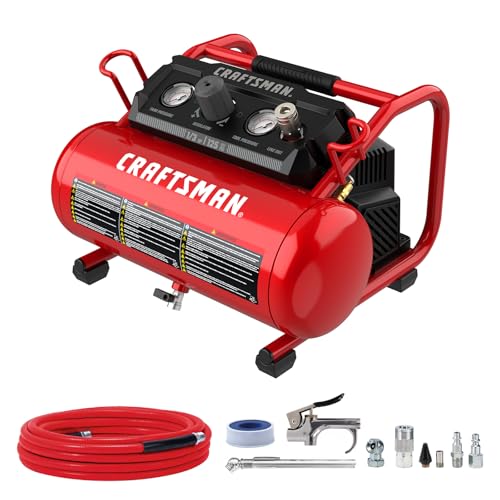
Compact power defines the CRAFTSMAN 2 Gallon Portable Air Compressor, making it a smart pick for DIYers and light-duty pros who want quick, reliable air without the bulk. We like its 125 PSI max, stable airflow, and oil-free, maintenance-free pump with overload protection. At roughly 19–24 pounds with a rubber-reinforced handle, it’s easy to carry and store. The 1/3 HP, 120V motor supports fast inflation and nailer tasks, while two quick couplings speed tool changes. The 10-piece kit—hose, plugs, coupler, chuck, gauge, blow gun, and nozzles—adds value. Noise hits about 78 dB. Users praise portability; some note size and sound. Rated 4.2/5.
Best For: DIYers and light-duty pros who need a compact, portable, oil-free compressor for quick inflations and small pneumatic tasks like brad nailing.
Pros:
- Lightweight and portable (about 19–24 lb) with a rubber-reinforced handle; compact 2-gallon tank for easy storage and transport
- Oil-free, maintenance-free pump with overload protection; up to 125 PSI with stable airflow and two quick couplers
- Includes 10-piece accessory kit (hose, plugs, coupler, chuck, gauge, blow gun, nozzles) for ready-to-use versatility
Cons:
- Limited 2-gallon capacity and 1/3 HP motor not ideal for continuous-duty or high-demand air tools
- Noise around 78 dB may be loud for quiet environments
- Accessory list is a bit inconsistent (duplicate 1/4 NPT auto plug entries) and may cause confusion
Cordless Air Compressor and Digital Tire Inflator (Makita 18V Compatible)

March 19, 2026 9:12 pm
Looking for a cordless inflator that snaps onto your existing Makita 18V batteries? This compact 2.6 lb unit delivers up to 160 PSI for fast tire work and 120 PSI to drive brad nailers or staplers. We like its upgraded motor, heat‑resistant hose, and 70% faster inflation with extended run-time. The oil-free pump cuts maintenance, and low-voltage protection safeguards your batteries.
Smart controls help: a clear LED display, four units, memory recall, and auto shut-off that stops exactly at target pressure. It includes a 25-inch hose, LED light, shoulder strap, and accessory kit. Noise is about 96 dB. Backed by a 5‑year warranty.
Best For: DIYers and Makita 18V battery owners who want a portable, fast inflator for tires and occasional pneumatic brad nailer/stapler use without the bulk of a traditional compressor.
Pros:
- Cordless and Makita 18V compatible with smart digital controls, auto shut-off, and memory recall for precise, convenient inflation.
- Powerful output: up to 160 PSI for fast tire inflation and 120 PSI for driving pneumatic nailers; upgraded motor with 70% faster inflation.
- Lightweight (2.6 lbs), oil-free, low-voltage protection, LED light, and included accessories (25″ hose, adapters, shoulder strap).
Cons:
- Battery not included; requires existing Makita 18V pack.
- Noise level around 96 dB—audible during operation.
- Not pro-grade quality; better suited for DIY and light-to-moderate tasks than heavy contractor use.
PORTER-CABLE Air Compressor, 6-Gallon, Pancake, Oil-Free (C2002-ECOM)
March 1, 2026 1:23 am
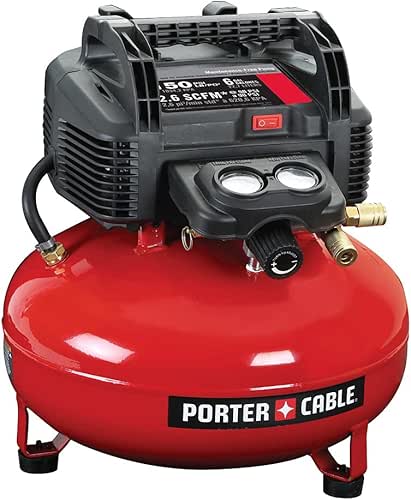
Need a no-fuss, jobsite-ready compressor that starts reliably in cold weather and keeps up with nailers and inflators? We like the PORTER-CABLE C2002-ECOM for its practical balance of power, portability, and durability. The 6-gallon pancake tank delivers stability, 150 psi max pressure, and 2.6 SCFM at 90 psi for quick recovery. Its low-amp 120V motor starts easily with an extension cord, and the oil-free pump needs no maintenance.
Made in the USA with Global Materials, it includes rubber feet and a water drain valve. It ships in sturdy ecommerce packaging. For longer tool runtimes without babysitting, this compact unit punches above its size.
Best For: DIYers and pros who need a portable, low-maintenance compressor that reliably powers nailers and inflators with quick recovery, even in cold weather.
Pros:
- 150 psi max and 2.6 SCFM @ 90 psi provide solid performance with quick recovery for most pneumatic tasks
- Oil-free, maintenance-free pump with durable build; made in the USA with Global Materials
- Low-amp 120V motor starts easily with an extension cord; stable pancake tank with rubber feet and drain valve
Cons:
- Pancake design can be louder than larger, belt-driven units
- 6-gallon capacity limits sustained use with high-demand air tools
- No included hose or accessories in many packages, adding to initial cost
Ironton Oil-Free Pancake Air Compressor, 0.3 HP, 3 Gallons, 110 PSI

March 19, 2026 9:12 pm
For DIYers and pros who want a light, no‑fuss inflator for trim work and quick jobs, the Ironton Oil‑Free Pancake Air Compressor stands out with its oil‑free pump and stable 3‑gallon tank. We like its 0.3 HP motor, 110 PSI max, and 20.6‑lb portability. The fold‑down handle, wide base, cord wrap, hose retainer, quick coupler, and large regulator knob make setup fast and tidy. It’s ideal for brad nailing, stapling, inflation, and blow‑off cleaning. Noise is modest versus big units, though indoors it’s noticeable. It’s not for continuous, high‑flow tools, but reviews (4.3/5) confirm reliable, compact performance and easy storage.
Best For: DIYers and pros who need a lightweight, low‑maintenance compressor for trim nailing, stapling, tire inflation, and quick clean-up tasks.
Pros:
- Oil-free pump with no maintenance; compact 3-gallon pancake tank and 20.6-lb portability
- User-friendly design: fold-down handle, wide stable base, cord wrap, hose retainer, large regulator knob, quick coupler
- Up to 110 PSI; quieter than larger compressors; strong reviews (4.3/5) for reliability and easy storage
Cons:
- Not suitable for continuous, high-demand air tools or long-duration use
- Noise can be noticeable indoors despite being modest vs. big units
- Limited power (0.3 HP) and small tank restrict airflow for heavy-duty applications
DEWALT Pancake Air Compressor, 6 Gallon, 165 PSI (DWFP55126)

March 15, 2026 4:24 am
Compact power meets jobsite practicality with DEWALT’s DWFP55126 pancake compressor, a 6-gallon, 165 PSI unit that’s ideal for trim crews, DIYers, and anyone who needs reliable air on a lightweight footprint. We get 2.6 SCFM at 90 PSI from a 0.9 HP, oil-free pump that starts well in cold weather and recovers fast for nailers, staplers, and light spraying. At about 30 pounds, it’s easy to move, with a cord wrap, high-flow regulator, dual couplers, and a rerouted outlet tube that avoids snags. Noise is listed at 78.5 dBA. Maintenance is minimal, repairs are straightforward, and the one-year warranty adds confidence.
Best For: Trim carpenters, DIYers, and jobsite users who need a portable, low-maintenance compressor with quick recovery for nailers, staplers, and light spraying.
Pros:
- 6-gallon tank and 165 max PSI deliver long tool runtime with 2.6 SCFM at 90 PSI for fast recovery
- Oil-free, 0.9 HP pump starts well in cold weather and requires minimal maintenance
- Lightweight (~30 lbs) with cord wrap, high-flow regulator, dual couplers, and snag-free outlet tube
Cons:
- Noise rating has conflicting specs (78.5 dBA vs 75.5 dB) and may be louder than expected in small spaces
- Not suitable for high-demand, continuous-use tools (e.g., heavy spraying, sanders)
- Requires a 14-gauge or larger extension cord (≤50 ft) for best performance, limiting cord options
Cordless Portable Electric Air Compressor for Woodwork and Automotive Use

March 16, 2026 9:44 pm
Looking for a truly go-anywhere compressor that keeps pace with woodshops and weekend wrenching alike? We love this cordless portable electric unit for its balance of power and portability. A 220W, low-speed 2000 RPM induction motor drives a 0.53-gallon tank quietly at just 65 dB, delivering smooth air without shop noise. It hits 116 PSI in 9 seconds, so we’re firing staple guns, brad nailers, spray guns, airbrushes, and light-duty drills fast.
At 8.14 lbs, the large 15000mAh battery and fast charger keep us mobile all day. The oil-free design cuts maintenance and starts reliably in cold weather—ready whenever we are.
Best For: Woodworkers, DIYers, and auto enthusiasts who need a quiet, truly portable compressor that powers nailers, staple guns, spray guns, and airbrushes on the go.
Pros:
- Cordless with 15000mAh battery and fast charger for all-day mobility
- Ultra-quiet 65 dB, low-speed 2000 RPM induction motor for smooth, reliable air
- Quick performance: reaches 116 PSI in 9 seconds; oil-free and cold-weather friendly
Cons:
- Small 0.53-gallon tank may not suit continuous high-demand tools
- 220W motor limits heavy-duty applications
- At 8.14 lbs, still heavier than some ultra-compact inflators
BOSTITCH 6 Gallon Oil-Free Pancake Air Compressor Kit (BTFP02012-WPK)

March 15, 2026 1:35 am
Meet the BOSTITCH BTFP02012-WPK, a 6-gallon, 150 PSI pancake compressor kit that suits DIYers and trim pros who need reliable power without the upkeep. We like its oil-free pump for maintenance-free operation and clean worksites. At 29 pounds with a narrow tank, it’s easy to carry and store. The high-flow regulator and dual universal couplers keep two tools fed efficiently. It’s rated 80 dBA, tested to ISO 3744, so jobsite noise stays reasonable. Performance lands at 2.6 SCFM at 90 PSI with quick recovery. The kit includes a 50-foot air hose plus a 10-piece inflation and blow gun set. One-year warranty.
Best For: DIYers and trim/finish carpenters who want a portable, low-maintenance compressor with enough output to run nailers and light pneumatic tools.
Pros:
- Oil-free, maintenance-free pump keeps worksites clean and reduces upkeep
- Lightweight 29 lb pancake design with narrow tank and 50 ft hose for easy carry and reach
- High-flow regulator with dual universal couplers supports two tools; 2.6 SCFM @ 90 PSI and 150 PSI max with quick recovery
Cons:
- 80 dBA is quieter than many, but still loud for enclosed indoor use
- Limited airflow (2.6 SCFM @ 90 PSI, 0.2 HP) not ideal for high-demand tools like sanders or grinders
- Voltage info can be confusing; intended for standard household power despite mixed user feedback
Factors to Consider When Choosing Pneumatic Air Compressors
As we compare 2025 models, we’ll match your required CFM and PSI to tools, then balance tank size and type for duty cycle and space. We’ll weigh oil-free vs oil-lubed designs, factor measured noise levels (dB), and assess portability and weight for job-site or shop use. With these criteria clear, we can target compressors that meet performance needs without sacrificing practicality.
Required CFM and PSI
Why do CFM and PSI matter so much? They determine whether our compressor can actually run the tools we buy. CFM measures airflow; PSI measures pressure. We should pick a unit whose sustained CFM meets or exceeds the tool’s requirement at the PSI we’ll use. Because CFM changes with pressure (for example, 4 CFM at 40 PSI versus 2.8 CFM at 90 PSI), we must match the tool’s operating PSI to the compressor’s rated CFM at that same PSI.
Ensure the pump’s max PSI comfortably exceeds the tool’s required pressure. Higher PSI capacity can reduce recharges for high-pressure tools, but performance still depends on delivered CFM at that PSI. Finally, account for short start-up surges and choose a duty cycle that handles brief peaks without noticeable pressure drop.
Tank Size and Type
Once we’ve matched CFM and PSI to our tools, we need a tank that keeps that airflow steady between refills. Tank size dictates how long we can work before the pump kicks back on. Larger tanks store more air, stretching run time and smoothing short bursts from high-demand tools without constant cycling. Smaller tanks recover quicker but can’t sustain continuous draw as long.
For portability, 2–4 gallon units suit light-duty or intermittent tasks. The 5–6 gallon sweet spot balances mobility with longer use, ideal for trim, finish work, and brad nailers. Style matters, too: pancake tanks emphasize compactness and stability on crowded sites. Vertical or larger cylinder designs often dissipate heat better during extended sessions and make draining condensate easier, aiding performance and longevity.
Oil-Free Vs Oil-Lubed
Before we pick a compressor, we should decide between oil-free and oil-lubed pumps because that choice shapes maintenance, longevity, air quality, and noise. Oil-free units keep upkeep simple—no oil to change, no leaks, and fewer serviceable parts. They typically run cooler and use Teflon or similar coatings with tight seals, so they’re ideal for clean-air tasks like paint and finish work.
If we expect heavy, high-cycle duty, oil-lubed systems shine. Their oil bath provides superior lubrication and cooling, supporting longer life under demanding workloads. The tradeoff is routine oil changes and filtration, plus vigilance against contamination.
Choose oil-free for low-maintenance, clean output and lighter to moderate duty. Choose oil-lubed for sustained, tough applications where durability and steadier high-load performance matter.
Noise Level (Db)
How loud a compressor runs can make or break where and how we use it, so we should check dB ratings with a skeptical eye. Small oil-free pancake models span roughly 68–80 dB; ultra-quiet options cluster around 68–70 dB. Some 6-gallon and larger units post 75–78.5 dBA, with a few reaching 80 dBA.
Let’s remember: “quiet” depends on how it’s measured—distance, mic placement, cord length, and whether the pump’s under load can swing results. Real-world perception often differs from the spec sheet. If we’ll run a compressor indoors or in occupied spaces, staying at the lower end of the range reduces disruption and fatigue. Also, higher airflow or pressure demands typically raise perceived noise, so tool choice and duty cycle matter.
Portability and Weight
Where will we use the compressor, and how often will we move it? Portability hinges on weight, dimensions, and hardware that helps us transport it. If we’re hopping between rooms or job sites, lighter designs—pancake or compact units around 20–30 pounds—keep lifting effortless.
Wheel kits and built‑in handles make on‑site shuffles quicker, while shoulder straps, fold‑down handles, or integrated casters reduce strain on stairs and long walks. Compact footprints—roughly 14–21 inches in length and width—fit neatly in small vans, closets, or under benches, simplifying storage.
Duty Cycle Rating
Portability gets us to the job; duty cycle keeps us working once we’re there. Duty cycle is the percentage of time a compressor can run versus rest in a 60-second cycle. A 50% rating means 30 seconds on, 30 seconds off. Higher duty cycles allow longer continuous operation without overheating, which matters when we’re driving nails, grinding, or sanding for extended periods.
We should match the duty cycle at our target PSI to the tool’s expected runtime. If we under-spec, we risk auto shutoffs, heat buildup, and delays. Oil-free units often manage heat well, but real results depend on cooling design and ambient temperature. For long tasks, we’ll prioritize models with 50% duty cycle or higher at the pressure we plan to use.
Power Source and Voltage
Which power source we choose dictates voltage, current draw, and where we can actually run the compressor. For corded models, 110–120V units plug into standard household outlets, but higher-demand compressors may need a dedicated circuit and properly rated extension cords. Matching voltage to our tools prevents under- or over-voltage during startup and operation, which protects motors and maintains pressure.
Cordless compressors trade unlimited runtime for mobility. We should match battery platforms and chemistries (12V, 18V, or higher) and plan around charge cycles and spare packs. Electric motor design matters, too: induction motors typically start more reliably in cold weather and hold torque under load, while universal motors are lighter but can struggle at startup. Verify amperage, breaker limits, and tool voltage before buying.
Conclusion
We’ve walked the job site and the garage, kicking the tires on the year’s best pneumatic air compressors. From quiet, oil-free pancakes to cordless workhorses, these picks balance power, portability, and low maintenance so we can hit 90 PSI and keep rolling. Match CFM to your tools, consider tank size for run-time, and weigh noise and portability. Choose smart, and your workflow will hum—steady as a metronome—whether you’re firing brads, filling tires, or spraying a flawless finish.