We’ve tested the latest compact compressors to find models that actually lighten the load without sacrificing performance. From quiet oil-free pumps to stable pressure and fast recovery, the right unit saves time and space on jobs big and small. We’ll compare portability, runtime, noise, and accessories that boost productivity in tight quarters or mobile setups. If you need dependable power under 30 pounds, the standouts might surprise you—and one clear winner emerges.
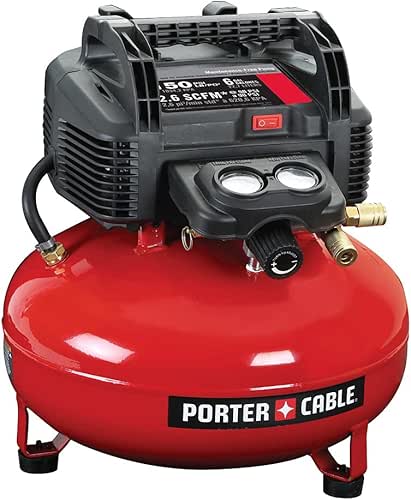
PORTER-CABLE Air Compressor, 6-Gallon, Pancake, Oil-Free (C2002-ECOM)

March 1, 2026 1:23 am
If you want a grab-and-go compressor that punches above its weight, the PORTER-CABLE C2002-ECOM is our pick. We like its 6-gallon pancake tank for stability and portability, and the oil-free pump that delivers long life with zero maintenance. It’s made in the USA with global materials, shipped in sturdy ecommerce-ready packaging, and built with rubber feet and a handy water drain valve.
Performance is strong: 150 psi max and 2.6 SCFM at 90 psi for quick recovery and longer tool runtimes. The low-amp 120V motor starts easily in cold weather or on an extension cord, making daily use simple.
Best For: DIYers and pros who need a portable, low-maintenance compressor with strong performance for nailers, inflation, and light-duty air tools.
Pros:
- Oil-free, maintenance-free pump with long life; made in USA with global materials
- 150 psi max and 2.6 SCFM @ 90 psi for quick recovery and longer tool runtimes
- Low-amp 120V motor starts easily in cold weather or on extension cords; stable 6-gal pancake tank
Cons:
- 6-gallon tank can be loud compared to larger, quieter units
- Not intended for continuous heavy-duty tools like grinders or sanders
- Heavier than ultra-compact compressors, which may limit one-handed carry for some users
California Air Tools Light & Quiet Portable Air Compressor (CAT-1P1060S)

March 15, 2026 3:47 pm
Need a whisper-quiet compressor for apartments, garages, or late‑night projects? We like California Air Tools’ CAT-1P1060S for its 56 dB hum, oil-free design, and compact 1-gallon steel tank. At 29 pounds, it’s easy to carry, yet delivers 1.2 CFM at 90 psi (1.6 at 40) and up to 120 psi. The 0.6 HP motor spins at 1680 RPM to cut wear and noise, with a claimed 3000+ hour lifecycle.
In practice, it’s perfect for brad and finish nailers, staplers, airbrushes, blow guns, and everyday inflating. Expect quick cycles—about 60 seconds to empty and ~15 seconds to refill. One-year warranty included.
Best For: Apartment dwellers, DIYers, and garage users who need an ultra-quiet, portable compressor for light-duty tools and everyday inflation tasks.
Pros:
- Ultra-quiet operation at 56 dB—great for indoor or late-night use
- Lightweight, compact 1-gallon design (29 lbs) with quick refill (~15 seconds to cutoff)
- Oil-free pump with 3000+ hour life and low maintenance
Cons:
- Small 1-gallon tank limits runtime for continuous or high-demand tools
- 1.2 CFM at 90 psi isn’t sufficient for larger pneumatic tools
- Short 1-year limited warranty compared to some competitors
Master Elite 25-Foot Air and Fluid Hose Set for Spray Guns

March 16, 2026 12:28 pm
Serious finishers who run pressure-feed spray guns will appreciate the Master Elite 25-foot Air and Fluid Hose Set’s pro-grade build and broad compatibility. We like that the kit pairs a 5/16-inch I.D. air hose (3/8 NPS female swivel) with a 1/4-inch I.D. fluid hose (1/4 NPS female swivel), both reinforced with braided fiber and EDPM synthetic rubber. The fluid line adds a PA-nylon barrier for solvent resistance and long life. Rated to 250 PSI, it’s ready for pressure pots, primer guns, and even resin work. The set arrives bundled with zip ties, weighs 6.76 lb, and carries a 30-day return guarantee.
Best For: Professional and serious DIY finishers using pressure-feed spray guns and paint pressure pots who need durable, solvent-resistant air and fluid lines with broad compatibility.
Pros:
- Pro-grade construction: braided fiber reinforcement with EDPM rubber; fluid hose adds PA-nylon barrier for solvent resistance and longevity
- Ready for pressure pots and primer/resin applications; rated to 250 PSI with proper NPS swivel fittings (3/8″ air, 1/4″ fluid)
- Complete 25-foot set with fittings and zip ties; multiple length options available within the series
Cons:
- Some users report size/fitting compatibility issues with specific pots or guns
- Heavier than lighter-duty hoses (6.76 lb), which may be cumbersome in tight spaces
- Not suitable for non-spray applications (e.g., fog machines) and limited to 250 PSI maximum
California Air Tools 8010 Ultra Quiet Oil-Free 8-Gallon Air Compressor

March 15, 2026 3:47 pm
Quiet power tops our shortlist here: the California Air Tools 8010 delivers 60 dB operation, an oil-free 1.0 HP dual-piston pump, and an 8-gallon steel tank—making it a standout for indoor workshops and noise‑sensitive jobs. We get 120 PSI max, 3.0 CFM at 40 PSI, and 2.2 CFM at 90 PSI—solid for nailing and light air tools. At 48 lbs with wheels, it’s easy to position. Setup’s quick: about 165 seconds to fill, 60 seconds from 90 to 120 PSI. The oil-free design is maintenance-free, rated for 3,000+ hours, with auto shut-off and a filter included. Users rate it 4.5/5; it runs on 110V/8 amps with 1/4-inch hose compatibility.
Best For: Quiet-focused DIYers and indoor workshop users who need a portable, low-maintenance compressor for nailing and light air tool tasks.
Pros:
- Ultra-quiet 60 dB operation ideal for indoor or noise-sensitive environments
- Oil-free dual-piston pump with 3,000+ hour life and minimal maintenance
- Quick setup and recovery (165s fill; 60s from 90 to 120 PSI) with wheeled, 48 lb portability
Cons:
- Limited airflow (2.2 CFM @ 90 PSI) not suited for high-demand, continuous-use tools
- 120 PSI max may be insufficient for some pneumatic applications
- Basic assembly required and standard 1/4-inch hose hookup may need adapters for certain tools
Metabo HPT THE TANK 6-Gallon Portable Pancake Air Compressor (EC914S)

March 15, 2026 3:44 am
Packing 200 PSI and 4 CFM at 90 PSI into a 41-pound pancake design, Metabo HPT’s THE TANK (EC914S) is the pick for pros who need portable power that keeps crews moving. We get 25% more pressure and 30% more airflow than basic pancakes, so heavy-duty nailing stays flush without delays. The 6-gallon tank supports multiple tools: run two framing, roofing, or siding nailers, three finish nailers, or five brad nailers at once. It’s 22% lighter than traditional twin-stacks, easy to haul, and built for framing to finish work. Backed by a 1-year warranty and Metabo HPT’s pro-preferred reputation.
Best For: Pros and serious DIYers who need a portable, high-pressure pancake compressor that can run multiple nailers simultaneously for framing through finish work.
Pros:
- 200 PSI and 4 CFM at 90 PSI deliver 25% more pressure and 30% more airflow than basic pancakes for flush, delay-free nailing
- 6-gallon tank supports multiple tools at once (up to 2 framing/roofing/siding, 3 finish, or 5 brad nailers) to keep crews productive
- Portable 41 lbs—22% lighter than traditional twin-stacks—backed by Metabo HPT’s pro-preferred reputation and a 1-year warranty
Cons:
- Louder and heavier than ultra-compact, low-CFM compressors for light-duty tasks
- 1-year warranty is shorter than some competitors offering longer coverage
- No included hoses or nailers; total setup cost can be higher for first-time buyers
Factors to Consider When Choosing Lightweight Air Compressors
As we compare options, we’ll weigh weight and portability against noise level so we can carry easily and work comfortably. We’ll match airflow and pressure to the tools we use and pair tank capacity with the duty cycle we need. We’ll also confirm the power requirements fit our outlets or jobsite power so performance stays consistent.
Weight and Portability
How do we judge a compressor’s true grab-and-go convenience? We start with weight. Compact models under 30 pounds are easier to lift, stash, and reposition, especially in tight rooms or crowded sites. Larger pancake and twin-stack units often push 30 to 50-plus pounds, so portability depends on smart design.
We weigh more than the spec sheet. A lighter unit usually speeds transport and setup, but overall dimensions and balance matter just as much. A well-balanced frame won’t tip when we carry it or roll it over thresholds. Features can offset heft: sturdy top handles, well-placed side grips, smooth-rolling wheels, and integrated cord storage keep hoses and cables out of the way. Some oil-free or ultra-quiet designs trim pounds while preserving performance for indoor, multi-tool work.
Noise Level
Why does noise matter so much with lightweight compressors? Because many of us use them indoors or near others. Quiet models minimize disruption, reduce fatigue, and help us focus. We look for ratings around 56 dB for ultra-quiet performance and up to about 60 dB for standard quiet units—both suitable for home shops, studios, and job sites with noise limits.
Oil-free compressors can be impressively quiet, often in the mid‑50s dB, which fits noise‑sensitive spaces. Still, rated numbers aren’t the whole story. Real-world noise shifts with room acoustics, ventilation, and tool load. We listen for smooth tone, not just volume, and we position the unit on stable surfaces. A quieter compressor usually means more comfortable, longer sessions with less operator fatigue and fewer complaints.
Airflow and Pressure
Need portable power that actually keeps up? Let’s look at airflow and pressure together. Airflow is measured in CFM at a stated psi. Higher CFM at your target psi means the compressor can run more or larger tools without lag. Maximum pressure (psi) tells us the peak the pump can reach, but sustained performance hinges on the CFM rating at the operating pressure, like 4 CFM at 90 psi.
Match the compressor’s rated CFM at your expected working psi to your tool’s requirement. If we’re driving nailers or small ratchets, we’ll want CFM at 90 psi that meets or exceeds the tool spec. For high intermittent demand, higher CFM at 90 psi shortens recovery time. A sky-high psi isn’t helpful if CFM there is low—balance both.
Tank Capacity
Curious where tank size really matters? Tank capacity determines how much compressed air we can store, which directly affects how long our tools run before the pump needs to refill. If we’re driving brads or airing tires in short bursts, a smaller tank works fine. For longer tasks—like stapling trim or running a small die grinder—more capacity keeps us working with fewer pauses.
Larger tanks, typically 6–8 gallons, deliver more sustained performance but add weight and trim portability. Pancake-style tanks stay lighter and easier to carry, yet they trade off extended runtime. Bigger tanks also pair with stronger pumps and can influence recovery time once we’ve drained the air. For lightweight use, we should balance tank size with mobility so the compressor stays easy to transport while meeting our tool demands.
Power Requirements
When we talk power requirements, we’re really matching the compressor’s draw and output to the outlets we have and the tools we’ll run. Most lightweight units are built for 110–120V mains and use roughly 0.6–1.0 HP motors. That typically translates to 6–10 amps, so we can plug into standard household circuits without tripping breakers—provided we avoid overloading the line.
We also check CFM at 90 psi. Single nailers or light trim work are fine on modest CFM, but running multiple nailers demands higher CFM and a sturdier duty cycle. Expect max tank pressures around 120–150 psi, with duty cycles tuned to portable power limits. Cold starts and long extension cords can sap performance, so we keep cords short and gauge-appropriate to maintain voltage.
Maintenance Needs
How do we keep a lightweight compressor running reliably without babysitting it? We prioritize designs that cut routine chores and prevent premature wear. Oil-free pumps are our first filter—they eliminate messy oil checks and changes, and dual or single piston variants still deliver solid performance.
We also look for maintenance-reducing features: automatic shut-off to prevent overrun, plus long-life pump components rated for thousands of hours. Quick recovery and fill times—often 60–165 seconds—mean less idle running, which preserves pistons, valves, and seals.
Build matters, too. Compact pancake tanks with rugged bases and rubber feet resist bumps, tipping, and vibration damage during transport and storage. Finally, clear warnings, accessible drain valves, and easy hose connections make routine checks fast, tool-free, and consistent—so we actually do them.
Conclusion
Choosing the right lightweight air compressor comes down to how we work and where we work. The models we covered balance portability, quiet operation, and dependable, oil-free performance—ideal for garages, apartments, and jobsite punch lists. Whether we need a compact pancake for brad nailing, an ultra-quiet unit for indoor tasks, or extra capacity for longer runs, there’s a fit here. Let’s match tank size, noise, weight, and accessories to our needs and keep projects moving with less hassle.