Most buyers don’t realize a 150 PSI cordless inflator can outpace some small shop units for quick top-offs. We’ve narrowed the field to three standout engine air compressors that balance power, durability, and value for real-world use. From a rugged portable with auto-stop and clear LCDs, to a quiet 8-gallon jobsite workhorse, to a smart 1-gallon kit for intermittent tasks—each earns its spot. Let’s see which one fits your workflow—and which to avoid.
Litheli Cordless Portable Air Compressor (150 PSI, 20V, with 2.0Ah Battery)

February 24, 2026 8:17 pm
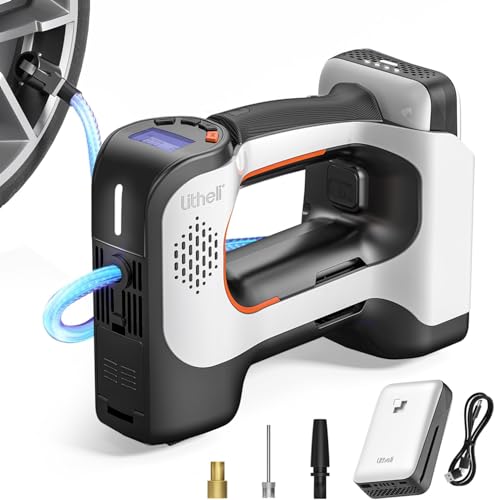
Looking for a compact, cordless inflator that nails everyday tire and gear top-ups without fuss? We like Litheli’s 20V cordless compressor for its 150 PSI ceiling, 25 L/min airflow, and auto-stop accuracy. It’s compact (9.13″ x 6.65″ x 4.02″), about 3.94 lb, and the 2.0Ah U20 battery pops in with a secure push. The LCD lets us set PSI, BAR, KPA, or kg/cm², and the LED worklight adds constant or SOS modes. Built-in accessory storage houses the Presta adapter, ball needle, and tapered tip. Plan brief cooldowns every five minutes. Warranty impresses: five years on the tool, three on the battery.
Best For: Drivers, cyclists, and home users who want a compact, cordless inflator for quick top-ups with precise auto-stop and easy, portable operation.
Pros:
- 150 PSI max with 25 L/min airflow for fast inflation across car and bike tires, balls, and inflatables
- Auto-stop with clear LCD (PSI/BAR/KPA/kg/cm²) and LED light with SOS; built-in accessory storage
- Lightweight, cordless 20V design with included 2.0Ah U20 battery; long 5-year tool/3-year battery warranty
Cons:
- Requires cooldown after every 5 minutes of use, limiting continuous inflations
- Heavier than some mini inflators at ~3.94 lb with battery
- Not intended for high-volume items or continuous-duty tasks despite 150 PSI rating
Metabo HPT 8-Gallon Trolley Air Compressor (EC1315S)

February 22, 2026 6:42 am
For crews who need high pressure in a portable package, Metabo HPT’s “THE TANK” EC1315S stands out with a 225 PSI max and 5.0 CFM at 90 PSI—enough to keep up with multiple nailers without bogging down. We like that it supports 3 framing, 4 roofing or siding, and up to 5 finish nailers, driving flush with consistency. The 8-gallon trolley design, 93 lb weight, ergonomic handle, and rubber tires make it jobsite-friendly and lighter than gas units. It runs at 76 dB, 120V, 1.5 HP. Expect mixed user feedback on real-world output, but strong portability and quiet operation. Includes two couplers and a 1-year warranty.
Best For: Crews needing a high-pressure, portable compressor to run multiple nailers reliably on busy job sites.
Pros:
- 225 PSI max and 5.0 CFM at 90 PSI deliver strong performance for multiple nailers (3 framing, 4 roofing/siding, up to 5 finish).
- Portable 8-gallon trolley design with ergonomic handle and rubber tires; lighter than gas units and runs relatively quiet at 76 dB.
- Durable build with Japanese engineering, includes two industrial couplers, and backed by a 1-year Metabo HPT warranty.
Cons:
- At 93 lbs, still heavy to lift into vehicles or up stairs despite trolley mobility.
- Mixed user feedback on real-world usable output versus the 225 PSI gauge rating.
- Corded 120V, 1.5 HP motor limits off-grid use compared to gas-powered alternatives.
EVIL ENERGY 1 Gallon Air Tank and 12V Compressor Kit (150 PSI)

February 26, 2026 6:05 am
Compact power defines the EVIL ENERGY 1 Gallon Air Tank and 12V Compressor Kit, making it a smart pick if you need quick bursts up to 150 PSI for air horns, tire top‑offs, light suspension tweaks, or DIY tools without sacrificing space. We like its reinforced, anti‑corrosion steel tank, precision welds, and high‑pressure sealing that resists leaks. The 12V setup includes a 1‑gallon tank, compressor, drain valve, hose, thread tape, and mounting hardware, with five 1/4 NPT ports for flexible routing. It’s compact (11.22 × 7.09 × 5.51 in, 6.84 lb), easy to install, and best for light, intermittent tasks. Drain weekly; avoid continuous duty.
Best For: Drivers and DIYers who need a compact 12V air setup for quick, intermittent bursts up to 150 PSI—ideal for air horns, tire top-offs, light suspension tweaks, and small pneumatic tasks in tight spaces.
Pros:
- Compact 1-gallon tank with five 1/4 NPT ports for flexible installation in tight spaces
- Reinforced, anti-corrosion steel construction with precision welds and high-pressure sealing to resist leaks
- Complete kit (compressor, hose, drain valve, thread tape, hardware) for easy, 12V plug-and-play setup
Cons:
- Not suited for continuous duty or powering large air tools
- Requires regular draining (weekly) to prevent moisture issues
- 1-gallon capacity limits runtime between compressor cycles
Factors to Consider When Choosing Engine Air Compressors
Before we pick a compressor, let’s match pressure and CFM to our tools, check the duty cycle rating for sustained use, and size the tank to our workflow. We’ll also confirm the power source—12V, 120V, or engine-driven—so it fits where we’ll run it. Finally, we should weigh portability and overall weight to balance mobility with performance.
Pressure and CFM
How do pressure and CFM shape what an engine-driven compressor can actually do? They define which tools we can run and how efficiently. Higher PSI helps seat bigger tires and deliver stronger bursts, but CFM determines whether we can keep tools running without pauses. Remember, a compressor’s max PSI is only the peak—it’s not the steady operating pressure we should plan around.
CFM at a given PSI is the spec that matters. Many framing nailers need about 2–5 CFM at 90 PSI; finishing nailers often do fine at 2–3 CFM. If we’re running multiple tools or want rapid recovery, we should prioritize higher CFM at our target PSI to reduce downtime. Oversizing PSI without enough CFM yields brief bursts and long recharge times, hurting productivity.
Duty Cycle Rating
Why does duty cycle matter? It tells us how long a compressor can run at full load before it must rest. A common example is 60%: six minutes on, four minutes off in a ten‑minute cycle. If we need steady airflow, we should choose a higher duty cycle—50–100%—to cut cooldown pauses and keep work moving.
Pushing a low duty cycle hard raises heat, saps performance, and shortens component life. Our actual runtime also depends on CFM at our target pressure; the higher the CFM draw at the same PSI, the faster we approach thermal limits, effectively lowering usable duty cycle.
Planning to run multiple tools or high‑volume processes? We should match a duty cycle that supports our expected load to minimize downtime and protect the system.
Tank Size Needs
So what tank size do we really need? Let’s match the tank to our workflow. Tank capacity, measured in gallons, determines how long tools run before the compressor refills. Larger tanks—think 8 gallons—store more air, support multiple or longer runs, and cut pump-on time. Smaller tanks, around 1–2 gallons, shine for portability and quick, short bursts but restart more often to hold pressure.
We should size the tank to our tools’ CFM draw and duty cycle. High-CFM or near-continuous tasks benefit from a larger reservoir to avoid constant cycling. For intermittent, light-duty work, a compact tank paired with higher operating pressure can deliver enough air without hogging space. Bottom line: map CFM and usage pattern to tank size to stay productive and protect the pump.
Power Source Compatibility
Where will we plug in—or will we at all? Power source compatibility dictates where and how we use an engine air compressor. If we’ve got reliable mains power, 120V or 230V units make sense—just match the outlet and circuit capacity. Hobby compressors draw moderate amps, while pro models can demand higher amperage that may require dedicated circuits.
For roadside needs, 12V automotive compressors (cigarette-lighter or direct-to-battery) are convenient but typically deliver lower CFM and longer fill times under load. Cordless battery models trade cords for flexibility; their voltage and amp-hour ratings determine runtime, peak pressure, and continuous-duty capability.
We should also check for built-in pressure switches or auto-stop features tied to the power system, so the compressor reaches the target pressure without constant monitoring.
Portability and Weight
How portable does it need to be? We should match the compressor to how we’ll move and use it. If we’re hiking between tasks or stowing it in a trunk, lighter units around 1–3 kg (2–7 lb) with compact footprints are easiest to carry and pack. Cordless models cut the cord and outlet hunt, but built-in batteries add weight and demand charging discipline.
On job sites, trolley frames or sturdy handles make heavier, high-capacity units manageable without back strain. We also look for integrated accessory storage and streamlined hoses; fewer loose parts mean faster setups and less bulk in the field. Finally, portability isn’t just size—duty cycle and cooldown policies matter. For extended outings, we’ll avoid overheating by planning rest intervals to maintain performance.
Noise and Durability
Quiet enough for a garage, tough enough for a job site—that’s the balance we’re after with noise and durability. We look at decibels first: 60–70 dB keeps conversations possible; 80 dB+ demands hearing protection and can limit indoor use. Noise often tracks with build quality, too—tight tolerances and vibration damping reduce rattles.
For durability, we favor cast iron pumps and frames over aluminum when longevity matters, and we note housing trade-offs: ABS/plastic cuts weight but won’t absorb impacts like metal. Thermal mitigation is nonnegotiable; cool-down cycles and thermal shutoff protect motors during repeated duty. Robust seals and corrosion-resistant coatings keep leaks and rust at bay. Finally, smart chassis design—trolley frames and wheels—distributes weight and guards components in transit.
Conclusion
Wrapping up, we’ve covered three standouts that nail power, durability, and value—from the speedy Litheli cordless to the quiet, jobsite-ready Metabo HPT, and the budget-smart EVIL ENERGY kit. Choose based on PSI needs, duty cycle, portability, and noise. Here’s a stat we love: quiet compressors can reduce perceived loudness by up to 50% with a 10 dB drop, helping cut fatigue on long days. Let’s pick the one that keeps our projects moving—and our ears happy.