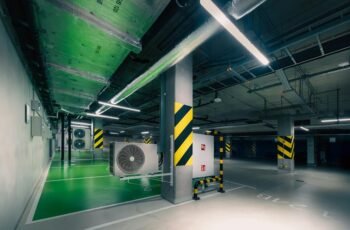
When we size up the best commercial air compressors of 2025, we focus on power, duty cycle, and real-world uptime. We’re looking at models that maintain high CFM at 90–175 PSI, manage noise well, and keep maintenance straightforward. Cast-iron builds, smart regulators, and dependable pumps matter more than spec-sheet hype. Whether you’re in auto repair or heavy spray work, the right unit can transform workflow. Let’s compare what actually holds up under pressure.
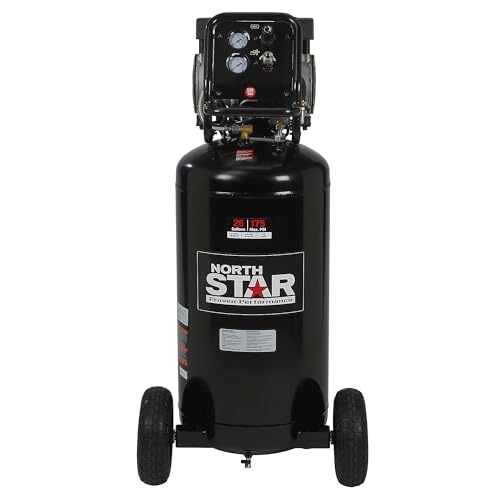
NorthStar Portable Electric Air Compressor, 26-Gallon (1.5 HP)

March 15, 2026 8:26 pm
Looking for a quiet, low-maintenance workhorse for shops that value conversation-level noise? We like the NorthStar Portable Quiet Electric Air Compressor for its 70 dBA operation and practical specs: 1.5 HP, 26-gallon tank, and 4 SCFM at 90 PSI. It’s up to 80% quieter than typical 2-gallon, 150 PSI oil-free units, so we can collaborate without shouting. The oil-free pump is maintenance free, and the heavy-duty, direct drive induction motor boosts reliability, delivering up to 4X the life of many 20-gallon compressors. For control, we get one coupler, two gauges, and a regulator. The handle shields the gauge panel for portable durability.
Best For: Shops, garages, and DIYers who need a quiet, portable, low-maintenance compressor for general pneumatic tools and sustained conversation-level work environments.
Pros:
- 70 dBA operation—up to 80% quieter than typical 2-gal., 150 PSI oil-free units
- Oil-free, maintenance-free pump with heavy-duty induction motor for long life (up to 4X that of many 20-gal. compressors)
- Practical capacity and control: 26-gal. tank, 4 SCFM @ 90 PSI, two gauges, regulator, and protective handle
Cons:
- Single coupler limits simultaneous tool use without additional manifolds
- 4 SCFM @ 90 PSI may be insufficient for high-demand, continuous-use air tools
- Larger 26-gal. footprint is less compact than small portable units for tight spaces
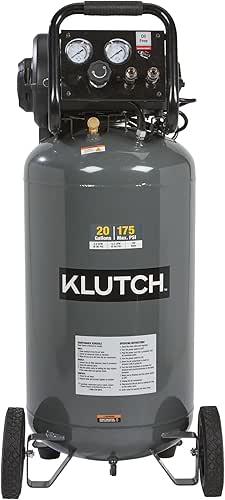
Klutch 20-Gallon Air Compressor, 2 HP, 120 Volts, 175 PSI
March 8, 2026 5:33 am
Built for shops that need high pressure without a huge footprint, the Klutch 20-Gallon Air Compressor hits 175 PSI from a 2 HP, 120V motor and an oil-free pump that keeps maintenance low. We get 4.2 SCFM at 90 PSI and 5.2 CFM max airflow, enough for impact wrenches, nailers, and tire work. It’s portable at 90 pounds with large rubber wheels, an ergonomic handle, and rubber foot stabilizers that tame vibration.
Thermal overload protection safeguards the motor, and the built-in regulator and gauges simplify setup. Noise is a manageable 80 dB. User feedback skews positive; tighten fittings if leaks appear. Thirty-day returns; warranty via product page.
Best For: DIYers and small-shop users who need a portable, low-maintenance compressor that delivers high pressure (up to 175 PSI) for tasks like impact wrenches, nailers, and tire service on a 120V circuit.
Pros:
- High pressure (175 PSI) with 4.2 SCFM @ 90 PSI; suitable for many pneumatic tools
- Oil-free pump and thermal overload protection for low maintenance and reliability
- Portable 20-gallon design with large wheels, ergonomic handle, and reduced vibration (rubber foot stabilizers)
Cons:
- 80 dB noise level may be loud for quiet indoor environments
- Occasional reports of leaks or shipping damage; may require tightening fittings or replacements
- 90 lb weight can be cumbersome to lift without ramps or assistance
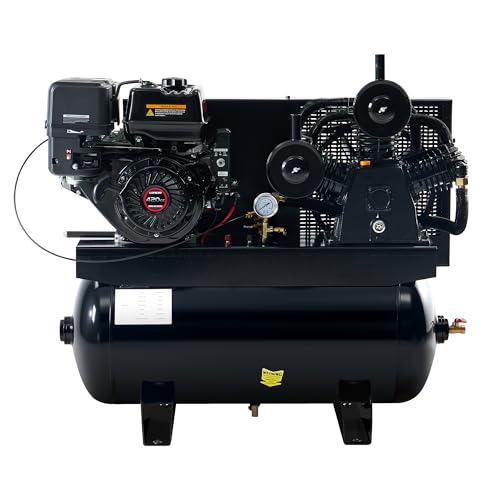
Albott 13HP Gas Powered 30-Gallon Air Compressor (18 CFM, 180 PSI)
March 18, 2026 11:53 am
Need off-grid air power with serious output? We like Albott’s 13HP Gas Powered 30-Gallon Air Compressor for mobile crews. Its 420cc Loncin engine drives a durable 3-cylinder cast iron piston pump to 18 CFM at 90 PSI, with a 180 PSI max for headroom. The ASME-certified 30-gallon tank delivers steady air and reduces run time.
We appreciate the large sight glass for fast oil checks, pump protection, and an automatic safety valve for reliable pressure control. With a 1/2-18 NPT outlet, it feeds nailers, spray guns, and more—ideal on trucks for construction, light industry, food processing, chemical work, and mining support.
Best For: Mobile crews and off‑grid professionals who need high-volume, reliable compressed air from a gas-powered unit on trucks or service vehicles.
Pros:
- Strong output: 18 CFM at 90 PSI with 180 PSI max provides headroom for demanding pneumatic tools
- Durable build: 3-cylinder cast iron pump and ASME-certified 30-gallon tank for longevity and steady air
- Field-friendly: 420cc Loncin gas engine, large sight glass, and automatic safety valve for easy checks and safe operation
Cons:
- Gas engine means noise, emissions, and fuel maintenance compared to electric units
- Heavier and bulkier than portable compressors; best suited for vehicle mounting
- Single 1/2-18 NPT outlet may require adapters/manifolds for multiple tool connections
DEWALT 60 Gallon Vertical Air Compressor, 5 HP, 175 PSI, 240V

March 15, 2026 3:44 am
For shops that demand steady air at higher pressures without hogging floor space, DEWALT’s 60 Gallon Vertical Air Compressor (DXCM603.COM) hits the sweet spot with a 5 HP motor, 175 PSI max, and 14.6 CFM at 90 PSI. We like its single-stage, oil-lubed pump for smooth operation and longevity, plus the ASME-certified 60-gallon tank that stabilizes pressure and cuts cycling. At about 70 dB, it’s quieter than many shop units. The heavy-duty induction motor runs on 240V (208-230V capable), ideal for continuous use. Expect easy integration: on/off switch, large outlet, gauges, and pro-grade components. Warranty: 2-year pump, 1-year parts.
Best For: Professional and serious DIY shops needing high airflow at higher pressures in a space-saving footprint for continuous pneumatic tool use.
Pros:
- Strong performance: 14.6 CFM at 90 PSI and 175 PSI max supports demanding tools and reduced cycling
- Durable, quiet operation: oil-lubed single-stage pump and ~70 dB noise level for smoother, quieter runtime
- Industrial build: ASME-certified 60-gallon tank and heavy-duty 5 HP induction motor (240V, 208–230V capable)
Cons:
- Requires 240V wiring and dedicated circuit, which may add installation cost/complexity
- Heavy and tall (222 lb, ~65 in); not portable and needs adequate ceiling clearance
- Some reports of shipping/motor issues in reviews despite solid specifications and warranties
10 HP Two-Stage 4-Cylinder Air Compressor Pump (36 CFM, CS2105T)

March 14, 2026 12:14 am
Serious airflow at modest RPMs makes the 10 HP Two-Stage 4-Cylinder CS2105T a smart pick for shops that demand steady output without overspinning a pump. We like its cast iron build, two-stage compression, and four-cylinder layout that deliver up to 36 CFM while starting at just 730 RPM. Pair it with a 7.5 HP or larger 220-volt motor and an 80-gallon (or bigger) tank for reliable, continuous duty.
As a replacement pump, the CS2105T lets us refresh a worn compressor without replacing the whole system. It’s built to last, moves air efficiently, and keeps pressure stable for tools that need consistent CFM.
Best For: Shops and serious DIYers needing a durable replacement pump that delivers steady, high CFM at modest RPMs for continuous-duty air tools on 80+ gallon tanks.
Pros:
- Two-stage, four-cylinder cast iron design delivers up to 36 CFM with smooth, efficient airflow
- Runs at modest RPMs (starts at 730), reducing wear and noise while maintaining steady pressure
- Compatible with 220V 7.5 HP or larger motors, making upgrades and replacements straightforward
Cons:
- Requires a large 80+ gallon tank, limiting use in compact setups
- Not ideal for low-power or 120V systems; needs a 220V 7.5 HP+ motor
- Pump only—additional components (motor, belts, filters) may be required for installation
Factors to Consider When Choosing Commercial Air Compressorss
Before we pick a unit, we should match power and CFM to our tools, confirm PSI requirements, and check the duty cycle for continuous workloads. We’ll also balance tank capacity for peak demand with footprint and portability. Finally, we should factor in noise level, especially for indoor or customer-facing spaces.
Power and CFM
How much power and airflow do we really need? Let’s start with CFM—cubic feet per minute—which tells us how much air the compressor delivers at a given pressure. Higher CFM supports demanding tools and speeds recovery between cycles. Many manufacturers list CFM at a standard pressure, often 90 PSI, so we can compare models under typical load.
Power matters, too. Horsepower and engine type influence sustained CFM, but design efficiency—oil-lubed versus oil-free—affects real-world delivery and maintenance. Two-stage or multi-stage pumps typically provide higher CFM at higher pressures than single-stage units, improving performance for heavy-duty, continuous tasks.
We should match compressor CFM to our tools’ intake needs. Undersizing starves tools and slows work; oversizing wastes energy and budget during continuous operation.
PSI Requirements
We’ve covered airflow and power; now let’s talk PSI—the pressure that actually drives your tools. PSI (pounds per square inch) defines the maximum pressure your compressor can deliver. Higher PSI unlocks tools with greater pressure demands, but it can shorten run time between cycles if the system isn’t sized correctly.
For portable 20–26 gallon units, 90–175 PSI usually balances tool compatibility with practical operation for intermittent, light-to-moderate tasks. If you’re running aggressive nailers, spray guns, or impact tools in tougher settings, look for 175–180 PSI to meet peak demands without pressure sag.
Match PSI to your highest-pressure tool and ensure the tank and regulator can hold that pressure under load. Oil-free and oil-lubed models differ here—relief valves and regulator design determine how steadily they maintain PSI.
Duty Cycle
Curiously, duty cycle is the quiet spec that determines whether a compressor keeps up or quits. It’s the percentage of a 10-minute window the unit can run before needing a cool-down—typically 50% to 100% for continuous-use machines. We should match duty cycle to how we actually work: higher-duty-cycle models suit perimeter or continuous operations, minimizing forced breaks during long runs.
Let’s validate ratings at our target PSI and CFM. If our tools demand CFM near or above the compressor’s rating, the effective duty cycle shrinks, heat rises, and service life drops. We can tilt the odds in our favor with refrigerated air dryers and solid cooling airflow to manage heat. Bottom line: pick a duty cycle that sustains our typical workload without downtime.
Tank Capacity
Duty cycle sets how long the pump can run; tank capacity decides how long we can work between cycles. Tank capacity is the air stored in gallons; more volume means longer runtime between refills, especially under higher demand. Larger tanks also let us run at lower cycling pressures, reducing start/stop events and smoothing air delivery for continuous tools.
For many commercial setups, 20–60 gallons strikes a balance between portability and reserve. A 60‑gallon tank supports longer bursts and better recovery under heavy load, but it costs more and takes more floor space. Remember, tank size doesn’t set delivered CFM. Two units with identical CFM can feel different based on tank volume and regulator settings. We size the tank to our tool demand, duty cycle, and available space.
Noise Level
How loud will it be where we work? Noise affects communication, safety, and productivity, so we should check decibel ratings under standard operating conditions. Quieter models hover around 70 dB or lower, which helps reduce fatigue and hearing risk during long shifts.
Oil-free pumps typically run quieter than oil-lubed systems and require less maintenance, lowering nuisance noise from both operation and service. If we need high CFM and duty cycle, a larger, louder compressor can still fit—provided we mount it away from work areas or place it in a sound-dampening enclosure.
Compact units often prioritize quiet operation for shared spaces, but they may trade off CFM and duty cycle. Let’s balance noise level with our required CFM, PSI, and duty cycle to ensure overall performance.
Portability Needs
Where will we need to move the compressor, and how often? Portability starts with tank size, weight, and mobility features. Smaller tanks with wheels and stout handles roll easily through doorways and up ramps, ideal for multi-room or multi-site crews. Larger 30–60 gallon units deliver longer run times and higher CFM, but they’re harder to maneuver on tight or uneven job sites.
Let’s match mobility to workload. If we’re running multiple tools, a two-stage or high-CFM portable model shortens recovery and keeps production steady without constant relocation. Quiet operation in the 70–80 dB range and vibration-damping supports safer, easier transport and use in occupied spaces. Oil-free pumps further streamline portability by eliminating oil checks and leaks, reducing downtime between locations.
Maintenance Demands
When we size up maintenance demands, we should plan for what keeps uptime high and surprises low. Oil-free pumps cut routine tasks by eliminating oil changes, though we’ll watch filters and seals more often, especially in dusty shops. Two-stage units, like CS2105T-class models, deliver higher CFM at set PSI and typically stretch service intervals, so we spend less time on heat and wear checks.
Large tanks—20 to 60 gallons—reduce start/stop cycling, easing stress on motors, valves, and belts. Higher PSI systems (175–180) demand stronger cooling, condensate management, and finer filtration to control moisture and protect tools. Finally, power matters: single-phase 120V versus 240V affects duty cycle, amperage, and access for service. We’ll match electrical capacity to simplify upkeep and protect components.
Conclusion
We’ve covered a range of commercial air compressors that deliver the power, CFM, and durability shops demand in 2025. Whether we need portable versatility, gas-powered freedom, or a stationary workhorse, there’s a reliable option here. Let’s match tank size, PSI, and duty cycle to our workflow, and confirm voltage, noise, and maintenance fit our space. Choose smart controls and rugged builds to reduce downtime. Invest once, service regularly, and we’ll keep air tools running at peak performance.