We’ve tested this year’s standout automotive electric air compressors to see which truly deliver fast, reliable tire inflation on the road and at home. From compact cordless units with auto shutoff to heavy-duty 12V workhorses, we’ll compare fill times, accuracy, durability, and noise. We’ll also note hose lengths, duty cycles, and useful accessories that matter when you’re stuck curbside or off-road. Let’s start with the portable picks that punch above their size—and where each one falls short.
Tire Inflator Portable Air Compressor, Cordless Air Pump with Gauge and Auto Shutoff


March 15, 2026 4:24 am
Looking for a compact inflator that’s truly road-trip ready? We’d pick the Aneson CZK-DC04 for its speed, accuracy, and portability. It pushes 34 L/Min up to 150 PSI, taking a car tire from 25 to 36 PSI in about a minute. Set a target, and the auto shutoff stops exactly there, while dual LCDs show live and preset pressures—even in bright sun.
At just 1 lb, it slips into a glovebox or backpack. Dual power (battery or 12V DC) plus USB-C charging keeps us covered. Presets, memory, and included adapters handle cars, bikes, and balls. Low noise, built-in LED, and a tidy carry bag seal the deal.
Best For: Drivers, cyclists, and road‑trippers who want a fast, accurate, and truly portable tire inflator with auto shutoff and dual power options.
Pros:
- Rapid inflation to 150 PSI with 34 L/Min airflow; boosts a car tire ~11 PSI in about a minute
- Auto shutoff with dual LCDs for real-time and target pressure; presets and memory for quick, repeatable use
- Lightweight (1 lb) with dual power (battery or 12V DC), USB‑C charging, LED light, and multiple adapters
Cons:
- Plastic build may feel less premium or rugged than metal-bodied inflators
- Max power (100W) and compact size aren’t ideal for large truck or heavy-duty tires
- Battery endurance (up to 18 inflations) may require recharging on extended trips without 12V access
AstroAI Tire Inflator Portable Air Compressor Pump (150 PSI, 12V/110V)

March 16, 2026 10:19 pm
For drivers who want true plug-anywhere flexibility, AstroAI’s dual‑power Tire Inflator (12V DC in the car or 120V AC at home) stands out. We like its dual metal motors, 150 PSI high‑pressure mode for car, bike, and motorcycle tires, plus a large‑volume mode (up to 350 L/min) for air mattresses. It inflates a tire from 0 to 36 PSI in about six minutes, then auto‑shuts off at your preset. The digital display, memory, LED light, and silicone buttons make operation simple.
Plan on 15 minutes of continuous use, then a 10‑minute cool‑down. It’s compact, with hose/cord storage, and includes adapters and a spare fuse.
Best For: Drivers and home users who want a compact, dual‑power (12V DC/120V AC) inflator that quickly handles car, bike, and motorcycle tires and can also fill larger inflatables.
Pros:
- Dual power options (12V DC in-car and 120V AC at home) with auto shut-off, digital display, memory, and LED light.
- High-pressure mode up to 150 PSI for tires and large-volume mode (up to 350 L/min) for air mattresses and inflatables.
- Compact design with hose/cord storage; includes multiple adapters (Presta, needle, nozzles) and a replacement fuse.
Cons:
- Not compatible with heavy-duty truck tires; best for cars, bikes, sedans, and mid-sized SUVs.
- Requires cool-down after 15 minutes of continuous use; heat and direct sun can affect performance and may trigger shutoffs.
- Some users report stiff hose/adaptor removal and occasional heat-related durability concerns.
Airmoto Portable Tire Inflator Air Compressor

March 15, 2026 5:43 am
Need a glove-box inflator that’s truly grab-and-go? The Airmoto Portable Tire Inflator packs a digital gauge, auto shut-off, and a bright LED into a compact, 1.19-pound body. It’s cordless, USB-C rechargeable (about 90 minutes), and inflates up to 120 PSI—great for cars, SUVs, motorcycles, and bikes. We set the target PSI, press Start, and it stops precisely, with PSI/kPa/BAR/KG/CM units plus a deflate function on a large LCD.
A 2000 mAh battery powers quick top-ups; performance varies by tire size and temperature. It includes Schrader, Presta, and needle adapters, hose storage, and a pouch. Not for air mattresses or heavy-load tires. High user ratings back reliability.
Best For: Drivers and cyclists who want a compact, cordless, grab-and-go inflator with precise auto shut-off for quick top-ups on cars, SUVs, motorcycles, and bikes.
Pros:
- Compact, 1.19 lb design with USB-C charging and built-in LED; fits in glove box with hose storage and pouch
- Accurate digital gauge up to 120 PSI with auto shut-off, unit conversion (PSI/kPa/BAR/KG/CM), and deflate function
- Includes Schrader, Presta, and needle adapters; strong user ratings and reliable performance for everyday needs
Cons:
- 2000 mAh battery may not handle multiple full tire inflations in one session; recharge about 90 minutes
- Not suitable for large-volume items (air mattresses, paddle boards) or heavy-load tires
- Performance can vary with tire size, temperature, and battery state
Kensun Portable Air Compressor Pump (AC/DC, 100 PSI)
March 15, 2026 5:58 am
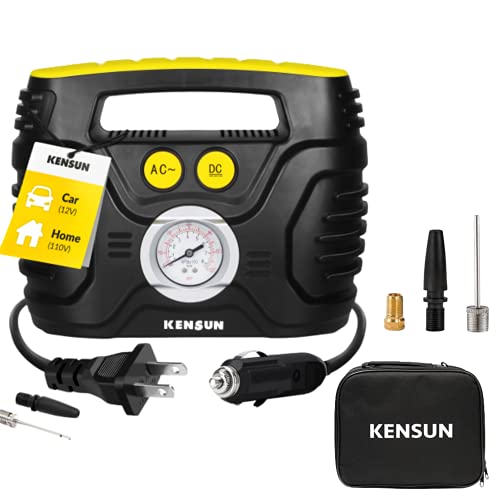
Dual-power convenience makes the Kensun Portable Air Compressor Pump a smart pick for drivers who want one inflator for the car and the garage. We like its AC/DC versatility: plug into a 12V car socket on the road or a 110V outlet at home. Dual metal motors deliver fast fills up to 100 PSI, with 18–20 L/min airflow and about 30 minutes of runtime at 35 PSI. The analog gauge reads PSI/Bar/KPA with ±1 PSI accuracy. It’s compact with a carrying case and includes nozzles for bikes, balls, and inflatables. Downsides: about 92 dB noise, modest bulk, and occasional cord/hose quirks.
Best For: Drivers and home users who want a single, portable tire inflator that works both on the road (12V DC) and in the garage (110V AC) with quick, accurate inflation up to 100 PSI.
Pros:
- Dual-power AC/DC design with long cords for flexible use at home or in the car
- Fast inflation via dual metal motors; accurate analog gauge (±1 PSI) showing PSI/Bar/KPA
- Versatile with included nozzles and carrying case; suitable for car, bike, motorcycle, and sports inflatables
Cons:
- Loud operation (~92 dB) and somewhat bulky for “portable” use
- Occasional cord/hose handling quirks and screw-on connection inconvenience for some users
- Gauge readability and cord length can be hit-or-miss depending on setup
VIAIR 88P Portable 12V Tire Inflator Air Compressor (120 PSI)

March 16, 2026 2:00 am
Looking for a compact, battery-clamp inflator that actually moves air fast? We like the VIAIR 88P. This 12V, 120 PSI unit hits 1.47 CFM free flow and fills a 225/60R18 from 20 to 30 PSI in 50 seconds or less—about 85% faster than many rivals. Its 25-minute duty cycle at 30 PSI suits cars, trucks, SUVs, Jeeps, and off-road toys.
Setup’s simple: clamp to the battery, start the engine, twist on the solid brass chuck, and go. You get a built-in gauge, LED work light, 16 ft hose, 10 ft cord, carry bag, three tips, and a Presta adapter. VIAIR’s 25+ years inspire confidence.
Best For: Drivers who want a compact, battery-clamp 12V inflator that fills tires fast for cars, trucks, SUVs, Jeeps, RVs, bikes, and off-road gear.
Pros:
- Fast inflation: 1.47 CFM and fills a 225/60R18 from 20 to 30 PSI in ≤50 seconds (about 85% faster than many rivals)
- Robust setup: 25-minute duty cycle at 30 PSI, solid brass twist-on chuck, built-in gauge, and LED work light
- Complete kit: 16 ft hose, 10 ft cord, carry bag, 3 tips, and Presta valve adapter
Cons:
- Requires direct battery clamps; not a plug-into-12V socket solution
- Built-in gauge may be less precise during active inflation due to pressure fluctuations
- Duty cycle limits continuous heavy use; needs cooldown after extended operation
ALL-TOP Portable 12V Air Compressor Tire Inflator (150 PSI)

March 18, 2026 10:24 pm
Built for off-roaders and truck owners who demand fast, repeatable fills, the ALL-TOP 12V Air Compressor delivers a stout 7.06 ft³/min airflow and a 150 PSI ceiling in a heavy-duty metal chassis. We like its aluminum cylinder for heat dissipation, auto-thermal cut-off, pressure safety valve, and sand-proof switch. The digital inflator’s hold-to-inflate control speeds up multi-tire work, while the 26 ft hose and 6.5 ft power cord reach all corners of a truck or trailer.
At 19 pounds and 78 dB, it’s solid and loud. Users praise fast fills and value; some report hose-gauge accuracy quirks. Backed by a 2-year warranty and lifetime support.
Best For: Off-roaders, truck and RV owners who need fast, repeatable tire fills with long reach and rugged, 12V portability.
Pros:
- High airflow (7.06 ft³/min) and 150 PSI max for quick inflation of large tires
- Durable metal build with aluminum cylinder, auto-thermal cut-off, and pressure safety valve
- Long 26 ft hose and digital inflator with hold-to-inflate control for efficient multi-tire work
Cons:
- Heavy at 19 pounds and loud at 78 dB
- Some users report hose-gauge accuracy quirks and prefer gauge placement elsewhere
- Bulkier than compact inflators; 12V corded setup requires vehicle power source
JACO SmartPro 12V Tire Inflator Air Compressor
March 18, 2026 10:24 pm
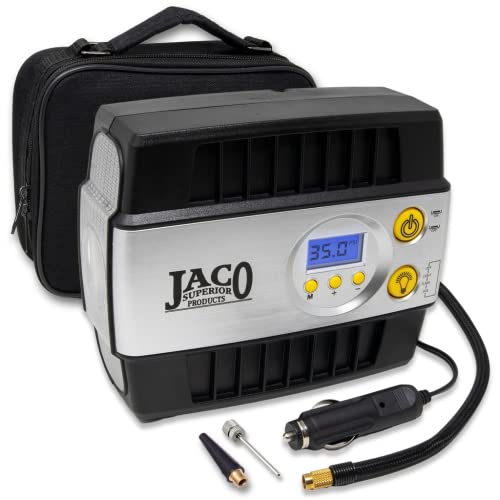
Need a compact 12V inflator that nails set-and-forget accuracy for daily drivers? We like the JACO SmartPro 12V Tire Inflator. It’s a 120W, 100 PSI digital pump with an auto shut-off once your preset pressure is reached. The backlit LCD reads 0–100 PSI with ±1 PSI accuracy, and the 25 L/min airflow handles cars, trucks, and motorcycles up to 45 PSI, plus bikes up to 100 PSI. The 24-inch woven hose and brass screw-on nozzle give a secure, hands-free seal. A 10-foot cord, four-mode LED, two inflation adapters, and a zippered case round it out. Lifetime warranty inspires confidence; storage quirks don’t.
Best For: Daily drivers and cyclists who want a compact 12V inflator with accurate set-and-forget operation, reliable auto shut-off, and convenient night-time usability.
Pros:
- Accurate digital gauge (±1 PSI) with auto shut-off for precise, hands-free inflation
- Solid performance for cars/trucks/motorcycles up to 45 PSI and bikes up to 100 PSI; 25 L/min airflow
- Practical touches: brass screw-on nozzle, 10 ft power cord, four-mode LED, adapters, and zippered case; lifetime warranty
Cons:
- Storage quirks: tight case and recessed cord/hose areas can make packing awkward
- Limited to 12V DC; not ideal for high-pressure car tires above 45 PSI or heavy-duty applications
- Some mixed long-term durability feedback despite overall positive ratings
AstroAI Portable Tire Inflator Air Compressor (12V, Yellow)

March 15, 2026 5:38 am
For drivers who want set-and-forget accuracy on a budget, the AstroAI Portable Tire Inflator (12V, Yellow) stands out with its programmable target pressure and auto shut-off. We set psi with the M and +/- buttons, clip the hose to the valve, and it stops at the target—simple and reliable. Powered by a 12V cigarette lighter with a 9.8 ft cord and 3 m hose, it reaches all tires on most cars. The backlit display and independent LED flashlight help at night. ToughUltra internals promise longer life. It inflates quickly to everyday pressures, but it’s loud and gets warm—limit sessions to 15 minutes.
Best For: Drivers who want an affordable, compact 12V inflator with set-and-forget accuracy, auto shut-off, and easy night use for routine top-ups on cars and SUVs.
Pros:
- Programmable target pressure with auto shut-off and four units (psi, bar, kPa, kg/cm2) for accurate, hands-off inflation
- Long reach with 9.8 ft power cord and 3 m hose; backlit display plus independent LED flashlight for dark conditions
- Durable ToughUltra internals (motor, gears, rod) for extended service life in a lightweight, compact body
Cons:
- Loud operation and noticeable heat buildup; recommended to limit use to 15 minutes per session
- 12V cigarette-lighter only (not battery-powered), so vehicle must be running during use
- Max pressure 100 psi and modest airflow mean it’s best for regular car tires, not high-volume truck or off-road tires
OlarHike Cordless Tire Inflator Portable Air Compressor (150 PSI, Dual Power)

March 16, 2026 2:00 am
Prefer a grab-and-go inflator that still handles full-size car tires quickly? We like OlarHike’s cordless inflator for its dual power and speed: it takes a 195/65 R15 from 29–35 PSI in about a minute, with airflow up to 24 L/min and max pressure rated to 160 PSI. Use the 5400mAh battery or plug into a 12V outlet. It remembers target pressures, auto-shuts off, and offers four modes with PSI/BAR/KPA/kg/cm² units. The LED display and light simplify night use. It’s compact at 1.96 lb, includes multiple nozzles, cords, a storage bag, and a spare fuse, and carries strong user reviews and awards.
Best For: Drivers and cyclists who want a fast, portable, cordless inflator with backup 12V power for quick top-ups on cars, bikes, and sports gear.
Pros:
- Dual power options (5400mAh battery or 12V DC) with fast inflation ~1 minute from 29–35 PSI on 195/65 R15 tires
- Auto shut-off with pressure memory, four preset modes, and unit switching (PSI/BAR/KPA/kg/cm²)
- Compact, lightweight design with LED display/light and multiple nozzles, cords, bag, and spare fuse included
Cons:
- Noise level around 80 dB may be loud for some users
- Short 23.6-inch hose may limit reach in certain positions
- Max airflow (24 L/min) and runtime best suited for top-ups, not large-volume inflatables or extended continuous use
R8 Portable Tire Inflator Air Compressor

March 15, 2026 7:04 am
Shaving minutes off roadside stops matters, which is why the R8 Portable Tire Inflator stands out for drivers who value fast, accurate top-ups from a 12V source. We like its 40 L/min output and 150 PSI ceiling, inflating a 215/50 R17 from 26–35 PSI in under a minute and Tesla 235/40 R19 to 36 PSI in about 1.5 minutes—roughly 3x faster than its predecessor. The dual digital screen shows real-time and target pressures, while auto-stop and memory enable one-key repeats. It’s compact (2.79 x 4.92 x 6.49 in, 2.16 lb), includes long cord/hose, multiple nozzles, night lighting, a carrying bag, and a 2-year warranty.
Best For: Drivers who want a fast, accurate, 12V-powered inflator for quick roadside top-ups across cars, EVs, bikes, and sports gear, with easy one-key operation and compact storage.
Pros:
- Fast inflation: 40 L/min fills common car/EV tires in about 1–1.5 minutes; 150 PSI max
- Dual digital display with auto-stop and memory for precise, repeatable results
- Compact, lightweight design with long cord/hose, night lighting, and multiple nozzles
Cons:
- Not battery-powered; requires a 12V cigarette lighter socket
- Short 2 ft hose may require positioning the unit near each tire
- Max current draw (10–15A) may not suit all vehicles’ accessory ports
Factors to Consider When Choosing Automotive Electric Air Compressors
As we compare compressors, we should weigh the power source (12V, 110V, or battery), maximum pressure rating, and airflow rate in cfm/lpm to match our vehicles and use cases. We’ll also check duty cycle limits so the motor can handle sustained inflations without overheating. Finally, let’s assess portability and size to ensure it fits our trunk space and on-the-go needs.
Power Source Options
Which power source fits your routine best—12V DC from the car, a 110V AC wall outlet, or a cordless battery? We should match the compressor to how and where we inflate. A 12V DC plug (cigarette-lighter/OBD) gives on-the-road convenience and essentially unlimited runtime from the vehicle, but many 12V-only units have short duty cycles—often 15–25 minutes—so they can overheat if we push long sessions.
AC (110V) models shine at home garages, typically offering steadier output and less strain. Cordless units with built-in batteries (e.g., 2000–5400 mAh) free us from cables and idling engines, yet they need recharging and handle fewer tires per charge.
Dual-power designs (12V + AC or battery) maximize flexibility, though they’re heavier and costlier. Compare duty cycle, flow rate, and auto shut-off.
Maximum Pressure Rating
How high does your compressor really need to go? Maximum pressure rating tells us the highest PSI a unit can reach. Most consumer models top out between 100 and 150 PSI. For typical passenger cars, a 100–120 PSI rating is plenty, since we’re inflating to roughly 30–40 PSI. We still want headroom: pick a max PSI that comfortably exceeds our target to ensure accurate auto shut-off without the compressor straining at its limit.
If we drive trucks, tow, or air up off-road tires that run higher pressures, a higher ceiling matters. Some inflators advertise 150 PSI, but real-world results can dip due to heat buildup and duty-cycle limits. Prioritize a rating matched to our highest expected tire pressure, with margin for consistent performance.
Airflow Rate (Cfm/Lpm)
Curious why one inflator beats another in speed? Airflow rate tells us. It’s listed as CFM or L/min and directly governs how quickly we hit target pressure. Higher flow moves more air per minute, so larger tires benefit most. Many portable units claim roughly 7.0–34 CFM or 120–350 L/min; as a rule, higher numbers mean faster top-offs.
For daily drivers, about 30–34 L/min (around 1–1.2 CFM) can inflate a tire in minutes. Moving up in flow trims wait times substantially, which matters if we service multiple tires or larger sizes.
When we compare ratings, we should check whether it’s maximum burst flow or sustained flow. Sustained flow reflects real-world performance better and helps us predict how quickly an inflator will finish the job.
Duty Cycle Limits
When we talk speed, we also need to talk stamina—duty cycle tells us how long a compressor can run at its rated CFM/PSI before it needs a break. It’s expressed as a percentage over a set period, typically 10 minutes. For example, a unit able to run 5–6 minutes within that window delivers a 50–60% duty cycle.
We look for real numbers at real pressures. A common benchmark is continuous work around 25–30 minutes at 30 PSI, but as PSI rises, usable duty usually drops, so rest periods must grow to prevent overheating. Motors, cooling design, and heat buildup are key drivers; better cooling—axial fans, heat sinks—extends run time at higher pressures. When comparing models, match the stated duty cycle to your target pressure—30 vs. 100 PSI—and your expected workload.
Portability and Size
Looking for something you can toss in the trunk and forget until you need it? Let’s weigh portability and size. Most compact compressors sit in the 1–4 pound range with 6–12 inch footprints, so they slide into trunks, door pockets, or glove boxes without hassle. Cordless units keep weight lowest—often 1–2 pounds—but we trade some run-time versus corded, plug-in models that add heft while delivering continuous power.
We should also think about reach. Longer hoses and power cords—roughly 3 to 16 feet—make it easier to access all four tires, even on larger vehicles or in tight parking spots. A tidy form factor plus a storage pouch or bag simplifies organization. Dual power options (12V DC with USB‑C or AC) boost versatility but can increase bulk due to extra batteries or cords.
Noise Level Range
How quiet should a compressor be for road-trip sanity and late‑night top‑offs? We should look at decibel ratings: automotive electric air compressors span roughly 40–92 dB. Quieter units run around 40–60 dB—conversation to office-level noise—while higher-output models can push past 80 dB, more like city traffic. If we’ll inflate tires frequently or use the pump inside the cabin, we should prioritize lower decibel numbers to cut fatigue and in-vehicle disturbance.
Design matters. Models with axial-flow cooling fans, optimized air ducts, and vibration-damping feet tend to sound softer without sacrificing airflow. Noise isn’t static, either. Sound can climb as duty cycles stretch or ambient temperatures rise, especially when a compressor overheats or runs continuously. When comparing specs, consider typical runtime and heat management.
Auto Shut-Off Accuracy
Curiously, auto shut-off accuracy can make or break a compressor’s convenience and safety. We look for precise sensors tied to a preset pressure target, with specs claiming ±1 PSI or better. The catch is real-world variation: heat buildup and rapid temperature shifts can nudge sensors, causing slight under- or over-inflation if drift occurs during use.
To verify performance, we favor units that display both current and preset pressures in real time, so we can confirm the shut-off aligns with the target. Premium models also maintain accuracy across low, medium, and high ranges—up to 150 PSI—reducing over-inflation risks on different tire types.
Finally, stable power and adequate cooling matter. Continuous operation without cooldown can degrade sensor precision and compromise shut-off reliability over time.
Attachments and Adapters
Reliable shut-off only matters if we can actually connect to what we’re inflating, so we weigh the attachments just as carefully. We look for a comprehensive adapter set—Schrader, Presta, and a ball needle—plus multiple nozzle tips for inflatables. A quick‑connect system speeds swaps and helps us secure a proper seal on different valve types.
Material quality matters. Brass or similarly robust adapters resist wear, thread cleanly, and hold pressure without leaks. We also favor compressors with an inflation hose that stores on or in the unit and a dedicated bag or case, so tips and hoses don’t vanish between uses.
Finally, we confirm hose length and power cord reach all four tires from varied parking positions, avoiding awkward repositioning or risky extension setups.
Conclusion
We’ve covered the top electric air compressors of 2025 to keep us ready for flats, road trips, and weekend adventures. Whether we want cordless convenience, AC/DC flexibility, or heavy-duty power for trucks and off-road tires, there’s a smart pick here. Let’s match PSI, duty cycle, noise, and portability to our needs, and value features like auto shutoff, accurate gauges, and sturdy hoses. With the right inflator in our trunk, we’re prepared for quick, reliable inflation anywhere.