We’re cutting through specs to highlight three American-made air compressors that match real job demands: durable builds, consistent CFM, and dependable support. We focus on rugged pumps, low-maintenance designs, and noise levels that keep shops workable. We’ll touch on warranties, parts availability, and where each model fits best—from trim tools to heavier-duty tasks. If you want gear that lasts without the guesswork, the shortlist starts here—and one pick might surprise you.
Key Takeaways
- Prioritize U.S.-assembled units from brands with proven reliability, robust warranties, and accessible domestic service networks and parts.
- Look for durable pumps and components, favoring oiled designs for heavy duty and oil-free for clean, low-maintenance home use.
- Match airflow and pressure to tasks: high CFM and 125–175 PSI for pro tools; moderate CFM for DIY inflating, brad nailers, and light spraying.
- Balance tank size and portability: larger tanks extend runtime; lighter models with wheels and handles ease transport on job sites.
- Verify real-world reviews on longevity, noise levels, duty cycle performance, and warranty claim responsiveness before purchasing.
VEVOR 13-Gallon Oil-Free Air Compressor (2HP, 125 PSI, 66dB)


March 15, 2026 7:02 am
Looking for a quiet, low‑maintenance compressor that still delivers real working power? We like VEVOR’s 13-gallon oil-free unit for its 2 HP motor, 125 PSI max, and 66 dB operation—quiet enough for garages and basements. It builds pressure fast in under three minutes and delivers 4.6 SCFM at 90 PSI, enough for tire inflation, light paint work, brad nailers, and many DIY tasks.
The reinforced, leak-proof valve system helps maintain steady output. Portability’s easy with two 7-inch rubber wheels. You’ll get filters, gauges, foot pads, and hardware in the box. Users rate it 4.3/5, praising low noise and value, with occasional valve/shipping hiccups.
Best For: DIYers, homeowners, and light-duty pros who need a quiet, low‑maintenance compressor with enough power for tire inflation, nailers, and small paint or auto tasks.
Pros:
- Quiet operation at 66 dB; suitable for garages/basements
- 4.6 SCFM @ 90 PSI and fast pressure build in under 3 minutes
- Oil-free, low maintenance design with portable 7-inch wheels and included accessories
Cons:
- 125 PSI and mid-range CFM limit use with air-hungry tools (e.g., sanders, grinders)
- Occasional reports of valve issues and shipping delays
- 71 lb weight can be bulky to lift without using wheels
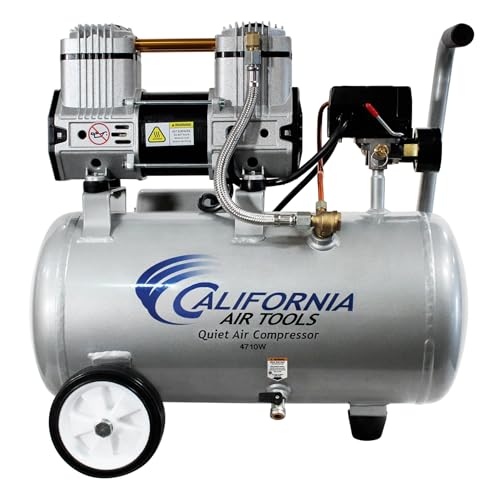
California Air Tools 4.7-Gallon Quiet Oil-Free Air Compressor (CAT-4710W)
March 16, 2026 9:44 pm
Prefer peace and portability without sacrificing usable power? We like California Air Tools’ CAT-4710W for quiet, light-duty jobs in noise-sensitive spaces. Its 1.0 HP motor delivers up to 135 PSI and 2.2 CFM at 90 PSI from a 4.7-gallon steel tank, filling from empty in about 78 seconds. At 35 pounds with wheels and a handle, it’s easy to move around the home or garage.
The oil-free dual-piston pump cuts maintenance and provides cleaner air, backed by 1000+ hour life and thermal overload protection. Expect about 75 dB noise. Two gauges and a quick connector simplify use. Note mixed reviews citing heat after extended runs.
Best For: Homeowners, DIYers, and small-shop users who need a quiet, portable, low-maintenance compressor for light-duty tasks in noise-sensitive spaces.
Pros:
- Quiet operation around 75 dB; suitable for garages and indoors
- Oil-free dual-piston pump with 1000+ hour life and minimal maintenance
- Portable 35 lb design with wheels/handle; quick 78-second tank fill to 135 PSI
Cons:
- Limited airflow (2.2 CFM @ 90 PSI) restricts use with high-demand air tools
- Some users report heat buildup during extended runs
- Mixed durability reports and occasional minor missing parts in packaging
California Air Tools 8010 Ultra Quiet Oil-Free 8-Gallon Air Compressor

March 15, 2026 3:47 pm
Need an ultra-quiet workhorse you can run indoors without annoying the neighbors? The California Air Tools 8010 delivers 60 dB operation, a 1.0 HP oil-free dual piston pump, and an 8-gallon steel tank rated to 120 PSI. It moves 3.0 CFM at 40 PSI and 2.2 CFM at 90 PSI on 110V/8 amps. We appreciate the 165-second fill and 60-second recovery, automatic shut-off, and 0.25-inch hose compatibility.
At 48 lbs with a wheel kit, it’s easy to maneuver. Expect over 3,000 hours before wear and simple, maintenance-free ownership. Users rate it 4.5/5, praising indoor-friendly noise, quick recharge, and straightforward setup.
Best For: DIYers, hobbyists, and pros who need a quiet, low-maintenance indoor compressor for nailing, small air tools, and garage projects in noise-sensitive spaces.
Pros:
- Ultra-quiet 60 dB operation suitable for indoor use and shared spaces
- Oil-free dual piston pump with 3,000+ hour life and minimal maintenance
- Quick 165-second tank fill and 60-second recovery; lightweight 48 lbs with wheels for easy mobility
Cons:
- Limited airflow (2.2 CFM @ 90 PSI) not ideal for high-demand tools like sanders or grinders
- Max pressure of 120 PSI may constrain some pneumatic applications
- 8-gallon steel tank adds bulk compared to smaller portable units
Factors to Consider When Choosing American Made Air Compressors
When we choose an American-made air compressor, we should start with build quality standards and verify the materials, warranty, and certifications. Next, we’ll match power and pressure to the tools we run, check airflow and CFM for sustained demand, and confirm the noise level rating fits our space. Finally, we’ll weigh oil-free vs oiled designs for maintenance needs, longevity, and clean air requirements.
Build Quality Standards
Though specs and pricing grab attention, build quality separates a workhorse from a headache. When we evaluate American-made compressors, we look for corrosion-resistant frames, rugged welds, and cast-iron or hardened steel components that hold up on job sites.
Tanks should be aluminum or steel with pressure-rated seams, tested to meet or exceed safety codes like ASME, and paired with UL-listed components. We also value oil-free pump designs or dual-piston systems that promise long life cycles and include thermal protection to prevent overheating.
Quality shows in the details: reinforced valve assemblies, accurate pressure gauges, and durable quick-connect fittings that deliver steady airflow under load. Finally, we verify factory testing claims and warranty coverage—typically 1–3 years—as practical signals of reliability and long-term support.
Power and Pressure
How much power and pressure do we really need for the jobs at hand? We start by matching maximum operating pressure (PSI) to our tools. Many American-made units deliver 120–135 PSI, which covers brad nailers, finish guns, and most automotive tasks. Higher PSI offers headroom for bursts and tougher fasteners, but we shouldn’t over-spec beyond our needs.
We also consider tank size because it shapes usable power between cycles. An 8–13 gallon tank stores more energy, extending runtime before the motor kicks back on, which keeps pressure stable for steady work. Pump design matters, too. Oil-free pumps cut maintenance and contamination risk, though duty cycles and longevity can vary versus oil-lubed models. Finally, quiet, efficient compressors that sustain target PSI at sub-70–75 dB minimize fatigue and improve shop comfort.
Airflow and CFM
Curiously, airflow tells us more about real‑world performance than headline PSI. We judge it in CFM at a stated pressure—typically 90 PSI for tools and 40 PSI for lighter tasks. Expect output to drop as pressure rises: a pump that moves 3 CFM at 40 PSI may only deliver 2.2–2.5 CFM at 90 PSI, which directly affects tool responsiveness.
To size correctly, match CFM at the tool’s operating PSI. Light nailers or inflators sip 0.5–2 CFM, while sanders and high‑demand impact tools often require 3–4+ CFM at 90 PSI. Multi‑stage systems or larger tanks help sustain higher CFM longer, limiting pressure sag during continuous use. Remember, oil‑free pumps cut maintenance but don’t boost airflow; CFM comes from motor power, pump design, and tank capacity.
Noise Level Rating
When noise matters, we need to read dB ratings as carefully as CFM specs. Decibels quantify loudness; quieter compressors land around 60–66 dB, while louder units exceed 75 dB. If we’ll work indoors or in shared spaces, we should prioritize models labeled “quiet” or those publishing explicit dB figures in the low 60s.
To compare fairly, we must check dB ratings at the same duty cycle and load. Some brands rate at idle or partial load, which understates real operating noise. Lower dB often reflects better engineering—larger enclosures, isolation mounts, and added sound‑dampening materials. These features can reduce fatigue and improve communication on the job.
Bottom line: verify the test conditions, target 60–66 dB for sensitive settings, and scrutinize published specs.
Oil-Free Vs Oiled
Trade-offs define the choice between oil-free and oiled compressors, and we should match the design to our workload and air-quality needs. Oil-free models cut upkeep with no oil changes, fewer mess risks, and cleaner air output—great for painting, finishing, and any task sensitive to contamination. They often run cooler and advertise longer consumer warranties. The drawback is durability: oil-free pumps typically face higher seal wear and shorter life cycles, especially under continuous or demanding duty.
Oiled compressors thrive in heavy use. Lubrication reduces friction and heat, extending pump life and improving reliability when we’re running tools for long stretches. While they require periodic oil service, they usually offer warranties aligned with industrial workloads. In short, choose oil-free for clean air and light-to-moderate duty; choose oiled for longevity under sustained work.
Portability and Size
How portable do we need our compressor to be? Tank size and layout drive the answer. Larger tanks, like 13-gallon models, extend run time but add weight and bulk. Smaller tanks—about 4.7 to 8 gallons—move easily yet need more pauses to refill. Total weight matters too: a 71 lb unit feels very different from one around 35 lb, especially on stairs.
We should also look at mobility features. Built-in wheels and integrated handles transform heavier units into practical shop-to-jobsite haulers. If a wheel kit is optional, factor that into cost and usability. Oil-free designs cut maintenance, but portability still depends on weight and whether wheels or handles are included.
Finally, compact, horizontal configurations save space and maneuver smoothly in tight garages and crowded work areas.
Warranty and Service
Portability gets the compressor to the job; warranty and service keep it working there. When we compare American-made units, we look beyond specs to the fine print. First, we verify the warranty length and scope—does a 1-year limited policy cover mechanical failure, and are wear parts excluded or prorated? We confirm if coverage depends on registration, original purchase, and documented maintenance.
Service access matters. We check for U.S.-based support, nearby authorized centers, and fast parts availability so downtime doesn’t drag on. Extended or transferable warranties can add peace of mind and bolster resale value.
Finally, we scan real-world feedback. Historical reliability, responsiveness to claims, and any part shortages tell us how a brand stands behind its machines after the sale.
Conclusion
In the end, choosing the right American-made air compressor is like picking a trusted workhorse for the long haul. We once watched a shop cut downtime by 40% after swapping to a cast-iron pump model—proof that durability pays dividends. With options like VEVOR’s 13-gallon and California Air Tools’ quiet, oil-free units, we’re investing in reliable power, parts support, and peace of mind. Let’s choose the compressor that won’t flinch when the job gets tough.