Choosing the right air compressor in 2025 means balancing power, portability, and performance for the tools we rely on. We weighed quiet oil-free units for indoor jobs, rugged gas models for mobile crews, and compact pancakes for quick tasks. We also looked at duty cycle, CFM at 90 PSI, tank size, and noise. If you use nailers, impact wrenches, or sprayers, these picks can save time and hassle—let’s see which one fits your workflow.
VEVOR 13-Gallon Oil-Free Air Compressor (2HP, 66dB)


February 21, 2026 2:49 pm
If you’re chasing a quiet, low-maintenance workhorse for light-to-midsize tools, VEVOR’s 13-gallon oil-free compressor stands out with 66 dB operation, a 2 HP motor, and 4.6 SCFM at 90 PSI. We get fast air buildup in under three minutes, a 125 PSI max, and about 3.6 CFM for steady output. The reinforced, leak-proof valve system helps stability across painting, auto repairs, woodworking, and inflation. At 71 pounds, the two 7-inch rubber wheels make transport easy indoors or out. It ships ready to use with filters, gauges, pads, and hardware. Users praise the quiet, value, and performance, noting occasional valve/shipping hiccups.
Best For: DIYers and pros who need a quiet, low‑maintenance, portable compressor for tire inflation, painting, auto repairs, and light-to-midsize pneumatic tools.
Pros:
- Quiet operation at 66 dB with fast tank fill in under 3 minutes
- 4.6 SCFM @ 90 PSI and 125 PSI max support many light-to-midsize tools
- Oil-free design and reinforced valve system for low maintenance and stable output
Cons:
- 71 lb weight can be bulky to lift despite wheels
- Not ideal for high-demand, continuous-duty air tools needing higher SCFM
- Some reports of valve part issues and occasional shipping delays
WEN Air Compressor, 6-Gallon, Oil-Free, Pancake Style (AP6092)

February 23, 2026 10:07 am
Built for DIYers and pros who want grab-and-go power, the WEN 6-gallon pancake compressor (AP6092) pairs a compact footprint with 150 PSI and 2.6 SCFM at 90 PSI to keep nailers, staplers, and light-duty air tools running smoothly. We like its reinforced steel tank and quick refill times, so you’re back to work fast between bursts. The oil-free pump means no messy lubrication and less maintenance over the long haul.
Dual 1/4-inch NPT quick couplers let us run two tools sequentially, while two gauges clearly show tank and outlet pressures. An onboard handle simplifies transport. The 11.5-amp motor starts reliably. WEN backs it with a two-year warranty.
Best For: DIYers and pros who need a compact, oil-free pancake compressor for nailers, staplers, and other light-duty air tools with quick refill and reliable performance.
Pros:
- 150 PSI with 2.6 SCFM at 90 PSI supports most trim and light-duty pneumatic tools
- Oil-free pump reduces maintenance and eliminates messy lubrication
- Dual 1/4-inch NPT quick couplers and two gauges for convenient tool changes and pressure monitoring
Cons:
- 6-gallon capacity may be limiting for continuous or heavy-duty air demands
- Pancake style can be louder than larger, belt-driven units
- 11.5-amp motor may require a dedicated circuit to avoid tripping breakers in older homes
VEVOR 2.1 Gallon Oil-Free Air Compressor (1.2HP, 116 PSI)

February 20, 2026 8:31 pm
Looking for a compact, low-maintenance compressor that still drives nailers and handles quick tire inflations? We like VEVOR’s 2.1-gallon oil-free unit for its punchy 1.2HP motor delivering 2.2 CFM at 90 PSI and a 116 PSI max. At 27 pounds with a handle, it’s portable, quietish at 70 dB, and stable on four foot pads.
The double-cylinder intake and dual silencers speed fill-ups while keeping noise down. Safety’s covered with auto overheat protection, pressure relief, and two cooling fans. The Q235B steel tank has multi-layer protection and seamless welding. It excels for trim nailers, tire top-offs, and light spray tasks, though not heavy-duty cycles.
Best For: DIYers and pros who need a compact, low-maintenance, portable compressor for trim nailers, quick tire inflations, and light pneumatic tasks without shop-level duty cycles.
Pros:
- Oil-free 1.2HP motor delivers 2.2 CFM at 90 PSI with up to 116 PSI max, suitable for nailers and quick inflations
- Portable and relatively quiet: 27 lb with handle, ~70 dB, dual silencers, stable four-foot design
- Safety and durability: overheating protection, pressure relief, dual cooling fans, Q235B steel tank with multi-layer coating
Cons:
- Small 2.1-gallon tank limits sustained use and heavy-duty cycles
- Mixed longevity reports under extended or heavy workloads
- 70 dB is “quietish” but not silent; still noticeable in small spaces
Portable Tire Inflator Air Compressor with 150 PSI and 6000mAh Battery

February 26, 2026 4:42 am
Commuters and DIYers who want cordless convenience will appreciate OQTER’s 150 PSI Portable Tire Inflator with a 6000 mAh battery, a compact 2.12-pound unit that slips into a glove box yet delivers 30 L/min airflow. We like its digital preset gauge, automatic shut-off, and readable display for accurate fills on car, motorcycle, and bike tires. The kit includes an air hose, EVA bag, four nozzles, and a USB charging cable, so we’re ready for balls, pool inflatables, and more. At 68 dB, it’s manageable roadside. It can double as a backup power bank. Users praise accuracy; some report inconsistent charge retention.
Best For: Commuters, DIYers, and travelers who need a compact, cordless tire inflator for quick, accurate top-ups on car, motorcycle, and bike tires, plus occasional inflatables.
Pros:
- 150 PSI with 30 L/min airflow and automatic shut-off for accurate, fast fills
- 6000 mAh rechargeable battery; cordless portability at just 2.12 lb
- Digital display with presets; includes air hose, EVA bag, 4 nozzles, and USB cable
Cons:
- Some users report inconsistent charge retention over several days
- Max PSI and 30 L/min may be slower for large truck/SUV tires from empty
- Battery-powered use means recharging is required; no mention of 12V car plug backup
PORTER-CABLE Air Compressor, 6-Gallon, Pancake, Oil-Free (C2002-ECOM)

February 22, 2026 12:03 pm
Power users who need reliable, maintenance-free air on the go will appreciate the PORTER-CABLE C2002-ECOM’s 6-gallon pancake tank and oil-free pump. We like its 150 psi max pressure and 2.6 SCFM at 90 psi, which deliver quick recovery and longer tool runtimes. The low-amp 120V motor starts easily in cold weather or on an extension cord, so jobsite hiccups don’t slow us down.
Built in the USA with global materials, it’s durable, stable, and portable. Rubber feet keep it planted, while a water drain valve simplifies upkeep. The ecommerce-friendly packaging helps ensure it arrives ready to work, not to repair.
Best For: Contractors, DIYers, and mobile crews who need a portable, maintenance-free compressor with quick recovery and reliable cold-weather starts.
Pros:
- 150 psi max and 2.6 SCFM @ 90 psi deliver quick recovery and longer tool runtimes
- Oil-free, durable pump with low-amp 120V motor that starts easily in cold weather or on extension cords
- Stable 6-gallon pancake tank with rubber feet; built in the USA with global materials; protective e-commerce packaging
Cons:
- Pancake compressors can be louder than larger, belt-driven units
- 6-gallon capacity may be limiting for high-demand, continuous-use pneumatic tools
- Single-voltage 120V design may not suit sites requiring higher-voltage equipment
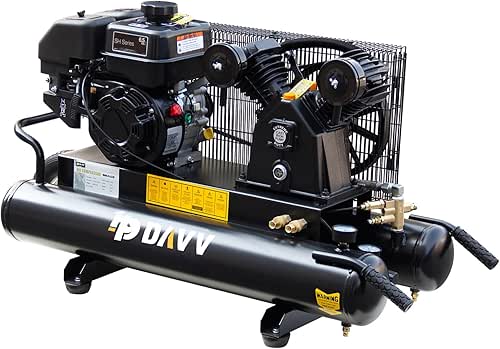
Gas Driven 6.5HP Wheelbarrow Portable Air Compressor, 9 Gal Twin Tank (Single Stage, 12 CFM @ 125 PSI)
February 2, 2026 1:54 pm
Need a gas-powered unit that keeps nailers, impact wrenches, and service tools running off-grid? We like HPDAVV’s 6.5HP wheelbarrow compressor for mobile crews and farm shops. Its single-stage, cast-iron pump and 9-gallon twin tanks deliver about 11–12 CFM at 125 PSI—enough for framing, roofing, light sanders, and service truck duty. The wheelbarrow frame, handle, and pneumatic wheels make it portable and truck-bed friendly.
Expect a 131.7 lb build, belt drive, and straightforward maintenance. Verify the actual CFM (listings vary). Run it outdoors only—never indoors due to CO risk. Warranty’s solid: one year overall, two on the air end, lifetime maintenance.
Best For: Mobile crews, farm shops, and service trucks needing a portable, gas-powered compressor to run nailers, impact wrenches, and light air tools off-grid.
Pros:
- 6.5 HP gas engine with single-stage cast-iron pump delivers ~11–12 CFM at 125 PSI for framing, roofing, and service tools
- Wheelbarrow design with handle and pneumatic wheels; portable and truck-bed friendly
- Solid support: 1-year product, 2-year air end, lifetime maintenance
Cons:
- CFM listing varies (11 vs 12); verify specs for tool matching
- Heavy at ~132 lb; still requires lifting/loading effort
- Gas engine exhaust is hazardous—must be used outdoors only
PCP Air Compressor 4500 PSI with Power Converter for Paintball and Air Rifles

February 26, 2026 4:42 am
Looking for a portable, high-pressure solution that runs at home or in the field? This PCP Air Compressor hits 30 MPa/4500 PSI fast and runs on 12V DC or 110V AC with the included converter. We like the compact build, carry handle, and 60 MPa hose with 8 mm quick-connect. The built-in oil/water separator delivers clean air for PCP rifles, paintball tanks, and mini diving bottles.
Safety needs attention: there’s no auto shutoff. Monitor the adjustable gauge and temperature display—pause at 80°C to cool. Expect about 9–10 minutes from 1000 to 3000 PSI (tank dependent). It’s noisy (78 dB), ~15.6 lb, model CS-WZ-AIR-COMPRESS-BLK.
Best For: Portable PCP users who need fast 4500 PSI fills at home or in the field via 110V AC or 12V DC, and who can actively monitor pressure and temperature.
Pros:
- Dual power with included 110V→12V converter; true home or car versatility
- Built-in oil/water separator and 60 MPa hose with 8 mm quick-connect for clean, quick hookups
- Compact, ~15.6 lb with carry handle; reaches 30 MPa/4500 PSI quickly (e.g., ~9–10 min from 1000→3000 PSI, tank dependent)
Cons:
- No auto shutoff or pressure setpoint; requires constant user monitoring to avoid over-pressurization
- Heat management needed—pause around 80°C; longer fills require cool-downs
- Noisy operation (~78 dB) and some reports of gauge readability quirks
Quiet 8-Gallon Oil-Free Air Compressor (1.2 HP, 2.8 CFM @ 90 PSI)

February 21, 2026 3:41 am
For DIYers and pros who want indoor-friendly performance, this 68 dB Limodot LJ8120 delivers quiet power and practical capacity. We get a 1.2 HP, oil-free motor feeding an 8-gallon steel tank to 120 PSI, delivering 4 CFM at 40 PSI and 2.8 CFM at 90 PSI—right for nailers, staplers, airbrushes, blow guns, and HVLP touch-ups. Recovery’s quick: about 30 seconds between cycles, roughly two minutes from empty to full.
At 43.5 pounds with a wheel kit, it’s portable enough for garage and jobsite. Automatic shut-off, easy cold starts, and low maintenance seal the deal. Ratings back it: 4.5/5 across 1,100+ reviews.
Best For: DIYers and pros who need a quiet, portable, oil-free compressor for indoor or garage use with nailers, airbrushes, blow guns, and light HVLP tasks.
Pros:
- Quiet operation at 68 dB for comfortable indoor use
- Fast cycling: ~30s recovery, ~2 minutes from empty to full
- Oil-free, low-maintenance design with reliable cold starts and automatic shut-off
Cons:
- Max 120 PSI and 2.8 CFM @ 90 PSI limit suitability for high-demand pneumatic tools
- Steel 8-gallon tank adds weight (43.5 lbs) versus lighter aluminum alternatives
- Single 110V, portable unit may not support continuous heavy-duty shop use
30 Gal Gas Powered Air Compressor, 13HP 35CFM with Electric Start and ASME Tank

February 23, 2026 7:25 pm
Built for crews who need serious air on the go, the HPDAVV 30 Gal Gas Powered Air Compressor delivers 35 CFM at a working 105–125 PSI, driven by a 13 HP gas engine with electric start. We get a rugged, one‑stage, 3‑cylinder cast‑iron pump spinning at 880 rpm, feeding a 30‑gallon ASME‑certified tank through a 1/2-inch NPT outlet. It’s truck‑mount ready at 429 pounds and sized for service rigs, yet flexible for multi‑site work.
Use it for nailing, drilling, spraying, or air brushing across construction, workshops, and field service. EPA certification is noted. Check the online warranty; reviews are mixed, with some shipping and warranty concerns.
Best For: Mobile crews and service trucks that need high-volume, reliable compressed air (35 CFM at 105–125 PSI) for tools across construction, workshops, and field service.
Pros:
- Strong output: 35 CFM at working 105–125 PSI handles multiple air tools and sustained use
- Durable build: cast-iron pump head and sleeves; ASME-certified 30-gallon tank; EPA certified
- Truck-mount ready: electric start, 1/2-inch NPT outlet, sized for service rigs and multi-site work
Cons:
- Heavy at 429 lb, limiting true portability without vehicle mounting
- One-stage design capped at 125 PSI may not suit higher-pressure applications
- Mixed customer feedback with noted shipping and warranty concerns
Compressor Source 4–5 HP Single-Stage 3-Cylinder Air Compressor Pump (CS3065A)

February 26, 2026 4:42 am
Serious DIYers and small shops that need steady air on a 60‑gallon tank will appreciate the Compressor Source CS3065A, a cast‑iron, single‑stage, three‑cylinder pump delivering 10–12 CFM at up to 115 PSI. We like its durable cast‑iron cylinders and crankcase, low oil consumption, and easy sight glass checks. Pair it with a 4–5 HP, 220V motor drawing 17–22 amps, spin it at 1000–1200 RPM, and you’re in the pump’s efficiency sweet spot. The included 10.5‑inch flywheel and three intake filters simplify setup. At 50 pounds with compact 17 x 15.5 x 12.25‑inch dimensions, it mounts cleanly and runs reliably.
Best For: Serious DIYers and small shops needing a durable, single-stage pump to maintain steady air on a 60-gallon tank at 10–12 CFM and up to 115 PSI.
Pros:
- Durable cast-iron cylinders and crankcase with low oil consumption and sight glass for easy checks
- Optimized performance at 1000–1200 RPM with 4–5 HP, 220V motors (17–22 amps)
- Includes 10.5-inch flywheel and three intake filters for straightforward setup
Cons:
- Max working pressure capped at 115 PSI, limiting higher-pressure applications
- Requires proper 220V power and compatible motor, adding to total system cost
- Single-stage design may not match the efficiency of two-stage pumps for heavy-duty continuous use
Factors to Consider When Choosing Air Compressors for Power Tools
Before we pick a compressor, let’s match our tools’ required CFM and PSI, then weigh tank size for burst demands and portability. We’ll compare oil-free vs oil-lube designs, consider noise levels (dB) for where we work, and factor in duty cycle for how long we can run continuously. With these in mind, we can choose a unit that performs reliably without overspending.
Required CFM and PSI
Why do CFM and PSI matter so much? CFM tells us how much air the compressor delivers at a set pressure, typically measured at 90 PSI. Many models fall around 2.6–3.6 CFM at 90–125 PSI. PSI is the maximum pressure the unit can sustain, which affects tool compatibility and peak performance for spraying, nail driving, and more.
We should match the tool’s required CFM at the target PSI. If the compressor can’t meet that flow at the working pressure, tools will stall or cycle slowly. A high PSI rating alone won’t help if CFM is inadequate at that pressure. For continuous work, choose a compressor that maintains the needed CFM as pressure dips from peak, so airflow remains stable during extended runs.
Tank Size Matters
How much air do we need on tap? Tank size answers that. Larger tanks store more compressed air, so the motor cycles less while we work. That steadier reserve keeps pressure from dipping when a tool gulps air. Pair tank volume with CFM: together they dictate how long we can run a tool at a set PSI before performance falls off.
For high-demand tools—grinders, impact wrenches, sprayers—a 6-gallon or larger tank typically runs smoother than small pancake units. Stepping up to 8–30 gallons boosts pressure stability and lets us deliver longer bursts for extended tasks.
There’s a trade-off. Bigger tanks add weight, expand the footprint, and draw more startup energy, which affects portability. We should match tank capacity to our duty cycle, workspace, and how often we move the compressor.
Oil-Free Vs Oil-Lube
Curious which pump style fits our tools and workload? Oil-free compressors skip external lubrication, so upkeep’s simple. They use coated pistons and alternative seals that prevent oil carryover, making them great for paint, finish work, or abrasive blasting where clean air matters. The trade-off: they can run hotter, and under heavy, continuous use, valves and seals may need service sooner, trimming lifespan.
Oil-lubed pumps circulate oil to reduce wear, so they generally handle longer duty cycles and tough shop demands better. They shine when we’re running grinders, impact wrenches, or sprayers for extended periods.
Noise Level (dB)
Looking at noise level (dB) first helps us decide where and how comfortably we can run a compressor. The dB spec tells us how loud a unit gets, independent of power or tank size, so we can judge indoor suitability and neighbor-friendly operation. Quiet models start around 68–70 dB—typical for portable pancake or compact units—making them workable in small workshops and garages without overwhelming conversation.
As output and tank size rise, noise climbs. Many 30–60 gallon shop compressors exceed 100 dB, which calls for hearing protection and good ventilation. Oil-free designs often run quieter and avoid motor oil fumes, a plus for enclosed spaces. When we compare candidates, we prioritize the published dB rating and match it to where we’ll work and how long we’ll be nearby.
Duty Cycle Rating
Why does duty cycle matter when we’re pairing compressors with power tools? It tells us how long a compressor can run in a 10‑minute window without overheating. A 50% rating means five minutes on, five off; 100% means continuous operation. Higher duty cycles keep continuous-demand tools like spray guns and roofing nailers running without forced breaks.
For intermittent tasks, a 40–60% duty cycle can work, but we should expect more cooldowns during longer sessions. Tank size and recovery time play a big role, too—larger tanks and quicker recovery effectively stretch usable duty cycle by reducing how hard the pump works between bursts.
Finally, we match the tool’s CFM at operating PSI to the compressor’s delivery and duty cycle to avoid overload and maintain consistent performance.
Portability and Weight
How easily can we move the compressor from the truck to the task? Portability starts with weight and carrying features. We should match the unit’s mass to our transport routine: tiny cordless inflators can weigh as little as 2.12 pounds, while quiet 8-gallon models approach 43 pounds and benefit from wheel kits or sturdy handles.
Pancake-style 6- and 8-gallon compressors shine for grab-and-go jobs. Their compact profiles and integrated handles make stairs, tight rooms, and quick load-outs simpler. For site mobility, wheelbarrow and twin-tank designs add balanced frames, wheels, and lightweight chassis to roll across gravel or curbs without strain.
If we need extended runtime and higher airflow, large tanks push portability down the list. Always weigh handles, wheels, and footprint against our daily hauling demands.
Power Source Options
Which power source fits our tools and job sites best? Most compressors run on electricity—120/110V for household circuits or 230V for heavier draws. If we’ve got reliable power, corded electric is quietest and simplest. Gas-powered units shine where outlets don’t exist; they’re truly portable but must stay outdoors because of exhaust.
We also weigh pump type. Oil-free pumps cut maintenance and eliminate oil carryover into air streams, though some oil-lubed models handle heat and long duty cycles better.
Match power with air demand. Tank size and CFM at a given PSI determine runtime before the motor recharges. Compact pancake units at 125–150 PSI and roughly 2–4 CFM at 90 PSI suit light-duty tasks. Dual-power or PCP-style high-pressure compressors reach extreme PSI but demand vigilant monitoring.
Regulator and Couplers
Curiously, the small hardware on the outlet side—regulator, gauges, and couplers—decides how usable a compressor feels day to day. We want a regulator that sets and holds output pressure precisely, so finish nailers, impact wrenches, and paint guns don’t get over-pressurized. Two gauges matter: one for tank pressure, one for regulated tool pressure, letting us monitor reserve air and fine-tune output.
Couplers and fittings dictate speed and reliability. Standard 1/4″ NPT quick-connects are common, but we must match type and size across hoses and tools for proper sealing and fast swaps. Durable, leak-proof valves and well-sealed fittings cut pressure drop, reduce cycling, and improve recovery between bursts. In short, a tight, compatible interface keeps tools consistent and workflows smooth.
Conclusion
We’ve covered the best air compressors of 2025, from whisper-quiet oil-free units to rugged gas-powered workhorses. Whether we’re running nailers, sprayers, or impact wrenches, the right match comes down to CFM, PSI, tank size, duty cycle, and noise. If portability and low maintenance matter, go oil-free; if nonstop power’s key, scale up tank and output. Let’s choose the compressor that fits our tools and workflow—and keep every job running smooth, consistent, and efficient.


