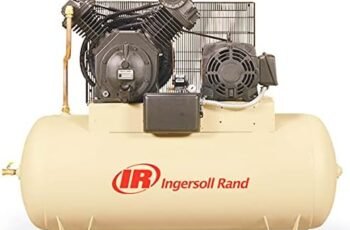
Looking for a rugged, workshop-ready air compressor that can handle heavy use without breaking a sweat?
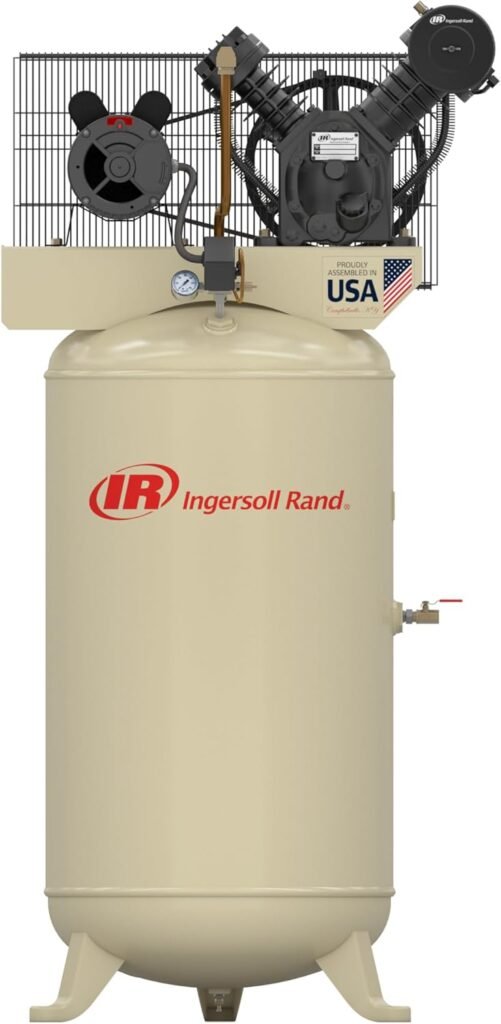

Product Overview: Ingersoll-Rand 2340N5-V 5hp 80 gal Two-Stage Compressor (230/1) 45464989
We’ll summarize what this model is and where it fits into a workshop or industrial setting. This is a two-stage, cast-iron compressor designed for continuous-duty operation and longer service life, intended for demanding applications where a steady air supply matters.
What this compressor promises
We’ll note the headline specifications and what they mean in practical terms. The compressor delivers 14.3 CFM at 90 PSI, a 5 HP motor running at 3,450 RPM, and an 80-gallon ASME-rated receiver with a maximum of 175 PSI. It’s built to last with 100% cast iron construction and design choices aimed at reducing maintenance.
Key Specifications Table
We’ve put the critical specs into a single table so we can compare them quickly and consistently. This helps when we want to evaluate suitability for particular tools or workflows.
| Specification | Detail |
|---|---|
| Model | Ingersoll-Rand 2340N5-V 5hp 80 gal Two-Stage Compressor (230/1) 45464989 |
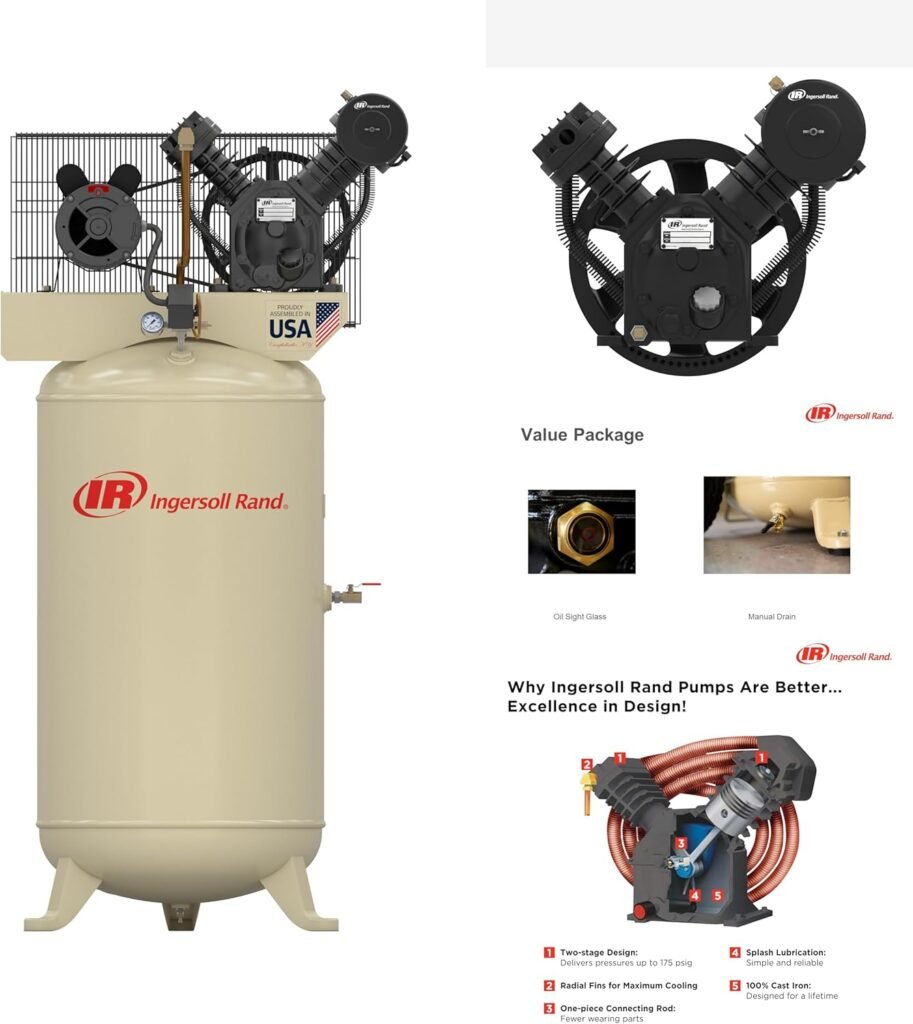
| Pump Construction | 100% cast iron, individually cast cylinders, one-piece connecting rod, overhung crankshaft |
| Motor Power | 5 HP |
| Motor Speed | 3,450 RPM |
| Delivery | 14.3 CFM @ 90 PSI |
| Duty Cycle | 100% continuous |
| Maximum Pressure | 175 PSI |
| Receiver Tank | 80 gallon ASME |
| Noise Level | 85 dB |
| Air Outlet | 1/2″ NPT |
| Voltage / Phase / Frequency | 230 V / Single-phase / 60 Hz |
| Current Draw | 22.5 Amps |
| Expected Pump Life | Designed for over 15,000 hours |
| Weight & Dimensions | Manufacturer listings may vary — confirm for installation planning |
| Typical Applications | Automotive shops, industrial maintenance, manufacturing, heavy pneumatic tools |
Build and Materials
We’ll look at how this unit is built and what materials are used. The cast iron construction and two-stage pump design are the headline structural features that contribute to durability and long life.
Cast iron durability
We’ll explain why cast iron matters for a compressor pump. Cast iron resists wear, handles heat well, and reduces vibration compared with lighter materials, which contributes to a longer pump life and fewer failure modes in high-duty environments.
Machining and component design
We’ll mention the individually cast cylinders, one-piece connecting rod, and overhung crankshaft. Those design choices simplify service, make parts more robust, and often reduce the number of failure points. From a maintenance standpoint, they also make individual components easier to access or replace.
Performance and Air Delivery
We’ll detail how the compressor performs under typical loads and what the CFM and PSI figures imply for tool operation. Performance includes continuous delivery capability and the real-world usability for shop equipment.
CFM and PSI real-world meaning
We’ll translate 14.3 CFM at 90 PSI into workshop terms. This output supports multiple pneumatic tools in sequence or moderate simultaneous use; for example, it will run impact wrenches, die grinders, and paint equipment for medium-duty work, and it will refill the 80-gallon tank fairly quickly under moderate draw.
100% continuous duty reliability
We’ll emphasize that this compressor is rated for continuous duty, meaning it’s engineered to run without mandatory cooldown cycles, which makes it suitable for industrial environments where air demands can be sustained for long periods.

Tank Capacity and Pressure
We’ll cover the implications of an 80-gallon ASME receiver and a 175 PSI rated maximum. Tank size and max pressure affect cycle frequency, steady air availability, and the ability to handle short bursts of high-demand.
Why 80 gallons help
We’ll explain how the large tank buffers compressed air, reducing motor start-stop cycles and giving longer, steadier air supply for intermittent bursts. That’s especially valuable for painters, sandblasters, or shops where big simultaneous draws are common.
175 PSI advantage
We’ll discuss how 175 PSI allows better reserve for high-pressure tools or longer pressure drops before the motor restarts. That extra headroom helps maintain performance and can increase efficiency for some systems that prefer higher working pressures.
Motor, Electrical, and Installation Considerations
We’ll outline electrical requirements, starting currents, and practical installation notes so we can plan a safe and compliant setup.
Voltage, current, and circuit needs
We’ll focus on the specification: 230 V, single-phase, 60 Hz, drawing approximately 22.5 amps. We’ll recommend verifying circuit sizing, dedicated breaker, and starting-rating considerations. Although running current is around 22.5 A, the startup current will be higher, so a proper 30 A (or manufacturer-specified) circuit with appropriate inrush support is typically required.
Placement and mounting
We’ll cover weight and footprint considerations, cooling, and drainage. This compressor will require a solid, level surface and adequate ventilation for heat dissipation. We’ll also note that you should ensure floor loading capacity for the weight and leave service access clearance.
Noise and Workplace Comfort
We’ll talk about the 85 dB sound level and how that translates into real-world conditions for operators. Noise control matters for long shifts and for shops with neighboring workstations.
Interpreting 85 dB
We’ll explain that 85 dB is noticeable and will require hearing protection for prolonged exposure. For continuous operation, we recommend hearing protection and, where possible, locating the compressor in an enclosed or isolated area to reduce overall shop noise levels.
Mitigation options
We’ll suggest practical steps to reduce perceived noise: rubber vibration mounts, placing the compressor in a ventilated room with sound-dampening surface treatments, or using a compressor enclosure with sufficient airflow and cooling.
Maintenance and Serviceability
We’ll present the maintenance expectations and how the design simplifies upkeep. Cast iron construction and straightforward components make long-term maintenance easier.
Regular maintenance tasks
We’ll list routine tasks like checking oil level and quality, replacing inlet filters, draining condensate from the tank, inspecting belts (if applicable), and checking safety valves. Adhering to oil change intervals and filter replacements will keep the unit performing as designed.
Simplified service by design
We’ll highlight individually cast cylinders, a one-piece connecting rod, and an overhung crankshaft. These features reduce complexity for replacement parts and lower the time required for common repairs, which matters in minimizing downtime for shops.
Reliability and Expected Lifetime
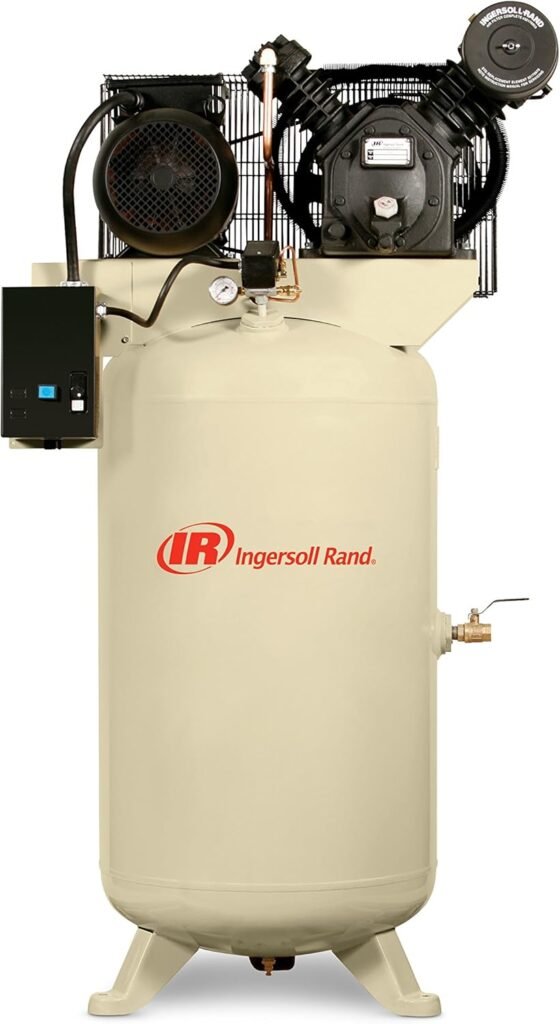
We’ll summarize the manufacturer’s claim about extended pump life and share what that indicates for long-term operational costs. A design for more than 15,000 hours implies a durable, serviceable unit for many years of regular use.
Interpreting the 15,000-hour claim
We’ll explain that “designed for over 15,000 hours” is a meaningful benchmark if routine maintenance is followed. In a high-use environment, that translates to years of service before major overhauls, reducing lifecycle cost and downtime.
Factors affecting lifespan
We’ll be candid about factors that influence longevity: proper installation, air quality (contaminant-free intake and good filtration), consistent oil changes, and not exceeding rated duty conditions will all help reach and exceed that figure.
Safety Features and Codes
We’ll briefly outline safety considerations and code compliance for installation and operation. The ASME tank rating and safety valve integration are two important aspects.
ASME tank compliance
We’ll explain why ASME certification matters: it confirms the receiver tank has met pressure vessel standards and is stamped accordingly, which is required in many jurisdictions and adds confidence in the tank’s structural integrity.
Safety devices and best practices
We’ll recommend regular testing of pressure relief valves, observing the manufacturer’s safety instructions, and ensuring proper grounding and electrical protections. We’ll also stress that operators should be trained in emergency shutdown procedures.
Use Cases and Ideal Applications
We’ll identify the jobs and workplaces where this compressor is most appropriate. This helps match the unit to user needs.
Workshops and automotive shops
We’ll note that the compressor is very well-suited to auto body shops, tire shops, and general automotive maintenance where impact tools, grinders, and spray equipment are commonly used.
Light manufacturing and maintenance shops
We’ll mention facilities with multiple pneumatic tools or intermittent heavy use: production maintenance, cabinet shops, fabrication shops, and industrial servicing. The continuous duty rating makes it a fit where air is needed throughout the shift.
Not ideal for small home garages
We’ll clarify that this unit is overkill for a typical small home garage due to its size, electrical needs, and noise. For hobbyists or light DIY work, a smaller single-stage compressor would be more convenient and economical.
Performance with Common Tools
We’ll look at how the compressor handles typical pneumatic tools to set expectations for users.
Impact wrenches, ratchets, and air hammers
We’ll explain that multiple technicians using impact wrenches intermittently will find the 14.3 CFM delivery adequate. For prolonged simultaneous high-demand tools, users should monitor pressure and consider sequencing tools or adding storage.
Spray guns and paint booths
We’ll point out that the large tank and continuous duty capability make this compressor suitable for paint booths or finishing setups, though users should ensure proper filtration and air drying to prevent moisture in paint jobs.
Sandblasting and continuous tools
We’ll advise that while the unit can support many continuous loads, extremely heavy continuous flows (e.g., large blast pots drawing high CFM continuously) may require parallel compressor systems or a higher CFM model; assessing the total CFM demand is essential.
Installation Checklist
We’ll provide practical steps to prepare for installation, which minimizes surprises during setup.
- Confirm dedicated 230 V single-phase circuit and breaker capacity, allowing for startup inrush.
- Ensure floor can support weight and that the location offers adequate ventilation and clearances for service.
- Arrange piping layout with adequate sized lines to reduce pressure drop; minimize sharp bends and long runs.
- Install condensate drains and consider adding an air dryer if moisture-sensitive tools or finishing work are planned.
- Verify local codes for ASME tank registration or inspection requirements.
Pros and Cons
We’ll give a concise pros and cons list to aid decision-making.
Pros
- Rugged 100% cast iron construction for long life.
- Designed for more than 15,000 hours of pump life with proper maintenance.
- 100% continuous duty rating allows long-running applications.
- 80-gallon ASME tank provides ample reserve.
- 175 PSI maximum gives headroom for demanding tools.
- Service-friendly design (individually cast cylinders, one-piece connecting rod).
Cons
- 85 dB noise level can be loud in open shop environments.
- Size, weight, and electrical requirements make it unsuitable for small garages.
- Startup current may require appropriately sized breaker and possibly soft-start solutions in constrained electrical systems.
- Higher up-front cost and more complex installation compared with portable compressors.
Comparison with Similar Models
We’ll compare briefly with common alternatives so we can judge trade-offs.
Smaller single-stage compressors
We’ll say that single-stage, oil-free portable compressors are cheaper and quieter but lack the continuous-duty rating and longevity of this Ingersoll-Rand 2340N5-V. For intermittent DIY tasks, the smaller units will be more convenient.
Larger industrial sets or multi-compressor systems
We’ll note that multi-compressor systems can provide redundancy and higher total CFM, but at greater complexity and cost. This 5 HP single unit hits a balance for medium-to-heavy shops that need continuous air without deploying multiple compressors.
Operational Tips to Maximize Value
We’ll provide practices that help get the most life and best performance from the compressor.
- Keep intake filters clean and replace per schedule to reduce wear and contamination.
- Maintain proper oil intervals and use manufacturer-specified lubricants.
- Drain condensate daily in humid conditions to avoid water in tools and piping.
- Use an appropriately sized mains line and piping to minimize pressure drop to distant tools.
- Consider a soft-start kit if the local electrical service struggles with startup inrush.
Cost of Ownership Considerations
We’ll cover operating costs, maintenance expense, and long-term value. Even with higher upfront cost, longer service life can reduce total cost per hour of operation.
Fueling uptime with lower maintenance downtime
We’ll explain that robust components and design translate to lower frequency of major repairs and less unexpected downtime. That’s valuable in production environments.
Energy and operating costs
We’ll mention that a continuous-duty compressor will consume power in proportion to use; effective piping, tank sizing, and regulation reduce cycling and inefficiencies, which helps manage electrical consumption.
Warranty and Support
We’ll recommend checking the current warranty terms and local service network. Ingersoll-Rand typically offers good warranty coverage and an established parts and service ecosystem, but exact terms can vary by region and vendor.
After-sales and parts availability
We’ll emphasize the importance of local parts availability for filters, valves, and service kits. The simpler service design of this model typically makes parts easier to source and install, which shortens repair windows.
Final Recommendation
We’ll give our bottom-line suggestion based on performance, durability, and target users. If you operate a medium-to-large workshop, automotive shop, or light manufacturing facility and need continuous-duty compressed air with a robust design, this Ingersoll-Rand 2340N5-V 5 HP two-stage with an 80-gallon ASME tank is a strong choice that balances longevity and usable performance. If you’re a homeowner or casual user, we’ll recommend choosing a smaller, quieter, and less electrically demanding compressor instead.
Frequently Asked Questions (FAQ)
We’ll answer common practical questions that buyers and operators typically ask.
Will this unit run on a standard household outlet?
We’ll clarify that this is a 230 V single-phase unit drawing about 22.5 amps, which typically requires a dedicated circuit and a proper breaker size — often a 30 A or as specified by the installer and local electrical code. Standard 120 V household outlets are not compatible.
Can we use this compressor for spray painting?
We’ll say yes, provided we add proper filtration, drying (air dryer), and pressure regulation to prevent moisture and oil carryover, which are critical for quality paint finishes.
How loud is 85 dB in practice?
We’ll explain that 85 dB is loud enough to require hearing protection for continuous exposure. Placing the compressor in a separate room or using sound mitigation strategies will make the workshop environment more comfortable.
Is a compressor of this size worth the investment?
We’ll respond that for commercial shops and industrial settings where uptime and continuous air are essential, the investment pays off in reliability and lower downtime. For occasional users, the cost and complexity likely outweigh the benefits.
Closing Notes
We’ll remind readers to assess their specific needs and shop constraints when choosing. This Ingersoll-Rand 2340N5-V 5hp 80 gal two-stage compressor is built for long life and continuous use, and when installed and maintained properly, it will serve as a durable backbone for a busy shop.

Disclosure: As an Amazon Associate, I earn from qualifying purchases.