?Are we ready to see whether the DEWALT 26 Gallon Quiet Portable Air Compressor (DXCMSAC260) is the right addition to our shop or jobsite?

Overview of the DEWALT 26 Gallon Quiet Portable Air Compressor (DXCMSAC260)
We want to know what this unit promises and whether it will make our work easier. The DEWALT 26 Gallon Quiet Portable Air Compressor (DXCMSAC260) is marketed as a lower-noise, heavy-duty, oil-free compressor designed for portability and demanding shop or jobsite use.
We’ll summarize the core selling points and examine how those translate to real-world performance. The manufacturer highlights a 65 dBA noise level, an oil-free pump for maintenance-free operation, and a roll cage with 10″ pneumatic wheels for portability.
Key Specifications and Features
We like to have the essentials clearly listed so we can compare at a glance. Below we present the main claims and attributes provided by DEWALT and observed in product descriptions.
| Feature | Specification / Claim |
|---|---|
| Model | DEWALT 26 Gallon Quiet Portable Air Compressor (DXCMSAC260) |
| Tank Capacity | 26 gallons |
| Noise Level | 65 dBA (manufacturer-stated) |
| Pump Type | Oil-free pump (maintenance-free) |
| Motor Type | Heavy-duty direct drive induction motor |
| Max Pressure (typical for category) | Manufacturer references 175 PSI category comparisons |
| Runtime Claim | Up to 3X longer air tool run time vs. other 20-gallon 175 PSI oil-free compressors (manufacturer claim) |
| Portability | Roll cage design, 10″ heavy-duty pneumatic wheels |
| Controls | Conveniently located control panel with gauges, regulator, quick connect |
| Intended Use | Shop, jobsite, air tools, finish work, framing, inflation, brad nailers, staplers |
We’ll keep in mind that some numbers are manufacturer claims; for any critical spec not listed here (for example exact horsepower, exact CFM at specific PSI) we recommend checking DEWALT’s full spec sheet or the owner manual.
Noise Level: What 65 dBA Means for Us
We want equipment that doesn’t make the whole shop unbearable to be around. At 65 dBA, the DXCMSAC260 is significantly quieter than many comparably sized compressors. DEWALT states it is 80% quieter compared to other 20-gallon induction oil-free compressors.
We should translate that into practical terms: 65 dBA is roughly comparable to normal conversation or background office noise. This means we can work nearby and communicate without shouting, and in many indoor settings it’s less likely to trigger hearing fatigue on short jobs. For prolonged exposure or very loud tasks, standard hearing protection is still a good practice.
Performance and Air Delivery
We want to know if the compressor can keep our tools running without frequent motor cycling. DEWALT claims the unit delivers up to three times longer air tool run time versus other 20-gallon 175 PSI oil-free compressors, which suggests better duty cycle or bigger effective reserve capacity due to the 26-gallon tank.
We should be realistic: the actual run time depends on the air consumption (CFM) of the tools we use and the required working pressure. For intermittent nailer or stapler work, this unit’s larger tank and induction motor design should reduce motor starts and keep air delivery consistent. For continuous high-demand tools like larger sanders or grinders, we should verify the compressor’s CFM ratings at common pressures before relying on it for long continuous runs.
Duty Cycle and Tool Compatibility
We want to match compressors to our tools. The DXCMSAC260’s design focuses on longer run times and a robust motor, which should pair well with finish guns, framing nailers, brad nailers, staplers, air ratchets, and impact wrenches used intermittently.
We must check specific CFM requirements of high-demand tools like paint sprayers or continuous sanders and compare with the compressor’s CFM output at 90 PSI. If those tools demand sustained high flow, the compressor may need to run more frequently or may not maintain target pressure for very long continuous operations.

Portability and Build Quality
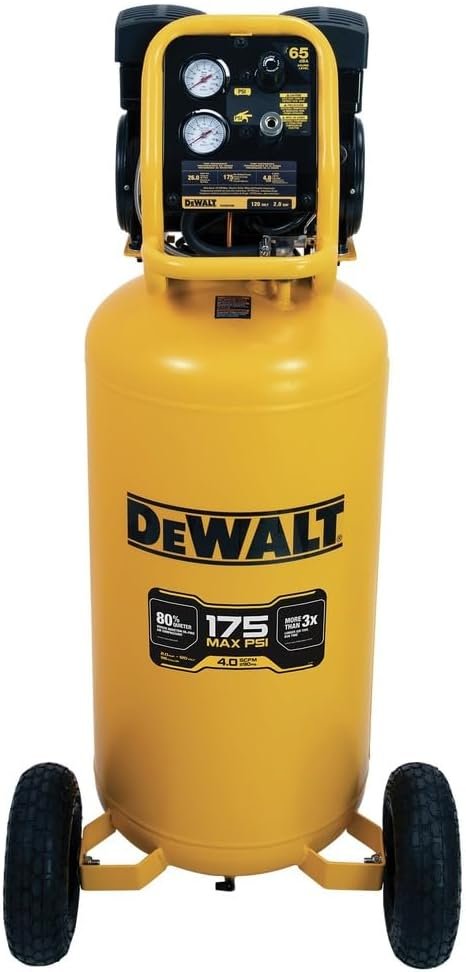
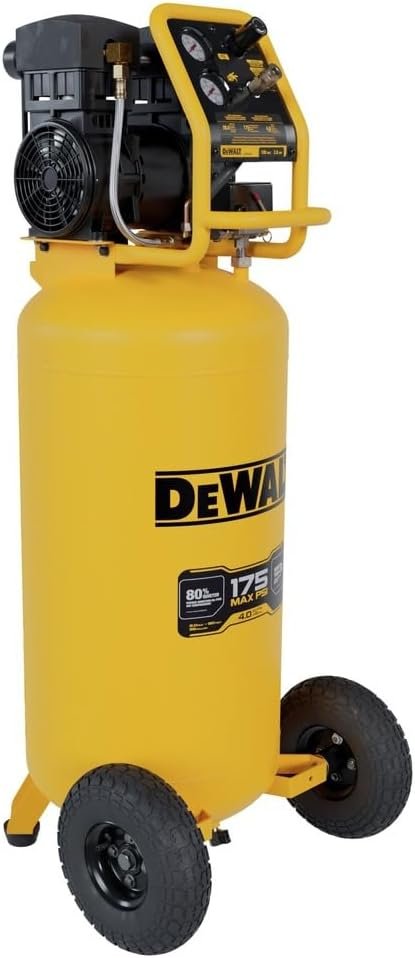
We expect heavy-duty compressors to be transportable without sacrificing protection for critical components. The DXCMSAC260 brings a roll cage design to protect the pump, motor, and controls, and the 10″ heavy-duty pneumatic wheels enhance maneuverability over rough ground and around a busy jobsite.
We find that a roll cage is particularly helpful when loading, unloading, or moving equipment around a truck bed or a crowded shop. The pneumatic tires also smooth out travel across uneven surfaces compared to hard wheels, which lowers the chance of tip-over when we’re transporting the compressor.
Frame, Handles, and Balance
We care about balance and how easy it is to move a nearly full tank. The combination of a sturdy roll cage and well-placed handles keeps the center of gravity manageable and reduces strain when we move the unit. We recommend testing how it feels with a single-person pull versus a two-person lift to determine whether a hand truck or additional help is advisable for frequent transport.
Controls and User Interface
We want quick, intuitive access to gauges and regulator adjustments so we can work efficiently. DEWALT’s design places the gauges, regulator, and quick connect fittings right at the control panel for fast adjustments and tool changes.
We appreciate an organized control area because it reduces downtime and fumbling during a job. Clear, easy-to-read gauges and a reliable regulator mean we can set pressures accurately for finish work and then get back to the task.
Maintenance and Reliability
We like tools that reduce the amount of routine maintenance we need to do. The oil-free pump is a major convenience here: it’s maintenance-free and eliminates the need for oil monitoring, oil changes, and related contamination concerns.
An oil-free pump generally lowers maintenance but can mean different longevity compared to oil-lubricated pumps under the most severe continuous-duty conditions. For most contractors, remodelers, and hobby shop owners who use compressors intermittently or periodically throughout the day, an oil-free compressor that’s well-built and protected by a roll cage is a practical choice.
Expected Longevity Tips
We want to prolong the life of our compressor. Even with an oil-free pump, we should keep the intake filters clean, drain the tank regularly to prevent corrosion, and avoid prolonged continuous operation beyond the unit’s intended duty cycle. Simple steps like these extend service life and maintain output performance.
Safety Considerations
We have to think about operator safety and compliance. DEWALT’s quieter operation reduces fatigue and may help us comply with workplace noise policies, but we should still follow standard compressor safety: avoid over-pressurization, ensure proper electrical connections, and use the unit on a stable surface.
Regular inspection of hoses, fittings, and safety valves is important. We should also verify that the compressor is grounded properly and matched to the outlet and circuit to prevent tripping breakers or causing motor stress.
Ideal Use Cases and Who Should Buy It
We consider who will get the most value. The DXCMSAC260 is well-suited for finish carpenters, trim installers, small contractors, woodworkers, and hobbyists who need quieter operation, portability, and maintenance-free pumping.
We’re less likely to recommend it as the primary compressor for continuous industrial processes that require constant high CFM at elevated pressures for many hours. For such applications, dedicated industrial compressors with oil lubrication and larger motors or multiple stages might be more appropriate.
Jobsite vs. Shop Use
We see this model performing well on jobs where mobility matters and frequent truck-to-site transport occurs. Its quieter operation is also an advantage for indoor projects such as residential interiors, multi-unit buildings, and workshops where noise complaints are a concern.
In a fixed shop with many simultaneous pneumatic tools running continuously, we would evaluate total CFM needs carefully and possibly pair this compressor with a secondary unit or choose a larger industrial model if necessary.
Real-World Handling and Ergonomics
We think about the everyday user experience. The combination of a cage, large pneumatic wheels, and accessible controls means that setup and movement are straightforward. We can wheel it across a site, secure it in a truck, and get to work quickly.
We also appreciate that DEWALT tends to place attention on small ergonomics like grip surfaces, accessible drain valves, and conveniently located quick connects, which speed up routine tasks like attaching tools or draining moisture.
Pros and Cons
We find it useful to have a clear list to compare options quickly. Below are major strengths and potential drawbacks that help us decide whether this compressor fits our needs.
Pros:
- Noticeably quieter at 65 dBA; better for indoor and multi-trade environments.
- Oil-free pump reduces maintenance and contamination risk.
- Larger 26-gallon tank offers more stored air than typical 20-gallon units, translating to longer run time between motor starts.
- Roll cage and 10″ pneumatic wheels improve durability and portability.
- Controls and quick-connects are conveniently located for fast adjustments and tool changes.
Cons:
- Manufacturer claims on runtime and noise are helpful but should be validated for our specific tools and use patterns.
- For sustained, continuous high-CFM tool use, another compressor with higher continuous output might be necessary.
- Exact CFM ratings and motor horsepower may need to be reviewed in the product manual to confirm compatibility with certain tools.
Comparison with Similar Compressors
We like to benchmark to see relative strengths. Compared to standard 20-gallon oil-free compressors, the DEWALT 26-gallon model offers a larger tank and quieter operation, which usually means less motor cycling and easier communication on site.
Against larger stationary or oil-lubricated compressors, the DXCMSAC260 trades off ultimate continuous CFM and maximum long-term duty cycle for portability, quieter operation, and lower maintenance. If our work demands sustained high airflow, we should consider a larger or oil-lubricated compressor.
How it Stacks Up for Common Tasks
- Brad nailers, finish nailers, staple guns: Excellent — longer run time and quick recovery.
- Impact wrenches and ratchets (intermittent use): Very good — tank capacity helps smooth bursts.
- Paint spraying or continuous sanding: Check CFM requirements — may require a higher-output unit.
- Inflation, air cleaning, and occasional brad work: More than sufficient and pleasant due to lower noise.
Cost and Value Considerations
We want to assess value based on features and needs. The value proposition of this model centers on quieter operation, less upkeep because of the oil-free pump, and a larger-than-typical tank for the category.
When evaluating price, we recommend factoring in reduced downtime and maintenance costs, plus potential productivity gains from quieter operation (we can work longer without excessive noise fatigue). Compare costs with other DEWALT models, competitors’ quiet models, and larger stationary compressors to make an informed choice.
Installation, Setup, and First Use
We like simple setup processes. Initial setup usually involves checking oil-free pump attachments, connecting the regulator and quick-connect fittings, ensuring correct electrical supply, and draining any moisture after initial runs.
We recommend reading the operator manual, confirming electrical requirements, and performing a test run without tools to confirm pressure build-up, gauge operation, and absence of leaks. That will give us confidence before attaching costly tools or beginning a job.
Maintenance Checklist
Even with maintenance-free components, there are routine tasks we should keep up with to preserve performance. We suggest a simple checklist:
- Daily/Before use: Inspect hoses and fittings for leaks; check control panel and gauges.
- Weekly: Drain tank to remove accumulated moisture; wipe down exterior and controls.
- Monthly: Inspect air intake filter and clean or replace as needed.
- Periodically: Verify pressure relief valve operation and electrical cord integrity.
These steps keep the compressor reliable and safe in long-term use.
Common Questions We Hear
We want to answer likely buyer queries to help make a quick decision.
Q: Is 65 dBA really quiet for a compressor? A: Yes — 65 dBA is significantly lower than many comparable compressors and allows easier conversation around the unit. It’s not silent, but it’s much less intrusive.
Q: Do we need to change oil with this compressor? A: No — the oil-free pump is designed to be maintenance-free regarding oil changes, which reduces routine upkeep.
Q: Will it run my paint sprayer continuously? A: That depends on your sprayer’s CFM at operating pressure. For continuous spray applications, confirm the compressor’s CFM output at 90 PSI and compare it to the sprayer’s requirements. For intermittent use it may perform acceptably; for continuous use, you might need a higher-capacity unit.
Q: How portable is it for a single person? A: The roll cage and 10″ pneumatic wheels make it much easier to move than compressors with smaller or hard wheels. However, it’s still a relatively heavy piece of equipment, so a single person should test movement carefully and use mechanical assistance when necessary.
Practical Tips for Best Results
We like actionable tips that help us get the most out of the compressor:
- Use quality hoses and fittings to reduce leaks and preserve pressure.
- Position the compressor on stable ground and avoid cramped, poorly ventilated areas.
- Keep the intake filter clean to maintain motor efficiency and performance.
- Drain the tank regularly to minimize internal corrosion and maintain effective capacity.
- Match the regulator to your tool’s required pressure for consistent results and to avoid tool damage.
Troubleshooting Basics
We prefer knowing basic fixes before calling support. Common minor issues include pressure fluctuations, motor not starting, or leaking fittings.
- Pressure drops quickly: Check for leaks in hoses, fittings, or tool connectors; verify regulator setting.
- Motor cycles too frequently: Make sure the tank is draining correctly and that the compressor is matched to tool demands.
- Compressor won’t start: Confirm power supply and breaker; check cord and plug integrity. If motor hums but won’t start, consult the manual and consider professional service.
Environmental and Operational Considerations
We think about how the compressor performs in different environments. The induction motor and oil-free pump are generally robust in typical jobsite conditions, but keep the unit away from excessive dust or moisture when possible.
For cold climates, bear in mind moisture in tanks will freeze faster, so consistent draining is important. For hot, dusty environments, protect the intake filter and provide some enclosure or cover when not in use.
Warranty and Support
We value reliable support and warranty coverage. Check the current DEWALT warranty terms for details on parts, labor, and duration. DEWALT’s service network and parts availability are typically good, which helps if repairs are needed down the line.
We recommend registering the product after purchase and keeping the receipt and serial number handy for warranty claims.
Final Verdict
We want a concise conclusion to guide our purchase decision. The DEWALT 26 Gallon Quiet Portable Air Compressor (DXCMSAC260) offers a compelling package for tradespeople and hobbyists who want quieter operation, low maintenance, and a larger tank for extended run time between cycles.
We recommend this compressor for finish carpentry, trim work, general shop tasks, and jobsite use where portability and noise reduction matter. If our work involves long-duration, high-flow air tools, we should verify CFM ratings and consider a larger industrial compressor if necessary.
If we value quiet operation, easy maintenance, and strong portability in a robust package, this DEWALT model deserves serious consideration.
Frequently Asked Questions (Additional)
We’ll finish with a few extra helpful notes for quick reference.
Q: Is the unit suitable for commercial daily use? A: Yes for many commercial intermittent use cases like finish nailing, stapling, and framing. For non-stop, continuous industrial processes, evaluate duty cycle needs and consider a dedicated industrial compressor.
Q: Can we use extension cords? A: It’s best to use a correctly rated outlet located near the compressor. If an extension is necessary, use one with adequate gauge for the motor load to avoid voltage drop.
Q: How loud is 65 dBA in comparison to other jobsite equipment? A: It’s significantly quieter than common compressors and comparable to normal conversation levels. It’s still audible, but much less fatiguing over an eight-hour day.
Q: What about vibrations and stability? A: The roll cage and pneumatic wheels help keep it stable during movement. For stationary use, ensure it’s on a flat, stable surface to minimize vibration-transmitted movement.
We hope this review helps us make an informed decision about the DEWALT 26 Gallon Quiet Portable Air Compressor (DXCMSAC260). If we have more specific tool requirements or want a side-by-side spec comparison with another model, we can gather those details and refine our recommendation.

Disclosure: As an Amazon Associate, I earn from qualifying purchases.