We’ve tested low-pressure air compressors that keep noise down, hold pressure steady, and won’t quit after a busy season. From smart switches that cycle at 10–40 psi to precise 0–60 psi regulators and clean air filters, these picks focus on control and longevity. We’ll also cover a portable inflator with flexible power and a dependable digital gauge. If you want reliable performance without fuss, here’s what stood out—and what to watch for next.
LEFOO LF08PS Air Compressor Pressure Switch (10–40 psi)


July 14, 2026 5:43 pm
If you’re piecing together a small, low-pressure setup and need hands-off control, the LEFOO LF08PS stands out with a tight 10–40 psi window—switching on at 10 psi and off at 40. We like its brass body, 1/8 NPT male thread, and 1/4 in-line terminals, which make installs quick. It’s rated from -30°C to 80°C and suits safety controls, air conditioning, and refrigeration.
Real-world use is solid: users report reliable cycling, easy setup, and success driving a pump via a 26 V sprinkler supply. Watch for listing mismatches: some units arrive NPT vs BSP, and contact state confusion (NC vs NO). Add a relay to invert logic if needed.
Best For: DIYers and technicians building low-pressure air or refrigeration controls who need an auto on/off switch with a tight 10–40 psi range and straightforward installation.
Pros:
- Tight 10–40 psi window (on at 10 psi, off at 40 psi) for predictable cycling
- Easy install with 1/8 NPT male thread and 1/4 in-line terminals; brass body and wide -30°C to 80°C rating
- Proven in real use (e.g., running small compressors or pumps from a 26 V supply)
Cons:
- Listing inconsistencies: NPT vs BSP threads and NC vs NO contact state can cause confusion
- Some reports of receiving units that don’t match photos/specs
- May require an external relay to invert logic if your system expects the opposite contact state
Portable Tire Inflator Air Compressor (Cordless, 150 PSI)

July 14, 2026 3:01 pm
Need a grab‑and‑go inflator that actually fills a car tire in about a minute and won’t wake the neighbors? This cordless 150 PSI portable inflator delivers 34 L/min airflow, hits 25–36 PSI in ~60 seconds, and runs up to 18 tire top‑offs per charge. We love the auto‑shutoff and dual LCDs showing real‑time and target pressure. It’s just 1 lb, rugged, and quiet at 60 dB.
Dual power keeps us covered: battery, 12V DC, and USB‑C charging. Presets and memory speed things up for cars, motorcycles, bikes, and balls. The LED light with emergency mode, adapters, and carry bag make roadside fixes simple.
Best For: Drivers, cyclists, and commuters who want a fast, quiet, cordless inflator with smart presets and dual power for reliable roadside and everyday use.
Pros:
- Rapid inflation: 34 L/min airflow fills a car tire from 25–36 PSI in about 60 seconds; up to 18 inflations per charge
- Auto shutoff with dual LCDs for real-time and target pressure; accurate, easy-to-read display even in bright light
- Compact 1 lb design with LED light, emergency mode, multiple adapters, USB‑C and 12V DC power options, and carry bag
Cons:
- Max 150 PSI and 100W power not suited for large truck tires or heavy-duty applications
- Small plastic body may feel less rugged than metal-bodied compressors
- Battery capacity limits extended continuous use; may need 12V power for long sessions
PneumaticPlus Compressed Air Drying System with Filters & Regulator (1/4″ NPT)

July 14, 2026 5:43 pm
Looking for cleaner, steadier air at low pressures without overcomplicating your setup? We like the PneumaticPlus PPC3C-N02G: a compact particulate/coalescing filter and regulator combo with 1/4″ NPT ports. It pairs a 5-micron prefilter and a 0.3-micron coalescer, plus an embedded 0–140 PSI gauge. Expect 16 SCFM at 90 PSI and max supply up to 250 PSI (use the metal bowl above 150 PSI or around solvents).
For airbrush work, set your compressor to, say, 50 PSI and dial the regulator to 20 PSI. Mount downstream, tape quick-connects, and drain regularly. Caveats: some gauge readability issues and occasional corrosion at bowl connections. Manufactured in Korea.
Best For: Hobbyists and small shops needing clean, stable low-pressure air for airbrushing, coatings, and precision tools without a complex multi-stage setup.
Pros:
- Dual filtration (5 µm particulate + 0.3 µm coalescing) delivers cleaner air for sensitive spraying.
- Integrated regulator with embedded 0–140 PSI gauge; supports up to 16 SCFM @ 90 PSI and 250 PSI supply.
- Compact 1/4″ NPT combo unit; easy mounting and maintenance with manual drains.
Cons:
- Some reports of corrosion at bowl connections over time, especially with moisture/solvents.
- Gauge readability and responsiveness can vary between units.
- Poly bowl not ideal above 150 PSI or around solvents; metal bowl recommended in those cases.
Airtac AR2000 1/4″ NPT Low-Pressure Air Compressor Regulator with Gauge and Bracket (0–60 PSI)

July 14, 2026 5:43 pm
Precision at single-digit PSI is where the Airtac AR2000L2T shines, giving us a 0–60 PSI adjustable range with a clear gauge that holds settings steady—reviewers report dialing in 14 PSI with ease. We like the pull-to-adjust, push-to-lock knob and the needle-style metering that makes tiny changes predictable. The 1/4″ NPT ports and included bracket simplify mounting, and the aluminum-alloy body keeps weight to just 6.4 ounces.
It’s rated to 145 PSI max (215 PSI proof) and works from -4 to 158°F. At roughly $30, it’s strong value with 4.4/5 ratings. Add a prefilter to block debris and preserve downstream tools.
Best For: DIYers, makers, and shop users who need stable, precise low-pressure control (single-digit to ~60 PSI) with easy mounting and clear gauge feedback.
Pros:
- Accurate low-pressure adjustment with pull-to-adjust/push-to-lock knob and fine needle-style metering
- Clear 0–60 PSI gauge; holds setpoint well (users report stable 14 PSI)
- Compact, lightweight aluminum body with 1/4″ NPT ports and included bracket
Cons:
- No built-in filtration/water separation; a prefilter is recommended
- Rated max 145 PSI may be limiting for higher-pressure systems
- Documentation can be sparse; value perception varies with competing lower-priced options
AstroAI Digital Tire Pressure Gauge with Inflator (3–250 PSI)
July 14, 2026 5:43 pm
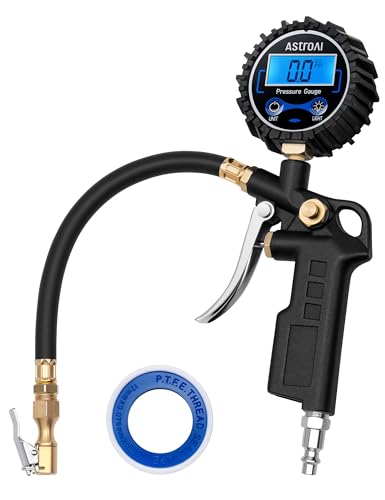
For drivers who want fast, accurate fills without juggling tools, the AstroAI Digital Tire Pressure Gauge with Inflator stands out for its all-in-one design: lock-on chuck, hose, bleed valve, and backlit digital gauge in one compact unit. We like that it plugs into 1/4″ or 1/2″ NPT compressor outputs and works with standard Schrader valves. It’s professionally calibrated to 1% accuracy with 0.1 resolution across 3–250 PSI. Auto-on/off saves batteries (2 AAA included). Stainless steel and brass parts feel durable, and the lock-on chuck minimizes leaks. Users praise readability and ease; some note seal-fit variability, especially on motorcycles. Warranty info’s linked.
Best For: Drivers and DIYers who want a fast, accurate, all-in-one inflator and gauge for cars, trucks, motorcycles, SUVs, RVs, and trailers using standard Schrader valves.
Pros:
- All-in-one design (lock-on chuck, hose, bleed valve, digital gauge) simplifies inflation, deflation, and pressure checks
- Wide 3–250 PSI range with 1% accuracy and 0.1 resolution; easy-to-read backlit display
- Durable stainless steel/brass build; compatible with 1/4″ and 1/2″ NPT compressor outputs; auto-on/off with included AAA batteries
Cons:
- Some users report seal-fit variability, especially on certain motorcycle valves
- Requires an air compressor to inflate (not a standalone pump)
- Lock-on chuck may be bulky for tight valve access on some wheels
Factors to Consider When Choosing Low Pressure Air Compressors
As we compare low-pressure compressors, we’ll match your required pressure range with the airflow (CFM) your tools need. We’ll weigh power source options, check the duty cycle rating for how long it can run, and consider noise level (dB) for where you’ll use it. With these in mind, we can narrow picks that fit your work and space.
Required Pressure Range
How low is low enough? We should match the compressor’s pressure capability to the tools we’ll run. Most low-pressure setups live in the 0–60 psi band, with many regulators rated 0–40 or 0–60 psi for spray and airbrush work. A “low pressure” regulator range like 0–60 (or 0–70) lets us dial in downstream pressure precisely, avoiding over-pressurization.
Look for pressure switches that engage near 10 psi and cut off around 40 psi if we want a 10–40 psi control window. When we need finer control, choose regulators and gauges with sub-psi to few-psi resolution within that 0–60 window to hold steady setpoints.
Finally, assure every component’s maximum rating comfortably exceeds our working pressure to handle transient spikes and maintain safety.
Airflow and CFM
Why does airflow matter as much as pressure? Because CFM tells us how much air the compressor actually delivers at a given PSI. Higher CFM keeps tools running without stalling, especially in continuous, low-pressure tasks like spraying, sanding, or inflating.
We should match CFM to our target PSI, not the headline rating. For example, a unit delivering 16 SCFM at 90 PSI provides substantial flow for steady spray patterns and smoother sanding. Regulator settings also affect usable CFM: when we dial pressure down, available flow changes, and downstream demands can bottleneck performance.
When comparing models, check both peak CFM and sustained CFM at our operating pressure. Smaller portable units can cover light, intermittent tasks but struggle with higher duty cycles. Choose airflow that fits the workflow.
Power Source Options
Which power source suits our workflow best? Battery, AC, or 12V vehicle power each changes how and where we work. Cordless Li‑ion models win on portability—great for field tasks and quick inflations—but runtime shrinks as target psi rises and workloads increase. AC-powered compressors deliver steady power for long sessions and shop benches; we trade mobility for uninterrupted operation.
If we frequently switch locations, dual‑power designs (battery plus AC or 12V) give us flexibility: roam cordlessly, then plug in for continuous use. Vehicle 12V units shine for roadside or trail work, provided the amperage matches the compressor’s needs.
Let’s also confirm accessory compatibility. The power platform can dictate which inflators, regulators, and pressure switches plug in cleanly and perform as intended.
Duty Cycle Rating
Power choice sets where we can work; duty cycle dictates how long we can keep working. Duty cycle is the ratio of on-time to total cycle time—it tells us how long a compressor can run before cooling off. Low-pressure models usually shine here, often delivering continuous or near-continuous operation, while high-pressure units need longer rests.
We should match the duty cycle to our actual load. Compare ratings at the operating pressure we’ll use most. A spec like 50% at full load or 100% at reduced load means longer runtime without overheating, but only if conditions cooperate.
Noise Level Db
How quiet is quiet enough? We look at decibels (dB) because they tell us how disruptive a compressor will feel in a garage or workspace. Quiet low-pressure models often run around 50–70 dB, while standard units can exceed 80 dB under load. That difference matters: every 10 dB increase roughly sounds twice as loud to our ears.
Compressor design influences noise. Piston units tend to be louder; scroll designs and sound-damping enclosures or mufflers can cut noise meaningfully. For indoor or shared spaces, we favor lower-noise options to reduce listener fatigue and help maintain cooler environments for longer runtimes.
Don’t just check running dB. Consider peak start-up spikes, which can be notably higher. If specs aren’t clear, ask for both continuous and peak measurements.
Port and Thread Type
Curiously, port and thread type can make or break an otherwise great low-pressure setup. Most low-pressure regulators and switches use 1/4 NPT ports, which lets us connect cleanly to compressor outlets and downstream gear. We always confirm the thread standard: NPT (National Pipe Thread) versus BSP (British Standard Pipe). They’re not interchangeable, and mismatches can leak or strip threads.
If we’re targeting a 0–60 psi range, we pair the regulator with 1/4 in NPT fittings to hold setpoints accurately. Keep the downstream path consistent, too—many components expect 1/4 NPT to maintain uniform flow at low pressures. Finally, check gauge and mounting compatibility. Regulators often ship with brackets and gauges sized for 1/4 NPT, ensuring stable readings at low ranges.
Filtration and Drying
Why sweat your finish when a simple air prep stack keeps moisture and grit out before they cause blisters, fisheyes, or sticking valves? We pair a 5‑micron particulate filter with a 0.3‑micron coalescing stage to strip solids and aerosolized oil, so spray guns, valves, and actuators perform consistently. Place the filtration and drying system downstream—after the compressor and before any spraying or fine finishing—to cut moisture and oil carryover at the last possible step.
Choose durable hardware. A metal bowl with a guard, or a corrosion‑resistant housing, resists solvents and won’t crack under higher pressures. Maintain it on schedule: drain bowls, replace the 5‑micron and 0.3‑micron elements, and inspect for corrosion or clouded indicators so clean, stable air stays assured.
Regulator and Gauges
Clean, dry air only pays off if we set and hold the right pressure at the tool. We look for regulators with the right range and accuracy for our tasks—most low-pressure needs land in 0–60 PSI, but some tools benefit from 0–100 or 0–145 PSI. Proof pressures around 215 PSI add safety margin. Stability matters: a fine needle-style adjustment and a positive knob lock prevent drift, especially on small flows.
Clear gauges make life easier. We prefer large, low-drift faces with crisp markings in 0–60, 0–100, or 0–160 PSI and good low-light readability. Filter/regulator combos help keep downstream pressure clean and steady. For integration, 1/4 NPT ports and sturdy brackets reduce leaks. Finally, in-line indicators and max-set labels safeguard precision work like painting or airbrushing.
Conclusion
We’ve covered five dependable picks that keep noise down and control up, from LEFOO’s steady 10–40 psi switching to Airtac’s precise 0–60 psi regulation, plus clean-air filtration and smart, portable inflators. Together, they tackle safety systems, coating jobs, and everyday tire care with durable builds and easy installs. As you choose, weigh pressure range, accuracy, filtration, power options, and mounting. Pick the setup that fits your workflow, and you’ll get consistent performance that lasts mile after mile.