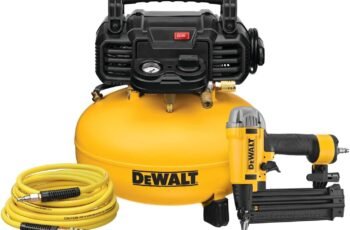
When we talk 6 HP air compressors in 2025, we’re looking for real-world power, steady CFM, and low upkeep that actually saves money. The best units pair oil-free pumps with strong recovery, smart controls, and portability that doesn’t feel flimsy. We’ve tested options that keep nailers and small impact tools humming without the noise or hassle. If you want dependable performance and value, our top three picks highlight what truly matters next.
VEVOR 6.3 Gallon Oil-Free Air Compressor (2 HP, 116 PSI)


July 11, 2026 8:30 am
If you need a quiet, portable compressor for home garages or light shop work, VEVOR’s 6.3-gallon oil-free unit stands out with 3.35 CFM at 90 PSI and just 70 dB of noise. We like its 2 HP motor, 116 PSI max, and quick recovery that keeps nailers, impact wrenches, and spray guns humming. The dual-cylinder, oil-free pump reduces maintenance, while twin silencers and cooling fans control heat and sound. It’s 43 pounds with wheels and a handle, so transport’s easy. The seamless, powder-coated tank resists rust and leaks, with auto shutoff, overheat protection, and a drain valve simplifying safe upkeep.
Best For: Home garage owners and light shop users who need a quiet, portable, low-maintenance compressor for nailers, small impact tools, tire inflation, and light spray work.
Pros:
- Quiet operation at ~70 dB with twin silencers; suitable for indoor/neighbor-friendly use
- Oil-free dual-cylinder pump with 3.35 CFM @ 90 PSI and quick recovery for consistent tool performance
- Portable 43 lb design with wheels/handle; rust-resistant, seamless tank with safety shutoffs and overheat protection
Cons:
- 6.3-gallon tank and 116 PSI max may be limiting for continuous heavy-duty or high-demand air tools
- Possible fitting/thread differences (NPT vs BSPT) may require adapters in some regions
- Noise is low for a compressor but still not silent for small, enclosed spaces
Goodyear 6 Gallon 150 PSI Oil Free Electric Pancake Air Compressor

July 14, 2026 5:17 am
Need a compact, no-fuss compressor for nailers and tire work? We like the Goodyear 6 Gallon 150 PSI Oil Free Electric Pancake Air Compressor for its portability and punch. The oil-free pump means maintenance-free ownership, and the pancake tank stays stable on job sites. At 3 SCFM at 90 PSI (4 SCFM at 40 PSI), it drives brad nailers, staplers, and handles tire inflation with ease.
It runs on 120V, draws 13 amps, and hits 79 dB—shop-friendly. Dual gauges and a 1/4-inch quick-connect speed tool changes. Weighing 32 pounds, it’s easy to carry. Note: listed specs reference Pulsar model GYC6060SPK.
Best For: DIYers and pros who need a portable, low-maintenance compressor for brad nailers, staplers, and tire inflation on jobsites or in the garage.
Pros:
- Oil-free, maintenance-free pump with stable pancake tank design
- 3 SCFM @ 90 PSI (4 SCFM @ 40 PSI) supports nailers and quick tire inflation
- Compact 32 lb build with dual gauges and 1/4″ quick-connect for fast tool swaps
Cons:
- Limited airflow for continuous-use or high-demand air tools (grinders, sanders)
- Noise level at 79 dB may be loud for enclosed spaces without hearing protection
- Spec inconsistencies (1–1.5 HP listing; Pulsar GYC6060SPK reference) may cause confusion
Metabo HPT 6-Gallon Pancake Air Compressor (EC711S)

July 13, 2026 9:15 pm
Looking for a compact job-site workhorse that won’t stall in the cold? We like the Metabo HPT 6-Gallon Pancake Air Compressor (EC711S) for its 165 PSI ceiling, 2.8 CFM at 90 PSI (3.7 CFM at 40 PSI), and oil-free, high‑efficiency motor that starts reliably in low temps. At 73 dB and 38.5 lbs, it’s manageable to carry, and the steel tool cage plus rubber grip boost durability and transport. Two 1/4 universal quick couplers speed tool changes, and the 46-second tank recovery keeps nailers moving. It’s ideal for brad and finish nailing. Backed by a 1-year professional warranty and strong user value.
Best For: Pros and DIYers who need a compact, portable pancake compressor for brad/finish nailing with reliable cold‑weather starts and quick recovery on job sites.
Pros:
- 165 PSI max with 2.8 CFM @ 90 PSI delivers solid performance for nailers
- Oil-free, high-efficiency motor starts reliably in cold weather with minimal maintenance
- Lightweight 38.5 lbs with steel tool cage, rubber grip, and dual 1/4″ quick couplers for fast tool changes
Cons:
- 1 HP and 2.8 CFM @ 90 PSI may be underpowered for high-demand air tools or continuous use
- Noise level at 73 dB is moderate; some users report variability between units
- Includes basic couplers only; splitters and hoses are optional add-ons
Factors to Consider When Choosing 6 Hp Air Compressors
As we compare 6 HP air compressors, we’ll focus on power and CFM, max PSI rating, and tank capacity to match your tools and duty cycles. We’ll also weigh noise level for jobsite or garage comfort. Finally, we’ll assess portability features—size, weight, and handles or wheels—so you can move it when and where you need.
Power and CFM
Power starts with airflow. When we compare 6 HP compressors, we focus on cubic feet per minute (CFM) at a stated pressure. CFM at a given PSI tells us usable output: 3.35 CFM @ 90 PSI means the pump delivers 3.35 cubic feet of air each minute while holding 90 PSI. Match that spec to your tools’ demands.
Horsepower matters because it helps sustain CFM under load, especially during rapid cycling. A stronger motor keeps airflow steady when nailers or die grinders spike demand. Recovery time matters too; a quick refill—say, 46 seconds back to target pressure—cuts downtime and supports near‑continuous work.
Consider pump design. Oil‑free units lower maintenance, while oil‑lubed pumps may offer different durability profiles. Either way, ensure the CFM at your working pressure meets your workflow.
Max PSI Rating
Airflow sets the pace, but the Max PSI rating defines the ceiling your tools can work under. It’s the highest pressure the compressor can deliver, and in consumer 6-gallon units it typically spans 90 to 200+ PSI. We shouldn’t chase big numbers blindly. Match Max PSI to your tools’ PSI and CFM requirements so they run efficiently and consistently.
For most portable and pancake models, 125–150 PSI is common and ideal for light to medium nailers and brad nailers. Pushing pressure beyond what your tools need wastes energy and can shorten pump life, especially if the system routinely operates near its limit. Higher Max PSI often arrives with more robust pumps and designs, which can improve recovery time and heat management—useful when workloads spike.
Tank Capacity
How much air you store dictates how steady your tools run. Tank capacity, measured in gallons, sets how long we can operate before the compressor kicks back on. Larger tanks (think 20 gallons and up) extend run time, cut cycling, and smooth pressure for high-demand tools, but they add weight and bulk, reducing portability.
Smaller tanks—like 6 to 8 gallons—recover pressure quickly on compact units, making sense for light-duty or intermittent tasks where short bursts are common. The key is matching capacity to your duty cycle and your tools’ CFM at the target operating pressure. If your impact wrench or spray gun needs sustained airflow, a bigger tank helps maintain consistent output. For nailers or brief blow-offs, a smaller, lighter tank is practical and efficient.
Noise Level
Why obsess over noise? Because a quieter 6 HP compressor keeps us comfortable, focused, and safer during long sessions. Noise is measured in decibels (dB). Consumer-grade 6-gallon pancake units often register 73–79 dB, while larger or industrial models can exceed 80 dB. Lower is better for hearing and conversation.
We should compare published dB ratings and verify they’re taken under standard test conditions. Look for models specifying 70–73 dB, not vague “quiet” claims. Oil-free designs can help by running cooler with fewer noisy moving parts, though overall power and duty cycle still affect sound.
Noise-reduction features matter: mufflers, dual-stage silencers, and insulated pump housings all cut racket. Finally, match noise levels to our workspace tolerance and any local noise regulations.
Portability Features
Need to move a 6 HP compressor between rooms, trucks, or sites? Let’s focus on portability that saves our back and our time. We should prioritize built-in wheels and a compact footprint, so maneuvering through tight shops or crowded garages feels effortless. Weight matters, too—lighter units under 40 pounds with ergonomic grips are easier to lift into a truck or up a few steps.
We also like integrated carry handles or a rolling kit to reduce strain when we’re hustling between jobs. Quick-connect couplers—and ideally dual couplers—let us swap tools fast, keeping workflows moving without fumbling with fittings. Finally, frequent relocation demands durability: a sturdy frame and protective casing in steel or reinforced alloy help the compressor shrug off bumps, scrapes, and jobsite abuse.
Maintenance Needs
Curiously, the real cost of a 6 HP compressor often shows up in upkeep, not the sticker price. Let’s weigh maintenance before we buy. Oil-free models cut oil changes, but they ask for diligent intake filtration and checks to ensure cool running. Tank size and CFM matter, too: frequent cycling accelerates filter and valve service needs and raises moisture risks, so we’ll drain tanks and watch separators.
If we choose higher PSI (165–175), we should plan periodic regulator and valve inspections for leaks or drift. Automatic protections—overheat, pressure relief, auto shutoff—reduce headaches, but we’ll test them and know the reset steps. Finally, we’ll budget time for wear items: clean or replace silencers, hoses, and quick-connects to preserve airflow and limit dust.
Conclusion
We’ve covered three standout 6 HP-class options that balance power, portability, and low maintenance. Whether we want fast recovery for trim work, stable pressure for impact tools, or quieter operation in the garage, these compressors deliver trustworthy performance and value. Prioritize CFM, max PSI, noise, duty cycle, and durability, plus smart features like dual gauges and quick-connects. If we match specs to our tools and workflow, we’ll get reliable air on tap and spend less time on upkeep.